


1. Background
The concept of phubbing emerged in 2012, coined by the Macquarie Dictionary, as a blend of the words "phone" and "snubbing". It refers to the act of ignoring individuals in a social setting by focusing on electronic devices, primarily smartphones, instead of engaging in direct, personal communication. This behavior disrupts traditional social dynamics, often leading to a decline in the quality of interpersonal relationships (1-5). Research has increasingly linked phubbing to negative psychological outcomes such as loneliness, depression, and sleep disturbances, portraying it as a form of "addiction" (6-8), particularly among younger generations who exhibit compulsive smartphone use (9). For example, studies have revealed a positive correlation between phubbing and depression across various age groups (10-12). The pervasive use of smartphones among university students, driven by academic, social, and leisure needs, amplifies the risk of phubbing, especially in fields like healthcare, where interpersonal skills are paramount for professional competence and patient care. Despite the growing literature on phubbing, studies focusing on specific student populations, particularly in healthcare disciplines, remain limited. Moreover, cultural contexts, such as those in Iran, have been underexplored (13). University students, especially in the field of rehabilitation sciences, rely heavily on digital devices for their academic purposes, social networking, and staying updated with advancements in their field, often exacerbated by the integration of artificial intelligence tools. This dependency raises concerns about the potential impact of phubbing on their academic performance, personal relationships, and clinical communication skills (14). Previous studies have shown a correlation between phubbing and mental health issues such as depression across various demographics, underscoring the urgency to investigate this phenomenon among specific cohorts. This study seeks to address this gap by examining the prevalence and implications of phubbing among rehabilitation students at Shahid Beheshti University of Medical Sciences (SBMU), focusing on its relevance to their academic and professional environments where effective communication directly influences outcomes in clinical settings.
2. Objectives
The present study aimed to assess the prevalence of phubbing behavior among students at the Faculty of Rehabilitation, SBMU, during the 2023 - 2024 academic year. By focusing on this specific population, the research aimed to understand the extent of the students’ smartphone dependency and its impact on interpersonal interactions within academic and clinical contexts, providing insights that may inform targeted interventions.
3. Methods
3.1. Participants and Procedure
This study employed a cross-sectional survey design, involving 320 students (141 males and 179 females) from the Faculty of Rehabilitation at SBMU. Participants were selected through convenience sampling from four academic disciplines: Optometry, audiology, physiotherapy, and occupational therapy. While this sampling method ensured accessibility, it might limit the generalizability of the findings. Inclusion criteria required participants to be regular smartphone users and willing to participate, with data confidentiality assured and informed consent implied through questionnaire completion. As the present study was questionnaire-based and the questionnaire was distributed to all students, those who were not willing to participate were excluded from the study. It is noteworthy that students undergoing psychiatric treatments were also supposed to be excluded from the study; however, we did not have any such students in our sample. Then, demographic data were collected (Figure 1).
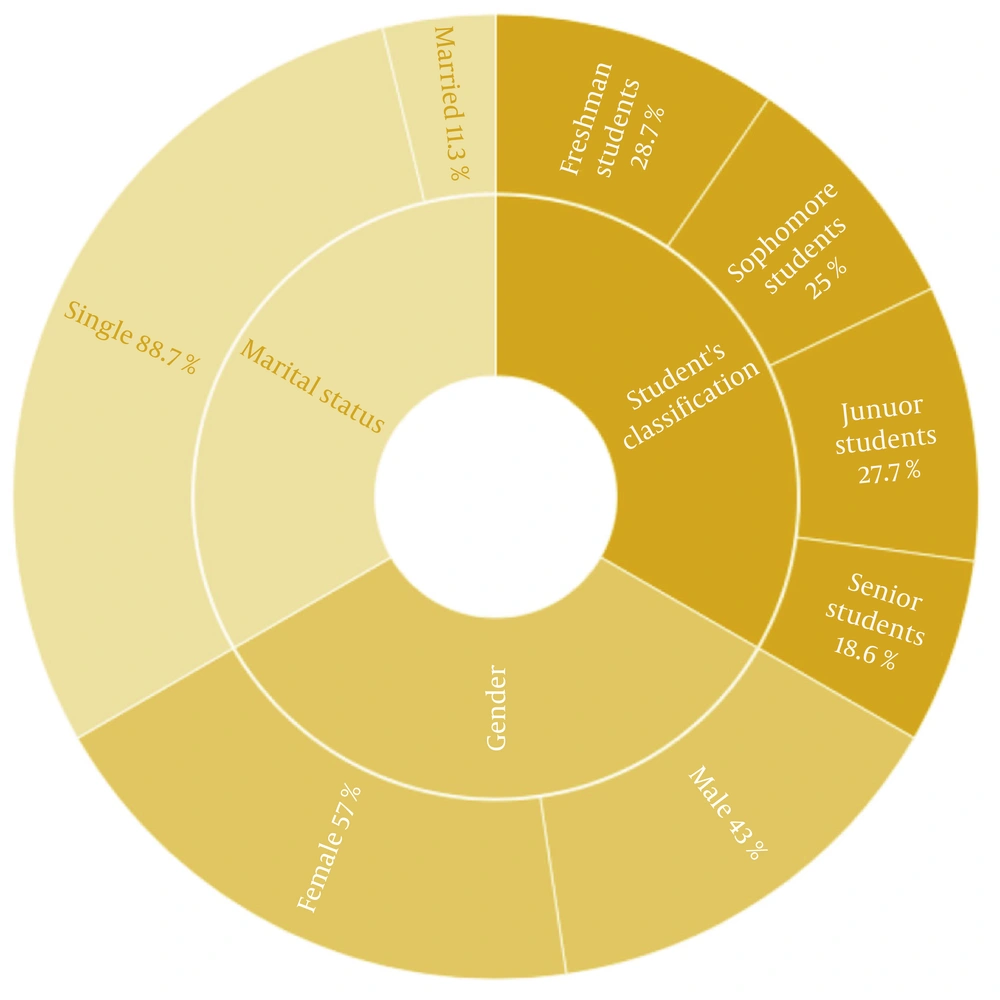
Figure 1.
The demographic status of the rehabilitation students (gender, marital status and student’s classification)
Data collection involved two main tools: A demographic questionnaire capturing information such as age, gender, marital status, and academic major, and the Generic Scale of Phubbing (GSP), a validated 15-item instrument assessing phubbing behavior on a 5-point Likert scale (1 = never to 5 = always), with scores ranging from 15 to 105. The GSP, previously validated in Persian, demonstrated high internal consistency (Cronbach’s alpha = 0.87). Participants completed the anonymous questionnaires during their class time, with 20 minutes allocated for this purpose, and were offered free registration in a research-focused webinar as an incentive. Incompletely filled questionnaires were excluded from the study and were not included in the statistical analysis. Ethical approval was obtained from the Ethics Committee of SBMU (IR.SBMU.RETECH.REC.1401.846).
3.2. Statistical Analysis
Statistical analyses were conducted using SPSS version 22, including the Kolmogorov-Smirnov test for data distribution, as well as Mann-Whitney and Kruskal-Wallis tests for comparisons.
4. Results
The study sample comprised 320 students, with a mean age of 21.34 ± 2.63 years, ranging from 18 to 42 years. The distribution across disciplines included 115 optometry students (35.1%), 57 audiology students (17.4%), 82 physiotherapy students (25%), and 74 occupational therapy students (22%). Phubbing was prevalent among 49.1% of the participants, with a mean phubbing score of 39.55 ± 9.51, ranging from 16 to 72. Severity analysis indicated that 50.9% of students showed no phubbing issues, 45.4% exhibited mild issues, and 3.7% had moderate issues, suggesting that while phubbing was present, it was not severely problematic for most students in this cohort.
Further analysis explored relationships between demographic variables and phubbing scores. No significant differences were found in phubbing behavior based on gender, marital status, or academic year. However, a significant gender difference was noticed in nomophobia scores (Mann-Whitney U = 10,992, P = 0.047), with males displaying higher levels of anxiety related to being away from their smartphones. Additionally, a significant association was identified between academic majors and phubbing scores (Kruskal-Wallis χ2 = 9.5, df = 3, P = 0.023), with optometry students showing the highest mean rank (185.8), followed by physiotherapy (158.48), occupational therapy (150.61), and audiology (148.03). Conflict scores related to smartphone use also varied significantly across majors (Kruskal-Wallis χ2 = 17.29, df = 3, P = 0.001), with optometry students again ranking highest.
No significant correlations were observed between age and any other measured variables, nor between the academic majors and other sub-scales like nomophobia, self-isolation, or problem acknowledgment. Phubbing behavior was defined as a score above the median on the GSP Scale, indicating a tendency to prioritize smartphones over face-to-face interactions. This suggests that while phubbing is present, it is not generally regarded as a severe issue for the majority of this specific student cohort. No significant relationships were found between phubbing scores and gender, marital status, or field of study (Table 1).
Table 1.Relationship Between Qualitative Variables (Gender, Marital Status, Field of Study, and Academic Year) and Phubbing
| Independent and Dependent Variables | Statistic | P-Value | Test |
|---|---|---|---|
| Gender | |||
| Phubbing | 11128 | 0.06 | Mann-Whitney |
| Nomophobia | 10992 | 0.047 a | Mann-Whitney |
| Conflict | 11161 | 0.07 | Mann-Whitney |
| Self-isolation | 12087 | 0.51 | Mann-Whitney |
| Confirmation of the problem | 12102 | 0.52 | Mann-Whitney |
| Marital status | |||
| Phubbing | 1116 | 0.57 | Mann-Whitney |
| Nomophobia | 1104 | 0.42 | Mann-Whitney |
| Conflict | 1055 | 0.32 | Mann-Whitney |
| Self-isolation | 973 | 0.18 | Mann-Whitney |
| Confirmation of the problem | 877 | 0.08 | Mann-Whitney |
| Field of study | |||
| Phubbing | 9.5 | 0.023 | Kruskal-Wallis |
| Nomophobia | 3.42 | 0.33 | Kruskal-Wallis |
| Conflict | 17.29 | 0.001 | Kruskal-Wallis |
| Self-isolation | 6.69 | 0.08 | Kruskal-Wallis |
| Confirmation of the problem | 2.80 | 0.42 | Kruskal-Wallis |
a P-value ≤ 0.05 is considered statistically significant.
5. Discussion
Phubbing, defined as excessive smartphone use during social or professional interactions, negatively impacts mental health and relationships. Studies reveal that 54% of students check their phones during classes, disrupting the learning process (15). In this study, 50.9% of students reported no issues, 45.4% experienced mild tendencies, and 3.7% reported moderate phubbing behavior. Globally, similar trends are observed, such as in India, where 52% are affected, distributed between 45.4% males and 54.6% females (10).
Our findings indicate no significant differences in phubbing scores based on gender, marital status, or academic level, consistent with studies by Davey et al. However, other study suggests that female students may score higher (6, 8, 10, 15, 16). Significant differences were observed in nomophobia across genders, with male students showing greater nomophobia levels due to problem-solving styles, preferring phone-based tools, while females used smartphones mainly for social interactions. Consistent with earlier research, males use phones more for gaming, videos, and music, whereas females mainly use them for communication and social networking (17-19).
Age was not significantly correlated with phubbing, aligning with Turkish studies where younger adults exhibit higher smartphone addiction levels, but age plays a limited role. Millennials and Generation Z, driven by fear of missing out (FoMO), are most affected, with compulsive smartphone usage undermining face-to-face communication — especially in healthcare fields requiring patient interaction (20, 21).
Significant differences were observed among academic disciplines, which could be linked to their professional demands for research and updated information. Students in healthcare-related fields rely heavily on smartphones for updates, increasing susceptibility to phubbing while reducing environmental awareness. This contributes to social anxiety and fear of missing critical information. The Iranian context highlights cultural dimensions, where phubbing in collectivist societies like Iran leads to greater social consequences, such as feelings of disrespect or isolation. Observed gender differences in nomophobia may reflect societal expectations for men to remain digitally accessible. Academic major variations also emphasize the importance of professional demands, such as those in health-related fields relying on smartphones for patient care and research.
We recommend university counseling programs to identify and address phubbing tendencies early to mitigate long-term psychological and social effects. Overall, excessive smartphone use driven by FoMO undermines effective communication, particularly in settings requiring direct interaction.
5.1. Conclusions
Phubbing significantly impacts clinical communication skills in healthcare settings. This behavior disrupts patient-provider rapport, diminishes trust, and misleads information exchange, leading to potential inaccuracies in diagnoses and treatment plans. Educational institutions should integrate smartphone usage training into academic curricula to raise awareness about its adverse effects, enhance active listening, and reinforce interpersonal communication skills. Implementing these interventions can mitigate phubbing behaviors, improve patient outcomes, and foster more effective clinical communication practices among healthcare professionals. Future studies should focus on developing culturally relevant strategies to reduce phubbing behavior, particularly in healthcare-related fields where effective communication is crucial.
5.2. Limitations and Future Directions
This study had some limitations, including its cross-sectional design, which prevents establishing causality between phubbing and related variables. Longitudinal studies are recommended to explore these dynamics over time. Additionally, the use of convenience sampling may limit the generalizability of findings, suggesting a need for more diverse and representative samples in future research. Exploring mediating factors such as stress, academic workload, and emotional regulation could further elucidate the drivers of phubbing behavior among students, paving the way for more comprehensive interventions.


