Iran J Psychiatry Behav Sci

Image Credit:Iran J Psychiatry Behav Sci

The Cognitive Behavioral Model of Eating Disorders in Iranian Women Students

Author(s):
Reza MoloodiReza Moloodi1,*, Maryam MahmoodiMaryam Mahmoodi2, Zinat MohammadpourZinat Mohammadpour2, Farnush NaghashianFarnush Naghashian2, Hanieh AlastiHanieh Alasti3, Zahra BabaeeZahra Babaee4, Zeinab SalehZeinab Saleh4, Paria AhmadiParia Ahmadi5, Masoumeh BaraniMasoumeh BaraniMasoumeh Barani ORCID4, Hanieh HosseiniHanieh Hosseini6
1Substance Abuse and Dependence Research Center, University of Social Welfare and Rehabilitation Sciences, Tehran, Iran
2Department of Cellular Molecular Nutrition, School of Nutritional Sciences and Dietetics, Tehran University of Medical Sciences, Tehran, Iran
3Department of Health Psychology, Kharazmi University, Tehran, Iran
4Department of Psychology, Faculty of Education and Psychology, Shahid Beheshti University, Tehran, Iran
5Department of Psychology, Université de Bourgogne Europe, Dijon, France
6Department of Psychology and Educational Sciences, Allameh Tabataba’i University, Tehran, Iran

IJ Psychiatry and Behavioral Sciences:Vol. 20, issue 1; e147147
Published online:May 25, 2026
Article type:Research Article
Received:May 12, 2024
Accepted:Apr 16, 2026
How to Cite:Moloodi R, Mahmoodi M, Mohammadpour Z, Naghashian F, Alasti H, et al. The Cognitive Behavioral Model of Eating Disorders in Iranian Women Students. Iran J Psychiatry Behav Sci. 2026;20(1):e147147. doi: https://doi.org/10.5812/ijpbs-147147

Abstract

Background:

The cognitive-behavioral model of eating disorders (EDs) has not been thoroughly investigated among women in Eastern societies, including Iran.

Objectives:

This study assessed the validity of the cognitive-behavioral model of eating disorders among Iranian female students.

Methods:

A cross-sectional study was conducted from September 2021 to February 2022 at Tehran University of Medical Sciences, Azad Islamic University, and the University of Social Welfare and Rehabilitation Sciences. A total of 516 female students aged 18 - 42 years were selected using cluster sampling and completed validated Farsi versions of the Eating Disorder Examination Questionnaire (EDE-Q 6.0), Binge Eating Scale (BES), Clinical Perfectionism Questionnaire (CPQ), Distress Tolerance Scale (DTS), Inventory of Interpersonal Problems-32 (IIP-32), and the Rosenberg Self-Esteem Scale (RSES). Data were analyzed using path analysis in AMOS 23, and confirmatory factor analysis (CFA) was conducted to validate the measurement model. Goodness-of-fit indices, including RMSEA, CFI, and GFI, were used to assess model fit.

Results:

Path analysis indicated that the enhanced CB-BN model provided the best fit to the data (RMSEA = 0.06, CFI = 0.96, GFI = 0.98). In this model, clinical perfectionism (β = 0.36, P < 0.01), interpersonal problems (β = 0.30, P < 0.01), distress tolerance (β = -0.28, P < 0.01), and low self-esteem (β = -0.45, P < 0.001) were significantly associated with overvaluation of weight and shape, which in turn predicted dietary restraint, binge eating, and purging. The study was conducted in a community sample of 516 Iranian female university students (mean age = 23.7 years).

Conclusions:

These results provide initial support for the cross-cultural applicability of the revised and original CB-BN models in the Iranian community. Accordingly, these models may help advance the understanding of eating-related concerns and their management among Iranian women.

1. Background

Eating disorders (EDs) substantially affect individuals’ well-being (1). Owing to the detrimental mental and physical health consequences of body image concerns, EDs impose a considerable global burden (2). Recent studies report an increasing global prevalence of EDs, particularly among women, with point prevalence rising from 3.5% in 2000 - 2006 to 7.8% in 2013 - 2018, representing a major public health challenge (3). In Iran, the estimated point prevalence of any eating disorder was 22% (2). Moreover, some Middle Eastern countries show even higher rates, likely driven by sociocultural changes (3). Therefore, examining etiological and maintenance models of EDs within these cultural contexts is both a critical research priority and a clinical necessity.

Fairburn (4) proposed the Cognitive Behavioral Model for Bulimia Nervosa (CB-BN), which explains how overvaluation of weight and shape leads to dietary restraint, binge eating, and purging behaviors. Individuals with bulimia nervosa often base their self-worth on weight and shape, resulting in rigid dietary rules. When these rules are inevitably broken, binge-eating episodes occur, intensifying weight concerns and reinforcing compensatory behaviors (4). Fairburn et al. (5) subsequently expanded the model to incorporate additional factors, including low self-esteem, clinical perfectionism, mood intolerance, and interpersonal problems. These traits were shown to drive unrealistic weight-related goals, increase self-criticism after failures, and exacerbate binge eating and purging behaviors as maladaptive coping mechanisms for emotional distress (5).

Cognitive behavioral therapy (CBT), which underpins the cognitive-behavioral model of eating disorders, has demonstrated efficacy across diverse psychological and medical contexts. For example, a randomized clinical trial showed that CBT significantly improved quality of life among patients with coronary artery disease (6). This evidence supports the transdiagnostic nature of CBT, suggesting that its underlying mechanisms may be relevant to understanding and addressing eating disorder symptoms in diverse populations.

Empirical evidence supports the CB-BN model. Longitudinal studies indicate that overvaluation of appearance predicts dietary restraint, eating disorder symptoms, and binge-eating behaviors (7-10). Research also indicates that dietary restraint predicts subsequent binge eating across diverse populations, including females (11), adolescents (12), and children (13). Other studies have highlighted the predictive roles of low self-esteem and limited social support in ED symptomatology (14, 15). In addition, path analysis and structural equation modeling (SEM) studies consistently validate both the original and enhanced CB-BN models. For example, studies show that low self-esteem contributes to body dissatisfaction, which predicts dietary restraint, binge eating, and purging behaviors (16-19). Research on the enhanced model indicates that clinical perfectionism, interpersonal problems, and mood intolerance also influence the overvaluation of weight and shape, dietary restraint, and binge-purging behaviors (17, 20, 21).

However, these models have been tested predominantly in Western societies, with limited research in non-Western cultural contexts, particularly among women from Eastern societies. This gap raises concerns about the generalizability of these models, as unique cultural factors may play a critical role in ED psychopathology. For example, in Iranian culture, family members often express love through food, and women may fast for both weight loss and religious reasons. Additionally, unlike in Western cultures, where binge eating often occurs alone, binge eating in Iranian society often occurs in social gatherings. These cultural distinctions may influence the development and maintenance of EDs.

2. Objectives

The present study aimed to address this gap by testing the validity of both the original and enhanced CB-BN models among Iranian female students. Specifically, this research sought to answer two questions: 1) Does the original CB-BN model accurately represent the associations among overvaluation of shape and weight, dietary restraint, binge eating, and purging among Iranian female students? 2) Can the enhanced CB-BN model effectively explain the relationships between clinical perfectionism, low self-esteem, mood intolerance, and interpersonal problems and overvaluation of shape and weight, dietary restraint, binge eating, and purging among Iranian female students?

3. Methods

3.1. Study Design and Participants

This study intentionally targeted female university students because EDs are particularly prevalent among women and because the primary objective was to examine CB-BN pathways in an understudied female, non-Western cohort. Key instruments have been validated in Persian among undergraduate women, supporting this sampling frame. The sample comprised 554 female students from Tehran University of Medical Sciences, Islamic Azad University, Tehran Medical Branch, and the University of Social Welfare and Rehabilitation Sciences. Participants were recruited via cluster sampling. Six classes were randomly selected from each university, and female students completed a battery of questionnaires. The inclusion criteria were female sex, age 18 - 50 years, and Iranian nationality. Of the participants, 38 (6.33%) had missing values on more than 10% of questionnaire items and were excluded from the analyses; therefore, 516 participants were assessed. The participants' mean age was 23.71 ± 3.14 years (range, 18 - 42). The mean body mass index (BMI) was 21.17 ± 3.29 kg/m2 (range, 14.88 - 35.91).

To minimize potential sources of bias, cluster sampling across multiple universities was used to enhance sample diversity. Validated Farsi versions of standardized questionnaires were used to reduce measurement bias and ensure cultural relevance. To address potential self-report bias, participants completed the surveys anonymously. Furthermore, cultural considerations, including the role of family and fasting practices, were considered when interpreting the findings. Data collection was conducted in a standardized manner to minimize interviewer bias. Demographic variables such as age and BMI did not differ significantly across universities, supporting the representativeness of the sample. Participants who did not meet the inclusion criteria (female sex, age 18 - 50 years, Iranian nationality, and completion of at least 90% of items) were excluded. Because the study targeted a non-clinical community sample of university students, individuals were not screened for psychiatric comorbidities. This approach allowed the cognitive-behavioral model of eating disorders to be examined in the general population, consistent with previous community-based studies.

3.2. Data Collection

Research assistants with MS degrees in clinical psychology screened students in the selected classes and invited them to participate in the study on eating behaviors. The research assistants provided information about the purpose and procedures of the study. Students who provided written informed consent were asked to complete a battery of questionnaires. To control for fatigue effects, the order of the questionnaires was randomly assigned. Participants did not receive any compensation, incentives, or course credit. The study was approved by the ethics committee of Tehran University of Medical Sciences (20805-161-03-91).

3.3. Measurements

The Eating Disorder Examination Questionnaire (EDE-Q 6.0) is a self-report scale that assesses cognitive and behavioral aspects of eating disorders, focusing on the past 28 days. The psychometric properties of the Farsi version of the EDE-Q have been demonstrated, showing strong internal consistency, with a Cronbach alpha of 0.93 for the global score and subscale alphas ranging from 0.70 to 0.93. In addition, it shows good convergent validity, with significant positive correlations with the Binge Eating Scale (BES), and good discriminant validity, distinguishing between individuals with and without self-reported eating disorders. These findings suggest that the Farsi version of the EDE-Q is a reliable and valid instrument for assessing eating disorder symptoms in Iranian populations (22).

The BES (23) is a 16-item measure developed to assess the severity of binge eating. The psychometric properties of the Farsi version of the BES have been demonstrated, with satisfactory internal consistency (Cronbach alpha = 0.90). Additionally, it shows good sensitivity and specificity for identifying individuals with binge-eating behaviors, confirming its reliability and validity for use in Iranian populations (22).

The Clinical Perfectionism Questionnaire (CPQ) (24) is a 12-item scale designed to measure the cognitive, behavioral, and emotional components of clinical perfectionism over the past month. The reliability and validity of both the English (25, 26) and Farsi (27) versions of the CPQ have been confirmed. The Farsi version of the Distress Tolerance Scale (DTS) has shown strong reliability and validity among Iranian university students. Cronbach alpha was 0.82, with a test-retest reliability of 0.71. Confirmatory factor analysis supported its four-factor structure, indicating that it is a reliable tool for assessing distress tolerance (27).

The DTS (28) is a self-report questionnaire consisting of 15 items designed to measure individuals' ability to tolerate psychological distress. Respondents rate their agreement with each statement on a 5-point Likert scale ranging from 1 (strongly agree) to 5 (strongly disagree), with lower scores indicating lower tolerance of negative emotions. The Farsi version of the DTS has demonstrated strong internal consistency and reliability among nicotine-dependent students at Tehran University. Cronbach alpha coefficients for the subscales ranged from 0.70 to 0.77, indicating acceptable internal consistency. Test-retest reliability over a 2-month interval yielded coefficients between 0.69 and 0.79, all statistically significant (P < 0.001). These findings suggest that the Persian DTS is a valid and reliable instrument for assessing distress tolerance in this population (29).

The Inventory of Interpersonal Problems-32 (IIP-32) is a self-report questionnaire that measures eight domains of interpersonal behaviors. Some studies have reported satisfactory validity and reliability for the IIP-32 (30, 31). A regression analysis study indicated that the Hard to Be Sociable and Too Dependent subscales accounted for unique variance in eating disorders (32). Two subscales of the IIP-32 were used. The Hard to Be Sociable subscale measures difficulties in social engagement, whereas the Too Dependent subscale evaluates reliance on others for approval.

The Rosenberg Self-Esteem Scale (RSES) is a self-report measure consisting of 10 items that assesses self-esteem on a 4-point scale ranging from 1 (strongly disagree) to 4 (strongly agree). Its Farsi version has demonstrated satisfactory validity and reliability (33, 34). In the study sample, the RSES showed acceptable internal consistency (0.86).

3.4. Data Analysis

Descriptive statistics were used to report participants' demographic information. Path analysis was conducted using AMOS 23. A preliminary analysis was performed to examine the validity of the measurement model using CFA. Following CFA, associations between variables were assessed using the Pearson correlation coefficient. Furthermore, the original and enhanced versions of the CB-BN model of EDs were evaluated using path analysis based on goodness of fit and parsimony. The incremental fit index (IFI), χ2/df, adjusted goodness-of-fit index (AGFI), goodness-of-fit index (GFI), and comparative fit index (CFI), with values ≥ 0.90, and the root mean square error of approximation (RMSEA), with values ≤ 0.08, were used as goodness-of-fit indices (35).

Model modification followed a theory-first protocol: Only modification index-suggested paths that were a priori plausible under CB-BN/CBT-E and reported in prior evaluations were considered. Accordingly, two paths were freed: overvaluation of shape/weight to binge eating and dietary restraint to purging. Residual covariances or cross-loadings were not added.

4. Results

4.1. Measurement Model

The study included 516 Iranian female university students, with a mean age of 23.71 ± 3.14 years (range, 18 - 42) and a mean BMI of 21.17 ± 3.29 kg/m2 (range, 14.88 - 35.91). Participants were recruited from Tehran University of Medical Sciences, Islamic Azad University, Tehran Medical Branch, and the University of Social Welfare and Rehabilitation Sciences.

Separate CFA was performed to examine the measurement models of overvaluation of shape and weight, restrained eating, binge eating, purging, distress tolerance, self-esteem, and clinical perfectionism (Table 1). Interpersonal problems were measured using two subscales (Hard to Be Sociable and Too Dependent) and therefore were not included in the CFA. The factor loadings across models ranged from 0.47 to 0.95.

Table 1.Measurement Model of the Variables a
VariablesMean ± SDFactor LoadingFit IndicesAlpha Coefficient
Overvaluation of shape and weightGFI = 0.99; AGFI = 0.97; IFI = 0.99; CFI = 0.99; RMSEA = 0.040.85
Shape concern2.53 ± 1.290.86
Weight concern1.64 ± 1.480.81
Eating concern1.03 ± 1.080.78
Restraint eatingGFI = 0.99; AGFI = 0.92; IFI = 0.99; CFI = 0.99; RMSEA = 0.080.77
EDE-Q Item 11.87 ± 2.220.67
EDE-Q Item 20.72 ± 1.470.51
EDE-Q Item 31.11 ± 1.780.71
EDE-Q Item 41.49 ± 1.980.61
EDE-Q Item 50.88 ± 1.580.66
Binge eatingGFI = 0.99; AGFI = 0.97; IFI = 0.99; CFI = 0.99; RMSEA = 0.040.71
Attitude toward binge eating2.91 ± 2.760.44
Binge-eating behaviors4.83 ± 4.360.49
EDE-Q Item 131.03 ± 1.310.55
EDE-Q Item 141.11 ± 1.310.81
EDE-Q Item 151.16 ± 1.330.82
PurgingGFI = 0.92; AGFI = 0.87; IFI = 0.99; CFI = 0.99; RMSEA = 0.040.70
EDE-Q Item 160.18 ± 0.710.66
EDE-Q Item 170.23 ± 0.590.61
EDE-Q Item 180.76 ± 1.260.36
Distress toleranceGFI = 0.94; AGFI = 0.90; IFI = 0.90; CFI = 0.91; RMSEA = 0.070.82
Tolerance7.15 ± 2.550.76
Appraisal16.38 ± 4.320.84
Absorption5.10 ± 1.950.72
Regulation8.12 ± 2.210.75
Self-esteemGFI = 0.93; AGFI = 0.89; IFI = 0.90; CFI = 0.90; RMSEA = 0.080.77
Item 12.43 ± 0.980.54
Item 22.15 ± 1.120.42
Item 31.90 ± 0.920.44
Item 41.87 ± 0.920.59
Item 51.92 ± 0.920.59
Item 62.73 ± 0.920.55
Item 72.45 ± 0.920.53
Item 92.05 ± 0.920.57
Item 101.98 ± 0.920.53
Clinical perfectionismGFI = 0.95; AGFI = 0.91; IFI = 0.92; CFI = 0.92; RMSEA = 0.070.78
Item 11.33 ± 0.920.49
Item 30.96 ± 0.920.58
Item 41.30 ± 0.920.57
Item 51.21 ± 0.920.53
Item 61.05 ± 0.920.57
Item 71.38 ± 0.920.56
Item 90.870.38
Item 101.05 ± 0.930.63
Item 111.12 ± 0.940.66
Item 120.88 ± 0.880.71

a Abbreviations: GFI, Goodness-of-Fit Index; AGFI, Adjusted Goodness-of-Fit Index; IFI, Incremental Fit Index; CFI, Comparative Fit Index; RMSEA, Root Mean Square Error of Approximation.

The relatively lower loading of Item 18 ("driven or compulsive exercise") may reflect contextual factors rather than measurement error. Among non-clinical Iranian female students, exercise for appearance or weight management is culturally acceptable and is often viewed as a healthy behavior. Consequently, this item may not fully capture pathological "compulsive exercise" as defined in eating disorder contexts, resulting in a lower factor loading.

4.2. Correlations Between Variables

Table 2 presents the correlation coefficients among the measured variables. Clinical perfectionism, interpersonal problems, overvaluation of shape and weight, and restrained eating were significantly associated with binge eating. Interpersonal problems, overvaluation of shape and weight, restrained eating, and binge eating were significantly correlated with purging behavior. Lower levels of distress tolerance were associated with higher levels of interpersonal problems, self-esteem, overvaluation of shape and weight, binge eating, and purging behaviors. There were significant positive relationships between clinical perfectionism and interpersonal problems, self-esteem, overvaluation of shape and weight, and restrained eating. Interpersonal problems were significantly associated with overvaluation of shape and weight and restrained eating. Finally, overvaluation of shape and weight was significantly correlated with restrained eating.

Table 2.Correlations Among Independent and Dependent Variables in the Model
No.Variables1234567
1Clinical perfectionism1
2Interpersonal problems0.151
3Self-esteem0.120.131
4Distress tolerance0.05-0.26-0.201
5Overvaluation of shape and weight0.110.110.05-0.161
6Restraint eating0.130.05-0.050.100.511
7Binge eating0.140.200.07-0.200.630.291
8Purging0.050.150.09-0.110.290.250.24

4.3. Path Analysis of the Original CB-BN Model
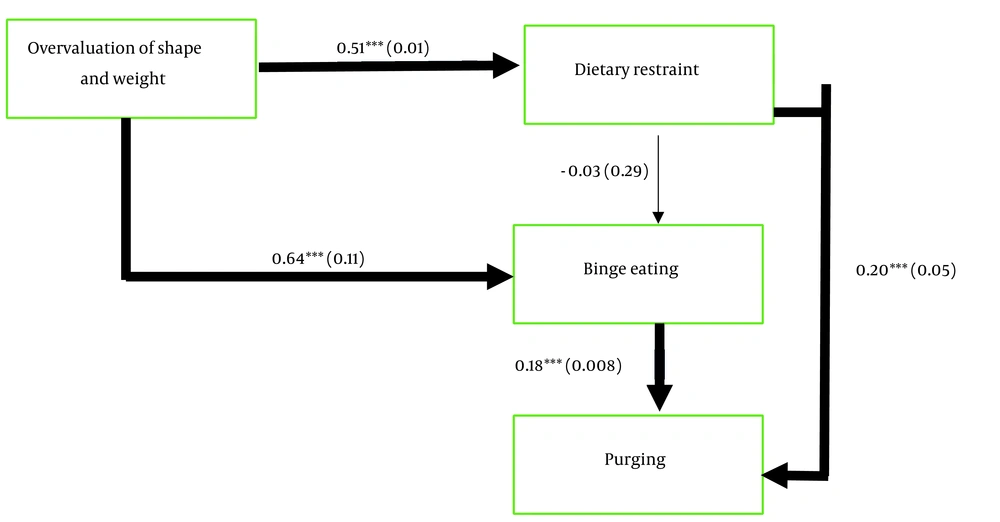
The model comprised one independent variable (overvaluation of shape and weight) and three dependent variables (binge eating, dietary restraint, and purging). The goodness-of-fit indices indicated that the original CB-BN model showed a good fit to the data from Iranian female students (CFI = 0.99, χ2/df = 4.37, GFI = 0.99, NFI = 0.98, AGFI = 0.95, IFI = 0.99, RMSEA = 0.06, 90% CI [0.02, 0.07], SRMR = 0.02) after incorporating two modifications (Figure 1). These modifications entailed adding a direct path from overvaluation of shape and weight to binge eating and a direct path from dietary restraint to purging. Significant paths were observed between overvaluation of shape and weight and dietary restraint, between purging and binge eating, and between dietary restraint and purging. However, a weak and non-significant inverse relationship was found between dietary restraint and binge eating.

Path analysis for the original cognitive-behavioral model of EDs (standard errors in parentheses; standardized coefficients reported; ***P &lt; 0.001). Note: The thickness of the arrows indicates the strength of the path.
Figure 1.

Path analysis for the original cognitive-behavioral model of EDs (standard errors in parentheses; standardized coefficients reported; ***P < 0.001). Note: The thickness of the arrows indicates the strength of the path.

4.4. Path Analysis of the Enhanced CB-BN Model
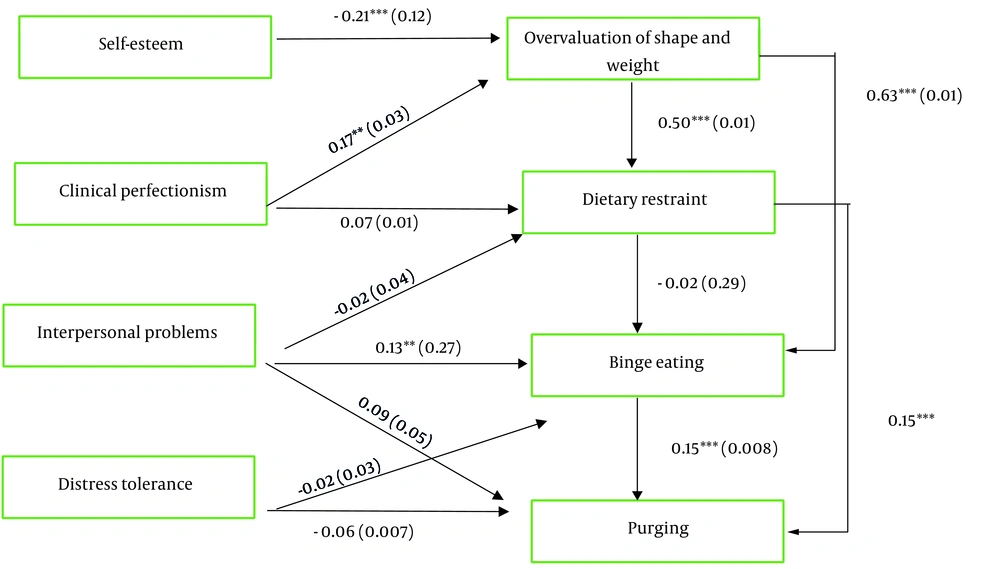
The enhanced CB-BN model comprised four independent variables (self-esteem, interpersonal problems, clinical perfectionism, and distress tolerance) and four dependent variables (overvaluation of shape and weight, dietary restraint, binge eating, and purging). The path analysis indicated that the enhanced CB-BN model did not show a good fit to the data (χ2/df = 17.48, GFI = 0.90, AGFI = 0.69, NFI = 0.58, IFI = 0.60, CFI = 0.58, RMSEA = 0.20, 90% CI [0.18, 0.23], SRMR = 0.10). The modification indices indicated two paths consistent with the theoretically proposed modifications to the original model. Specifically, a direct path from overvaluation of shape and weight to binge eating and a direct path from dietary restraint to purging were added to the model. After these modifications, the enhanced CB-BN model showed a good fit to the data (CFI = 0.96, χ2/df = 2.90, NFI = 0.95, GFI = 0.98, AGFI = 0.94, IFI = 0.96, RMSEA = 0.06, 90% CI [0.04, 0.07], SRMR = 0.06) (Figure 2).

Path analysis for the enhanced cognitive-behavioral model of EDs (standardized coefficients reported; standard errors in parentheses; **P &lt; 0.001; ***P &lt; 0.001).
Figure 2.

Path analysis for the enhanced cognitive-behavioral model of EDs (standardized coefficients reported; standard errors in parentheses; **P < 0.001; ***P < 0.001).

A significant association was observed between self-esteem and the excessive importance placed on body shape and weight. In addition, clinical perfectionism was significantly associated with overvaluation of shape and weight. Overvaluation of shape and weight was also associated with dietary restraint and binge eating. Binge eating was further associated with purging, and dietary restraint was also linked to purging. Furthermore, interpersonal problems were associated with binge eating. No significant association was observed between clinical perfectionism and dietary restraint. Distress tolerance showed no significant association with binge eating or purging. Moreover, interpersonal problems showed no association with dietary restraint or purging. Finally, no association was observed between dietary restraint and binge eating.

The enhanced CB-BN model provided a better overall fit than the modified original model. The enhanced model initially demonstrated poor fit indices (χ2/df = 17.48, RMSEA = 0.20); however, adding direct paths from overvaluation of shape/weight to binge eating and from dietary restraint to purging substantially improved model fit (χ2/df = 2.90, RMSEA = 0.06). The enhanced model also incorporates additional psychological factors (self-esteem, interpersonal problems, clinical perfectionism, and distress tolerance), making it more comprehensive. These findings suggest that incorporating broader psychological influences enhances the explanatory power of the CB-BN model in Iranian female students, supporting its cross-cultural applicability (Table 3).

Table 3.Model Fit Comparison of CB-BN Models a
IndexOriginal CB-BN ModelEnhanced CB-BN Model (Before Modification)Enhanced CB-BN Model (After Modification)
χ2/df4.3717.482.90
GFI0.990.900.98
AGFI0.950.690.94
NFI0.980.580.95
IFI0.990.600.96
CFI0.990.580.96
RMSEA0.060.200.06

a Abbreviations: GFI, Goodness-of-Fit Index; AGFI, Adjusted Goodness-of-Fit Index; IFI, Incremental Fit Index; CFI, Comparative Fit Index; RMSEA, Root Mean Square Error of Approximation.

5. Discussion

The present study aimed to evaluate the cognitive-behavioral model of eating disorders among Iranian female university students. The findings are consistent with earlier research conducted in Western populations, supporting the cross-cultural validity and generalizability of the CB-BN model.

These findings align with recent studies and add to the growing evidence supporting the adaptability of CBT across populations and delivery formats. For instance, an internet-based CBT program has been shown to be as effective as pharmacotherapy in reducing postpartum depression and improving related outcomes, such as child weight gain (36). These results underscore the flexibility and effectiveness of CBT principles in diverse settings and reinforce the cross-cultural relevance of the CB-BN model. However, observed discrepancies suggest potential cultural or sample-specific influences that warrant further investigation.

The present findings corroborate earlier research (5, 20) by identifying overvaluation of shape and weight as a central predictive factor for both dietary restraint and binge eating. Furthermore, the established link between binge eating and purging was also observed, aligning with evidence from Western populations (16, 17) and supporting its cross-cultural relevance. Additionally, the results support prior evidence that clinical perfectionism and low self-esteem contribute to this core overvaluation (19, 21).

The present study found that dietary restraint, a core component of the original CB-BN model, was not a significant predictor of binge eating. This finding suggests that pathways involving dietary restraint may not be universally applicable across cultural contexts, consistent with other SEM studies that have also failed to support this link (20, 21). Similarly, distress tolerance did not significantly predict binge eating or purging, in contrast to findings in some clinical populations (28).

The consistency observed in key pathways, such as the role of overvaluation of shape and weight, may be explained by the fact that body dissatisfaction is a transdiagnostic feature of eating disorders across diverse cultural contexts. The significant relationship between interpersonal problems and binge eating further supports the enhanced CB-BN model, which posits that social difficulties contribute to disordered eating behaviors.

The absence of a significant association between dietary restraint and binge eating may be attributable to the characteristics of the sample. Compared with clinical groups, university students may exhibit less severe dietary restraint, at levels that do not reliably precipitate binge episodes. In addition, the measurement of binge eating in this context may have captured subjective binge episodes (37), in which individuals perceive normal intake as excessive, thereby attenuating the expected association with dietary restraint.

Although the direct dietary restraint-to-binge eating path was small and non-significant (β = 0.10, P = 0.09), several cultural factors in Iran may attenuate this association. First, religious fasting is socially sanctioned and time-limited, which may normalize restraint and lessen deprivation-driven loss of control. Second, binge eating frequently occurs in social gatherings and within family contexts where food expresses affection, shifting triggers away from prior dietary restraint. Third, some students may report subjective rather than objective binges, weakening the measured restraint-to-binge link. Consistent with this pattern, restraint was more strongly related to purging than to binge eating in these data. Future studies should measure fasting frequency and motives, social-eating contexts, and type of restraint to test these cultural moderators (29).

The absence of a significant relationship between distress tolerance and eating behaviors can be contextualized by both cultural and clinical considerations. While research in Western populations often identifies low distress tolerance as a risk factor for binge eating (28), culturally specific coping mechanisms prevalent in the Iranian sample, including religious practices and social and familial support, may serve as alternative emotion-regulation strategies. Additionally, the subclinical presentation in this community sample suggests that the role of distress tolerance may be more pronounced in the progression and maintenance of diagnosable eating disorders.

The present study supports the applicability of the CB-BN model in Iranian women while identifying key cultural and sample-specific differences. Future research should employ longitudinal designs and clinical samples to further explore these relationships and determine whether cultural factors moderate the pathways proposed in the CB-BN model.

Generalizability is limited to female, non-clinical Iranian university students. Results should not be extrapolated to males or clinical populations; future research should replicate the findings in male samples and clinical cohorts and test measurement invariance across sex and clinical status. The cross-sectional nature of this study also precludes causal inference and temporal ordering of the CB-BN pathways; path coefficients should be interpreted as associations only. Multi-wave longitudinal designs and prospective clinical cohorts are recommended to examine directionality and potential bidirectional effects.

5.1. Conclusions

The current investigation provides initial support for the cross-cultural applicability of both the original and enhanced CB-BN models in the Iranian community. These findings suggest that these models may offer deeper insights into EDs and their management among Iranian women. Accordingly, future studies should further examine the efficacy of transdiagnostic prevention and treatment programs for EDs based on the cognitive-behavioral model among Iranian women. In addition, practitioners may use this transdiagnostic model to assess, conceptualize, and treat EDs. However, clinical applicability remains preliminary and is limited to young, non-clinical women. Replication in clinical and male samples is recommended before broad implementation.

Footnotes

References

  • 1.
    Melisse B, de Beurs E, van Furth EF. Eating disorders in the Arab world: a literature review. Journal of eating disorders. 2020;8(1). 59. [PubMed ID: 33292520]. [PubMed Central ID: PMC7646071]. https://doi.org/10.1186/s40337-020-00336-x.
  • 2.
    Hashemi SH, Hosseini SH, Moosazadeh M, Shamspour M, Hajizadeh-Zaker R, Hashemi SB. Prevalence of eating disorders in Iran from preschool to old age: A systematic review and Meta-analysis. Journal of Pediatrics Review. 2022;10(3):175-190. https://doi.org/10.32598/jpr.10.3.1026.1.
  • 3.
    Galmiche M, Déchelotte P, Lambert G, Tavolacci MP. Prevalence of eating disorders over the 2000 - 2018 period: a systematic literature review. The American journal of clinical nutrition. 2019;109(5):1402-1413. [PubMed ID: 31051507]. https://doi.org/10.1093/ajcn/nqy342.
  • 4.
    Fairburn CG, Kirk J, O'Connor M, Cooper PJ. A comparison of two psychological treatments for bulimia nervosa. Behaviour research and therapy. 1986;24(6):629-643. [PubMed ID: 3800834]. https://doi.org/10.1016/0005-7967(86)90058-6.
  • 5.
    Fairburn CG, Cooper Z, Shafran R. Cognitive behaviour therapy for eating disorders: A "transdiagnostic" theory and treatment. Behaviour research and therapy. 2003;41(5):509-528. [PubMed ID: 12711261]. https://doi.org/10.1016/S0005-7967(02)00088-8.
  • 6.
    Mahmoodi Molaee A, Hassanzadeh R, Khajevand Khoshli A. The Effect of Cognitive Behavioral Therapy on Quality of Life in Patients with Coronary Artery Disease: A Randomized Clinical Trial. Journal of Nursing and Midwifery Sciences. 2023;10(1). https://doi.org/10.5812/jnms-133734.
  • 7.
    Dakanalis A, Gaudio S, Serino S, Clerici M, Carrà G, Riva G. Body-image distortion in anorexia nervosa. Nature Reviews Disease Primers. 2016;2(1). 16026. https://doi.org/10.1038/nrdp.2016.26.
  • 8.
    Rohde P, Stice E, Marti CN. Development and predictive effects of eating disorder risk factors during adolescence: Implications for prevention efforts. International Journal of Eating Disorders. 2015;48(2):187-98. [PubMed ID: 24599841]. [PubMed Central ID: PMC4156929]. https://doi.org/10.1002/eat.22270.
  • 9.
    Barakat S, McLean SA, Bryant E, Le A, Marks P, Aouad P, et al. Risk factors for eating disorders: findings from a rapid review. Journal of eating disorders. 2023;11(1). 8. [PubMed ID: 36650572]. [PubMed Central ID: PMC9847054]. https://doi.org/10.1186/s40337-022-00717-4.
  • 10.
    Harrer M, Adam SH, Messner E, Baumeister H, Cuijpers P, Bruffaerts R, et al. Prevention of eating disorders at universities: A systematic review and meta-analysis. International Journal of Eating Disorders. 2020;53(6):813-833. [PubMed ID: 31943298]. https://doi.org/10.1002/eat.23224.
  • 11.
    Linardon J, Messer M, Shatte A, Skvarc D, Rosato J, Rathgen A, et al. Targeting dietary restraint to reduce binge eating: A randomised controlled trial of a blended internet-and smartphone app-based intervention. Psychological Medicine. 2023;53(4):1277-1287. [PubMed ID: 34247660]. https://doi.org/10.1017/S0033291721002786.
  • 12.
    Mason TB, Dolgon-Krutolow A, Smith KE. A Systematic Review of Moderators of the Association between Dietary Restraint and Binge Eating. Obesities. 2024;4(2):132-144. [PubMed ID: 39649010]. [PubMed Central ID: PMC11619762]. https://doi.org/10.3390/obesities4020013.
  • 13.
    Lawless M, Shriver LH, Hubbs-Tait L, Topham GL, Swindle T, Harrist AW. Bidirectional associations between restrained eating and body mass index in middle childhood. Nutrients. 2021;13(5):1485. [PubMed ID: 33924792]. [PubMed Central ID: PMC8146129]. https://doi.org/10.3390/nu13051485.
  • 14.
    Krauss S, Dapp LC, Orth U. The link between low self-esteem and eating disorders: A meta-analysis of longitudinal studies. Clinical psychological science. 2023;11(6):1141-1158. https://doi.org/10.1177/21677026221144255.
  • 15.
    Langdon-Daly J, Chuang H, Handke AM. Social safeness and eating disorder symptoms: a correlational study exploring associations of social safeness, eating disorder symptoms, social support and shame in a non-clinical young adult sample. Journal of Eating Disorders. 2024;12(1). 102. [PubMed ID: 39039534]. [PubMed Central ID: PMC11265091]. https://doi.org/10.1186/s40337-024-01057-1.
  • 16.
    Byrne SM, McLean NJ. The cognitive-behavioral model of bulimia nervosa: A direct evaluation. International Journal of Eating Disorders. 2002;31(1):17-31. [PubMed ID: 11835294]. https://doi.org/10.1002/eat.10002.
  • 17.
    Dakanalis A, Zanetti AM, Riva G, Colmegna F, Volpato C, Madeddu F, et al. Male body dissatisfaction and eating disorder symptomatology: Moderating variables among men. Journal of health psychology. 2015;20(1):80-90. [PubMed ID: 23988683]. https://doi.org/10.1177/1359105313499198.
  • 18.
    Decaluwé V, Braet C. The cognitive behavioural model for eating disorders: A direct evaluation in children and adolescents with obesity. Eating Behaviors. 2005;6(3):2120-220. [PubMed ID: 15854867]. https://doi.org/10.1016/j.eatbeh.2005.01.006.
  • 19.
    Womble LG, Williamson DA, Greenway FL, Redmann SM. Psychological and behavioral predictors of weight loss during drug treatment for obesity. International Journal of Obesity. 2001;25(3):340-5. [PubMed ID: 11319630]. https://doi.org/10.1038/sj.ijo.0801551.
  • 20.
    Lampard AM, Byrne SM, McLean N, Fursland A. An evaluation of the enhanced cognitive-behavioural model of bulimia nervosa. Behaviour Research and Therapy. 2011;49(9):529-35. [PubMed ID: 21724176]. https://doi.org/10.1016/j.brat.2011.06.002.
  • 21.
    Hoiles KJ, Egan SJ, Kane RT. The validity of the transdiagnostic cognitive behavioural model of eating disorders in predicting dietary restraint. Eating Behaviors. 2012;13(2):123-6. [PubMed ID: 22365794]. https://doi.org/10.1016/j.eatbeh.2011.11.007.
  • 22.
    Mahmoodi M, Moloodi R, Ghaderi A. The Persian version of Eating Disorder Examination Questionnaire and clinical impairment assessment: Norms and psychometric properties for undergraduate women. Iranian journal of psychiatry. 2016;11(2):67.10. 5812/ijps. 2088. https://doi.org/10.5812/ijps.20882.
  • 23.
    Marcus MD, Wing RR, Lamparski DM. Binge eating and dietary restraint in obese patients. Addictive behaviors. 1985;10(2):163-8. [PubMed ID: 3859990]. https://doi.org/10.1016/0306-4603(85)90022-X.
  • 24.
    Fairburn CG, Cooper Z, Shafran R. Clinical perfectionism questionnaire. Behavioural and Cognitive Psychotherapy. 2003. https://doi.org/10.1037/t59141-000.
  • 25.
    Egan SJ, Shafran R, Lee M, Fairburn CG, Cooper Z, Doll HA, et al. The Reliability and Validity of the Clinical Perfectionism Questionnaire in Eating Disorder and Community Samples. Behavioural and Cognitive Psychotherapy. 2016;44(1):79-91. [PubMed ID: 25731214]. [PubMed Central ID: PMC4762235]. https://doi.org/10.1017/S1352465814000629.
  • 26.
    Stoeber J, Damian LE. The Clinical Perfectionism Questionnaire: Further evidence for two factors capturing perfectionistic strivings and concerns. Personality and Individual Differences. 2014;61 - 62:38-42. https://doi.org/10.1016/j.paid.2014.01.003.
  • 27.
    Moloodi R, Pourshahbaz A, Mohammadkhani P, Fata L, Ghaderi A. Psychometric properties of the Persian version of Clinical Perfectionism Questionnaire: findings from a clinical and non-clinical sample in Iran. Personality and Individual Differences. 2017;119:141-6. https://doi.org/10.1016/j.paid.2017.07.003.
  • 28.
    Simons JS, Gaher RM. The Distress Tolerance Scale: Development and validation of a self-report measure. Motivation and emotion. 2005;29(2):83-102. https://doi.org/10.1007/s11031-005-7955-3.
  • 29.
    Azizi AR. Reliability and validity of the Persian version of distress tolerance scale. Iranian journal of psychiatry. 2010;5(4):154-8. [PubMed ID: 22952509]. [PubMed Central ID: PMC3395925].
  • 30.
    Barkham M, Hardy GE, Startup M. The IIP‐32: A short version of the Inventory of Interpersonal Problems. British Journal of Clinical Psychology. 1996;35(1):21-35. [PubMed ID: 8673033]. https://doi.org/10.1111/j.2044-8260.1996.tb01159.x.
  • 31.
    Mohammad Mehr R, Pourbohlool S, Azizi L. Psychometric properties of a short form of the Inventory of. Advances in Nursing & Midwifery. 2012;21(76):10-9.
  • 32.
    Lampard AM, Byrne SM, McLean N, Fursland A. The Eating Disorder Inventory-2 Perfectionism scale: factor structure and associations with dietary restraint and weight and shape concern in eating disorders. Eating behaviors. 2012;13(1):49-53. [PubMed ID: 22177396]. https://doi.org/10.1016/j.eatbeh.2011.09.007.
  • 33.
    Joshanloo M, Ghaedi GH. Reinvestigation of the reliability and validity of the rosenberg self-esteem scale in Iran. Clinical Psychology and Personality. 2008.
  • 34.
    Shapurian R, Hojat M, Nayerahmadi H. Psychometric characteristics and dimensionality of a Persian version of Rosenberg Self-esteem Scale. Perceptual and Motor Skills. 1987;65(1):27-34. [PubMed ID: 3684462]. https://doi.org/10.2466/pms.1987.65.1.27.
  • 35.
    Arbuckle JL. Amos 23.0 user's guide. Chicago: SPSS Inc; 2014.
  • 36.
    Shariatpanahi G, Effatpanah M, Moienafshar A, Shariati M, Kheiltash A, Ahadpourkhanghah E, et al. Comparing the Effectiveness of Internet Cognitive Behavioral Therapy and Drug Therapy for Treating Postpartum Depression and Children Weight Gain: A Randomized Clinical Trial. International Journal of High Risk Behaviors & Addiction. 2022;11(4). https://doi.org/10.5812/ijhrba-117830.
  • 37.
    Stice E. Risk and maintenance factors for eating pathology: a meta-analytic review. Psychological bulletin. 2002;128(5):825-848. [PubMed ID: 12206196]. https://doi.org/10.1037/0033-2909.128.5.825.

Crossmark
Crossmark
Checking
Share on
Metrics

Purchasing Reprints

  • Copyright Clearance Center (CCC) handles bulk orders for article reprints for Brieflands. To place an order for reprints, please click here (   https://www.copyright.com/landing/reprintsinquiryform/ ). Clicking this link will bring you to a CCC request form where you can provide the details of your order. Once complete, please click the ‘Submit Request’ button and CCC’s Reprints Services team will generate a quote for your review.
Search Relations

Author(s):

Related Articles