


1. Background
The human face plays a central role in social interactions, and imperfections in its appearance can pose social and psychological challenges for individuals (1). Subjects afflicted with dental deformities often exhibit discrepancies in their facial skeletons and malocclusion, conditions that can result from excessive facial bone growth (hyperplasia) or underdevelopment (hypoplasia) (2). Facial and dental abnormalities refer to alterations that affect the jaws and teeth, potentially impacting various craniofacial structures (3). Such abnormalities often arise from moderate to severe genetic deviations affecting the natural growth process. Common conditions include bimaxillary prognathism, lower jaw prognathism, retrognathism, and vertical maxillary excess, all of which can significantly impact facial structure and function (4). In adults, these issues necessitate correction through orthodontic and orthognathic surgical interventions (5). Orthognathic surgery involves repositioning the upper and lower jaws, or both, often accompanied by chin correction (6). The traditional approach to orthognathic surgery entails orthodontic treatment before and after the surgical procedure to achieve dental correction by aligning dental arches (7). While limited quantitative data are available on the precise prevalence of orthognathic surgery globally, it is estimated that approximately 2% of the United States population grapple with malocclusion or facial deformities that may benefit from this corrective procedure (8). Orthognathic surgery may be considered a potentially traumatic event with the potential to induce postoperative stress. Research indicates that individuals exhibit varying psychological responses to such traumatic events over time (9). In the immediate postoperative phase, most patients may experience a brief episode of acute mood disturbance, often manifesting as depression, which typically subsides after a few days (10). The corrective nature of orthognathic surgery creates a temporary stressor due to its invasive procedure, which may trigger psychological discomfort after surgery. Research findings demonstrate individual differences in resilience levels, where certain patients face temporary mood issues such as short-term depression right after surgery, which usually resolves in a few days (11, 12). The existence of skeletal facial deformities leads to chronic psychosocial and functional difficulties separate from surgical stress (10). Patients with malocclusion or jaw discrepancies develop non-functional blockages that disrupt vital functions like eating and speaking while worsening psychological symptoms, including social anxiety and body dysmorphia. The multiple impacts validate orthognathic surgery because it combines functional improvements, such as better occlusion and airway patency, with aesthetic improvements, including facial symmetry and balanced profiles, through accurate skeletal and soft-tissue modifications (13, 14). People with skeletal facial deformities encounter complex social difficulties that reach beyond mere physical or mental aspects within their sociocultural environments. Media depictions and cultural stories powerfully shape beauty norms, creating a limited view of attractiveness in society. Individuals with facial differences often face increased stigmatization and social isolation due to societal pressures (15, 16). Family standards, together with cultural conventions, augment the examination people undergo about their physical appearance. Individuals residing in collectivist cultures that prioritize conformity to social norms may experience both personal discontent and societal and familial disapproval when their facial appearance deviates from established standards (17, 18). These cultural pressures can lead people to pursue corrective surgeries, such as orthognathic surgery, to make their appearance match accepted social standards (19). Skeletal facial deformities often result in non-functional obstructions, engender social and psychological well-being issues, and aesthetic and functional challenges (20). These challenges encompass difficulties in function, sleeping, breathing, phonetics, and general oral health problems. Consequently, some patients grapple with emotional and psychological difficulties (21). Orthognathic surgery aims to concurrently address dental function and aesthetic objectives, necessitating careful consideration of skeletal movement and soft tissue changes (22). In recent decades, the focus of this surgical procedure has shifted primarily towards aesthetics, as patients increasingly seek orthognathic surgery for various aesthetic and quality-of-life improvement purposes. Previous studies in other surgical contexts have also highlighted the influence of psychological factors on postoperative outcomes and quality of life (23-25). These findings support the importance of considering mental health in patients undergoing orthognathic surgery.
2. Objectives
The present study aims to investigate the impact of orthognathic surgery on perfectionism, psychological well-being, and quality of life.
3. Methods
3.1. Study Design and Participants
This study employed a prospective cohort study design to evaluate changes in mental health and quality of life outcomes before and six months after orthognathic surgery. Participants served as their own controls in a pre-post intervention framework. The sample consisted of 35 candidates for orthognathic surgery who had been referred to Saadi and Al-Zahra Hospitals in Isfahan over six months. Participants were selected based on specific inclusion criteria using a census sampling method (Figure 1).
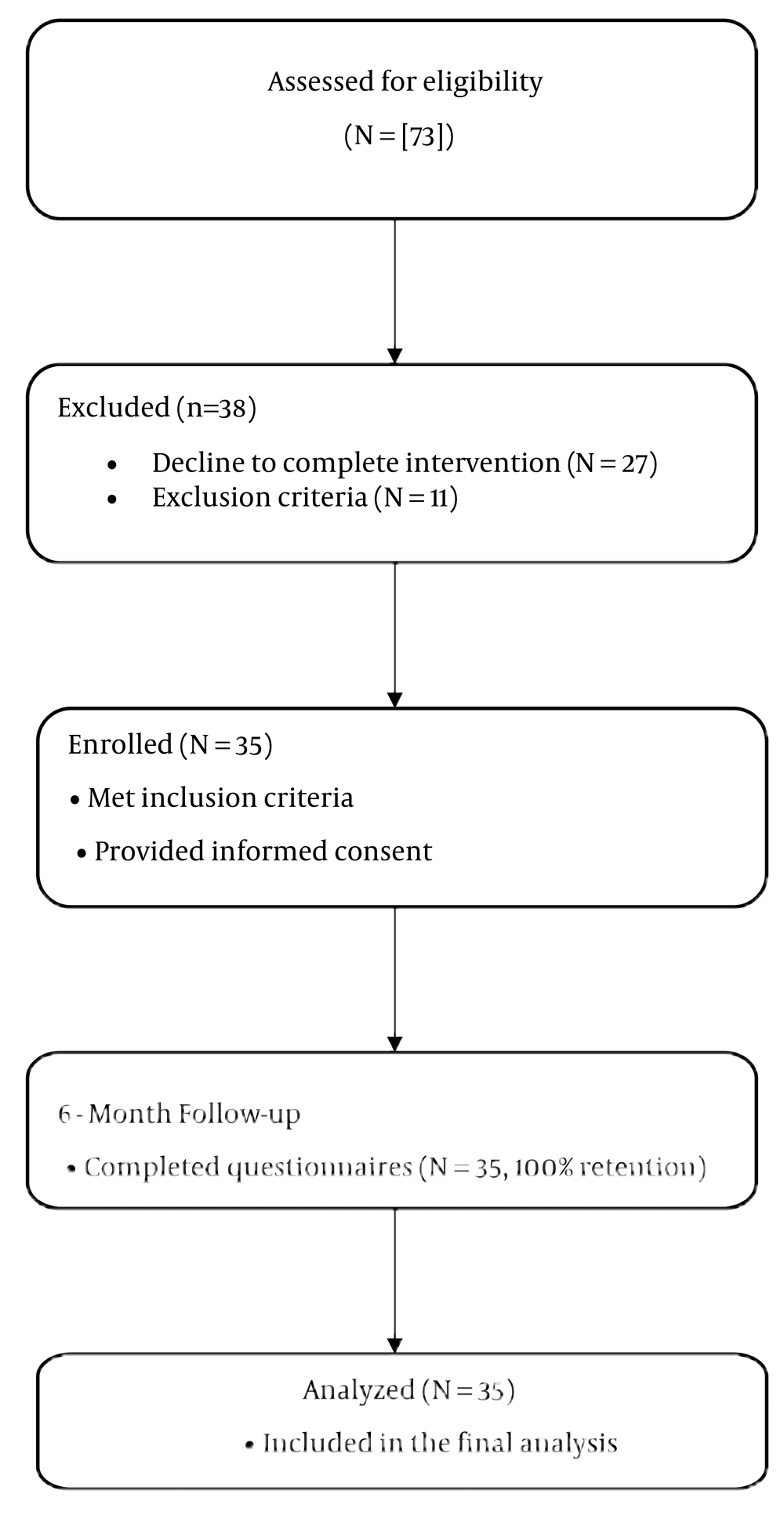
Figure 1.
Flowchart diagram
The inclusion criteria required participants to be between 18 and 50 years of age, have at least a basic literacy level, and provide informed consent to participate in the study. Conversely, the exit criteria excluded patients with cleft lip and palate, individuals with severe congenital abnormalities requiring surgical intervention, those with severe traumatic injuries, and those with significant psychiatric and neurological disorders. Following the acquisition of ethical approvals and the necessary permissions, the researcher identified patients in Saadi and Al-Zahra Hospitals and provided them with comprehensive information about the study's objectives. All surgeries were performed by the same multidisciplinary team at Saadi and Al-Zahra Hospitals under the leadership of the senior maxillofacial surgeon. Preoperative planning followed a uniform protocol, including model surgery and 3D imaging, to define osteotomy lines and skeletal movements. The Le Fort I osteotomy (maxilla) and bilateral sagittal split osteotomy (mandible) were executed using identical surgical instruments and rigid internal fixation (titanium plates and screws) across all cases. Intraoperative landmarks and the sequence of bony cuts were consistent for every patient. Postoperative management (antibiotic prophylaxis, analgesia, dietary instructions) followed a standardized regimen to ensure comparable recovery parameters. The questionnaires were administered before and six months after the surgical procedure. The Ethics Committee of Isfahan University of Medical Sciences approved this study (IR.MUI.Reseaech.REC.1399.455). All orthognathic surgeries were performed between May 2020 and September 2020. Finally, the lack of a control group limits our ability to isolate the effect of surgery from other temporal or contextual factors. Future studies should employ matched controls or randomized designs, where ethically permissible.
3.2. Patient Screening
Before enrollment, all candidates underwent a comprehensive screening protocol to identify medical, psychosocial, and functional risk factors. This included a detailed clinical evaluation of jaw deformities, dental occlusion, and general health status; standardized cephalometric analysis to confirm surgical indications; and structured interviews using the Depression Anxiety Stress Scales-21 (DASS-21) and Frost Multidimensional Perfectionism Scale (FMPS) to detect elevated depression, anxiety, stress, or maladaptive perfectionism. Patients scoring above established cutoffs on any psychological scale were offered a preoperative consultation with a clinical psychologist to determine the need for targeted interventions. Additionally, social history (including smoking, substance use, and support network assessment) and logistical considerations (e.g., ability to attend follow-up visits) were documented to ensure adherence potential. Those with uncontrolled systemic disease, active psychiatric disorders, or inadequate perioperative support were deferred until optimized, thereby maximizing both safety and likelihood of favorable clinical and psychosocial outcomes.
3.3. Variable Measurement Instruments
3.3.1. Frost Multidimensional Perfectionism Scale (FMPS)
This test comprises 35 items, arranged into six subscales. These subscales include concern about mistakes, skepticism about actions, parental expectations, parental criticism, individual standards, and being well-organized. The perfectionism score is obtained through a total of 35 items. The score is based on a 5-point scale, where “I strongly disagree” is referred to as 1, and “strongly agree” is referred to as 5. The scale demonstrates strong reliability, with subscale internal consistency coefficients ranging from 0.73 to 0.93 and an overall homogeneity coefficient of 0.90. While high scores on individual subscales are not inherently problematic or directly indicative of overall perfectionism, their interaction with elevated scores on other subscales may exacerbate dysfunction. The scale is divided into four subscales: Doubts about actions and concern over mistakes (e.g., Questions 9, 10, 13, 14, 17, 18, 21, 23, 25, 28, 32, 33, 34), reflecting self-doubt and sensitivity to errors; Extreme Concern with Parents' Expectations and Appraisal (Questions 1, 3, 5, 11, 15, 20, 22, 26, 35), capturing stress from parental standards; Excessively High Individual Standards (Questions 4, 6, 12, 16, 19, 24, 30), measuring a drive for overly ambitious goals; and Great Concern and Extreme Care About Discipline (Questions 2, 7, 8, 27, 29, 31), evaluating preoccupation with order and discipline. These subscales collectively provide insight into the complexity and potential interplay of perfectionism-related traits (26).
3.3.2. Orthognathic Quality of Life Questionnaire
This questionnaire, developed by Coyingham, includes 22 items related to quality of life and oral health. Each item is set on a 4-point Likert scale. Option 1 means that this case is the least annoying, and option 4 is the most bothersome for the person. Options 2 and 3 are the two alternatives. This questionnaire is divided into four subscales: Aesthetic Impact (items 1, 7, 10, 11, and 14, with scores ranging from 0 to 20), Oral Function (items 2 through 6, with a range of 0 to 20), Awareness Impact (items 8, 9, 12, and 13, with a range of 0 to 16), and Social Impact (items 15 through 22, with a range of 0 to 32). The total score, which is the sum of all individual item scores, can range from 0 to 88, with higher scores indicating a lower quality of life. The psychometric evaluation of this questionnaire was conducted in Iran, demonstrating strong validity and reliability. Criterion validity was supported by its ability to differentiate between individuals with orthodontic issues and those without, including volunteers and non-volunteers (P < 0.018), highlighting its discriminative capability. Reliability measures showed a Cronbach's alpha of 0.86, indicating good internal consistency, and a test-retest coefficient of 0.91, reflecting excellent stability over time (27).
3.3.3. Depression, Anxiety, and Stress Scale (DASS-21)
This questionnaire assesses the three mental states of anxiety, depression, and stress. It includes options related to signs and symptoms of depression (7 questions), anxiety (7 questions), and stress (7 questions) that the candidate completes. The points given to each subscale range from 0 to 21. Cronbach's alpha coefficient for the depression subscale is 0.77, the anxiety subscale is 0.79, and the stress subscale is 0.78. The concurrent validity is measured through the correlation of the DASS-21 depression subscale with the Beck Depression Inventory (BDI-II), yielding a correlation coefficient of 0.70. The correlation coefficient for the anxiety subscale with the test Zonk anxiety is reported as 0.67, and for the stress subscale with the perceived stress test, it is reported as 0.49 (28).
3.3.4. Control of Confounding Variables
Across all analyses, potential confounding variables — including age, gender, baseline quality-of-life scores, and baseline psychological states — were controlled using multivariate linear regression. Variance inflation factors (VIF) were also examined to ensure that multicollinearity did not distort the associations among variables. This approach helped to minimize bias and enhance the validity of our findings. To minimize seasonal or temporal confounding, all baseline (preoperative) assessments and the corresponding six-month follow-up evaluations fell within the same seasonal window (both conducted between May and September), ensuring that any changes observed are unlikely to be driven by external seasonal factors.
3.3.5. Postoperative Care Protocols
All patients received a standardized postoperative regimen beginning in the recovery room, which included intravenous antibiotic prophylaxis (cefazolin 1 g every 8 hours for 24 hours) and analgesia (intravenous ketorolac 30 mg every 6 hours, transitioning to oral NSAIDs and acetaminophen). A soft-liquid diet was initiated on postoperative day 1, advancing to a soft diet by week 2 and regular consistency by week 6. Oral hygiene instructions emphasized the use of gentle chlorhexidine mouthwash twice daily for 14 days and careful toothbrushing around the fixation sites. All patients were prescribed corticosteroid tapering (dexamethasone 8 mg on day 0, then 4 mg on days 1 - 2) to mitigate edema. Follow-up visits were conducted at 1 week, 1 month, 3 months, and 6 months, during which the surgical sites, occlusion, and neurosensory function were assessed, and any plate- or screw-related discomfort was managed according to protocol. Physical activity was restricted to light ambulation for 2 weeks, with gradual return to normal activities by postoperative week 4 under the supervision of the surgical team.
3.3.6. Statistical Analysis
Data were analyzed using IBM SPSS Statistics Version 23. Continuous variables are reported as mean ± standard deviation (SD), and categorical variables are presented as frequencies and percentages. Non-normal distributions (confirmed via Shapiro-Wilk test) necessitated non-parametric methods: Wilcoxon signed-rank tests assessed pre-post-surgical changes in quality of life (Orthognathic Quality of Life Questionnaire), perfectionism (Frost Multidimensional Perfectionism Scale), and mental health (Depression Anxiety Stress Scales-21), with effect sizes (Cohen's d: Small [0.2], medium [0.5], large [≥ 0.8]) and bootstrapped 95% confidence intervals (1,000 resamples). Spearman's correlations (r) evaluated relationships between variables (weak [0.1 - 0.3], moderate [0.3 - 0.5], strong [> 0.5]). A multiple linear regression model (adjusting for baseline scores, perfectionism, age, and gender; VIF < 2.0) identified predictors of post-surgical Orthognathic Quality of Life Questionnaire. Missing data (< 5%) were managed through complete-case analysis, validated by Little's MCAR test (χ² = 12.4, P = 0.14). Post-hoc power analysis (G*Power 3.1) indicated 78% power to detect medium effects (d = 0.5, α = 0.05). Analyses emphasized effect sizes and 95% confidence intervals over multiple comparison corrections, with significance set at P < 0.05 using the default settings in SPSS 23.
4. Results
This study examined a cohort of 35 patients. The mean age of these patients was 24 ± 4.78 years, with 18 of them (51.4%) being female. Moreover, 13 patients (37.1%) held a bachelor's degree, while the vast majority, 32 patients (91.4%), were unmarried. Table 1 presents the comparison of questionnaire scores across key demographic subgroups. Notably, patients younger than 25 reported significantly better oral–dental quality of life than those aged 25 and older (Orthognathic Quality of Life Questionnaire: 45.2 ± 18.3 vs. 53.8 ± 20.1; Z = –2.1, P = 0.03). No other demographic comparisons reached statistical significance: Gender (Orthognathic Quality of Life Questionnaire, U = 142, P = 0.42), education level (Orthognathic Quality of Life Questionnaire, Z = –1.9, P = 0.06), and marital status (Orthognathic Quality of Life Questionnaire, U = 28, P = 0.12) all showed similar mean scores for Frost Multidimensional Perfectionism Scale, depression, anxiety, and stress between groups. In summary, age was the only demographic factor significantly associated with postoperative oral health–related quality of life.
| Demographic and Group | OQLQ | FMPS | Depression | Anxiety | Stress | Test Statistic (P-Value) | Cohen’s d |
|---|---|---|---|---|---|---|---|
| Age group (y) | Z = -2.1 (P = 0.03) | 0.48 | |||||
| < 25 (n = 20) | 45.2 ± 18.3 | 107.1 ± 14.2 | 6.1 ± 4.8 | 4.9 ± 4.1 | 8.7 ± 5.0 | ||
| ≥ 25 (n = 15) | 53.8 ± 20.1 | 110.2 ± 16.5 | 7.2 ± 5.6 | 5.8 ± 5.3 | 9.5 ± 6.2 | ||
| Gender | U = 142 (P = 0.42) | 0.08 | |||||
| Female (n = 18) | 48.5 ± 19.0 | 108.4 ± 15.0 | 6.3 ± 5.1 | 5.2 ± 4.5 | 8.9 ± 5.3 | ||
| Male (n = 17) | 50.1 ± 19.8 | 106.9 ± 14.8 | 6.8 ± 5.3 | 5.0 ± 4.8 | 9.2 ± 5.7 | ||
| Education level | Z = -1.9 (P = 0.06) | 0.50 | |||||
| Bachelor’s (n = 13) | 42.7 ± 17.5 | 104.2 ± 13.5 | 5.8 ± 4.3 | 4.5 ± 3.9 | 7.9 ± 4.8 | ||
| Non-Bachelor’s (n = 22) | 52.3 ± 19.6 | 109.8 ± 15.7 | 7.0 ± 5.5 | 5.5 ± 5.0 | 9.6 ± 5.9 | ||
| Marital status | U = 28 (P = 0.12) | 0.36 | |||||
| Unmarried (n = 32) | 49.0 ± 19.2 | 107.8 ± 14.9 | 6.5 ± 5.2 | 5.1 ± 4.6 | 8.8 ± 5.4 | ||
| Married (n = 3) | 55.3 ± 21.4 | 112.0 ± 17.2 | 7.7 ± 6.1 | 6.3 ± 5.9 | 10.2 ± 6.8 |
Abbreviations: OQLQ, oral quality of life questionnaire; FMPS, Frost Multidimensional Perfectionism Scale.
a Data are provided as mean ± SD.
b Cohen’s d calculated for all pairwise comparisons.
Table 2 illustrates that patients experienced a significant improvement in their quality of life related to oral and dental health, specifically in terms of aesthetic, functional, and awareness domains, both before and 6 months after surgery (P < 0.05). Nevertheless, there was no significant impact on interpersonal relationships among the patients (P > 0.05). Overall, orthognathic surgery resulted in a large improvement in patients’ quality of life, with an effect size of Cohen’s d = -0.80. The effects of orthognathic surgery on psychological and quality-of-life outcomes are summarized in Table 2.
| Variables | Before Surgery | After Surgery | F | P-Value | Cohen’s d | Interpretation |
|---|---|---|---|---|---|---|
| Depression | 6.54 ± 5.4 | 6.17 ± 5.35 | 0.273 | 0.579 | -0.07 | Negligible |
| Anxiety | 5.31 ± 5.6 | 4.28 ± 4.4 | 0.866 | 0.390 | -0.20 | Small |
| Stress | 9.1 ± 5.6 | 8.9 ± 5.24 | 0.140 | 0.889 | -0.04 | Negligible |
| OQLQ (total) | 48.92 ± 19.71 | 32.42 ± 21.71 | 9.069 | 0.004 | -0.80 | Large |
| Aesthetic (0 - 20) | 13 ± 5.65 | 7.17 ± 5.42 | 16.244 | 0.0001 | -1.04 | Large |
| Function (0 - 20) | 11.88 ± 6.19 | 8.88 ± 6.61 | 3.974 | 0.051 | -0.48 | Medium |
| Awareness (0 - 16) | 9.08 ± 4.72 | 5.88 ± 4.22 | 7.561 | 0.008 | -0.73 | Medium–Large |
| Social (0 - 32) | 14.96 ± 9.14 | 10.48 ± 9.09 | 3.515 | 0.066 | -0.49 | Medium |
| FMPS (total) | 108.36 ± 15.47 | 106.5 ± 12.95 | 0.216 | 0.644 | -0.13 | Small |
| Concern over mistakes/doubts | 35.32 ± 10 | 34.22 ± 8.12 | 0.033 | 0.856 | -0.12 | Small |
| Parents’ expectations/evaluation | 23.68 ± 5.28 | 23.91 ± 4.59 | 0.863 | 0.357 | +0.05 | Negligible |
| Personal standards | 25.56 ± 3.62 | 24.62 ± 3.96 | 0.001 | 0.977 | -0.25 | Small |
| Order/organization | 23.8 ± 3.95 | 23.77 ± 3.57 | 0.244 | 0.623 | -0.01 | Negligible |
Abbreviations: OQLQ, oral quality of life questionnaire; FMPS, Frost Multidimensional Perfectionism Scale.
aData are provided as mean ± SD.
b Cohen’s d interpreted as small (0.2 - 0.49), medium (0.5 - 0.79), large (≥ 0.8). Negative values indicate post-surgical improvement.
• Post-surgical assessment demonstrated large improvements in overall quality of life (Orthognathic Quality of Life Questionnaire total; d = -0.80) and in the aesthetic subscale (d = –1.04).
• Medium to large effect sizes were observed in the awareness subscale (d = -0.73), while medium effects were seen for functional (d = -0.48) and social impact (d = -0.49) domains.
Changes in psychological variables, including depression (d = -0.07), anxiety (d = -0.20), and stress (d = -0.04), as well as in total and subscale Frost Multidimensional Perfectionism Scale scores, were small or negligible, indicating minimal impact on perfectionism traits over the six-month follow-up period. Overall, orthognathic surgery yielded substantial functional and aesthetic benefits, reflected by large effect sizes in key quality-of-life domains, whereas effects on psychological distress and perfectionism were limited.
In Table 3, the correlation between the examined factors is presented. The quality of life related to dental and oral health exhibits a significant negative correlation with depression, anxiety, and stress. As levels of depression, anxiety, and stress increase, the quality of life related to oral and dental health decreases (P < 0.05). Furthermore, a significant positive association exists between perfectionism and the quality of life related to oral and dental health. An increase in perfectionism is associated with an improvement in patients' quality of life related to dental and oral health (P < 0.05).
Table 3.Correlation Between the Psychological Distress and Oral Quality of Life Questionnaire and Frost Multidimensional Perfectionism Scale
| Variables | OQLQ | FMPS |
|---|---|---|
| Depression | P = 0.0001; r = 0.-564 | P = 0.234; r = 0.207 |
| Anxiety | P = 0.001; r = -0.553 | P = 0.137; r = 0.256 |
| Stress | P = 0.008; r = 0.-440 | P = 0.244; r = 0.202 |
| OQLQ | 1 | P = 0.016; r = 0.405 |
Abbreviations: OQLQ, Oral Quality of Life Questionnaire; FMPS, Frost Multidimensional Perfectionism Scale; P, P-value; r, The correlation coefficient.
5. Discussion
Patients with dental irregularities often exhibit timid, defensive, and passive behaviors due to their low self-esteem regarding their appearance. Their appearance can significantly impact various aspects of their lives, including social interactions, job opportunities, partner selection, and personality traits, affecting their quality of life. In these persons, orthognathic surgery assumes greater importance (29).
According to this result, the dental and oral health-related quality of life (in aesthetics, functionality, and awareness) significantly improved in patients 6 months after surgery. Based on Cohen's d and Hedges' g, the effect sizes of orthognathic surgery on patients' quality of life were found to be 0.806726 and 0.803444, respectively. Values of 0.2 to 0.5 are considered small, 0.5 to 0.8 are considered medium, and greater than 0.8 are considered significant. Based on the effect size index, the findings of this study indicate that the strength of the relationship between orthognathic surgery and quality of life in patients undergoing surgery is strong and high (r = 0.806726). Therefore, it can be concluded that 80% of the variance in the participants' quality of life change scores is due to the orthognathic surgery variable. The findings of the present study, in comparison with the results of the systematic review by Alkaabi et al., ultimately, 29 eligible studies were reviewed based on their effect size. One study indicates the significant impact of orthognathic surgery on the quality of life of these patients (30). The results of the present study support the findings of Sen et al. (17), dos Santos Cordeiro et al. (31), Schaefer et al. (32), and Johansson et al. (33). In these studies, orthognathic surgery also significantly affected the quality of life related to oral and dental health. It seems that the improvement in quality of life after surgery is due to changes in appearance and a sense of satisfaction with life.
The theoretical basis of this study is grounded in the perspective of Steven Hayes, developer of the theory of psychological flexibility and acceptance and commitment therapy (ACT). According to this perspective, one aspect of psychological inflexibility is fusion with a real or imagined defect, body image, thought, memory, or emotion. Therefore, it seems that with orthognathic surgery and improvement in the patient's appearance, instead of fusion, the patient reaches diffusion, and consequently, other components of psychological inflexibility, including avoidance, conceptualized self, and dominance of the conceptualized past and future, are modified. The patient moves towards clarifying their life values and taking active action towards essential life values, which ultimately leads to an improved quality of life (34).
On the other hand, according to psychological findings, improvement in body image is associated with a better sense of self-esteem and, consequently, with an increase in quality of life. The findings of the meta-analysis and systematic review (2023) support this psychological explanation (35, 36).
However, it did not significantly impact patient social relationships. Furthermore, there was no significant effect on perfectionism, stress, anxiety, and depression among patients. In explaining and justifying these findings, it can be said that perfectionism is a relatively stable personality trait (37). Although it is one factor that makes a person dissatisfied with their appearance and makes people volunteer for cosmetic procedures, it is resistant to change. This personality trait does not change simply with orthognathic surgery. On the other hand, the findings of the present study showed that orthognathic surgery did not have a significant effect on mental health indicators such as depression, anxiety, and stress. Perhaps one of the reasons for this lack of significant difference in the level of psychopathology indicators before and after surgery is that psychological disorders are multifactorial and cannot be improved by surgery alone, and require serious psychological treatments.
Other findings of this study reported the relationship between personality (perfectionism), psychological variables such as depression, anxiety, stress, and oral and dental-related quality of life. The dental and oral health-related quality of life maintains a significant negative relationship with depression, anxiety, and stress. As depression, anxiety, and stress levels increase, the dental and oral health-related quality of life decreases.
Additionally, a significant positive association exists between perfectionism and dental and oral health-related quality of life, wherein an increase in perfectionism is associated with an improvement in patients' dental and oral health-related quality of life. According to the literature on perfectionism, there are two distinct types of perfectionism: Positive and negative. While negative perfectionism is a personality trait associated with avoidance and procrastination, positive perfectionism is pragmatic and high-standard but requires reasonable effort to achieve the goals. Therefore, it is possible that the patients who were candidates for surgery were individuals with positive perfectionism, so this type of perfectionism was positively related to quality of life but not to psychological distress.
Comparing our findings with the results of Eslamipour's study is noteworthy. Eslamipour (8) examined 43 patients and found that facial and orthognathic surgery significantly improves and increases the quality of life in persons with dental-facial abnormalities six months after the surgery. The most significant changes occurred in the emotional dimension. Although the results of the present study were consistent with the Eslamipour findings, the most important improvements were observed in the aesthetic dimension. The findings of our study support the explanation and conceptualization made by Miguel et al.'s study (38), which indicates that the decision to undergo orthognathic surgery depends on its impact on each individual's beauty, function, and social relationships. It appears that these components contribute to changes in self-concept and self-esteem by altering one's attitude towards their appearance, ultimately improving the quality of life after orthognathic surgery.
Our findings share similarities and differences with those of similar studies conducted in both developed and developing countries, which are noteworthy. For example, Tuk et al. (39) in the Netherlands demonstrated that patients' quality of life decreased immediately after the operation but improved over time. Therefore, it seems that more than 6 months must pass after the operation so that the mental health status gradually changes with the increase in the dimensions of quality of life, and depression, anxiety, and psychological distress decrease. Perhaps this is why the quality of life increased in the participants of our study after the operation, but no significant change was seen in the psychopathology variables. Duarte et al. (40) also obtained similar results after examining the results of orthognathic surgery, which aligned with the present study's findings. It is also comparable to the findings of our study and similar studies in Eastern countries. For example, Abdullah (41) found a significant improvement in clients' quality of life after orthognathic surgery, involving 17 patients in Saudi Arabia. Rezaei et al. (42) reported that orthognathic surgery is significant for clients with skeletal Class III malocclusion and significantly improves their quality of life, as observed in a study of 112 patients in Kermanshah. In addition, the results of Al-Bitar's and Al-Ahmad study (10) indicated that patients undergoing orthognathic surgery had lower levels of anxiety and PTSD symptoms. These findings differ from our study. In the present study, surgery after 6 months increased quality of life but did not affect anxiety, depression, and stress. This difference may be due to the etiology of the surgical candidates in the two groups. As mentioned earlier, trauma led to the surgery. Therefore, treatment of the effects of trauma reduced the anxiety caused by it, while in our study, psychological symptoms were associated with personality traits and were, therefore, resistant to change. In support of this explanation, we can also refer to the study by Kim (43), which found that most clients in Korea undergo orthognathic surgery for aesthetic purposes, resulting in improvements in both beauty and functionality after the surgery. Bamashmous et al. (44), with 70 patients, indicated that social anxiety and quality of life were improved after orthognathic surgery. Barel et al. (45) in Brazil showed that increased awareness of orthognathic surgery methods reduces anxiety levels. In this study, we find a high and significant negative association between quality of life and anxiety severity. In addition, other studies, contrary to the findings of our research, showed that surgery can significantly reduce the symptoms of at least one of the psychological disorders, such as depression or anxiety, which we will mention, and then explain the possible reason for this difference. For example, another researchers stated in a study in France that orthognathic surgery increases the quality of life and reduces depression, but there was no effect on anxiety. However, patients who had high levels of anxiety before surgery showed less improvement in the mentioned indicators. This is while in the present study, orthognathic surgery improved the quality of life but had no significant effect on anxiety and depression. Nevertheless, we find a high and significant negative association between quality of life, stress, anxiety, depression severity, and perfectionism. Since oral health-related quality of life is inversely and significantly correlated with depression, stress, and anxiety, and surgery improves quality of life, we expected that surgery would also be effective in reducing depression and anxiety, but this was not seen in this study. It may be said that since in this study, surgery did not have a significant effect on deep personality traits such as perfectionism, despite the improvement in oral health-related quality of life, reducing symptoms of depression and anxiety requires changes in mediating variables such as dysfunctional attitudes toward oneself and others, maladaptive schemas, and personality traits such as perfectionism.
Finally, our study group shared similar age and educational backgrounds; however, we recognize that socioeconomic status influences the availability of orthognathic care, patient expectations for aesthetic improvements, and postoperative care assistance. People with higher socioeconomic status in Iran experience more financial freedom to undergo surgery and complete their follow-up care, unlike lower-income patients who encounter obstacles to accessing treatment and psychological support. Iran's collectivist society values family endorsement and community standards, which makes facial deformities more psychologically distressing and pushes people towards surgical correction for social acceptance. The sample consisted of women as the majority group, at 51.4%, which illustrates both women's growing interest in aesthetic procedures and possible variations in health-seeking patterns between genders. Future research should analyze outcomes based on socioeconomic status indicators, investigate cultural beliefs through qualitative interviews, and determine whether gender-specific support systems enhance both functional recovery and psychosocial adjustment.
The current study has yielded promising results; however, it is essential to acknowledge its multiple limitations. The study's results may lack wider applicability because they are based on data from a single center, which may not accurately represent broader populations with similar conditions. Multi-center studies would help improve external validity. The study's follow-up duration of six months might not be adequate for detecting the intervention's extended psychological and functional results. Extended follow-up periods in future research will help determine whether these treatment effects remain stable over time. Monitoring participants for at least one year or more will yield deeper insights into the intervention's lasting effects on life quality and mental health. The study evaluated quality of life and mental health exclusively through self-reported questionnaires. Although these tools receive broad usage and validation, they remain subjective in nature and vulnerable to biases from memory recall and social desirability as well as varied personal perceptions. The use of self-report measures introduces potential confounding factors which make deriving objective conclusions challenging. Upcoming research must integrate clinician-administered evaluations or physiological measurements to improve measurement precision. The study employed a pre-post design, which could potentially introduce response bias. The fact that participants knew they were being evaluated multiple times during the study might have affected their responses in both conscious and subconscious ways. Subsequent research should investigate the implementation of control groups or alternative research designs, such as randomized controlled trials, to minimize bias and strengthen causal conclusions. The census sampling method used caused selection bias, compromising sample representativeness and creating confounding variables. Future investigations should employ multi-center studies with objective evaluations, along with control groups and randomized sampling methods, to enhance the validity and applicability of research outcomes. Future research initiatives must focus on including bigger sample sizes and more diverse demographics, along with extended follow-up durations, to achieve a thorough analysis of long-term effects.
5.1. Potential Hawthorne Effect
The participants' knowledge of constant observation and evaluation may have led to enhanced self-reported results through the Hawthorne effect, where study participation alters behavior rather than producing genuine treatment effects. Our six-month interval and use of well-validated trait-based questionnaires (Depression Anxiety Stress Scales-21, Frost Multidimensional Perfectionism Scale, Orthognathic Quality of Life Questionnaire) reduce short-term reactivity, as all follow-ups occurred during routine clinical care without extra attention. However, we cannot eliminate this bias (46). Blinded outcome assessors and objective measurements should be included in future controlled studies to further reduce observation-related effects.
5.2. Practical Implication
Our findings suggest that orthognathic patients would benefit from clinicians implementing a multidisciplinary care pathway throughout their treatment. Healthcare providers should begin with routine pre-surgical assessments for psychological risks like high perfectionism and depression/anxiety/stress symptoms, then direct those who need it to behavioral health specialists for specific treatments before surgical procedures. The care pathway requires structured follow-up appointments at 1 week, 1, 3, and 6 months postoperatively to detect complications or distress early and perform functional assessments and psychosocial evaluations. Patients should receive standardized educational materials that describe realistic aesthetic and functional results, recovery timelines, and emphasize the importance of following post-surgery regimens. Incorporate family members into counseling sessions to build social support networks that promote long-term lifestyle changes, including smoking cessation and nutritional improvements, leading to ongoing quality-of-life benefits.
5.3. Conclusions
According to the study's findings, orthognathic surgery significantly improved patients' quality of life related to dental and oral health. Still, it did not substantially affect perfectionism, depression, and anxiety symptoms 6 months after surgery. On the other hand, depression, anxiety, and stress levels were significantly associated with patients' oral and dental health-related quality of life. Therefore, orthognathic surgery and appropriate psychological interventions are recommended to increase the quality of life of these patients.
