


1. Background
Aggression manifests in adolescents through various behaviors, including physical, verbal, social, and virtual actions (1, 2). These behaviors result from the interaction of psychological, environmental, and biological factors and vary in intensity and type depending on the context (3). According to definitions provided by the DSM-5-TR and the APA Dictionary of Psychology, aggression is characterized as an impulsive and unpredictable reaction to stress that may include verbal tirades or physical attacks (4, 5).
Failure to identify aggressive patterns early can lead to severe mental and social health consequences, such as the development of psychological disorders, deterioration in interpersonal relationships, and an increase in violence within educational and familial settings (6). The present study’s added value lies in designing an accurate, up-to-date assessment tool that not only aids in preventing future disorders but also facilitates the formulation of effective intervention policies.
Research indicates that a significant proportion of adolescents worldwide exhibit aggressive behaviors, although the manifestation and intensity depend on cultural and social factors (7-10). In Iran, the incidence of such behaviors is reported to be higher than the global average, underscoring the necessity for localized assessment instruments (11). Existing measures — such as the Adolescent Aggression Scale, the adolescent risk behavior checklist, and tools like the Child and Adolescent Aggression Scale (CASA) and the high-risk behavior (HRB) checklist — primarily focus on traditional forms of aggression (12, 13). They often neglect the evolving digital dimension of aggression driven by technological advancements, thus failing to accurately assess the full spectrum of aggressive behaviors in today’s adolescents (14-18). These shortcomings suggest that previous tools, due to their outdated design and limited scope, are insufficient for capturing contemporary aggressive behaviors.
The rapid growth of digital media and changes in communication have given rise to new forms of aggression (19). Today, adolescents engage not only in physical and verbal altercations but also in online aggression through social media, video games, and other virtual platforms (20, 21). This form of aggression — manifesting as online insults, cyberbullying, and digital threats — has profound effects on the mental health of adolescents, posing a novel challenge to the field of mental health (22). Furthermore, increased aggressive behaviors in schools disrupt learning and social relationships, thereby reducing overall social cohesion (2, 16, 23, 24).
Aggressive behavior in adolescents affects not only the individual but also the broader social environment (17, 25). The absence of precise tools for early detection can lead to increased violence, diminished social cohesion, and widespread societal dysfunction (26). Consequently, a comprehensive and accurate evaluation of aggression is critical for implementing timely preventive measures. Early identification of aggressive patterns plays a vital role in preventing long-term psychological and social disorders (27).
In Iran, unique economic, political, and social conditions — such as post-revolutionary changes, sanctions, the eight-year war, and economic challenges like inflation and reduced social welfare — have resulted in chronic stress that may exacerbate aggressive behaviors (3, 28). These conditions highlight the urgent need to adopt innovative approaches for the early detection and intervention of aggression, as the failure to do so may result in significant adverse outcomes, including increased rates of mental and social disorders.
In response to the need for a comprehensive and culturally adapted evaluation tool, the present study was designed to develop and validate the "Tehran Adolescent Aggression Scale (TAAS) ". This instrument adopts a multidimensional approach to assess physical, verbal, virtual, and even self-directed aggression among adolescents, thereby providing a precise and updated picture of aggression within the Iranian cultural and social context. Unlike existing tools that primarily address traditional forms of aggression, TAAS also considers emerging dimensions related to technological advancements and virtual interactions. This broader coverage enables TAAS to offer greater accuracy compared to instruments like CASA and HRB.
Recent studies conducted between 2024 and 2025 — such as those by Bayat Mokhtari et al. and Sajadi Monazah et al.— have underscored the necessity of designing modern, precise assessment tools (3, 11). These investigations reveal that reliance on outdated instruments can lead to the misidentification of aggressive patterns and subsequently to severe consequences, including an increase in psychological and social disorders among adolescents (3). Incorporating these recent scientific findings further substantiates the need for developing TAAS and demonstrates the added value of this research.
This research, conducted between September 2022 and March 2023 in Tehran, leverages innovative approaches in aggression assessment to address the gaps present in earlier instruments. The findings of this study are expected to serve as a foundation for formulating preventive strategies and timely interventions in adolescent mental health, ultimately improving both individual and social outcomes. The development and application of TAAS not only enhance awareness and educational conditions but also strengthen social cohesion by providing valuable insights into the characteristics of aggression for researchers and mental health professionals.
In summary, TAAS represents an effort to offer a comprehensive, precise, and culturally adapted tool for the assessment of aggression. By focusing on both traditional and emerging dimensions of aggression, TAAS meets the needs of Iranian adolescents in today’s dynamic economic, political, and social environment.
2. Objectives
The anticipated outcomes of this research are expected to serve as a basis for predicting future trends, reducing psychological and social disorders, and informing targeted mental health policies. Consequently, TAAS can play a crucial role in enhancing public awareness, improving educational conditions, and reinforcing social cohesion, thereby providing critical information for researchers and mental health experts.
3. Methods
This developmental research utilized a mixed-methods approach, integrating both quantitative and qualitative techniques to address the research questions. The study was conducted in Tehran, Iran, from 23 September 2022 to 20 March 2023. The qualitative phase involved extracting the experiences of Iranian adolescents through interviews, while the quantitative phase focused on validating an Aggression Questionnaire — hereafter referred to as TAAS.
3.1. Sampling and Participants
3.1.1. Target Population
This study targeted adolescents aged 14 to 18 residing in Tehran to comprehensively understand their experiences with aggression.
3.1.2. Inclusion and Exclusion Criteria
In this study, the inclusion criteria include obtaining informed consent from participants, being between 14 and 18 years old, residing in Tehran, and recording basic demographic information such as gender, age, education level, and socioeconomic status (SES). Additionally, a predefined aggression score is not required for inclusion, and a wide range of aggression levels is considered. The exclusion criteria include submitting an incomplete questionnaire and having a history of psychological disorders.
3.1.3. Qualitative Phase
In this study, participants were selected using purposeful sampling to ensure the inclusion of individuals capable of providing in-depth insights into the research topic. To guarantee the diversity of experiences, interviewees were recruited from various districts of Tehran, taking into account cultural and social differences. Data saturation was achieved after 22 interviews, meaning that no new themes or codes emerged and the main patterns repeatedly appeared in the data. To assess the level of data saturation, a Saturation Index was utilized. In this method, after every three consecutive interviews, a provisional data analysis was conducted and the newly identified themes were compared with those from previous interviews (6). The analysis revealed that from the nineteenth interview onward, the repetition of themes exceeded 90%, and no new themes were added to the initial set of codes (29). This index confirmed that the data were sufficiently rich and comprehensive, and that conducting additional interviews would not add value to the research findings (30). Moreover, to validate the data saturation, the findings were reviewed by several collaborating researchers, and a comparative analysis was performed between the results of the final interviews and earlier data (6). The results indicated that the main themes and patterns remained unchanged in the later interviews, confirming that data saturation had been reached. Accordingly, 22 interviews were deemed adequate for achieving data saturation. Ethical considerations were maintained throughout the interview process, with participants being informed prior to the interviews about the interviewer's identity, the study objectives, the voluntary nature of participation, and the confidentiality of the data. All procedures were conducted in accordance with ethical research standards to ensure the accuracy and validity of the data (Figure 1).
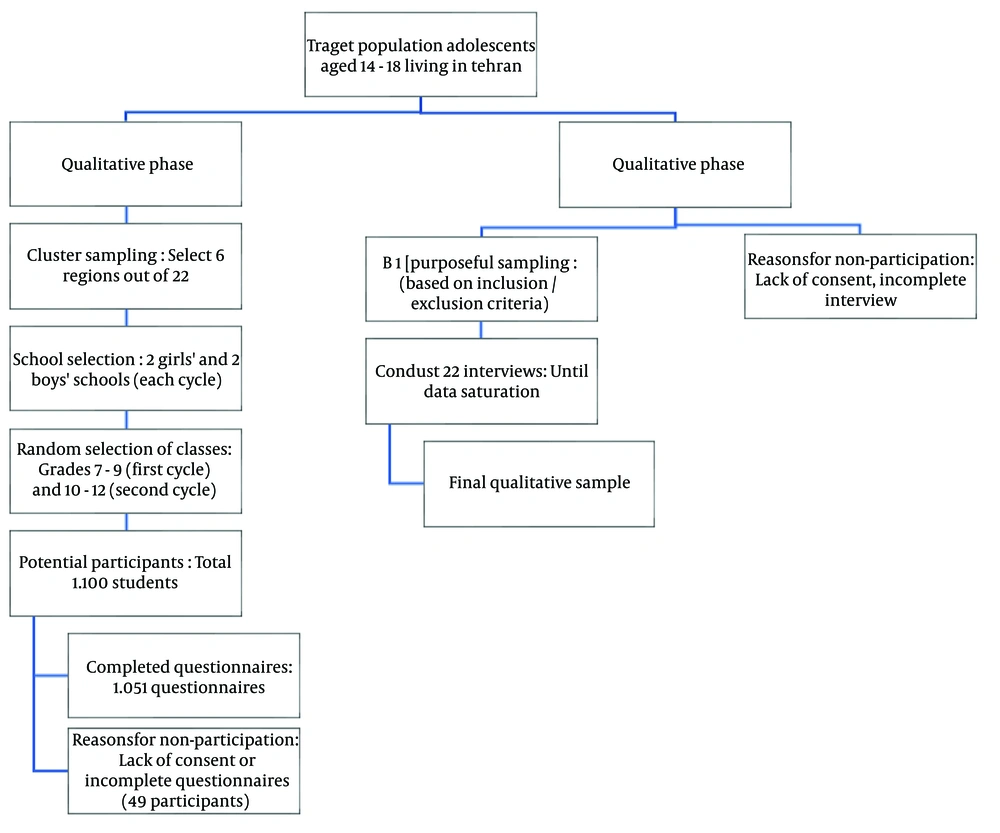
Figure 1.
Flowchart of participant selection and reasons for non-participation (qualitative and quantitative phases)
3.1.4. Quantitative Phase
A stratified sample of 1,100 adolescents from Tehran was carefully selected to ensure statistical validity in various analyses. To ensure independent samples for factor analysis, the total sample was split such that a subgroup of 500 participants was used exclusively for exploratory factor analysis (EFA) to establish a strong factor structure, while a separate subgroup of 300 participants was used for confirmatory factor analysis (CFA) to validate the EFA findings (31). For concurrent validity, 200 participants were selected, which fell within the optimal range of 50 to 400 (32, 33). Reliability testing was conducted with 100 adolescents to assess the questionnaire's consistency (34). Each sample size was determined based on the specific needs of the statistical validation techniques used in the study (35, 36).
In the quantitative phase, a cluster sampling method was employed. First, six regions (1, 5, 9, 13, 17, 20) were randomly selected from 22 educational regions in Tehran. These regions were chosen to represent various parts of the city with diverse cultural and social characteristics. Next, within each selected region, two girls' high schools (one from the first cycle and one from the second cycle) and two boys' high schools (one from the first cycle and one from the second cycle) were randomly selected. From each school, two classes per grade level were randomly chosen (for the first cycle, two classes from grades 7 to 9, and for the second cycle, two classes from grades 10 to 12). All students in these classes were considered potential participants; if any student or their parents declined to participate, a substitute student from the same class was selected. Overall, 1,100 adolescents participated in the study, and 1,051 completed questionnaires were collected (Figure 1).
3.1.5. Qualitative Phase Implementation
To conduct the interviews, planning and preparation were first carried out, including selecting participants using purposeful sampling, informing participants about the interviewer's identity and study objectives, and obtaining written consent from all participants. The interviews were conducted in a calm and undisturbed environment to allow participants to comfortably express their experiences. The interviews were semi-structured, meaning that the main questions were predetermined, but the interviewer was allowed to ask follow-up questions based on the participant's responses. Each interview lasted between 45 to 60 minutes.
The main questions asked in the interviews included: Can you describe an experience of aggression you have had at school or other settings? What factors do you think contribute to aggression in adolescents? How do you deal with aggressive situations? Do you think aggression among adolescents is increasing? Why? All interviews were recorded with the participants' consent and then transcribed verbatim.
For coding the interviews, the transcripts were first read multiple times to familiarize the researcher with the data and identify initial patterns and concepts. Then, key concepts and phrases were extracted from the transcripts and recorded as initial codes. Similar codes were grouped into conceptual categories to identify common patterns. Conceptual categories were transformed into main and sub-themes representing the primary topics discussed in the interviews.
The themes were reviewed and confirmed by the research team to ensure their accuracy and comprehensiveness. To ensure the validity of the themes, various methods were used. First, the codes and themes were reviewed by other research team members to ensure their accuracy and validity. Then, the preliminary results were shared with some participants to incorporate their feedback into the final analysis. This process is known as "participant validation" and helps increase the accuracy and validity of the results (30). Additionally, data triangulation methods were used, which involved comparing and combining data from different sources to ensure the accuracy and comprehensiveness of the themes (29).
3.1.6. Research Instruments
The demographic questionnaire, administered to all participants, recorded variables including age, gender, educational status, and SES; these variables were chosen as they are known to influence aggression levels and help ensure a representative sample reflective of Tehran’s diverse social and economic contexts.
3.1.7. Questionnaire Development
Based on the domains and concepts identified during the qualitative phase, an initial pool of items was generated and refined into a final 30-item Aggression Questionnaire using a 5-point Likert scale. This instrument, known as TAAS, underwent comprehensive validation procedures — including assessments of face, content, and construct validity — prior to its large-scale administration.
3.1.8. Buss-Perry Aggression Questionnaire
The Buss-Perry Aggression Questionnaire (BPAQ) is a widely used instrument for assessing aggression across four dimensions, consisting of 29 items rated on a 5-point Likert scale (1 = “strongly disagree” to 5 = “strongly agree”). Physical aggression is measured by items 1, 4, 7, 10, 13, 16, 19, 22, and 25 (score range: 9 - 45); nonphysical aggression by items 2, 5, 8, 11, and 14 (score range: 5 - 25); anger by items 3, 6, 9, 12, 15, 18, and 21 (score range: 7 - 35); and hostility by items 17, 20, 23, 24, 26, 27, 28, and 29 (score range: 8 - 40). The overall BPAQ score, obtained by summing the subscale scores, ranges from 29 to 145. The validity and reliability of this scale have been confirmed (16). Additionally, the BPAQ has been validated in Iran using internal consistency methods, confirmatory factor analysis, and correlation validity by comparison with other questionnaires (37). In the present study, the Cronbach's alpha for the overall scale was 0.89, with subscale values ranging from 0.72 to 0.85.
3.2. Validation
3.2.1. Face Validity
To assess face validity, both qualitative and quantitative methods were employed. For qualitative face validity, semi-structured interviews were conducted with 10 adolescents from the target group. During these interviews, participants were asked to comment on the transparency, relevance, and difficulty of the TAAS items. The sampling was performed using a convenience method. Based on their feedback, item wording was revised to simplify language, clarify ambiguous terms, and ensure cultural sensitivity and contextual appropriateness.
For quantitative face validity, TAAS was distributed to 20 adolescents who rated each item using a 5-point Likert scale. The Item Impact Index was then calculated using the formula: Item Impact Index = (Relative frequency of respondents scoring 4 or 5) × (Mean score of importance) (38). This pilot assessment, typically involving 15 - 30 participants, was designed to identify ambiguous items and improve the clarity and relevance of the instrument before final administration to a larger sample (39).
3.2.2. Content Validity
The content validity ratio (CVR) and the Content Validity Index (CVI) were calculated to ensure the adequacy and quality of the TAAS items. The questionnaire consisted of 30 items evaluated by a panel of ten experts holding doctoral degrees with at least ten years of experience, including three psychologists, two psychometricians, two counselors, one sociologist, and two psychiatrists.
For the CVR evaluation, the necessity of each item was assessed using the Lawshe method, where items were rated on a scale of 1 (essential), 2 (useful but not essential), and 3 (not essential). The CVR was then calculated using the formula: The CVR = (Ne - N/2) / (N/2), where Ne represents the number of experts who rated the item as "essential" and N the total number of experts (40).
In assessing the CVI, each item was evaluated based on three criteria: Relevance, simplicity, and clarity. Relevance indicates the degree to which an item aligns with the topic and research objectives; items with higher relevance scores more effectively reflect the key aspects of the subject, with ratings ranging from 1 (not relevant) to 4 (highly relevant). Simplicity refers to the clarity, fluidity, and unambiguity of the language and structure of the items, such that items with higher simplicity scores are easily understood by respondents, avoiding complex terminology or unconventional sentence structures; this was rated from 1 (complex and unclear) to 4 (highly simple). Clarity was similarly evaluated based on how easily the items could be understood, with ratings from 1 (unclear and ambiguous) to 4 (highly clear).
The CVI for each item was calculated using the formula: CVI = (Number of experts who gave a score of 3 or 4) / (Total number of experts), and the overall CVI was determined as the mean of the CVIs for relevance, simplicity, and clarity (41).
3.2.3. Concurrent Validity
The correlation between the total scores of TAAS and the BPAQ was analyzed to determine concurrent validity.
3.2.4. Construct Validity
The EFA was conducted using principal component analysis with varimax rotation to identify the underlying factor structure of TAAS. Factors with eigenvalues greater than 1 were retained (42). The CFA was subsequently conducted to validate the factor structure identified by EFA.
3.3. Data Analysis Tools
The qualitative data of this study were analyzed using the Colaizzi method, a rigorous and systematic seven-step process. Initially, all interview transcripts were read thoroughly and repeatedly to immerse the researchers in the data and gain a comprehensive understanding of the participants' narratives. Subsequently, significant statements were extracted, through which approximately 307 key concepts related to the phenomenon under study were identified — these concepts included descriptions of aggressive experiences, contributing factors, and coping strategies.
In the next step, each significant statement was analyzed to formulate its underlying meanings; thereafter, the concepts were organized into primary and secondary clusters to identify the main patterns and axes of the research. The findings from the preceding stages were compiled into an exhaustive description of the phenomenon, and the fundamental structure of the adolescent aggression experience was distilled, elucidating the relationships among the concepts and how they influenced one another.
To enhance the credibility and reliability of the findings, the extracted concepts, clusters, and final structure were reviewed by several collaborating researchers, and a portion of the results was returned to the participants to assess their alignment with their actual experiences. Finally, the review and naming of the clusters were conducted through group discussion sessions with research colleagues to ensure that the categorizations and labels were consistent with the content of the interviews and the participants’ perspectives.
For quantitative data analysis, this study used SPSS version 22 and Lisrel version 8 to perform a range of statistical evaluations, including descriptive statistics, content validity assessment through CVR and CVI, concurrent validity through Pearson correlation, and construct validity through both exploratory and confirmatory factor analyses. Additionally, data reliability was determined by calculating Cronbach's alpha, split-half reliability, and the correlation between individual items and the total score.
4. Results
The demographic profile of 1,051 adolescents shows an almost equal gender split and a balanced age distribution, with 15-year-olds being the largest age group. Most parents are married, and while more fathers have higher education than not, mothers with higher education constitute the majority. Employment is high among fathers and even higher among mothers, with few being retired or housewives (Table 1).
Table 1.Demographic Information of the Participants in the Study a
| Variables | Total (N = 1051) | Concurrent Validity (N = 1921) | EFA (N = 478) | Confirmatory Factor Analysis (N = 286) | Reliability (N = 95) |
|---|---|---|---|---|---|
| Gender | |||||
| Male | 523 (49.76) | 84 (43.75) | 238 (49.79) | 153 (53.50) | 48 (50.53) |
| Female | 528 (50.24) | 108 (56.25) | 240 (50.21) | 133 (46.50) | 47 (49.47) |
| Age (y) | |||||
| 16 | 213 (20.27) | 40 (20.83) | 94 (19.67) | 58 (20.28) | 21 (22.11) |
| 14 | 209 (19.89) | 38 (19.79) | 103 (21.55) | 51 (17.83) | 17 (17.89) |
| 15 | 221 (21.03) | 41 (21.35) | 104 (21.76) | 51 (17.83) | 25 (26.32) |
| 17 | 188 (17.89) | 34 (17.71) | 85 (17.78) | 55 (19.23) | 14 (14.74) |
| 18 | 220 (20.93) | 39 (20.31) | 92 (19.25) | 71 (24.83) | 18 (18.95) |
| Marital status of parents | |||||
| Married | 857 (81.54) | 160 (83.33) | 393 (82.22) | 229 (80.07) | 75 (78.95) |
| Divorced | 194 (18.46) | 32 (16.67) | 85 (17.78) | 57 (19.93) | 20 (21.05) |
| Education of father | |||||
| Higher education | 514 (48.90) | 103 (53.65) | 233 (48.74) | 132 (46.15) | 46 (48.50) |
| Diploma and lower | 537 (51.09) | 89 (46.35) | 245 (51.26) | 154 (53.85) | 49 (51.58) |
| Education of mother | |||||
| Higher education | 551 (52.40) | 109 (56.77) | 256 (53.56) | 137 (47.90) | 49 (51.60) |
| Diploma and lower | 500 (47.57) | 83 (43.23) | 222 (46.44) | 149 (52.10) | 46 (48.42) |
| Occupation of father | |||||
| Retired | 199 (18.93) | 36 (18.75) | 91 (19.04) | 56 (19.58) | 16 (16.84) |
| Unemployed | 69 (6.57) | 9 (4.69) | 25 (5.23) | 26 (9.09) | 9 (9.47) |
| Employed | 783 (74.50) | 147 (76.56) | 362 (75.73) | 204 (71.33) | 70 (73.68) |
| Occupation of mother | |||||
| Retired | 107 (10.18) | 20 (10.42) | 40 (8.37) | 38 (13.29) | 9 (9.47) |
| Housewife | 244 (23.22) | 45 (23.44) | 122 (25.52) | 56 (19.58) | 21 (22.11) |
| Employed | 700 (66.60) | 127 (66.15) | 316 (66.11) | 192 (67.13) | 65 (68.42) |
Abbreviation: EFA, exploratory factor analysis.
a Values are expressed as No. (%).
4.1. Qualitative Findings
In the findings section, the qualitative data analysis revealed that aggression in adolescents is divided into several conceptual sub-themes. These sub-themes include verbal aggression, group aggression, empathy, cyber aggression, anger, discrimination, self-harm, and physical aggression. Each of these sub-themes encompasses specific conceptual codes, as presented in Figure 2.
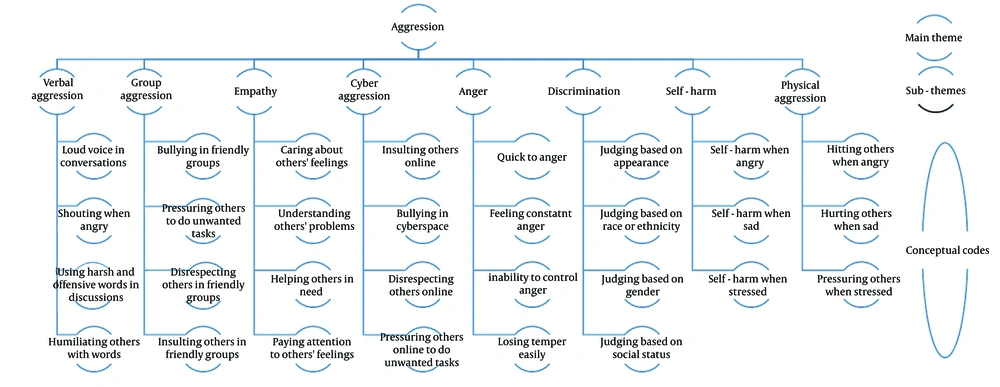
Figure 2.
Conceptual codes and sub-themes in aggression assessment
4.2. Face Validity
The face validity of the TAAS was assessed both qualitatively and quantitatively. In the qualitative evaluation, direct feedback from adolescents indicated that the items were clear, conceptually relevant, and appropriately challenging. As a result of this feedback, several items were modified to simplify language and clarify ambiguous terms. In the quantitative evaluation, all items achieved an Impact Index greater than 1.5, which justified retaining every item in the final version of the scale (Table 2) (18).
Table 2.General Fit Indices of the Aggression Questionnaire Among Adolescents
| Variables | CMIN/DF | GFI | AGFI | NFI | CFI | IFI | PNFI | RMSEA |
|---|---|---|---|---|---|---|---|---|
| Results | 1.64 | 0.87 | 0.84 | 0.93 | 0.97 | 0.97 | 0.80 | 0.047 |
| Acceptable fit | 5 | 0.80 | 0.80 | 0.80 | 0.80 | 0.80 | 0.50 | 0.10 |
4.3. Content Validity
Content validity of the TAAS was confirmed using expert evaluations. The CVR values ranged from 0.81 to 0.89, exceeding Lawshe’s threshold of 0.62 for a panel of 10 experts. Similarly, the CVI values ranged between 0.86 and 0.92, surpassing Waltz and Bausell’s benchmark of 0.70 (34).
4.4. Concurrent Validity
To evaluate concurrent validity, the TAAS was administered alongside the BPAQ. The analysis revealed a significant and positive correlation between the two instruments (R = 0.82, P = 0.001), confirming that the TAAS accurately measures the same aggression construct as the well-established BPAQ (43).
4.5. Exploratory Factor Analysis
To determine whether the correlation matrix between the questions of the scale was sufficient for factor analysis, the Kaiser-Meyer-Olkin (KMO) measure of sampling adequacy and Bartlett's test of sphericity were used. The results showed that the KMO value for the present study was 0.92, which indicates the adequacy of the sample size; therefore, the sample group size was sufficient for this analysis (44). Bartlett's test of sphericity yielded a value of 6647.19 x2 = (df = 435 and P < 0.001). Additionally, the communalities of the questions were between 0.59 and 0.78, so no scale was removed from the questionnaire (45).
The extracted eigenvalues for the eight factors were 10.299, 6.541, 5.590, 4.796, 4.492, 4.221, 3.703, and 3.359, respectively, which further supports the factor structure. The scale was saturated by eight factors that explained 67.03% of the variance based on principal component analysis with varimax rotation. The percentage of variance explained by each factor was as follows: First factor, 9.420%; second factor, 8.915%; third factor, 8.577%; fourth factor, 8.489%; fifth factor, 8.485%; sixth factor, 8.353%; seventh factor, 7.510%; and eighth factor, 7.282%. The factor loadings, as presented in the rotated component matrix, ranged from 0.113 to 0.802 across the items, demonstrating robust associations between the items and their corresponding factors.
Table 3 displays the extracted dimensions of the Aggression Questionnaire for adolescents, along with the related questions. These dimensions include verbal aggression (questions 1 to 4 with a factor loading greater than 0.75), group aggression (questions 24 to 27 with a factor loading greater than 0.71), empathy (questions 16 to 19 with a factor loading greater than 0.69), cyber aggression (questions 20 to 23 with a factor loading greater than 0.68), anger (questions 8 to 11 with a factor loading greater than 0.71), discrimination (questions 12 to 15 with a factor loading greater than 0.68), self-harm (questions 28 to 30 with a factor loading greater than 0.77), and physical aggression (questions 5 to 7 with a factor loading greater than 0.77).
Table 3.Questions Related to Each Extracted Dimension of the Aggression Questionnaire Among Adolescents
| Items | Dimensions | Communalities | Face Validity | |||||||
|---|---|---|---|---|---|---|---|---|---|---|
| 1 | 2 | 3 | 4 | 5 | 6 | 7 | 8 | |||
| I1 | 0.76 | 0.10 | 0.12 | 0.16 | 0.14 | 0.11 | 0.07 | 0.11 | 0.68 | 3.87 |
| I2 | 0.78 | 0.07 | 0.12 | 0.16 | 0.13 | 0.11 | 0.15 | 0.13 | 0.72 | 2.63 |
| I3 | 0.75 | 0.08 | 0.10 | 0.15 | 0.12 | 0.11 | 0.13 | 0.14 | 0.66 | 2.12 |
| I4 | 0.76 | 0.06 | 0.12 | 0.15 | 0.12 | 0.10 | 0.14 | 0.11 | 0.68 | 3.19 |
| I5 | 0.17 | 0.14 | 0.16 | 0.14 | 0.13 | 0.13 | 0.14 | 0.77 | 0.74 | 2.67 |
| I6 | 0.17 | 0.14 | 0.16 | 0.15 | 0.13 | 0.13 | 0.11 | 0.77 | 0.73 | 2.84 |
| I7 | 0.15 | 0.13 | 0.15 | 0.13 | 0.12 | 0.13 | 0.12 | 0.78 | 0.73 | 2.34 |
| I8 | 0.09 | 0.08 | 0.13 | 0.13 | 0.73 | 0.16 | 0.10 | 0.12 | 0.63 | 2.63 |
| I9 | 0.12 | 0.10 | 0.13 | 0.13 | 0.71 | 0.16 | 0.08 | 0.08 | 0.60 | 2.54 |
| I10 | 0.15 | 0.12 | 0.17 | 0.17 | 0.71 | 0.20 | 0.15 | 0.04 | 0.66 | 3.83 |
| I11 | 0.18 | 0.11 | 0.14 | 0.14 | 0.71 | 0.18 | 0.12 | 0.18 | 0.66 | 2.67 |
| I12 | 0.09 | 0.13 | 0.11 | 0.14 | 0.16 | 0.72 | 0.11 | 0.10 | 0.62 | 2.57 |
| I13 | 0.17 | 0.17 | 0.15 | 0.16 | 0.20 | 0.71 | 0.05 | 0.08 | 0.66 | 2.12 |
| I14 | 0.08 | 0.12 | 0.12 | 0.15 | 0.16 | 0.72 | 0.14 | 0.16 | 0.65 | 2.54 |
| I15 | 0.11 | 0.14 | 0.14 | 0.17 | 0.18 | 0.68 | 0.13 | 0.07 | 0.60 | 2.34 |
| I16 | 0.11 | 0.18 | 0.73 | 0.14 | 0.14 | 0.13 | 0.13 | 0.06 | 0.66 | 2.34 |
| I17 | 0.11 | 0.17 | 0.69 | 0.11 | 0.12 | 0.11 | 0.14 | 0.18 | 0.61 | 3.04 |
| I18 | 0.11 | 0.19 | 0.72 | 0.12 | 0.16 | 0.14 | 0.08 | 0.13 | 0.65 | 1.44 |
| I19 | 0.16 | 0.21 | 0.72 | 0.12 | 0.15 | 0.14 | 0.10 | 0.15 | 0.68 | 3.15 |
| I20 | 0.16 | 0.14 | 0.15 | 0.74 | 0.15 | 0.16 | 0.06 | 0.03 | 0.67 | 3.20 |
| I21 | 0.19 | 0.12 | 0.11 | 0.71 | 0.14 | 0.16 | 0.09 | 0.17 | 0.64 | 1.85 |
| I22 | 0.16 | 0.13 | 0.09 | 0.68 | 0.13 | 0.15 | 0.04 | 0.16 | 0.58 | 3.40 |
| I23 | 0.13 | 0.13 | 0.13 | 0.73 | 0.15 | 0.16 | 0.15 | 0.10 | 0.67 | 2.60 |
| I24 | 0.07 | 0.72 | 0.18 | 0.13 | 0.10 | 0.14 | 0.18 | 0.14 | 0.65 | 2.28 |
| I25 | 0.09 | 0.71 | 0.16 | 0.12 | 0.08 | 0.13 | 0.15 | 0.11 | 0.61 | 2.47 |
| I26 | 0.06 | 0.73 | 0.18 | 0.13 | 0.11 | 0.13 | 0.13 | 0.11 | 0.64 | 2.87 |
| I27 | 0.10 | 0.77 | 0.19 | 0.14 | 0.11 | 0.15 | 0.10 | 0.07 | 0.71 | 3.08 |
| I28 | 0.17 | 0.18 | 0.15 | 0.10 | 0.15 | 0.14 | 0.79 | 0.13 | 0.78 | 3.11 |
| I29 | 0.16 | 0.20 | 0.14 | 0.10 | 0.15 | 0.14 | 0.78 | 0.13 | 0.76 | 3.15 |
| I30 | 0.16 | 0.18 | 0.14 | 0.10 | 0.14 | 0.13 | 0.80 | 0.11 | 0.78 | 2.12 |
4.6. Confirmatory Factor Analysis
The general fit indices of the TAAS are presented in Table 2. According to the results of the ratio of chi-square to degrees of freedom, Goodness-of-Fit Index, Adjusted Goodness-of-Fit Index, Normed Fit Index, Comparative Fit Index, Parsimonious Normed Fit Index, root mean square error of approximation, and acceptable fit indices (46), the data support the eight-factor model (Table 2 and Figure 3).
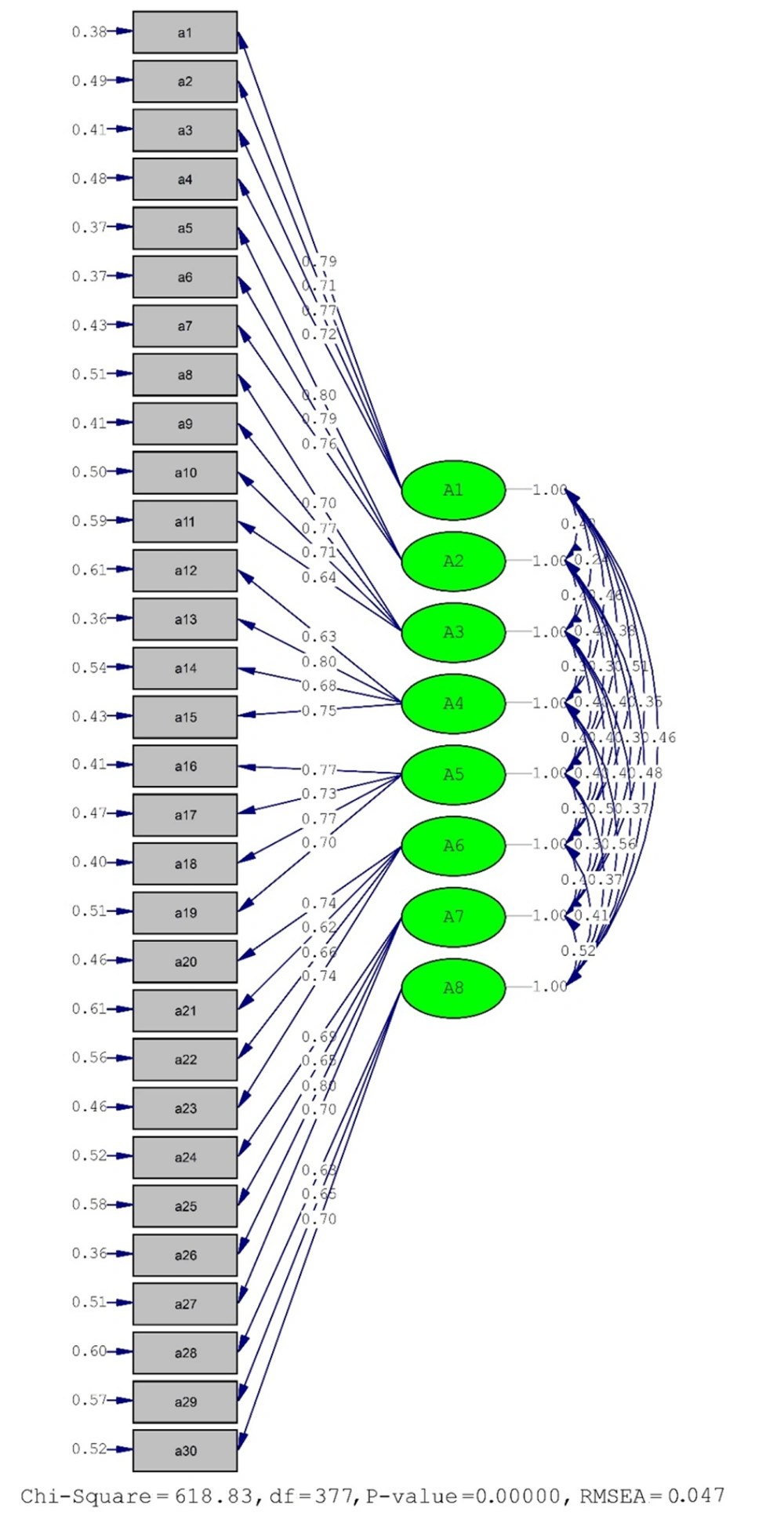
Figure 3.
Standardized coefficients mode
4.7. Scale Reliability
The TAAS exhibited excellent internal reliability, as evidenced by a Cronbach’s alpha of 0.95 for the overall scale (47). The subscale reliabilities ranged from 0.75 to 0.83, indicating good to very good consistency within each dimension. Additionally, the split-half reliability was high, with Cronbach’s alpha values of 0.92 for the first half and 0.91 for the second half of the scale, and an inter-half correlation coefficient of 0.85 (48).
5. Discussion
This study addresses the dynamic nature of aggression, a social phenomenon influenced by cultural and technological evolution. This research underscores the necessity for assessment tools that adapt to these changes, particularly for adolescents who are profoundly impacted. Based on the results of face validity and direct feedback from adolescents, the questionnaire items were confirmed in terms of clarity, conceptual relevance, and appropriate difficulty level. A high item Impact Index above 1.5 indicates that participants considered these items suitably relevant and applicable.
While instruments such as the Orpinas and Francooski Aggression Scale have yielded desirable results regarding face validity, and the Exposure to Violence Scale (EVS) primarily emphasizes behavioral dimensions (49, 50), the TAAS, by incorporating contemporary items such as cyber aggression, provides a more up-to-date portrayal of adolescent experiences. This approach not only covers behavioral dimensions but also enhances the emotional and cognitive understanding related to aggression, thereby increasing the tool’s acceptability and broader applicability within modern cultural and technological contexts.
The CVR (ranging from 0.81 to 0.89) and CVI (ranging from 0.86 to 0.92) indices indicate that, from the experts’ perspectives, the questionnaire items exceed acceptable thresholds in terms of necessity, clarity, and simplicity, and adequately cover the construct of aggression. Whereas instruments such as the Orpinas and Francooski Aggression Scale, as well as the Reactive-Proactive Aggression Questionnaire (RPQ), are limited to focusing on behavioral dimensions (49, 51), the TAAS — with the inclusion of items reflecting contemporary realities such as cyber aggression — demonstrates a better cultural fit and, by expanding the scope of assessment to include emotional and cognitive dimensions, offers a more comprehensive evaluation of the phenomenon of aggression.
Statistical analyses reveal a significant and positive correlation (R = 0.82, P = 0.001) between the TAAS and the BPAQ, which robustly confirms the instrument’s concurrent validity and indicates that the TAAS measures the construct of aggression similarly to the standard instrument. While both the BPAQ and the RPQ report similar correlation coefficients (16, 51), the TAAS, by incorporating complementary emotional and cognitive dimensions, not only confirms the core construct but also captures novel aspects of modern aggression — including cyber aggression — that, compared to the Buss-Durkee Hostility Inventory (BDHI) which focuses more on indirect hostility and suspicion (52), provides a more comprehensive perspective.
Using EFA, eight distinct factors were identified — verbal aggression, group aggression, empathy, cyber aggression, anger, discrimination, self-aggression, and physical aggression — that collectively explain 67.03% of the variance in aggression. Confirmatory factor analysis further validated this eight-factor structure through various fit indices. While previous instruments such as the Orpinas and Francooski Aggression Scale report multidimensional structures and the RPQ differentiates among various behavioral dimensions (49, 51), the TAAS, by adding novel dimensions such as cyber aggression and self-aggression, offers a more comprehensive and current depiction of adolescent aggression, demonstrating that it is capable of reflecting both traditional and modern aspects of aggression within an integrated framework.
Statistical analyses also indicate that the TAAS exhibits very high reliability; Cronbach’s alpha for the entire scale is 0.95, and for the subscales, it ranges between 0.75 and 0.83. Moreover, split-half reliability coefficients of 0.92 and 0.91 for the two halves reflect excellent item homogeneity. Although instruments such as the Orpinas Aggression Scale and the BPAQ have also demonstrated high reliability (16, 49), the TAAS — with a Cronbach’s alpha of 0.95 and exceptionally high split-half reliability — demonstrates superior accuracy and consistency, and by incorporating complementary emotional and cognitive dimensions, it provides a more comprehensive evaluation of aggression.
Although the TAAS has managed to cover a wide range of aggression dimensions — including behavioral, emotional, and cognitive aspects — it does not clearly distinguish between reactive and proactive aggression, nor between self-directed and other-directed aggression. For example, reactive aggression typically refers to immediate responses to environmental stimuli or threats, whereas proactive aggression arises from planned and deliberate intent to harm. Additionally, the differences between self-directed aggression (aimed at alleviating individual distress, such as reducing stress or guilt) and other-directed aggression (intended to harm others or gain social advantage) are not separately delineated in the TAAS. For instance, the RPQ precisely evaluates the distinction between reactive aggression (with items like “immediate response to provocation”) and proactive aggression (for example, “planning to cause harm”) (50, 51); similarly, while the BDHI focuses on indirect hostility and suspicion (52), the TAAS, by including items related to cyber aggression, anger, and self-aggression, endeavors to cover the modern dimensions of aggression. However, the lack of a clear separation between personal and environmental triggers suggests that employing multivariate analyses and group-specific segmentation could improve the psychometric accuracy and enhance the utility of the instrument in prevention and clinical intervention programs.
5.1. Conclusions
This study demonstrates that the development of aggression assessment tools in line with cultural and technological transformations is essential, especially for adolescents who face rapid changes. The Adolescent Aggression Questionnaire developed in this research, in addition to exhibiting high face validity and reliability, offers a more comprehensive portrayal of behavioral, emotional, and cognitive patterns by incorporating novel dimensions such as cyber aggression and self-aggression, thereby effectively meeting modern needs in aggression assessment.
Furthermore, marginal findings indicate that adolescents’ emotional and cognitive experiences in the face of environmental and digital threats have evolved compared to the past and require more detailed investigation. Given the insufficient differentiation between reactive and proactive aggression as well as between self-directed and other-directed aggression, it is recommended that further multivariate analyses and group-specific segmentation be conducted to enhance the psychometric precision of the TAAS.
Moreover, expanding research to other cities with diverse cultural and traditional backgrounds and developing specialized preventive and clinical intervention programs could serve as effective strategies to address future challenges and promote wider application of this instrument in psychological research and clinical evaluations.
5.2. Strengths and Potential of the Tehran Adolescent Aggression Scale
The TAAS, with its multidimensional approach to assessing adolescent aggression, demonstrates high strength in terms of face, content, and structural validity, and it has comprehensively covered a wide range of aggression aspects — including verbal aggression, group aggression, anger, discrimination, and physical aggression. Statistical analyses, such as the high CVR and CVI values and the positive correlations with standard questionnaires, attest to the diagnostic capability and consistency of this scale. Moreover, the eight-factor structure extracted through both exploratory and confirmatory factor analyses reflects the TAAS’s ability to precisely distinguish among different dimensions of aggression, positioning it as a novel tool with great potential for application in psychological research and clinical interventions.
In comparison with previous studies, including the Orpinas and Francooski Aggression Scale (2001), which employed 11 items to assess overt aggression among secondary school students, the TAAS — by incorporating novel dimensions such as cyber aggression and self-aggression — offers a more comprehensive and flexible portrayal of adolescent aggression. Furthermore, while other studies based on the theory of planned behavior (TPB) (53) or similar psychometric instruments (such as the Aggression Intention Scale proposed by Jang and Ahn (54), the TPB-based Aggression Questionnaire, and the Aggression Attitude Scale) have reported high reliability and face validity by emphasizing both direct and indirect aggression dimensions, the TAAS, by combining qualitative and quantitative approaches and covering a broader spectrum of behavioral, emotional, and cognitive aspects, not only adheres to scientific standards but also lays the groundwork for improved diagnosis and preventive interventions in educational and clinical settings. These innovations, along with the advantages inherent in instruments such as the EVS, RPQ, BPAQ, and BDHI (16, 49-52), establish the TAAS as a more up-to-date and comprehensive tool for assessing adolescent aggression.
5.3. Limitations and Suggestions
Although the Adolescent Aggression Questionnaire exhibits high face validity and reliability, serving as a valuable tool for assessing aggression based on contemporary adolescent experiences, it also has several significant challenges and limitations. Firstly, the questionnaire does not clearly distinguish between reactive and proactive aggression, nor between self-directed and other-directed aggression, and it does not consider the impact of environmental factors such as family, school, and media on aggression. Therefore, future research is recommended to employ advanced statistical and analytical methods to identify the various types of aggression and comprehensively examine their causes and consequences.
Additionally, it is suggested that complementary research fields — such as investigating the interplay between environmental and psychological factors, conducting longitudinal assessments of changes in aggression patterns over different educational periods, and using advanced statistical techniques to analyze relationships among aggression dimensions — be explored. Furthermore, since this study was conducted exclusively in Tehran, a metropolitan city, the generalizability of the findings to other regions with different cultural and social contexts (especially smaller cities and areas with diverse ethnic and traditional compositions) is limited; hence, it is recommended that the TAAS be validated in various cities and non-metropolitan settings.
Lastly, rapid changes in the digital space and the emergence of new behavioral patterns necessitate the application of more complex and up-to-date analytical methods in future studies. Conducting longitudinal studies to monitor changes in aggression patterns and evaluate the effectiveness of proposed interventions could significantly contribute to the continuous improvement of prevention and management strategies.


