


1. Background
Self-actualization is one of the most important subjects in psychological theories (1). The concept can be defined as the discovery, expression, and development of one’s true self (2). Maslow defined self-actualization as the goal of an individual to become who he or she desires to be (3, 4). According to Maslow’s hierarchy of needs, a self-actualized person is at the top of the hierarchy of needs, having satisfied their previous needs long ago. Such a person is able to recognize his or her true capabilities and use them effectively (3, 4). Maslow defines human needs as a hierarchy in which physiological needs (such as thirst and hunger) take precedence over safety, which in turn take precedence over social needs (love, belonging, and confidence in others). When all of these physiological and social needs are met, a person can reach self-actualization. These people are also self-motivated, independent, and free from social influences (5, 6).
Nonetheless, various academics have challenged Maslow’s theory, especially since it fails to specify the type of society that best supports self-actualization (7). For this reason, many researchers have attempted to define self-actualization as culture-dependent (8). This is because people from collectivist cultures typically describe themselves as dependent on society, whereas people from individualist cultures define themselves individually (9, 10). Researchers believe that the cultural and social environment in which a person grows up has a significant influence on a person’s desire for self-actualization.
In this context, various tools have been created to assess self-actualization. One of the most important was the 370-item Shostrom Scale (11). However, these tools had notable shortcomings, such as their excessive length and issues with validation (12, 13). Because the long form is not applicable to many situations and is not intended to assess dimensions of self-actualization, Jones and Crandall developed a shorter measure to examine self-actualization (14). This scale, commonly referred to as the Short Index of Self-Actualization (SISA) or the Self-Actualization Scale (SAS) (14), is now a popular brief tool for assessing Maslow’s idea of self-actualization, which is “viewed as the ultimate level of well-being for individuals” (15). The index, made up of 15 items, features a 4-point Likert-type scale with these options: 1 (Disagree), 2 (somewhat disagree), 3 (somewhat agree), and 4 (agree). The items were taken from well-established scales (POI, and POD). Principal component analysis revealed five factors arising from the 15-item questionnaire: (A) Autonomy or self-direction, (B) self-acceptance and self-esteem, (C) acceptance of emotions and freedom of emotional expression, (D) trust and responsibility in interpersonal relations, and (E) ability to cope with undesirable aspects of life. The initial four factors can be linked to key characteristics of a psychologically healthy or self-actualizing individual, while the fifth factor is less straightforward but seems to pertain to the capacity to confront unfavorable aspects of life instead of evading them (14). As has been shown many times, this short measure is particularly useful when there is not enough time to complete a longer scale or when the self-actualization sub-facets are not relevant. Although there is general evidence supporting the use of SISA, some concerns have been raised regarding the factor structure of the instrument (16-18).
However, this concept has not received significant attention in Iran. A key reason for this is likely the absence of a well-structured questionnaire with adequate psychometric properties that has been developed or verified in Iran. The SISA by Jones and Crandall is a tool whose psychological validity has been evaluated in various countries (8, 19), yet this questionnaire has not garnered significant attention in Iran. On the other hand, according to some researchers, the modern world has promoted people’s self-actualization, and Iran is a country that is undergoing a transformation from the traditional world to the modern world (7, 20). Consequently, the study in this area in Iran regarding a suitable instrument is especially significant. As a result, this study was carried out to examine the psychometric characteristics of the SISA among the Iranian population.
2. Objectives
Research must be carried out to establish a foundation for exploring and utilizing tools that affect the psychological well-being of both individuals and society. Therefore, the present study aims to examine the psychometric characteristics of the SISA within the Iranian population.
3. Methods
3.1. Procedure
This descriptive study was conducted to investigate the psychometric properties and factor structure of the SISA within a statistical population in Tehran, Iran, during 2022 - 2023. Participants were invited through survey links posted on various groups, channels, and pages on Telegram, Instagram, and WhatsApp, accompanied by the questionnaire and test instructions. Convenience sampling was employed to select 479 participants to enhance the reliability of the study and minimize the impact of sample loss. Fourteen participants were excluded due to incomplete responses, leaving 466 participants for analysis. The statistical population comprised the general population and did not belong to any clinical or specific group. The study received approval from the Medical Ethics Committee of Shahid Beheshti University of Medical Sciences (IR.SBMU.MSP.REC.1401.222).
To prepare the questionnaire, it was initially translated from English to Persian by two bilingual health professionals. Six professional psychologists then reviewed the instrument for cultural appropriateness, item fluency, meaning, and content validity. Subsequently, the questionnaire was distributed to 20 participants to identify and edit unclear items. In the fourth step, a bilingual translator unfamiliar with the original English version translated it back into English to ensure consistency with the Persian version. Finally, six psychology experts compared the translated version with the original. The Persian version of the survey was used with minimal editing.
Various guidelines exist for determining sample size in psychometric studies, with a sample size of 300 generally considered adequate for factor analysis. Ethical considerations included ensuring confidentiality of information and the mental and psychological suitability of participants. Inclusion criteria were being 18 years or older, having minimum literacy, willingness to participate, and dedicating the anticipated time to complete the questionnaire. The target population encompassed the general population, including both self-actualized and non-self-actualized individuals. Exclusion criteria included invalid and incomplete surveys. Following data collection, 13 surveys were excluded due to incomplete or missing data, leaving 466 surveys for evaluation and analysis.
3.2. Instruments
3.2.1. Demographic Characteristics
To collect information about the demographic characteristics of the participants, a form was created to gather data on age, gender, educational background, and marital status.
3.2.2. Short Index of Self-actualization
The SISA was developed by Jones and Crandall in 1986 to assess self-actualization. This scale consists of 15 items regarding beliefs, attitudes, feelings, and affects. Self-actualization is rated highest when participants agree with items 1, 3, 4, 7, 10, 12, and 15, and disagree with items 2, 5, 6, 8, 9, 11, 13, and 14. Items are rated on a 4-point Likert scale (1 = agree, 4 = disagree), with a maximum score of 60. Scores above 50 indicate high levels of self-actualization. Jones and Crandall reported an internal consistency of α = 0.65, a test-retest reliability of 0.69, and good validity for this questionnaire (14).
3.2.3. Tolerance for Ambiguity Scale
Developed by Budner in 1962, this scale measures tolerance for ambiguity. It can be analyzed based on two general response categories (phenomenological denial, phenomenological submission, operational denial, operational submission) and situation types (being new and novel, being permanent and unresolvable, being complex). A 5-point Likert scale is used (1 = fully agree, 5 = completely disagree). Scores range from 16 (high ambiguity tolerance) to 112 (high ambiguity intolerance) (21). The Budner’s scale is considered reliable for assessing ambiguity tolerance in medical students (22). It was first translated by Shokrkon and Boromandnasab in 2009 (23). A study by Ahmadi and Sayahi in 2017 examined its psychometric characteristics, reporting an inter-item correlation of 67%. Reliability was assessed through Cronbach’s alpha and the split-half approach, yielding values of 70% and 62%, respectively. The calculated convergence was 0.37 (24). In this study, Cronbach’s alpha was 0.71.
3.2.4. Rosenberg Self-esteem Scale
Developed by Rosenberg in 1965, this scale consists of 10 items assessing positive and negative self-feelings. Its psychometric characteristics are well-documented, and it is popular among researchers (25). The scale offers four response options (from highly agree to strongly disagree), though in its Persian form, options are "agree" and "disagree." According to Greenberger et al., the scale had an internal consistency of 0.84 and test-retest coefficients of 0.84, 0.67, and 0.62 at intervals of two weeks, five months, and a year, respectively (26). Makhubela and Mashegoane and Beshlideh et al. confirmed its validity by examining its factor structure. Reliability was calculated by Cronbach’s alpha at 0.78, with a convergent validity of 0.61 (27, 28). In this study, Cronbach’s alpha was 0.74.
3.2.5. Rational Behavior Inventory
Created by Whiteman and Shorkey in 1977, this inventory evaluates logical reasoning skills through a 37-item, 5-point Likert scale. The overall score, comprising 11 subscales, reflects the general degree of rationality, with higher scores indicating more rational perspectives. The subscales assess various dimensions of rationality: Catastrophizing, guilt, perfectionism, desire for approval, care and assistance, blame and punishment, inertia and avoidance, independence, self-criticism, expected distress, and sense of control. The subscales are derived from the Gottman scale framework (29). Initial reliability of the subscales was examined through repeatability and scaling coefficients, with values of 0.90 - 0.96 and 0.61 - 0.74, respectively. Total semi-test reliability was examined with the Spearman-Brown formula, yielding 0.73 (30). Rashidi and Alavi confirmed the validity of the questionnaire. Reliability was evaluated with Cronbach’s alpha, yielding 0.75, and its convergent validity was 0.43 (31). In this study, Cronbach’s alpha was 0.74.
3.3. Statistical Analysis
Demographic characteristics were analyzed using descriptive statistics. Internal consistency of the scale was assessed using Cronbach’s alpha and McDonald’s omega. An exploratory factor analysis (EFA) approach with principal axis factoring (PAF) and varimax rotation was employed to identify and determine the factors underlying the subtest performance. Bartlett’s test of sphericity and the Kaiser-Meyer-Olkin (KMO) measure were used to determine the adequacy of the sample size. A scree plot and Kaiser’s criterion were utilized to determine the number of factors. Content validity was assessed using the content validity ratio (CVR) and Content Validity Index (CVI).
4. Results
4.1. Demographic Characteristics
Of the 466 participants, 78.3% (n = 365) were female and 21.7% (n = 101) were male. Participants’ ages ranged from 20 to 30 years (35.4%). Among them, 45.3% were married, 54.7% were unmarried, and the majority held a bachelor’s degree (44.2%). Demographic characteristics are shown in Table 1. Participation in this research was fully voluntary to meet ethical considerations. Although the study included a larger than estimated sample, the convenience sampling method was used, and sample balance was not optimally achieved.
Table 1.Demographic Characteristics
| Variables | No. (%) |
|---|---|
| Gender | |
| Female | 365 (78.3) |
| Male | 101 (21.7) |
| Age | |
| 20 - 30 | 165 (35.40) |
| 30 - 40 | 143 (30.60) |
| 40 - 50 | 96 (20.60) |
| 50 - 60 | 62 (13.40) |
| Education | |
| Diploma | 43 (9.20) |
| Bachelor | 206 (40.20) |
| MSc. | 121 (25.90) |
| PhD. | 96 (20.70) |
| Marital status | |
| Married | 255 (54.70) |
| Single | 211 (45.30) |
| Occupation | |
| Unemployed | 98 (21.10) |
| Employed | 368 (78.90) |
4.2. Exploratory Factor Analysis
The result of the KMO test was 0.724. An acceptable KMO value is reported to be 0.70 or higher, confirming that the data was suitable for EFA. To determine the number of extractable factors, an EFA was performed on the 15 items, and the results showed five factors based on the Kaiser criterion (values greater than 1). Additionally, the downward slope of the scree plot (Figure 1) indicated five factors with factor loadings greater than 0.40. Each item had a factor loading of at least 0.5 on one of the factors. Therefore, considering five factors for the 15 items resulted in a suitable simple structure.
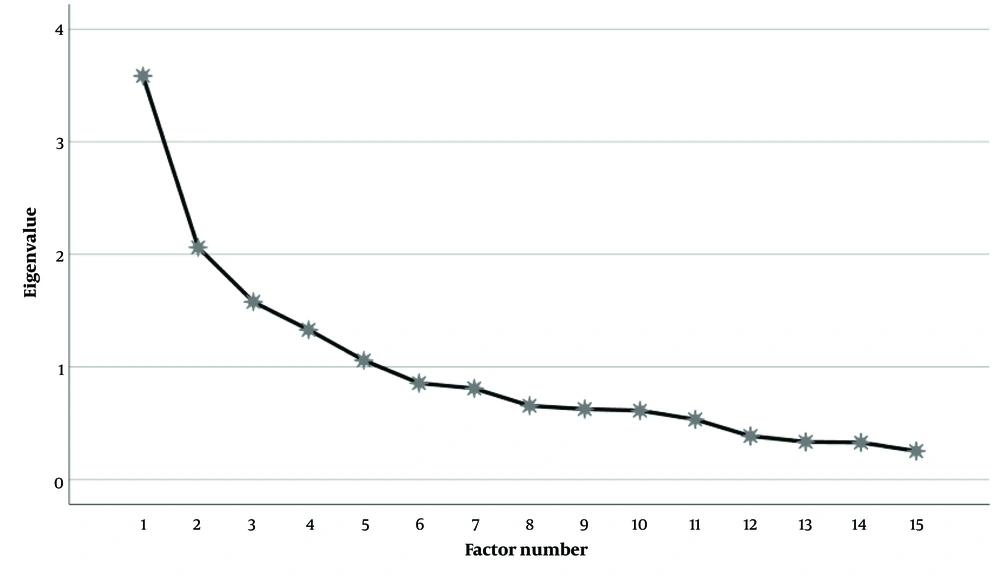
Figure 1.
Scree plot
One method used for calculating the number of factors of the scale is the scree plot. Cattell states that the number of main factors that account for the most variance is located on the steep part of the scree plot, while the minor factors that account for less variance are on the shallow part. The criteria for extracting factors are the breakpoints of the graph. Therefore, the turning point is at the sixth factor, and after this point, the slopes of the factors become almost equal (32). The graph below shows the six factors in the steep part (Figure 1). According to the Kaiser criterion, the eigenvalues (lambda values) of the five factors are all greater than 1. If the eigenvalue is greater than 1, it can be considered a major factor. Therefore, there are five major factors in this questionnaire, and the appropriate composition of the questionnaire can be obtained by considering these five factors.
As mentioned above, there are two methods for extracting major factors from the correlation matrix: Principal axis factoring and varimax rotation. The results in Table 2 show that after rotation, the five factors explain 47.234% of the total variance. The first factor explains 18.547% of the total variance, the second factor explains 9.814%, the third factor explains 8.606%, the fourth factor explains 5.399%, and the fifth factor explains 4.868%. Based on these results, it can be concluded that the structure of the questionnaire is appropriate and the identified factors are suitable and acceptable for the Iranian population, suggesting that this scale is valid and reliable.
The varimax rotation method was used to obtain a simple structure, and the optimal factor composition according to the factor analysis results is shown in Table 3. The results of factor analysis showed that two factors (Factors 1 and 2) had the highest loadings, indicating that these factors explained most of the variance in the data. This demonstrates that the questions were well-constructed and effectively measured the intended construct. To investigate the simple structure of the self-actualization questionnaire targeting the Iranian population, factors were extracted using the varimax rotation method. The analysis revealed that each item loads strongly on one factor and somewhat on the others, and the factors were classified based on the related questions. Each factor is described as follows:
- Factor 1: Items 2, 5, 9, 10, 11, and 13 (autonomy and self-directedness)
- Factor 2: Items 6, 8, and 14 (self-acceptance and self-confidence)
- Factor 3: Items 7 and 12 (avoidance of unpleasant experiences)
- Factor 4: Items 3 and 15 (trust and responsibility in interpersonal relationships)
- Factor 5: Items 1 and 4 (greater acceptance of emotions)
Table 2.Total Variance Explained
| Factors | Initial Eigenvalues | Extraction Sums of Squared Loadings | Rotation Sums of Squared Loadings | ||||||
|---|---|---|---|---|---|---|---|---|---|
| Total | % of Variance | Cumulative (%) | Total | % of Variance | Cumulative (%) | Total | % of Variance | Cumulative (%) | |
| 1 | 3.585 | 23.901 | 23.901 | 3.124 | 20.826 | 20.826 | 2.782 | 18.547 | 18.547 |
| 2 | 2.062 | 13.746 | 37.647 | 1.642 | 10.944 | 31.769 | 1.472 | 9.814 | 28.361 |
| 3 | 1.578 | 10.519 | 48.166 | 1.056 | 7.043 | 38.812 | 1.291 | 8.606 | 36.967 |
| 4 | 1.330 | 8.869 | 57.035 | 0.784 | 5.224 | 44.036 | 0.810 | 5.399 | 42.366 |
| 5 | 1.058 | 7.055 | 64.090 | 0.480 | 3.197 | 47.234 | 0.730 | 4.868 | - |
| 6 | 0.855 | 5.701 | 69.791 | - | - | - | - | - | - |
Table 3.Rotated Factor Matrix
| Items | Factors | Mean ± SD | ||||
|---|---|---|---|---|---|---|
| 1 | 2 | 3 | 4 | 5 | ||
| 13 | 0.814 | - | - | - | - | 3.11 ± 0.956 |
| 2 | 0.804 | - | - | - | - | 2.94 ± 0.962 |
| 5 | 0.723 | - | - | - | - | 2.92 ± 0.976 |
| 10 | 0.564 | - | - | - | - | 3.42 ± 0.816 |
| 11 | 0.552 | - | - | - | - | 2.88 ± 1.022 |
| 9 | 0.477 | - | - | - | - | 3.06 ± 0.969 |
| 8 | - | 0.841 | - | - | - | 2.37 ± 1.039 |
| 6 | - | 0.639 | - | - | - | 2.76 ± 1.039 |
| 14 | - | 0.486 | - | - | - | 2.46 ± 1.093 |
| 12 | - | - | 0.787 | - | - | 2.86 ± 0.996 |
| 7 | - | - | 0.773 | - | - | 3.00 ± 0.962 |
| 15 | - | - | - | 0.550 | - | 3.08 ± 0.868 |
| 3 | - | - | - | 0.411 | - | 2.48 ± 0.912 |
| 4 | - | - | - | - | 0.557 | 2.55 ± 0.974 |
| 1 | - | - | - | - | 0.545 | 2.99 ± 0.814 |
4.3. Confirmatory Factor Analysis
After EFA, a confirmatory factor analysis (CFA) was conducted using AMOS24 software to validate the proposed model. The second sample was used to perform a CFA. At least 24 fit indices are proposed to measure the fit of the data, with the most important ones presented below. In the initially developed model, the degrees of freedom/chi-square Fit Index was less than 5, which is a satisfactory value. The comparative fit indices indicated a good but poor fit, while the root mean square error of approximation (RMSEA) indicated a poor fit. As shown in Figure 2, the model was modified by adding several covariate paths. In this modified model, the CFI and RMSEA fit values also showed a good fit. Additionally, the factor loadings of all items exceeded 0.40, indicating a good fit of the measurement model (Table 4).
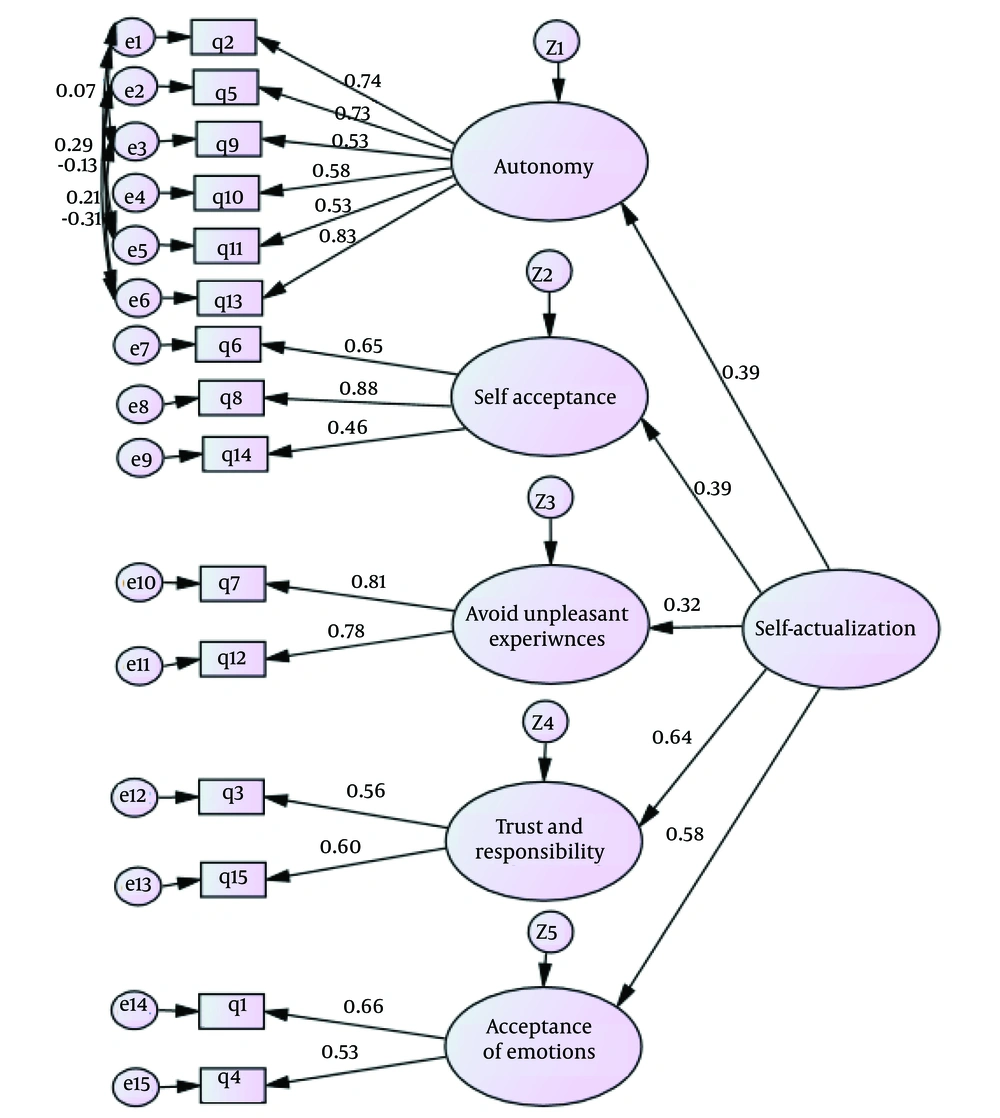
Figure 2.
The modified model
Table 4.Fitness Indices
| Fitness Indicators | NPAR | CMIN | df | CMIN/DF | CFI | RMSEA |
|---|---|---|---|---|---|---|
| Default model | 32 | 328.12 | 88 | 3.73 | 0.881 | 0.077 |
| Modified model | 37 | 230.05 | 83 | 2.77 | 0.919 | 0.062 |
| Independence model | 15 | 1921.27 | 105 | 18.30 | 0.000 | 0.193 |
Abbreviation: RMSEA, root mean square error of approximation
4.4. Content Validity
Six content validity experts reviewed the survey. These individuals were all university faculty members with valid English language proficiency certificates and a history of translating English books into Persian. They provided guidance on proper language, grammar, and usage. A qualitative content analysis was also conducted. The CVI and CVR were employed to evaluate content validity. Six experts used a three-point Likert scale ('unnecessary', 'useful but not necessary', and 'necessary') to verify the necessity of each item. The results showed that the content validity level of all items was higher than the value in the Roche table, indicating good content validity. The content validity of item simplicity, ambiguity, and relevance was assessed using a four-point Likert scale: (1) No ambiguity, (2) slightly ambiguous, (3) very ambiguous, and (4) completely ambiguous. The results showed that the CVI of all items was greater than 0.79, indicating that all items had content validity.
4.5. Convergent and Divergent Validity
To determine convergent validity, correlations between scores on the Self-Actualization Questionnaire and scores from the self-esteem, Ambiguity Tolerance, and Rational Behavior Questionnaires were examined. These instruments have been employed in related research and were chosen to investigate convergent and divergent validity. The Pearson correlation coefficient between the self-actualization and the self-esteem was 0.498, with ambiguity tolerance was -0.219, and with rational behavior was 0.423 (P < 0.05). This indicates that the Self-Actualization Questionnaire has satisfactory convergent validity with the Self-Esteem and Rational Behavior Questionnaires, and satisfactory divergent validity with Ambiguity Tolerance Questionnaire.
4.6. Reliability of the Questionnaire
The Cronbach’s alpha method was used to evaluate the reliability coefficient of the questionnaire. Based on this, the reliability coefficient for each item of each factor was derived, followed by the Cronbach’s alpha for all items. The reliability of the five factors — autonomy, self-acceptance, avoidance of unpleasant experiences, trust, and acceptance of emotions — and the entire questionnaire were 0.682, 0.773, 0.63, 0.495, 0.501, and 0.73, respectively. The omega coefficient was also used to more accurately measure internal consistency, yielding scores of 0.75, 0.84, 0.71, 0.58, 0.60, and 0.81 for autonomy, self-acceptance, avoidance of unpleasant experiences, trust, acceptance of emotions, and the full questionnaire, respectively. This suggests that the questionnaire has strong internal consistency.
5. Discussion
The SISA Scale is one of the most widely used instruments for measuring self-actualization. Given the need to investigate the psychometric properties of the instrument across cultures and samples (33), this study aimed to verify the validity of the SISA in assessing self-actualization tendencies in a non-clinical Iranian population. The questionnaire was meticulously translated by knowledgeable and skilled individuals who adhered to translation guidelines, ensuring cultural compatibility. A notable strength of this study is its adherence to the four basic steps recommended in the translation process, which guarantees cultural adaptation of the scale (34).
After ensuring the accuracy of translation and pre-application, validity (including construct validity through exploratory and CFA, and convergent and discriminant validity) and reliability were assessed using several methods. An EFA was initially performed to investigate the factor structure of the SISA in the Iranian sample, identifying five components with eigenvalues greater than one. The results of the CFA showed that the selected items were appropriate and that the questionnaire maintained its original structure with minimal changes. Therefore, it can be concluded that the cultural and ethnic differences and diverse experiences of the Iranian sample did not cause any differences in the scores of the SISA compared to other samples.
Overall, considering the fit and appropriateness of the five-factor model and the model’s compliance with CFA, the SISA is a suitable tool for measuring self-actualization tendencies and has acceptable validity for research purposes. The CFA further supported the construct validity of the scale, with a RMSEA of 0.062, where a value less than 0.08 indicates a good fit, a value between 0.08 and 0.10 indicates a moderate fit, and a value greater than 0.10 indicates a poor fit. Finally, this self-assessment questionnaire was validated with 15 questions and 5 main components that align with the findings of earlier research (8, 14, 35).
Finally, this self-assessment questionnaire was validated with 15 questions and 5 main components that align with the findings of earlier research (8, 14, 35). Autonomy and self-directedness (items 2, 5, 9, 10, 11, 13) are the needs for self-determination and the perception of having options in starting, continuing, and managing activities. When people believe they are in charge of their own behavior, they become autonomous. This indicates that they are able to make decisions with confidence and operate at their best based on internalized values and personal motivations (36, 37). Self-acceptance and self-esteem (items 6, 8, 14) involve recognizing one’s strengths and weaknesses, enhancing strengths and addressing weaknesses, being comfortable with one’s current situation, lacking shame, and refraining from self-blame for shortcomings or errors (38, 39). Self-actualization entails finding, expressing, and growing into your genuine self, which necessitates self-acceptance. Individuals that struggle with self-acceptance either deny or misrepresent who they really are (2). The factor of acceptance of emotions and freedom to express emotions (items 1, 4) refers to being receptive and open to one’s inner world, thoughts, and physical feelings (40). Self-actualization is a set of interpersonal and emotional capacities and skills that impact our behavior and communication with others. Furthermore, it enhances flexibility, enabling individuals to be more conscious and in touch with the present moment (41). These abilities can serve as a foundation for emotional growth and foster self-actualization (42).
Self-actualized persons have deeper and healthier interpersonal relationships than other people, as evidenced by the factors of trust and commitment in interpersonal interactions (items 3, 15) (3). The ability to build intimacy with others without expectations or obligations is a basic human need that is met in interpersonal relationships. Among the most crucial social behaviors are trust and responsibility. Trust refers to the general tendency of people to take risks in interpersonal relationships, regardless of their ability to evaluate or control others (43). Responsibility refers to people’s desire to trust and be loyal to others (44, 45). Now consider the factor of the ability to cope with rather than avoid undesirable aspects of life (items 12, 7). Avoiding unpleasant experiences will prevent people from engaging in certain behaviors that they fear, and thus limit their lives, preventing them from learning and developing their talents and abilities. Rather, the ability to confront and overcome difficult and unfavorable situations changes the relationship with the inner self. This enhances flexibility and decision-making, helping people act according to their values and cope with new experiences and situations. They are able to recognize and fulfill their important life values and potentials through this process (46).
A successful fit of the 5-factor model of the SISA is also shown by the fit indices of the model and the values derived from them. In addition, the internal consistency of the scale was evaluated using Cronbach’s alpha, and the results showed that there was a strong correlation between the items. This indicates that there was no measurement error in the scale and that respondents had relatively consistent perceptions of the scale. The results of the convergent validity of the entire scale showed a high positive correlation, which confirmed that this self-assessment scale had convergent validity for self-actualization. Furthermore, the results of the discriminant validity of SISA revealed weak but substantial negative correlations between the Ambiguity Tolerance Questionnaire and the components of SISA. This is different from the previous studies (14, 47, 48) that found no significant relationship between these factors. In contrast, other researchers found a relationship between these variables (49). As Maslow pointed out, self-actualized people appear to “not only tolerate ambiguity and unstructured situations, but also enjoy them” (3). Previous studies have shown that tolerance for ambiguity is important for personality change and self-actualization (49). This variable is considered a cognitive control style and represents the ability to cope with situations with ambiguous or unstructured stimuli (50, 51). It is also related to various aspects of cognitive and emotional functioning, cognitive style traits, belief systems, attitudes, interpersonal and social functioning, and problem-solving behavior (52). Individuals with high ambiguity tolerance find unclear circumstances interesting and challenging, and they frequently score higher on openness to experience (53) and are more likely to take risks (54).
In line with earlier studies, the study also discovered a strong positive correlation between the SISA and both rational behavior and self-esteem (14, 51, 55). Goal achievement, interpersonal relationships, and self-focus are all correlated with self-esteem (56). People have the self-confidence necessary for self-actualization when they feel appreciated. A variety of flexible reactions and adaptations are necessary for high self-confidence. Self-actualization can be improved when people’s problem-solving skills are tested (57, 58). Those with rational thoughts and actions hold the belief that no one deserves blame or rejection for errors. They accept themselves and others unconditionally, regardless of their shortcomings or flaws. Individuals who think rationally can analyze their thought patterns, enabling them to handle their emotions more effectively and substitute anxiety-provoking thoughts with more reasonable and practical ones. These people are self-directed and take responsibility for their own emotions rather than blaming others for their problems (38, 59, 60). This perspective allows individuals to improve their functioning and achieve greater self-actualization than others.
5.1. Conclusions
In conclusion, based on the findings of the present study, the Persian version of the SISA exhibits appropriate psychometric properties. This study can be regarded as a pioneering work in this sector because there are few thorough studies evaluating the psychometric characteristics of this questionnaire across different groups in Iran. It lays the groundwork for future research by highlighting the significance of self-actualization in individuals and opening the door for the creation of precise and useful measurement instruments in this area. Hence, applying the findings to different populations must be approached carefully. To enhance the generalization of the findings to various groups, it is recommended that future research investigates this tool across diverse demographics, including student and clinical populations. Another drawback of this study is that the data were gathered through self-report questionnaires. Self-report instruments frequently face two influencing factors: Social desirability and the inaccuracy inherent in self-reports.


