


1. Background
At present, the prevalence of online pornography is increasing on a global scale (1). This trend is driven by its easy accessibility and the nearly infinite variety of sexual content and activities (2). Pornography refers to any sexually explicit media — videos, websites, magazines, books, etc. — created to sexually arouse the viewer (3). The frequency of pornography viewing has risen among young adults compared to other age groups (4). Watching pornography is associated with psychological distress, poor social and occupational performance, disturbances in family relationships, decreased sexual satisfaction and intimacy, a higher likelihood of infidelity and divorce, and negative impacts on marital well-being (5).
Studies have shown that pornography encourages users to engage in similar behaviors during real sexual experiences (6). Men consistently view more pornography (7) and experience greater arousal from it. The likelihood of engaging with pornography is influenced by various factors, including individual differences, especially personality traits (8), such as emotion-seeking tendencies (9), sexual desires (erotophobia) (10), and narcissistic traits (11). Additionally, coping with boredom (11), loneliness (12), and fear of commitment (13), as well as combining personal and social hedonic motives (14), are also related to increased pornography consumption.
The Big Five personality traits — extraversion, agreeableness, conscientiousness, neuroticism, and openness to experience — have been associated with high-risk sexual behaviors and pornography use (PU) (15). The present study's findings demonstrate a moderate positive relationship between extraversion, neuroticism, and openness to experience, on the one hand, and PU, on the other. In contrast, conscientiousness and agreeableness tend to show a moderate negative association. A separate study revealed that individuals with elevated levels of agreeableness exhibited a reduced tendency to engage with internet pornography (16). Furthermore, substantial correlations have been documented between PU and variables such as anxiety, depression, impulsivity, and vulnerability to stress (17). Among the characteristics influenced by personality traits, impulsivity may serve as a mediating factor in the relationship between personality dimensions and the tendency to engage in PU.
Impulsivity is a multidimensional construct conceptualized through models such as the Barratt Impulsiveness Scale (BIS-11), which includes attentional, motor, and non-planning impulsivity. Each of these dimensions reflects distinct cognitive and emotional mechanisms. Extensive empirical evidence has demonstrated an association between impulsivity and various psychiatric disorders, particularly addictive and risky behaviors. The findings of the present study indicate that all three components of impulsivity serve as psychological vulnerability factors in the onset and maintenance of problematic pornography use (PPU). The underlying mechanisms may involve a tendency for novelty seeking, impaired emotional regulation and decision-making, heightened reward sensitivity, and an attentional bias toward sexual cues. Furthermore, the presence of dysfunction within the brain's reward system may serve a mediating neurobiological role in this association (18).
Individuals with high levels of neuroticism often experience intense negative emotions such as anxiety and depression, and may resort to maladaptive coping strategies, including PPU, as a way to regulate their affective states. Impulsivity — characterized by low distress tolerance and heightened urgency — can mediate this relationship by increasing the likelihood of acting on emotional impulses without considering long-term consequences (19). Research has demonstrated that impulsivity is closely associated with the dimensions of the Five-Factor Model of personality, showing a positive correlation with neuroticism and negative correlations with extraversion and conscientiousness (19). This suggests that individuals high in neuroticism and low in extraversion and conscientiousness are more prone to impulsive behavior. Furthermore, recent studies indicate that impulsivity may mediate the relationship between personality traits and PPU. For example, individuals with high impulsivity are more likely to engage in compulsive pornography consumption, especially in the presence of emotional distress or reward-seeking tendencies (20). These findings highlight the critical role of impulsivity in the pathway linking personality traits to problematic sexual behaviors. Although previous studies have highlighted the roles of personality and impulsivity in pornography consumption, limited research has examined the pathways and relationships between these variables. Specifically, studies investigating the mediating role of impulsivity in the relationship between personality traits and PU are scarce. Therefore, this research aims to develop a model illustrating the relationship between personality traits, impulsivity, and pornography viewing. The findings may aid in diagnosis, formulation, and intervention strategies for PPU.
2. Objectives
This study employed a structural equation modeling (SEM) approach to evaluate the correlates of the severity of PPU. We hypothesized that personality traits predict the severity of PPU, and that these relationships are mediated by impulsivity. Therefore, the conceptual model of the current study is presented in Figure 1.

Figure 1.
Conceptual model of the research
3. Methods
3.1. Participants and Procedures
This study utilized a descriptive-correlational design to examine the relationships between personality traits, impulsivity, and PU. The study population included all students at Kashan University of Medical Sciences (KAUMS) during the 2022 - 2023 academic year. A random cluster sampling method was employed, selecting three classes from each faculty (Medicine, Dentistry, Health, Nursing and Midwifery, and Paramedicine). A total of 265 students were selected based on the attendance list. Data collection took place over three months, starting in November 2022. The inclusion criteria for participants were: Being a student, over 18 years of age, Muslim, and providing informed consent to participate. Exclusion criteria included the use of psychiatric medications, the presence of psychiatric disorders (such as depression, bipolar disorder, and obsessive-compulsive disorder), drug addiction, and incomplete or invalid questionnaires. These exclusion criteria were determined based on self-reports from participants. After removing incomplete responses, 248 questionnaires were included in the final analysis.
3.2. Data Analysis
For data analysis, descriptive statistics (mean ± standard deviation) and Pearson correlation were applied using SPSS-19, and SEM was conducted using AMOS-22. The Shapiro-Wilk test was applied to assess the normality of the data. To analyze the mediation model, SEM was conducted using AMOS. Model fit was evaluated using the chi-square/degree of freedom (χ2/df) ratio, along with the Comparative Fit Index (CFI), Adjusted Goodness of Fit Index (AGFI), and root mean square error of approximation (RMSEA). A good model fit was indicated by the following criteria: χ2/df < 3, RMSEA < 0.05, AGFI > 0.8, and CFI > 0.9. Also, the Sobel test was used to examine the role of the mediator, and a Sobel test value > 1.96 was considered significant mediation. In the proposed model, there are seven measured variables, and based on multivariate regression guidelines, 10 to 20 samples per measured variable are recommended (21). Also, Hoyle and Loehlin suggested that 200 samples for the SEM analysis are suitable, while some others suggested 300 samples (22). Therefore, a sample size of at least 265 students was chosen to account for potential dropouts.
3.3. Measures
The following instruments were utilized for data collection.
3.3.1. Problematic Pornography Consumption Scale
The Problematic Pornography Consumption Scale (PPCS) is an 18-item self-report measure developed by Bothe et al. (23) to assess problematic pornography consumption over the past six months. Sample items include statements such as "I feel like I can’t stop watching pornography, even when I want to" and "I use pornography to escape from my problems." Responses are evaluated using a 7-point Likert scale, ranging from 0 (never) to 6 (always). The Persian version has high reliability (Cronbach’s alpha = 0.94) and confirmed construct validity (GFI = 0.97, RMSEA = 0.05) (24).
3.3.2. NEO Five-Factor Personality Inventory (NEO-FFI)
The NEO-FFI, developed by Costa and McCrae (1992), is a shortened version of the full NEO Personality Inventory and consists of 60 items designed to assess the five major personality dimensions: Neuroticism, extraversion, openness to experience, agreeableness, and conscientiousness (25). Sample items include: "I often feel tense and jittery" (neuroticism) and "I keep my belongings neat and clean" (conscientiousness). Each item is rated on a 5-point Likert scale ranging from 0 (strongly agree) to 4 (strongly disagree), with some items reverse scored. The reliability and validity of this instrument have been confirmed in multiple studies. Cronbach’s alpha coefficients for the five factors range from 0.48 to 0.76, and test-retest reliability over a two-week interval has been reported between 0.79 and 0.87, indicating acceptable internal consistency and stability. The Persian version of the questionnaire has also demonstrated satisfactory psychometric properties (26).
3.3.3. Barratt Impulsiveness Scale
The BIS-11, developed by Barratt, is a 30-item self-report questionnaire designed to assess impulsivity (27). Sample items include: "My actions are often impulsive." The rating of items is conducted using a four-point Likert scale, ranging from 1 (never) to 4 (always). The scale measures three dimensions of impulsivity: Cognitive impulsivity, motor impulsivity, and lack of planning. The Persian version of the BIS-11 demonstrates acceptable reliability, with all subscales significantly correlating with the total score (P < 0.05). The reliability coefficients were calculated using two methods: Cronbach's alpha and test-retest, yielding values of 0.81 and 0.77, respectively, providing further evidence of the reliability of the scale. The findings offer substantiation for the construct validity and applicability of the BIS-11 in an Iranian sample (28).
3.4. Ethical Considerations
This study was conducted in full compliance with the Helsinki Declaration. It was approved by the Ethical Committee at KAUMS (ethical ID: IR.KAUMS.REC.1401.215).
4. Results
This study involved 248 students, including 117 (47.2%) males and 131 (52.8%) females. The age range was 18 to 37 years, with a mean age of 21.68 years. Of these, 93.1% were single, and 6.9% were married. Regarding educational status, 42.3% were pursuing doctoral degrees (medicine, dentistry, and PhD), and 57.6% were enrolled in bachelor’s or master’s programs. All students reported daily internet access; 69.8% used it for 2 - 5 hours per day, and 25% used it for more than 5 hours daily. Additionally, 84.7% reported viewing pornographic sites (99% of males and 71.7% of females), with 14.5% visiting such sites daily or several times a week. Pearson’s correlation analysis revealed significant relationships between impulsivity and the personality traits conscientiousness, agreeableness, and neuroticism, as well as with PU. No significant relationships were found with extraversion and openness (Table 1).
Table 1.Pearson Correlation of the Five Personality Traits with Impulsivity and Problematic Pornography Use Variables a
| Variables b | 1 | 2 | 3 | 4 | 5 | 6 | 7 | Values |
|---|---|---|---|---|---|---|---|---|
| Impulsiveness | 1 | - | - | - | - | - | - | 204.0 ± 35.79 |
| Pornogeraphy | 0.330 c | 1 | - | - | - | - | - | 42.02 ± 22.63 |
| Neurotisism | 0.365 c | 0.145 d | 1 | - | - | - | - | 36.28 ± 8.35 |
| Extraversion | -0.104 | -0.005 | -0.502 c | 1 | - | - | - | 39.83 ± 6.78 |
| Openness | 0.040 | -0.057 | -0.049 | 0.140 d | 1 | - | - | 41.19 ± 5.71 |
| Agreeableness | -0.264 c | -0.246 c | -0.213 c | 0.232 c | 0.030 | 1 | - | 39.73 ± 5.10 |
| Conscientiousness | -0.658 c | -0.264 c | -0.445 c | 0.387 c | -0.033 | 0.197 c | 1 | 42.52 ± 6.54 |
a Values are expressed as mean ± SD.
b Pearson correlation
c Correlation is significant at the 0.01 level (2-tailed).
d Correlation is significant at the 0.05 level (2-tailed).
The initial model was developed based on the relationships between conscientiousness, agreeableness, and neuroticism with PU, mediated by impulsivity. The regression coefficients, standard errors, and significance levels for these relationships are presented in Table 2. Despite good model fit indices (CFI > 0.9, AGFI > 0.8, RMSEA < 0.08), there was no direct significant relationship between agreeableness, conscientiousness, and emotional neuroticism with PU. Based on these findings, the direct relationships between agreeableness, conscientiousness, and neuroticism with PU were omitted from the initial model, and a final model was developed emphasizing the mediating role of impulsivity (Figure 2).
Table 2.Regression Coefficients, Standard Error and Significance Level of the Relationship Between Variables
| Variables | Standard Coefficients | SE | Critical Proportion | P-Value |
|---|---|---|---|---|
| Agreeableness-pornography | -1.96 | 1.01 | -1.93 | 0.053 |
| Agreeableness-impulsiveness | -12.57 | 2.96 | -4.24 | < 0.001 |
| Impulsivity-pornography | 0.100 | 0.034 | 2.93 | 0.003 |
| Conscientiousness-pornography | 0.620 | 1.501 | 0.413 | 0.680 |
| Conscientiousness-impulsiveness | -22.482 | 3.155 | -7.125 | < 0.001 |
| Impulsivity-pornography | 0.151 | 0.055 | 2.762 | 0.006 |
| Neuroticism-pornography | 0.209 | 0.735 | 0.284 | 0.776 |
| Neuroticism-impulsivity | 9.786 | 2.350 | 4.164 | < 0.001 |
| Impulsivity-pornography | 0.136 | 0.031 | 4.419 | < 0.001 |
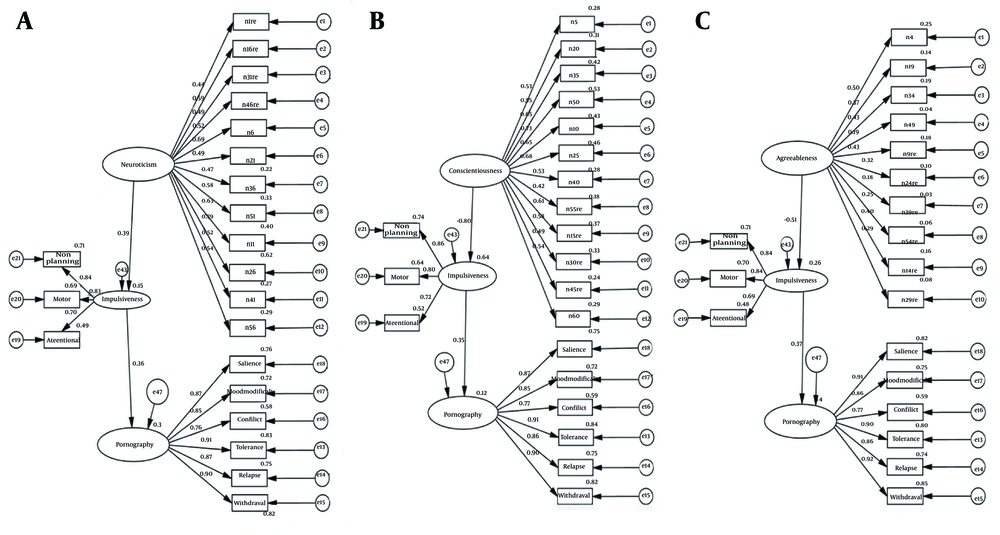
Figure 2.
The structural model of three research personality traits: A, neuroticism; B, conscientiousness; C, agreeableness to problematic pornography use (PPU) with the mediating role of impulsivity.
Results indicated that impulsivity mediates the relationship between these three personality traits and PU (Table 3).
Table 3.The Model Fit Indexes of Personality Traits and Problematic Pornography Use with the Mediating Role of Impulsivity
| Variables | χ2/df | CFI | AGFI | RMSEA |
|---|---|---|---|---|
| C-I-P | 2.54 | 0.91 | 0.80 | 0.07 |
| A-I-P | 2.35 | 0.90 | 0.82 | 0.07 |
| N-I-P | 1.63 | 0.96 | 0.87 | 0.05 |
Abbreviations: CFI, Comparative Fit Index; AGFI, Adjusted Goodness of Fit Index; RMASEA, root mean square error of approximation; C, conscientiousness; A, agreeableness; N, neuroticism; I, impulsiveness; P, pornography.
Neuroticism, conscientiousness, and agreeableness do not exert direct effects on pornography consumption (β = 0.000), but influence it indirectly through impulsivity (β = 0.389, -22.423, and -11.947, respectively). Regarding model explanatory power, the squared multiple correlations (R2) indicate the proportion of variance explained in each model. For agreeableness, the model accounted for 21.8% of the variance in impulsivity and 13.7% of pornography consumption. In the conscientiousness model, 62.2% of impulsivity variance and 12.4% of pornography consumption variance were explained. The neuroticism model explained 15.1% of impulsivity variance and 12.9% of pornography consumption variance. The mediating role of impulsivity was confirmed by Sobel tests for agreeableness (Sobel = -2.622), conscientiousness (Sobel = -2.766), and neuroticism (Sobel = 3.002). These results indicate that impulsivity fully mediates the relationship between these three personality traits and pornography consumption.
5. Discussion
The objective of this study was to examine the association between personality traits and PU among KAUMS students, with impulsivity as a mediator. This research showed that people with certain personality traits, such as neuroticism, conscientiousness, and agreeableness, and high impulsivity are more prone to engage in pornographic behavior with its diverse consequences. Understanding these relationships and consequences will enable society to plan, control impulses, and increase resilience. The results showed a significant gender difference, with males showing higher PU than females. This aligns with previous research by Jain and Pandey (29), Hasanzadeh et al. (30), and Bailey et al. (31), which point to men’s greater interest in visual stimuli and societal norms that tolerate male sexual behavior, thereby facilitating greater porn use. Conversely, social and cultural restrictions perceived as more stringent for women, alongside feelings of shame, contribute to their lower consumption, even within Western cultures (14, 32, 33).
The initial analyses revealed significant positive correlations between PU and three personality traits: Neuroticism, extraversion, and openness, and negative correlations with agreeableness and conscientiousness. However, when impulsivity was included in the model, these relationships lost statistical significance, suggesting that impulsivity plays a mediating role. This is consistent with Lobell et al. (22), who found a positive association only between openness and pornography, and Jain (34), who reported that four personality dimensions — openness to experience, conscientiousness, extraversion, and neuroticism — along with emotional adjustment, were positively related to PU. The inconsistent findings across studies underscore the complexity of personality influences on such behaviors and suggest that multiple interacting factors shape these relationships.
The study also highlights that neuroticism, which is characterized by emotional instability and a tendency toward negative emotions, may lead individuals to use pornography as a mood regulator, particularly to counteract feelings of loneliness, anxiety, and mood swings (35, 36). It has been demonstrated that low conscientiousness is associated with negligence, carelessness, and irresponsibility (37). It seems that these traits have the potential to increase impulsivity and thereby indirectly increase the likelihood of problematic and uncontrolled PU. Similarly, individuals with low agreeableness, often described as less friendly, cooperative, and tolerant, are more prone to negative emotions and poorer emotional regulation (38, 39), which may increase their tendency to view pornography impulsively.
Conversely, extraversion and openness, despite their interaction with impulsivity, did not show significant correlations with PU. According to Digman (40) and Ng et al. (41), these traits tend to be associated with active personality development and a preference for real-world interactions. Those with extraverted and open personalities tend to be more engaged in social and experiential activities that can satisfy their needs without resorting to virtual spaces (42-44). Their propensity for flexibility, creativity, and desire for meaningful experiences may serve as protective factors against PPU.
This study had some limitations, including a cross-sectional design, a small sample size within a university context, and reliance on self-report questionnaires, which may be subject to social desirability bias. Future research with larger, more diverse populations and longitudinal methods is recommended to deepen the understanding of these complex relationships.
5.1. Conclusions
In conclusion, the study shows that three personality traits — agreeableness, conscientiousness, and neuroticism — are predictive of PU, with impulsivity fully mediating these relationships. These insights have significant implications for therapeutic and preventive interventions, emphasizing the importance of addressing impulsivity and emotional regulation strategies.


