


1. Background
Dreaming, defined as any cognitive activity occurring during sleep, is a familiar mode of cognitive function, and sleeping people involuntarily experience it. Despite long-term exploration by scientists, dreams remain puzzling and not fully understood (1). General anesthesia, as a state of unconsciousness, is similar to natural sleep; however, patients are unresponsive to stimuli (2). Initially, it was hypothesized that patients who reported dreams after anesthesia were awake during a period of surgery and, in fact, had an inappropriate depth of anesthesia. A very small number of patients wake up during surgery but do not remember the event, indicating wakefulness. However, a smaller percentage of them are able to recall the events during surgery, which points to awareness. The considered time is between the induction of anesthesia and the first moment of consciousness after anesthesia (3). These cases may be affected by unwanted side effects and post-traumatic stress syndrome (PTSD). However, Asto and Leslie distinguished intraoperative dreaming as distinct from wakefulness, with dream content resembling the patient's typical dreams (4). Studies have shown that dreaming can occur even under sufficient anesthesia depth, with content ranging from negative to positive or vague (5). The results of studies show that the content of dreams during anesthesia is influenced by conversations and encounters that are held with the patient immediately before anesthesia (6). Dreaming during anesthesia refers to a condition in which the patient experiences, remembers, and describes events between the induction of anesthesia and the first moment of consciousness (7, 8). Studies show that the content of dreams during anesthesia is influenced by gender, mental state, anesthetic drugs, the time the person is interviewed, the type of surgery, and conversations and interactions with patients immediately before anesthesia (6). Overall, studies have shown that most dreams during anesthesia are pleasant (9). In this regard, some anesthetic drugs cause euphoria with the potential for addiction and abuse. Meanwhile, propofol, as the most commonly used anesthetic agent in GA, is known as a predisposing factor for intraoperative dreaming compared with other anesthetics (6, 10). In the study by Kim et al., it was demonstrated that most intraoperative dreaming occurred with propofol (11). Tactile hallucinations have also been frequently reported with this anesthetic (12).
Why is it important to investigate the issue of dreams during GA? Dreaming can reduce patients’ satisfaction with care due to the fear that their anesthetic was insufficient and make patients feel distressed (4). The present study was planned due to the following facts: Research on this subject is limited, and similar studies have described intraoperative awareness, not dreaming. Most intraoperative dreaming has been reported with propofol. Most reports have been from women and in gynecological surgeries, and most dreams leading to lawsuits against doctors are tactile hallucinations and sexual fantasies (13).
2. Objectives
This study aimed to evaluate the status of dreaming in gynecological surgeries performed under GA with propofol at a teaching referral center.
3. Methods
After approval from the Honorable Vice Chancellor, this cross-sectional analytical study was conducted at Al-Zahra Teaching Hospital during 2023. The study population consisted of women admitted to Al-Zahra Hospital who underwent elective gynecological surgeries under general anesthesia (GA) using propofol.
3.1. Inclusion Criteria
Women with written informed consent, aged 18 - 75 years, and of American Society of Anesthesiologists (ASA) physical status I - II.
3.2. Exclusion Criteria
Women who did not agree to participate, had inadequate communication skills due to intellectual disability, language barrier, or cognitive deficit, psychological disorders, substance abuse, or major affective disorder.
After complete emergence from anesthesia and in stable conditions, a checklist was completed via a face-to-face interview. The variables included age, Body Mass Index (BMI), level of education, history of previous experience of dreaming during general anesthesia, type of surgery, and marital status. For this purpose, the Modified Brice questionnaire was used, and the patient was asked to answer the following items: Did you have any dreams while under anesthesia? The patient was asked to express the content of the dreams (tactile dreams, vague dreams, dreams of pleasant or unpleasant events) (14).
3.3. Statistical Analysis
The SPSS 21 statistical software (SPSS, Inc., Chicago, IL, USA) was used for data analysis. Results were expressed as frequency (percentage) for categorical data, or as mean and standard deviation (SD), or median for continuous data. A P value less than 0.05 was considered statistically significant.
3.4. Ethical Considerations
This study is part of an ongoing doctoral research project titled "Investigating the State of Dreaming in Gynecological Surgeries Under General Anesthesia with Propofol and Related Factors During 2023." Ethical approval was obtained from the Institutional Ethics Committee at the University of Medical Sciences (ethical code: IR.GUMS.REC.1402.297). Prior to participation, all individuals were fully informed about the study’s purpose and procedures. Participants provided written informed consent, ensuring transparency and adherence to ethical standards throughout the research process.
4. Results
A total of 171 patients with a mean age of 40.4 ± 10.83 years and a mean BMI of 26.27 ± 2.8 participated in the study. The incidence of intraoperative dreaming was 6.4% (11/171). Most participants were married (162, 94.7%) and had no history of GA (106, 62%). Most of them had a diploma degree (92, 53.8%), and only 4 people (2.3%) were illiterate (Table 1). The most common surgery performed was hysteroscopy (42.7%), and the least common was vaginal hysterectomy (6.4%). No statistically significant association was found between the type of surgery and intraoperative dreaming (P = 0.806) or its content (P = 0.091). The most commonly reported type of dreaming was "unremembered and vague," and one patient reported tactile dreaming. A statistically significant association was observed between lower age (P = 0.02), history of general anesthesia (P = 0.015), and higher BMI (P = 0.0001) with dreaming. However, no statistically significant association was found between other variables studied, such as level of education (P = 0.0552), marital status (P = 0.419), and history of GA (P = 0.336) with dreaming experience (Tables 2 and 3) (Figure 1).
Table 1.Characteristics of Women Undergoing Gynecological Surgeries with Propofol a
| Variables and Status | Values |
|---|---|
| Age (y) | |
| < 30 | 34 (19.9) |
| 30 - 40 | 66 (38.6) |
| 40 - 50 | 38 (22.2) |
| > 50 | 33 (19.3) |
| Age (y) | 40.4 ± 10.83 (22 - 71) |
| BMI | |
| < 25 | 36 (21.1) |
| 25 - 30 | 113 (66.1) |
| > 30 | 22 (12.9) |
| BMI (kg/m2) | 27.26 ± 2.8 (19.7 - 33.91) |
| Education level | |
| Illiterate | 4 (2.3) |
| Elementary | 12 (7) |
| Middle school | 28 (16.4) |
| Diploma | 92 (53. 8) |
| University degree | 35 (20.5) |
| Marital status | |
| Single | 9 (5.3) |
| Married | 162 (94.7) |
| History of general anesthesia | |
| Yes | 65 (38) |
| No | 106 (62) |
a Values are expressed as No. (%) or mean ± SD (min - max).
Table 2.The Content of Intraoperative Dreaming Among Women Undergoing Gynecological Surgeries with Propofol
| Type of Dreaming | No. (%) |
|---|---|
| Tactile | 1 (9.1) |
| Unpleasant | 1 (9.1) |
| Pleasant | 3 (27.3) |
| Vague | 6 (54.5) |
Table 3.The Association Between Women Characteristics and Intraoperative Dreaming a
| Variables and Status | Intra Operative Dreaming (+) | Intra Operative Dreaming (-) | P-Value |
|---|---|---|---|
| Age (y) | 0.004 b | ||
| < 30 | 7 (63.6) | 27 (16.9) | |
| 30 - 40 | 3 (27.3) | 63 (39.4) | |
| 40 - 50 | 0 (0) | 38 (23.8) | |
| > 50 | 1 (9.1) | 32 (20) | |
| Age (y) | 32.27 ± 12.64 | 40.96 ± 10.51 | 0.0001 c |
| BMI | 0.026 b | ||
| < 25 | 0 (0) | 36 (22. 5) | |
| 25 - 30 | 7 (63.6) | 106 (66.2) | |
| > 30 | 4 (36.4) | 18 (11.2) | |
| BMI (kg/m2) | 29.75 ± 1 | 27.08 ± 2.8 | 0.0001 c |
| Education level | 0.552 b | ||
| Illiterate | 0 (0) | 4 (2.5) | |
| Elementary | 1 (9.1) | 11 (6.9) | |
| Middle school | 0 (0) | 28 (17.5) | |
| Diploma | 8 (72.7) | 84 (52.5) | |
| University degree | 2 (18.2) | 33 (20.6) | |
| Marital status | 0.419 b | ||
| Single | 0 (0) | 9 (5.6) | |
| Married | 11 (100) | 151 (94.4) | |
| History of general anesthesia | 0.336 b | ||
| Yes | 6 (54.5) | 59 (36.9) | |
| No | 5 (45.5) | 101 (63.1) |
a Values are expressed as No. (%) or mean ± SD.
b Fisher’s Exact.
c Kolmogorov Smirnov.
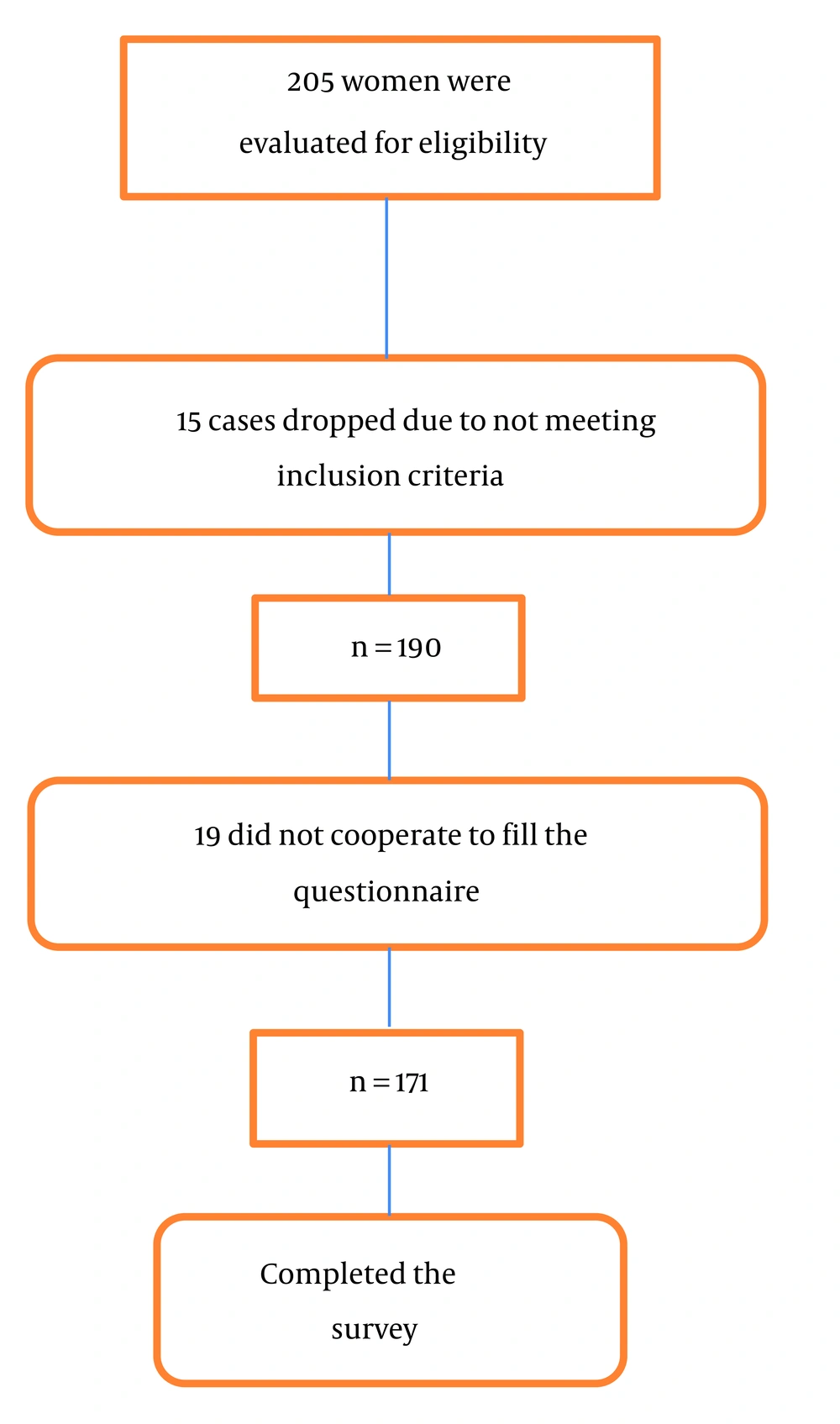
Figure 1.
Flow diagram for patients’ recruitment
5. Discussion
Tactile hallucinations and sexual fantasies occur in both sexes, but men are more likely to report these experiences. This may be because women are aware of the potential consequences of reporting illegitimate and undefined tactile relationships and, in many cases, avoid reporting such experiences. Of course, it should be kept in mind that if the patient complains, intraoperative dreaming should not be the sole diagnosis, and the circumstances must be examined to make a decision based on the truth (15). Radek et al. reported that insufficient depth of anesthesia and the patient's lack of response to surgical stimuli do not indicate complete cessation of consciousness and brain activity (16). Dreams show that the brain can generate conscious experiences even when disconnected from the environment. The incidence of dreams as a common phenomenon in GA has been reported across a wide range (13). Some studies have reported 12% (17) and 7.6% (18). An important point is that it is necessary to distinguish intraoperative dreaming from wakefulness. Al Jabri et al. reported in a study, 0.3% of participants had awareness, while 7.6% had dreaming, none of whom had sustained psychological damage at follow-up, while 49% of patients who had daydreamed during surgery developed serious psychiatric complications (18).
Based on the results of this study, it was found that 6.4% of the studied women experienced dreams during anesthesia. More than half of these cases reported dreams with ambiguous content, and only one reported a dream with unpleasant content, and one reported a tactile content with sexual fantasies. However, none of these cases stated any motivation to complain against the doctors. This finding was contrary to some previous studies in which the patient decided to sue the doctor following these experiences. The case of sexual fantasies was a 35-year-old married woman with a university degree, ASA class 1, who underwent hysteroscopy by a male anesthesia assistant. At Al-Zahra Hospital, all the obstetricians and gynecologists are female, while in the anesthesia team, male residents are also involved in the patients' anesthesia process. From the time the patients enter the operating room until they are fully conscious, at least an anesthesia technician and a surgeon's assistant are present in the operating room. Definitely, that only one such report was received cannot indicate a completely acceptable situation in this area. Because a very small percentage of patients in this center are directly and independently placed under GA by a male anesthesiologist. Although a limited number of male assistants are trained in this center, the attending are responsible for both the anesthesia group and the female group of the patients. Therefore, we are unaware of the patients' dream status if, like in the private sector, this gender match cannot always be established.
It is important to note that the patient who reported this issue in this study underwent surgery using a face mask ventilation method, and propofol was injected as titration throughout the procedure. On the other hand, considering the patient's high BMI, the possibility of insufficient depth of anesthesia can be suggested. This patient had an academic degree and accepted the anesthesiologist's explanations that the content of the dream was just related to the effect of the selected anesthetic drug and did not indicate insufficient depth of anesthesia or lack of respect for her privacy. However, this reassurance may not work for all patients.
In this study, younger age and higher BMI were significantly associated with dreaming. This result was in line with some previous studies. In general, studies have shown that patients with high BMI were more likely to remember, be awake during surgery, and dream. Marital status, history of GA, and education of patients were not related to dreaming during anesthesia. Nightmares during anesthesia with propofol have been reported in up to 74% of cases. If these dreams contain tactile hallucinations, they can be grounds for lawsuits against doctors (13, 17). Of course, this issue has a very long history. In 1849, women who were given chloroform used obscene and immoral language, which led to the cessation of the use of chloroform in anesthesia for women (19). Also, women experienced tactile dreams while inhaling ether, and doctors concluded that there is a possibility of experiencing tactile hallucinations in various forms during anesthesia, and whether people report them or not depends on cultural and personal characteristics (20).
Several case reports of tactile dreams following anesthesia have been published. Two women who were sedated for a dental procedure sued their dentist for indecent exposure. Despite the dentist's defense, he was ultimately convicted because he had been alone with them without the presence of a witness (21). In a study conducted by Dundee, the intensive care unit (ICU) staff was sedated with 30 mg of intravenous midazolam. A number of female participants reported tactile dreams, some of which were unpleasant (22). Despite the research that has been done on the topic of anesthesia and tactile dreams, there are still many uncertainties about this subject. The important point is that in many cases, these dreams could be very serious and problematic and have even led to the revocation of the doctor's license. To prevent these problems, it is recommended to talk to the patients before anesthesia and inform them about the possible occurrence of these types of dreaming. Also, during anesthesia, a third person should be present as a witness in the operating room. Additionally, if the patient reports these types of dreams and fantasies, it should be documented in his/her medical file record (23).
Matus et al. conducted a prospective observational study to investigate the incidence and nature of dreams in patients undergoing gastrointestinal endoscopy under intravenous propofol anesthesia (3). In Matus et al.'s study, the incidence of intraoperative dreaming was reported in 43% of patients, which was higher than in this study (3). Bi-spectral Index (BIS) values were lower among patients who had the experience of dreaming. However, significant differences between the two studies should be considered. The type of procedures, gynecologic surgeries versus endoscopy or colonoscopy, influences the results. The studied population in terms of age, gender, and ASA class were also different. A notable difference was that, in contrast to Matus et al.'s study, psychiatric or opium-addicted patients were excluded in our study due to potentially unreliable judgment and reporting of dreaming (3).
Schäfer et al. investigated the likelihood of dreaming when receiving positive sleep suggestions before surgery. Forty patients with standard care and forty patients with pre-operative sleep suggestions enrolled in the study. The day before surgery, patients were asked to imagine a pleasant dream, and just before anesthesia, they were asked to imagine their dreams. After surgery, the patients were questioned about intraoperative dreaming. They reported that the incidence of intraoperative dreaming was significantly higher in the intervention group (24).
Focus on an understudied area is a strength of this study. Upon searching the literature, no native study from Iran was found. In fact, the lack of similar studies in Iran is the novelty of this work, while on the other hand, it limits the possibility of comparing the results with other studies. As mentioned, the results of studies were not in line, which could be explained by different methods and study populations. First of all, it should be noted that in a number of studies, the difference between intraoperative awareness as a failure and dreaming has not been well discussed. Furthermore, the different anesthesia methods and anesthetic agents, especially the induction choice, operation site, patients’ gender, mental status, and the severity of preoperative anxiety are all influential factors (9, 25). In one study, it was shown that men had more dreams with pleasant content. They examined brief anesthesia with propofol in upper GI endoscopy. In their study, 30% of men and 17% of women experienced dreaming (26). In addition, the time of interviewing and the dreaming diagnosis tool, whether the patient has a desire to report the content of the dreams, are also important. In this regard, the importance of socio-cultural characteristics of each region and individuals’ characteristics in terms of fears, concerns, and prejudices in reporting their dreams during anesthesia are also undeniable. In our country, as far as our studies have shown, no research has been conducted on the subject of dreams, especially with emphasis and attention to its content. It is hoped that this research will pave the way for future studies. In this way, with knowledge and awareness of the conditions, we can partly prevent complaints against doctors and related psychological complications for patients.
5.1. Limitations
Despite the valuable information obtained, this study had limitations. It was a single-center study, and only the female gender was enrolled in the study. In addition, in most cases, the patient, anesthesiologist, and surgeon were female. While in most studies, problems have arisen when the doctor and patient were of the opposite gender. However, it should be noted that in this study, the choice of propofol and the type of surgical procedures were two important predisposing factors. There is also the possibility that a number of women participating in the study may have refrained from expressing their dreams and the real content.
5.2. Suggestions
Given that this issue is important both from the perspective of complaints against doctors and from the perspective of ethical issues, it is recommended that this study be conducted in situations where the doctor and patient are not of the same gender, as well as in other surgical procedures. Therefore, to achieve practical results, considering the religious and cultural characteristics of the society, the private sector where gender mismatch between the doctor and the patient is inevitable should be studied.
5.3. Conclusions
According to the results of this study, it seems that the intraoperative dreaming status in gynecological surgeries at this center was acceptable. However, considering that the majority of women in this hospital receive anesthesia and surgery interventions by the same gender, and in this situation, a case of dreaming with tactile content was reported, further investigation is recommended. Given the risk of patient anxiety and dissatisfaction and also the potential to sue the doctor, informing the patients in preoperative visits about the possibility of this event is crucial.


