


1. Background
Bipolar disorder (BD) is one of the most serious psychiatric disorders, characterized by recurrent episodes of depression, mania, and mood disorders (1). Bipolar disorder is divided into two categories, BD types I and II, which differ in the presence or absence of a full-blown manic episode. Bipolar disorder-I is characterized by single manic symptoms (2). Bipolar disorder-I is characterized by at least one manic episode. During this episode, the mood is abnormally and persistently elevated, expansive, and irritable, with persistent and abnormally high activity or purposeful energy lasting at least one week. During this episode, at least three or more symptoms must be present, and at least four symptoms must be present if the mood is only irritable. Symptoms include false or grandiose self-esteem, decreased need for sleep, being more talkative than usual, racing thoughts or experiencing mental states that are racing, distractibility, increased purposeful activity or psychomotor agitation, and behaviors such as spending too much, sexual recklessness, or reckless investing (3). One of the factors that negatively affects the functioning of patients with BD is emotional dysregulation (ED) (4). Emotional dysregulation encompasses a wide range of deficits, including lack of understanding and awareness of emotions, difficulties in accepting negative emotional experiences, inability to control impulses, difficulties in achieving desired goals, and inability to use appropriate emotion regulation strategies when faced with negative emotions (5). Based on the cognitive and neurophysiological model, BD can be partially understood as the result of deficits in cognitive control of emotion (6). From a clinical perspective, this disorder clearly implies disturbances in the control of impulses, emotions, and interpersonal interactions (7). Studies conducted on patients with BD have shown that ED is a prominent feature of these patients (8), which reduces function and quality of life (QOL) in affected patients (9). Emotional disorder, mood instability, and repeated periods of depression and mania affect various aspects of life, including social, occupational, functional, and well-being conditions, and the overall QOL of affected individuals (10). Quality of life is a multidimensional concept that emphasizes an individual’s satisfaction with all aspects of life and includes physical, social, environmental, and psychological well-being (11). People with BD have difficulty with interpersonal communication during periods of depression due to a tendency to isolate themselves and avoid social contact (12). This can become problematic during periods of mania and hypomania in the form of restlessness and inappropriate interference in the affairs of others, and with the impact it has on other people and the environment, it has a negative impact on the social functioning and QOL of these patients (13). In summary, it can be said that ED, mood instability, and repeated periods of depression and mania affect the QOL of these patients (14). Attention to effective treatment of BD has been a concern of psychiatrists and psychologists for many years. Although pharmacotherapy is the first-line treatment for this disorder, research suggests that combining pharmacotherapy with psychological therapies may be more effective for these patients (15). One treatment that can help reduce the signs and symptoms of BD is emotion regulation group intervention based on acceptance (16). This therapy combines aspects of acceptance and commitment therapy, dialectical therapy, and emotion-centered therapy (17). This treatment directly targets ED and behavioral avoidance. In this treatment, emotion regulation is considered a multidimensional construct that includes awareness, understanding, and acceptance of emotion; the ability to behave purposefully and control impulsive behaviors when experiencing negative emotions; the flexible use of emotion regulation strategies to modulate the intensity and duration of emotional responses rather than eliminating emotion; and the willingness to experience negative emotions as part of meaningful activities in life. In fact, the main goal of this treatment is to change the client’s relationship with their emotions, promote acceptance of emotions, and increase the ability to control behavior (16). The ultimate goal of this treatment is to help patients with BD break and overcome the vicious cycle of impulsive behaviors and emotional instability. Teaching effective interpersonal skills as part of acceptance-based emotion regulation group therapy techniques helps patients improve the relationships in their lives (16). Teaching these skills helps patients rebuild their relationships when needed. Therefore, teaching communication techniques such as saying no and negotiating to resolve conflict and assertiveness skills to patients with BD reduces emotional instability in these patients (18). In confirmation of these findings, Jones et al. (18) examined the effect of acceptance-based emotion regulation group therapy on mood regulation and improving QOL in patients with BD (18). Also, Gratz et al. showed the effect of acceptance-based emotion regulation group therapy on reducing self-injurious behavior and improving mental health and QOL in women with borderline personality disorder (17).
2. Objectives
In summary, it can be said that despite the fact that a wide range of integrated psychotherapies have been used in the treatment of this disorder alongside medication, the rate of relapse in this disorder is still significant. The treatment of patients with mood disorders still has a long way to go to be more perfect, and researchers are trying to achieve more specific treatments through research. Therefore, the present study can reduce the likelihood of relapse of BD by targeting emotion regulation problems in these patients and reducing other signs and symptoms of this disorder. The present study aimed to determine the effectiveness of the emotion regulation group intervention based on acceptance on the severity of symptoms and signs, ED, and QOL in patients with bipolar I disorder.
3. Methods
The present research design was semi-experimental with a pre-test, post-test, and 2-month follow-up with a control group. The study encompassed all patients with bipolar I disorder referred to 505 Nezaja Neurology and Psychiatry Subspecialty Hospital in the first half of 2023. Through purposeful sampling and using the effect size formula, 36 patients were selected. To calculate the sample size, the sample size calculation method based on the effect size formula was used, and a sample size of 18 patients for each group and a total of 36 patients was obtained. In this formula, the effect size was considered to be 0.4, the alpha level was considered to be 0.05, and the beta level was considered to be 0.2.
The main inclusion criteria were a definitive diagnosis of bipolar I disorder by psychiatrists’ colleagues, absence of psychotic disorders and substance abuse disorder based on the structured clinical interview for DSM-5 disorders-clinical version (SCID-5-CV), and willingness and informed consent to participate in the research. The main exclusion criteria were the absence of psychiatric medication, suicidal thoughts and attempts while attending sessions, and participating in psychotherapy intervention while participating in the research. The emotion regulation group intervention based on acceptance, as outlined by Gratz et al. (17), consisted of sixteen 90-minute sessions and was conducted once a week for the experimental group. A summary of the sessions of this treatment protocol is presented in Table 1.
Table 1.Summary of Acceptance-Based Emotion Regulation Intervention Sessions in Bipolar I Patients
| Sessions | Content |
|---|---|
| 1 and 2 | Introduction and training function of emotion |
| 3 and 4 | Emotion awareness |
| 5 and 6 | Getting to know primary and secondary emotions; Getting to know clear and ambiguous emotions |
| 7 and 8 | Emotional avoidance/disinclination versus emotional acceptance/desire |
| 9 and 10 | Identifying emotion regulation strategies; Impulse control training |
| 11 and 12 | Education of valued orientations |
| 13 and 14 | Education of valued orientations; Commitment and valued actions |
| 15 and 16 | Review of previous assignments; Prevention of relapse and review of previous assignments |
3.1. Instruments
3.1.1. Structured Clinical Interview for DSM-5 Disorders-Clinical Version
First et al. in 2015 used this instrument to assess the extent of impairment and severity of clinical disorders (19). The overall Content Validity Index of the instrument was reported as 0.85, and the content validity ratio as 0.79. Also, the Kuder-Richardson method was used to examine the reliability coefficient, and the Kuder-Richardson method coefficients for this instrument were between 0.75 and 0.84, indicating its desirable reliability (20).
3.1.2. Structured Clinical Interview for Personality Disorders DSM-5
In 2015, First et al. designed a new version of a structured diagnostic interview based on DSM-5 to evaluate ten personality disorders (19). The overall Content Validity Index of the instrument was reported as 0.8, and the content validity ratio as 0.75. Also, the Kuder-Richardson method was used to examine the reliability coefficient, and the Kuder-Richardson coefficients for this instrument were between 0.72 and 0.87, indicating its desirable reliability (21).
3.1.3. The Mania Rating Scale
The Mania Rating Scale was developed by Young et al. (22). This scale has 11 items and is assessed based on the patient’s statements about their clinical condition over the past 48 hours. Except for four items that have a score between 0 and 8, the rest of the items are scored between 0 and 4. In the "mania" tests, the inclusion criterion is a score of 20 or higher, and the threshold criterion for "hypomania" is a score of 12 (in some sources a score of 7) or lower. The reliability of this scale was obtained from the internal consistency by comparing the scores of two independent testers during a joint interview; the overall correlation was 0.96, and its minimum correlation was 0.66. The Cronbach’s alpha of this scale was reported to be 0.72 in Young’s study (22). In the Persian version of this scale, the reliability coefficient using Cronbach’s alpha was 0.72. Also, results indicated that all questions had high diagnostic power in distinguishing the normal group from the patient group, confirming the validity of this scale (23).
3.1.4. The Emotional Dysregulation Scale
This scale was designed by Gratz and Romer in 2004 and consists of 36 items, which are scored using a 5-point Likert scale. Higher scores indicate greater difficulties in emotional regulation. This scale measures six subscales: Denial of emotional responses, difficulty in performing goal-directed behavior, difficulty in impulse control, lack of emotional awareness, limited access to emotional regulation strategies, and lack of emotional clarity. Gratz and Romer reported the reliability of this scale based on test-retest reliability as 0.88 and internal consistency based on Cronbach’s alpha for the entire scale as 0.93 and for the subscale as 0.8 (24). In Iran, Besharat et al. reported in 2018 the reliability of the Persian version of the scale based on Cronbach’s alpha and the classification method as 0.86 and 0.80, respectively, and the data obtained from the correlation of this scale with the Zuckerman Sensation Seeking Scale (r = 0.26) confirmed the convergent validity of the scale (25).
3.1.5. The Quality of Life Questionnaire
World Health Organization designed this questionnaire in 1998. This questionnaire consists of 26 items. Scoring is done on a five-point Likert scale from 1 (very low) to 5 (very high). The range of scores is between 26 and 130, with higher scores indicating better QOL. Bat-Erden et al. reported Cronbach’s alpha for the entire questionnaire as 0.84 (26). Almarabheh et al. showed that the values of the correlation coefficients for all areas of this questionnaire were significantly correlated at the 0.01 level, and the convergent validity of the questionnaire was confirmed (27). Abdollahpour et al. reported that the test-retest reliability coefficient of this questionnaire after 2 weeks was 0.7. They also reported the convergent validity of this questionnaire as 0.68, which indicates the appropriate validity of the questionnaire (28).
3.1.6. Statistical Analysis
To analyze the data, both descriptive and inferential statistical methods were employed. The significance of the research hypotheses was examined with inferential statistics (multivariate mixed analysis of variance method) with an alpha of 0.05, power of average size of 0.8 in SPSS-24 software.
4. Results
Figure 1 shows the process of conducting the study. In terms of gender, in both the experimental and control groups, 8 individuals (44.6%) were male, while 7 individuals (38.9%) were female. In terms of marital status, in the experimental group, 5 individuals (27.8%) were single, 7 individuals (38.9%) were married, and 6 individuals (33.3%) were divorced. In the control group, 7 individuals (38.9%) were single, 6 individuals (33.4%) were married, and 5 individuals (27.7%) were divorced. In terms of education, in the experimental group, 1 individual (5.6%) was under diploma, 8 individuals (44.4%) had a diploma, 8 individuals (44.4%) had a bachelor’s degree, and 1 individual (5.6%) had a master’s degree. In the control group, 1 individual (5.6%) was under diploma, 10 individuals (55.4%) had a diploma, 6 individuals (33.4%) had a bachelor’s degree, and 1 individual (5.6%) had a master’s degree.
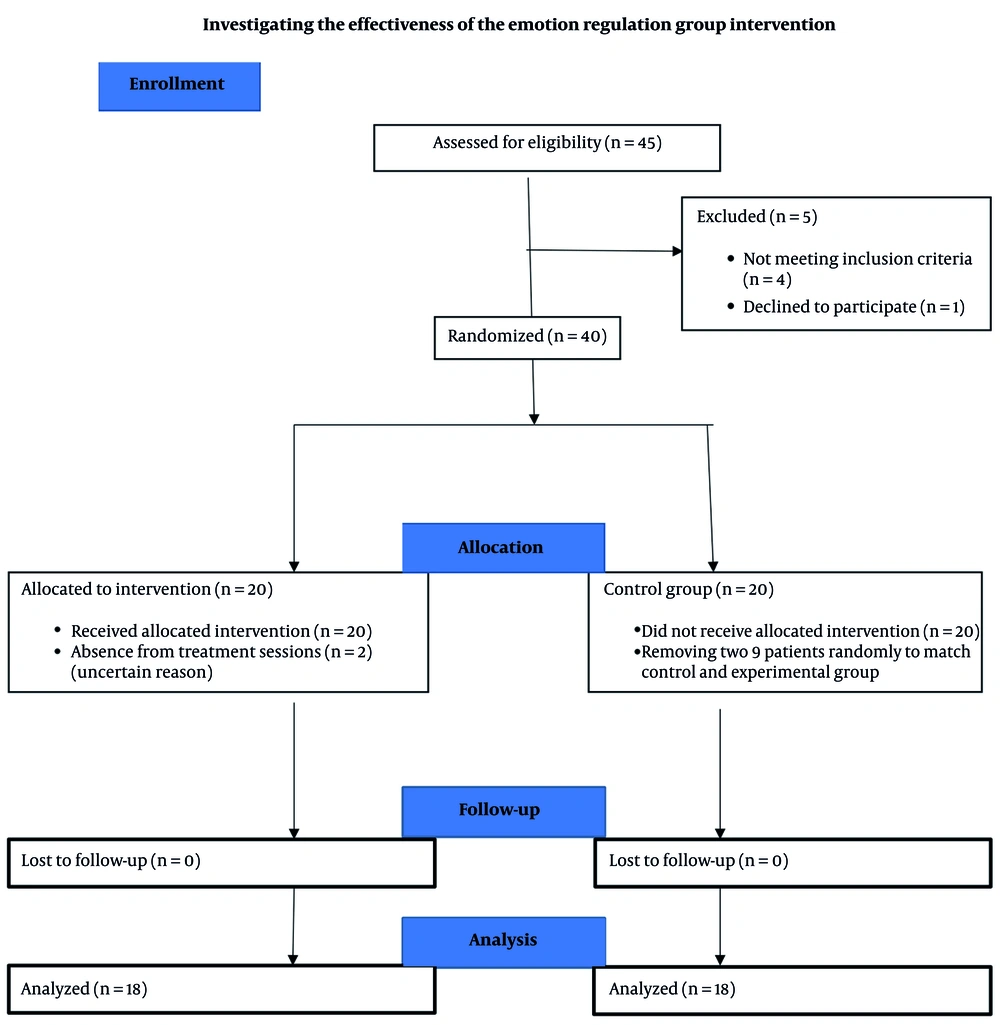
Figure 1.
Consort diagram of the study
The results in Table 2 showed that the effect of measurement time on ED (F = 10.01, P = 0.001), severity of signs and symptoms (F = 44.6, P = 0.001), and QOL (F = 14.43, P = 0.001) is significant. Under these conditions, it can be stated that there is a significant difference between the mean of ED, severity of signs and symptoms, and QOL in the pre-test, post-test, and follow-up. Also, the interactive effect of time and treatment group on ED (F = 17.56, P = 0.001), severity of signs and symptoms (F = 109.1, P = 0.001), and QOL (F = 22.51, P = 0.001) is significant. The results in Table 3 show that the interactive effect of time and group on ED was significant in the pre-test and post-test stages (P = 0.001, F = 22.1), but not in the post-test and follow-up stages (P = 0.008, F = 3.5). Also, for the variable of severity of signs and symptoms, the interactive effect of time and group was significant in the pre-test and post-test stages (P = 0.001, F = 112.9), but not in the post-test and follow-up stages (P = 0.7, F = 0.15). Additionally, for the QOL variable, the interactive effect of time and group was significant in the pre-test and post-test stages (P = 0.001, F = 50.3), but not in the post-test and follow-up stages (P = 0.06, F = 3.64). Therefore, the results showed the effectiveness of the intervention on ED, the severity of signs and symptoms, and the QOL of patients in the post-test phase.
Table 2.Evaluation of the Effectiveness of Emotion Regulation Group Intervention Based on Acceptance on Three Research Variables
| Variables and Sources | Sum of Squares | Mean of Squares | F | P-Value | Eta-squared |
|---|---|---|---|---|---|
| ED | |||||
| The effect of time | 438.41 | 233.1 | 10.01 | 0.001 | 0.21 |
| The interaction effect of time and group | 768.94 | 408.9 | 17.56 | 0.001 | 0.33 |
| Error | 1576.02 | 67.71 | 23.28 | - | - |
| Severity of symptoms and signs | |||||
| The effect of time | 3801.56 | 2407.93 | 44.6 | 0.001 | 0.55 |
| The interaction effect of time and group | 9299.88 | 5890.58 | 109.1 | 0.001 | 0.75 |
| Error | 1576.02 | 67.71 | 23.28 | - | - |
| QOL | |||||
| The effect of time | 1141.06 | 650.67 | 14.43 | 0.001 | 0.29 |
| The interaction effect of time and group | 1780.22 | 1015.14 | 22.51 | 0.001 | 0.39 |
| Error | 2846.62 | 63.13 | 45.09 | - | - |
Abbreviations: ED, emotional dysregulation; QOL, quality of life.
Table 3.Checking the Comparison of Means According to the Time
| Variables and Times | Sum of Squares | Mean of Squares | F | P-Value | Eta-squared |
|---|---|---|---|---|---|
| ED | |||||
| Pre-test/post- test | 698.9 | 698.9 | 22.1 | 0.001 | 0.193 |
| Post-test/follow-up | 140.9 | 140.9 | 3.5 | 0.06 | 0.09 |
| Severity of symptoms and signs | |||||
| Pre-test/post-test | 14237.57 | 14237.57 | 112.9 | 0.001 | 0.76 |
| Post-test/follow-up | 6.07 | 6.07 | 0.15 | 0.7 | 0.06 |
| QOL | |||||
| Pre-test/post-test | 3285.4 | 3285.4 | 50.3 | 0.001 | 0.58 |
| Post-test/follow-up | 204.4 | 204.4 | 3.64 | 0.06 | 0.09 |
Abbreviations: ED, emotional dysregulation; QOL, quality of life.
5. Discussion
The present study aimed to determine the effectiveness of the emotion regulation group intervention based on acceptance on the severity of symptoms and signs, ED, and QOL in patients with bipolar I disorder. The results showed that emotion regulation group intervention based on acceptance led to a reduction in ED in the experimental group. This finding is somewhat consistent with previous studies (29-31). Emotion regulation group intervention based on acceptance skills targets ED. A core component of this intervention is mindfulness and emotion regulation skills, which teach patients to be aware of their emotions, thoughts, and behaviors. These skills are particularly effective when individuals are experiencing episodes of depression, mania, and hypomania. In addition, practicing dissociation of thoughts and emotions is beneficial for emotional regulation and reducing instability (16). Additionally, teaching effective interpersonal skills as an important part of this treatment helps patients improve communication in their lives. Teaching these skills helps patients rebuild their communication in cases where needed. Therefore, teaching communication techniques such as saying no and negotiating skills to resolve conflict and assertiveness skills to patients with BD leads to a reduction in emotional disorder in them (31).
Also, emotion regulation group intervention based on acceptance led to the development of mindfulness in patients in the intervention group. Mindfulness techniques teach clients to become more aware of their emotions, thoughts, and behaviors, and as a result, have a higher level of self-control and emotional management ability. Using mindfulness exercises helps patients with BD use more effective strategies for regulating emotions. When emotions are revealed in the form of thoughts simultaneously with a physical sensation, if the person learns to stay with their physical sensations in this state, their emotional reactivity decreases. In fact, mindfulness helps people have higher self-control and self-efficacy by mastering internal experiences before they are affected by stressful stimuli (29).
Also, the results showed a reduction in the severity of symptoms and signs, which was aligned with previous studies (17, 18, 32). Emotion regulation group intervention based on acceptance techniques, relying on the use of exposure techniques, helps the individual to be more flexible in their cognitions and increase their mental skills and ability to create a balance between two different issues and increase the ability to think about multiple concepts. In this way, patients are enabled to understand emotions and feelings and accept problems and inefficiencies, while also making life understandable, more controllable, and meaningful. By replacing new beliefs and ideas with new thought patterns, patients’ cognitions are influenced and cause flexibility in cognition (32). On the other hand, the existence of cognitive flexibility creates the skill and ability of the mind to balance between two different subjects and increases the ability to think about multiple concepts simultaneously. This is why cognitive flexibility can help improve the condition of patients and lead to a reduction in the severity of the symptoms of the disease and an increase in their ability to function (17).
By utilizing emotion regulation group intervention based on acceptance techniques, patients with BD change their way of looking at events and interpret events in different ways. By learning skills such as different definitions of a problem, forming different and diverse thoughts and ideas about a specific event, weighing interpretations about a specific event, considering the benefits or harms of each of them, and ultimately deciding on the best choice, they can better cope with the problems and consequences of this disorder. In fact, patients who have these skills will have higher self-confidence, a greater sense of self-efficacy, and a lot of peace of mind compared to other people who lack these characteristics (18).
Also, the results showed an increase in QOL in the experimental group. These results were aligned with previous research findings (33-35). Emotion regulation group intervention based on acceptance uses emotion regulation techniques to increase positive emotions and reduces the patient’s struggle with negative emotions, increasing acceptance of the current situation. This improves the QOL of individuals by increasing psychological well-being (35). In this treatment, the patient is taught about the harmfulness of his/her behaviors and is explained why such behaviors should be stopped; therefore, the first step in dealing with such behaviors in this treatment is a commitment to change. By identifying these behaviors and changing them, the patient increases the quality of his/her life (33). Since in emotion regulation group intervention based on acceptance, acquiring skills and creating behavioral motivations is the basis of change, utilizing the principles and strategies of this therapy, relying on the training of behavioral skills (interpersonal skills, distress tolerance skills, emotional regulation skills, and mindfulness skills) is the basis of the therapist’s work and helps the patients to generalize them to their own life situations, thereby improving interpersonal skills, mental and psychological well-being, and ultimately the level of QOL (34).
This study was conducted on individuals with BD type I referred to 505 Nezaja Neurology and Psychiatry Subspecialty Hospital using a purposeful (non-random) sampling method, which limits the generalizability of the results. The inability to control the social and economic status of the subjects was another limitation of the present study. In line with these limitations, it is suggested that further research should be conducted on a larger sample to increase the generalizability of the findings. Future research should consider the impact of the subject’s social and economic status on the research results and, as much as possible, try to control confounding factors that affect the research results.
5.1. Conclusions
The findings of the present study showed that emotion regulation group intervention based on acceptance is an effective treatment for patients with bipolar I disorder and can lead to a reduction in the severity of signs and symptoms, ED, and improvement in their QOL.


