Cognitive Aging and Discourse: Exploring the Association Between Working Memory and Narrative Performance in Healthy Older Adults

Author(s):
Ali MoshtaghAli Moshtagh1, Mohammad RezaeiMohammad Rezaei1, Ailin TalimkhaniAilin Talimkhani2, Bahareh RezaeiBahareh RezaeiBahareh Rezaei ORCID1,*, Nasrin Shirmohammadi-KhoramNasrin Shirmohammadi-Khoram3
1Department of Speech Therapy, School of Rehabilitation Sciences, Hamadan University of Medical Sciences, Hamadan, Iran
2Department of Physiotherapy, School of Rehabilitation Sciences, Hamadan University of Medical Sciences, Hamadan, Iran
3Department of Biostatistics, Faculty of Health, Hamadan University of Medical Sciences, Hamadan, Iran

IJ Psychiatry and Behavioral Sciences:Vol. 20, issue 2; e164064
Published online:Jun 29, 2026
Article type:Research Article
Received:Jun 28, 2025
Accepted:Jun 22, 2026
How to Cite:Moshtagh A, Rezaei M, Talimkhani A, Rezaei B, Shirmohammadi-Khoram N. Cognitive Aging and Discourse: Exploring the Association Between Working Memory and Narrative Performance in Healthy Older Adults. Iran J Psychiatry Behav Sci. 2026;20(2):e164064. doi: https://doi.org/10.5812/ijpbs-164064

Abstract

Background:

Working memory is a core component of cognitive processing that supports complex language abilities, including narrative discourse. Age-related changes in working memory may affect older adults’ ability to organize and produce coherent and cohesive narratives.

Objectives:

This study examined the association between working memory and discourse in healthy older adults, focusing on coherence, cohesion, syntactic complexity, and verbal output errors.

Methods:

In this cross-sectional descriptive-analytical study, conducted from October to December 2023, 84 cognitively healthy older adults (44 females, 40 males) were recruited by convenience sampling from four nursing homes in Tehran. Working memory was assessed using the Wechsler Memory Scale and the N-back task. Narrative discourse was evaluated using the Persian Narrative Discourse Test and scored for coherence, cohesion, syntactic complexity, and verbal output errors. Statistical analyses were performed in SPSS 26, with significance set at P < 0.01.

Results:

Participants with formal education scored significantly higher on both working memory assessments (P = 0.001) and on measures of syntactic complexity, while committing fewer verbal errors (P = 0.003); however, education level showed no significant effect on discourse cohesion (P = 0.199) or coherence (P = 0.294). Pearson correlation analyses revealed strong positive associations between Wechsler working memory scores and discourse features, including coherence, cohesion, and syntactic complexity (P < 0.001). Conversely, working memory scores were significantly negatively correlated with verbal output errors (P = 0.001).

Conclusions:

This study highlights a direct relationship between working memory and narrative discourse abilities. The results support the hypothesis that stronger working memory is likely to enhance narrative discourse production in older adults.

1. Background

In contemporary society, maintaining health and cognitive function in older age has become increasingly important, as global aging poses substantial healthcare and economic challenges. Aging is commonly accompanied by declines in physical and cognitive abilities, particularly in attention, memory, executive functions—including working memory—and reasoning (1, 2). Among these, working memory is central to executive functioning, enabling the temporary storage and manipulation of information (3, 4).
This study adopts the multi-component model of working memory proposed by Baddeley and Hitch, which includes four subsystems: the central executive (attentional control), the phonological loop (verbal and auditory processing), the visuospatial sketchpad (spatial and visual integration), and the episodic buffer (linking to long-term memory) (5). Each subsystem has limited capacity. The central executive regulates attention and coordination, whereas the phonological loop and visuospatial sketchpad process verbal and spatial inputs, respectively. The episodic buffer integrates information across modalities and with long-term memory (6, 7). Our findings regarding the association between working memory and narrative discourse can be explained by considering the roles of specific working memory subsystems within Baddeley's multi-component model. According to this model, working memory subsystems are differentially related to narrative features: the phonological loop supports syntactic complexity and reduces verbal errors, whereas the episodic buffer maintains narrative coherence.
Individual differences—such as age, gender, and education—affect working memory capacity. Higher educational levels are associated with stronger performance across the central executive, phonological loop, and visuospatial sketchpad (8). Age is known to affect performance on executive tasks, and fMRI studies show different neural activity patterns between older and younger adults during such tasks (9). These cognitive changes also influence language abilities (10).
Language, an essential communication tool, is closely linked to executive functions and working memory (11). Rather than single-word exchanges, communication typically involves discourse, a complex linguistic form that enables meaningful, contextualized language production (12). Narrative discourse, in contrast to interactive conversational discourse, requires individuals to independently organize and convey coherent messages, placing greater cognitive demands on the speaker (13). As a form of expressive language, narrative discourse provides insights into higher-level cognitive functioning. It involves describing temporally sequenced events coherently and is considered a core indicator of linguistic competence (14).
Narrative discourse can be analyzed at multiple levels: microlinguistic (e.g., sentence length and complexity) (14), macrolinguistic (e.g., inter-sentence grammatical cohesion), macrostructural, and superstructural (15-17). Studies suggest that older adults tend to produce narratives that are less coherent than those of younger individuals (18). In interviews about work or family, their responses were less relevant, and they made more tangential remarks (19). Furthermore, aging has been associated with declines in causal and logical connections in discourse (14, 20).
Narrative samples can be elicited using tasks such as event casts, fictional stories, and recounts. Among these, picture description tasks are highly structured and provide visual support, thereby reducing the memory load on speakers. Because the visual stimulus remains present, these tasks are considered effective for both clinical and research purposes in eliciting narrative discourse (21). Therefore, this study used a picture description task to examine discourse performance.

2. Objectives

The aim of this study was to investigate the relationship between working memory and discourse in cognitively normal older adults, in terms of coherence, cohesion, syntactic complexity, and verbal output errors.

3. Methods

3.1. Study Design and Participants

This cross-sectional descriptive-analytical study was conducted in Tehran, Iran. Participant recruitment and data collection were performed from October to December 2023. The study included 84 cognitively healthy older adults recruited from four nursing homes in Tehran. Ethical approval was obtained from the Ethics Committee of Hamadan University of Medical Sciences (IR.UMSHA.REC.1402.395), and written informed consent was obtained from all participants before enrollment. The sample size was determined based on the study by Park et al. (22), assuming a medium effect size for the correlation between working memory and discourse measures (r = 0.30). The required sample size for a two-tailed correlation analysis was calculated using G*Power version 3.1, based on Fisher's z-transformation formula:
n=((Zα2+Zβ)2ln(1+r1-r))2+3
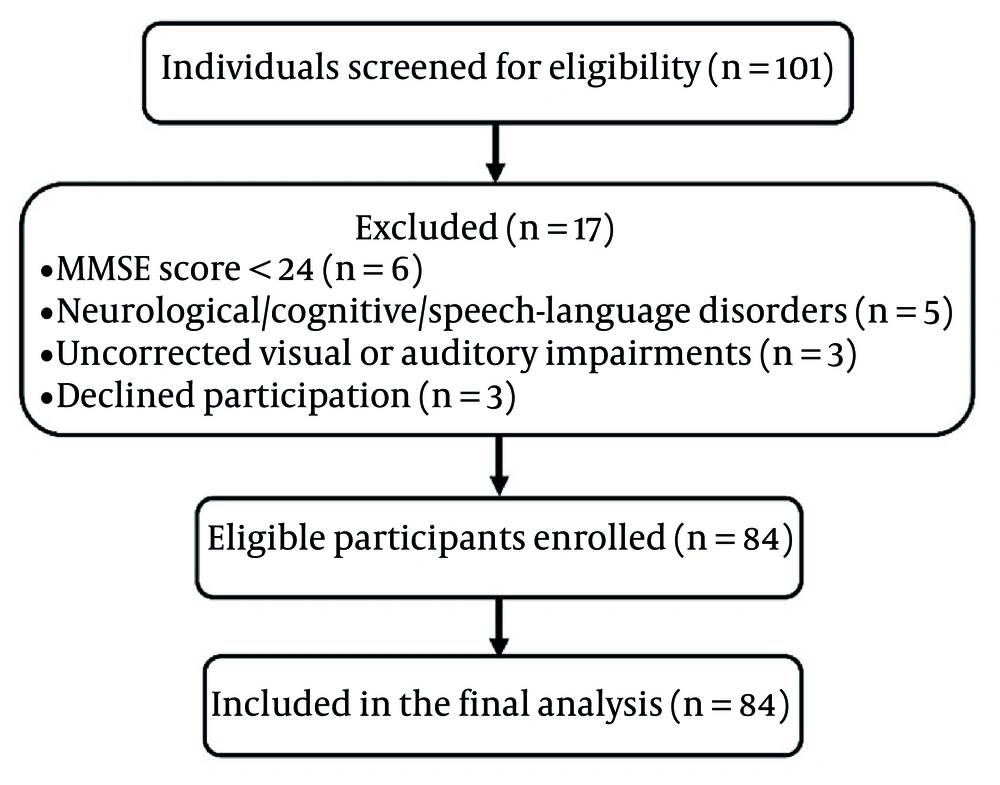
Using a 95% confidence level (α = 0.05; Z(α/2) = 1.96) and 80% statistical power (1 - β = 0.80; Zβ = 0.84), the minimum required sample size was estimated to be 82. To account for an anticipated attrition rate of approximately 5%, the final target sample size was set at 84 participants. The inclusion criteria were: (a) age 60 years or older; (b) being a native Persian speaker; (c) right-handedness; (d) a Mini-Mental State Examination (MMSE) score of 24 or higher, indicating preserved global cognitive functioning; (e) absence of self-reported or documented neurological, cognitive, or speech-language disorders; and (f) willingness to participate in the study. The exclusion criteria included uncorrected visual or auditory impairments that could interfere with task performance, as well as inability or unwillingness to cooperate during the assessment sessions. The flow of participant screening, eligibility assessment, and final inclusion is presented in Figure 1.
Flow diagram of participant recruitment and inclusion.
Figure 1.

Flow diagram of participant recruitment and inclusion.

3.2. Procedure

Participants were enrolled and assessed using both the Wechsler Memory Scale (WMS) and the N-back task to evaluate working memory, as each measure captures different aspects of this cognitive function. The WMS assesses structured verbal and visual memory capacity, whereas the N-back task evaluates the dynamic updating and monitoring of information. The Persian Narrative Discourse Test (PNDT) was used to assess discourse ability. All assessments were administered using standardized procedures, validated instruments, and uniform testing conditions to minimize potential sources of measurement bias.

3.3. Materials

3.3.1. Persian Narrative Discourse Test (PNDT)

The Persian Narrative Development Test (PNDT) was used to assess narrative discourse in Persian-speaking adults. Participants created a story based on six thematically linked pictures, with minimal prompts. Narratives were audio-recorded, transcribed, and analyzed across four domains: syntactic complexity (ratio of clauses to C-units), verbal output errors (e.g., disfluencies per C-unit), cohesion (grammatical and lexical ties per relational unit), and topical coherence (semantic relevance of C-units). The cutoff points were 1.22 for syntactic complexity, 0.23 for verbal output errors, 1.13 for cohesion, and 3.97 for coherence. Verbal output errors were defined as disruptions in speech production, including but not limited to lexical substitutions, repetitions, omissions, or phonetic misarticulations. Each domain was scored separately using mean scores and cutoffs; no total score was provided. The PNDT showed excellent intra-rater reliability (r > 0.99, P < 0.0001) (23).

3.3.2. Wechsler Memory Scale III (WMS-III)

The WMS-III includes 18 subtests assessing auditory, visual, and working memory in individuals aged 16 - 89. The working memory section has three parts: letter-number sequencing (0 - 21 points) and forward and backward spatial tasks (32 points), which are summed to obtain the total score. Split-half reliability ranges from 0.74 to 0.93, and test-retest reliability ranges from 0.62 to 0.88. In 2016, Saeed et al. examined the psychometric properties of the WMS-III in 226 students, reporting a Cronbach's alpha of 0.65 - 0.85 and split-half reliability of 0.62 - 0.84.

3.3.3. N-Back Task

The N-back task is a common test of working memory in which participants identify whether the current digit matches one presented n items earlier. It involves encoding, temporary storage, and continuous updating of information. In this study, 120 stimuli were presented for one second each, with 1.5-second intervals. The maximum score is 120. Validity studies report correlations ranging from r = 0.02 to r = 0.36 (24).

3.4. Statistical Analysis

Data were analyzed using SPSS version 26. Descriptive statistics (mean, standard deviation, frequency, and percentage) were calculated for continuous variables. Normality was assessed using the Kolmogorov-Smirnov test. Associations between working memory and narrative discourse measures were examined using Pearson correlation coefficients, with effect sizes interpreted based on Cohen's guidelines. Independent t-tests were used to compare participants with and without academic education. Age and education were examined as potential confounding variables through correlational and subgroup analyses; however, no multivariable adjustment was performed because of sample size limitations. Statistical significance was set at P < 0.01.

4. Results

Eighty-four older adults (44 females, 40 males; mean age = 69.03 years, SD = 5.27) participated in this study. All eligible participants completed the assessments, and no data were missing; therefore, all analyses were conducted on the full final sample. Demographic information is summarized in Table 1.
Table 1.Demographic and Baseline Cognitive Characteristics of the Participants (N = 84) a
CharacteristicValues
Age (y)69.03 ± 5.27
Age range60 - 82
Sex
Female44 (52.4)
Male40 (47.6)
Education level
Non-academic45 (53.6)
Academic39 (46.4)
Native language (Persian)84 (100)
Handedness (right-handed)84 (100)
Global cognitive status (MMSE)27.8 ± 1.9

a Values are expressed No. (%) or mean ± SD.

Descriptive statistics for working memory and narrative discourse are presented in Table 2. Participants scored a mean of 20.88 (SD = 3.95) on the WMS-III and 81.07 (SD = 24.7) on the N-back task, indicating moderate working memory with notable interindividual variability. In narrative discourse, syntactic complexity averaged 1.39 (SD = 0.11), whereas verbal output errors were more variable, with a mean of 0.87 (SD = 0.34). Cohesion and topical coherence were relatively stable, averaging 0.49 (SD = 0.07) and 3.9 (SD = 0.09), respectively. These findings reflect variability in cognitive and linguistic abilities among the older participants.
Table 2.Descriptive Statistics for Working Memory and Narrative Discourse Measures (N = 84) a
MeasureMinimumMaximumMeanSD
WMS-III12.029.0820.883.95
N-back28.0118.081.0724.7
Syntactic complexity1.161.651.390.11
Verbal output errors0.361.580.870.34
Cohesion0.320.660.490.07
Coherence3.724.153.90.09

a Minimum and maximum values represent observed scores in the present sample. The possible score ranges for each measure are as follows: WMS-III, 0 - 53; N-back, 0 - 120; syntactic complexity, 1.24 - 1.65; verbal output errors, 1 - 1.66; cohesion, 0.12 - 0.42; coherence, 3.91 - 4.25.

As summarized in Table 2, educational level had a significant impact on working memory performance and narrative discourse. Participants with academic education performed better on the WMS-III than those without university education (M = 23.30 vs. M = 19.10, P = 0.001). Similarly, on the N-back task, the academic group achieved higher scores (M = 99.40 vs. M = 63.60, P = 0.001). In terms of syntactic complexity, academically educated participants also outperformed their non-academic counterparts (M = 1.46 vs. M = 1.31, P = 0.001). Moreover, the academic group produced fewer verbal output errors (M = 0.63 vs. M = 1.04, P = 0.003). Age and education were considered potential confounding variables and were examined in relation to working memory and narrative discourse measures.
In contrast, no significant differences were observed between the two groups in cohesion (P = 0.199) or topical coherence (P = 0.294). These findings, as shown in Table 3, suggest that higher education is positively associated with working memory capacity, syntactic complexity, and fewer verbal errors, but does not significantly influence cohesion or topical coherence in narrative discourse.
Table 3.Differences in Working Memory and Narrative Discourse Scores by Educational Background
MeasureNMeanSDStd. ErrorP-Value
WMS-III0.003
Non-academic4519.104.400.66
Academic3923.303.200.51
N-back0.001
Non-academic4563.6029.004.33
Academic3999.4027.004.32
Syntactic complexity0.001
Non-academic451.310.110.02
Academic391.460.110.02
Verbal output errors0.003
Non-academic451.040.410.06
Academic390.630.330.05
Cohesion0.199
Non-academic450.460.100.01
Academic390.500.060.01
Coherence0.294
Non-academic453.880.100.01
Academic393.910.080.01
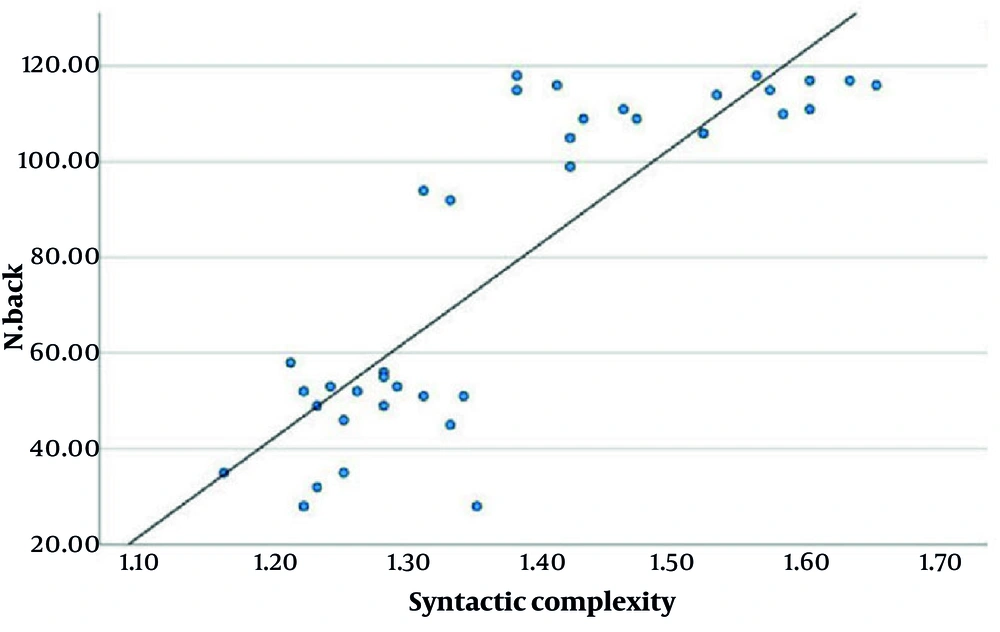
The results showed that mean WMS-III scores were strongly and positively correlated with syntactic complexity (r = 0.67, P < 0.001), cohesion (r = 0.51, P < 0.001), and coherence scores on the narrative discourse test (r = 0.57, P < 0.001). In addition, a strong negative relationship was found between WMS-III scores and verbal output errors (r = -0.66, P = 0.001, large effect), indicating fewer errors among individuals with better working memory performance. Verbal output errors are defined as disruptions in speech production, including but not limited to lexical substitutions, repetitions, omissions, or phonetic misarticulations. Furthermore, N-back working memory scores showed strong positive linear relationships with both syntactic complexity (r = 0.79, P < 0.001, large effect) and coherence scores in discourse (r = 0.33, P = 0.018, medium effect), as shown in Figure 2.
Scatter plot of syntactic complexity and N-back scores. The fitted regression line illustrates the positive linear trend between the variables, showing a strong positive correlation (r = 0.79, P &lt; 0.001).
Figure 2.

Scatter plot of syntactic complexity and N-back scores. The fitted regression line illustrates the positive linear trend between the variables, showing a strong positive correlation (r = 0.79, P < 0.001).

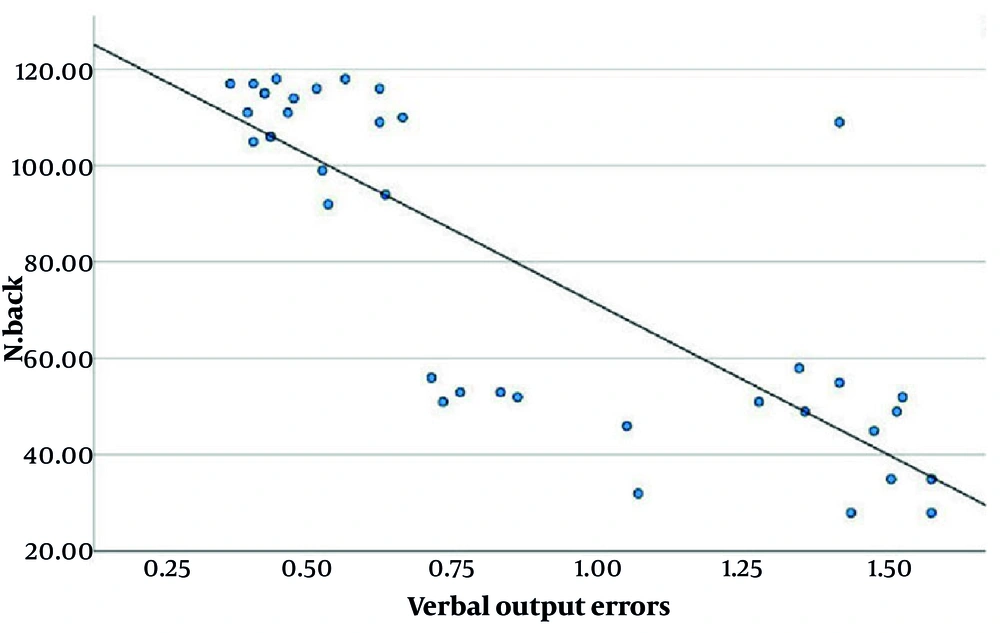
In contrast, the negative relationship between N-back scores and verbal output errors (r = -0.42, P = 0.001, medium effect, as shown in Figure 3) indicates that as working memory capacity improves, speakers are less likely to produce lexical retrieval mistakes, hesitations, or incoherent phrases. This pattern reinforces the hypothesis that adequate working memory resources are essential not only for grammatical structuring but also for maintaining fluency and semantic clarity during discourse. Given the complexity of managing multiple linguistic components simultaneously, a robust working memory system may serve as a cognitive scaffold supporting effective message planning, execution, and monitoring.
Scatter plot of verbal output errors and N-back scores. The fitted regression line illustrates the negative linear trend between the variables, showing a significant negative correlation (r = -0.42, P = 0.001).
Figure 3.

Scatter plot of verbal output errors and N-back scores. The fitted regression line illustrates the negative linear trend between the variables, showing a significant negative correlation (r = -0.42, P = 0.001).

Table 4 indicates significant associations between working memory and discourse. WMS-III and N-back scores correlated strongly with syntactic complexity (r = 0.67, 0.83) and cohesion (r = 0.51, 0.42), and moderately with coherence (r = 0.57, 0.33). Verbal output errors showed negative correlations with working memory (r = -0.66, -0.79). Age demonstrated modest negative associations with both cognitive and linguistic measures.
Table 4.Correlation Coefficients Between Working Memory and Narrative Discourse Measures (N = 84)
Measures and StatisticSyntactic complexityVerbal output errorsCohesionCoherenceAge
WMS-III
Pearson correlation0.67 a-0.66 a0.51 a0.57 a-0.30 b
Sig. (2-tailed), n = 840.0000.0010.0000.0000.007
N-back
Pearson correlation0.83 a-0.79 a0.42 a0.33*-0.28 b
Sig. (2-tailed), n = 840.0000.0010.0010.0180.024

a P < 0.01.

b P < 0.05.

5. Discussion

This study explored the relationship between working memory capacity and key structural features of narrative discourse—coherence, cohesion, syntactic complexity, and verbal output errors—in healthy older adults. A central finding was the strong association between education and working memory, supporting Stern’s proposal that education may serve as a proxy for cognitive reserve (25). Cognitive reserve enables the brain to compensate for pathology through efficient or alternative neural pathways. Although the cross-sectional design precludes causal inference, the results suggest that education not only correlates with working memory but may also mediate its role in discourse production (25).
More broadly, emerging evidence indicates that the cognitive mechanisms supporting healthy aging, including working memory and executive functions, are modifiable through intervention. Recent studies have examined approaches such as non-invasive brain stimulation, training in activities of daily living, psychosocial models of healthy aging, and cognitive training programs designed to enhance cognitive performance in older adults (26-27). A recent systematic review and meta-analysis found that cognitive training can improve key functions in older adults—especially working memory and executive processes—suggesting that discourse-related cognitive skills may benefit from targeted intervention (27). Although these studies did not directly assess narrative discourse, they provide an important contextual basis for interpreting discourse production as dependent on cognitive systems that can be strengthened through appropriate interventions.
The findings demonstrated robust associations between working memory and discourse-level measures, reinforcing the view that narrative production is not merely linguistic but also a cognitively demanding activity that integrates multiple domains (28). A moderate positive correlation was observed between working memory and syntactic complexity, whereas no significant relationship emerged between age and syntactic performance. This pattern diverges from studies reporting age-related decline (29) but aligns with research emphasizing syntactic stability in aging (30). Such variation may be explained by protective factors related to cognitive reserve, such as education and linguistic experience, and the observed link underscores the cognitive demands of producing complex structures (30, 31).
Verbal output errors—including substitutions, repetitions, omissions, and mispronunciations—were also closely related to working memory capacity. Working memory plays a central role in fluent language production by temporarily storing and integrating syntactic and lexical information into coherent discourse (32, 33). It also supports real-time self-monitoring. Mandal showed that individuals with post-stroke aphasia had difficulty detecting phonological and semantic errors due to impaired monitoring that depends on working memory (34). Similarly, Farquharson reported that reduced efficiency compromises monitoring and increases error rates, with individuals affected by persistent speech disorders performing poorly on working memory tasks (35).
Regarding macrolinguistic features, no significant association emerged between age and cohesion or coherence, which contrasts with prior findings of age-related discourse disruptions (16, 32). Several factors may account for this discrepancy. The narrative task was relatively simple, possibly minimizing cognitive demands. The participants were cognitively healthy older adults, whose preserved functioning and the protective effects of cognitive reserve may have buffered decline. Methodological differences are also relevant: this study used a fine-grained scoring framework to assess grammatical and lexical cohesion—including mechanisms such as synonymy, repetition, semantic inclusion, and contrast—providing greater nuance than the global coherence ratings typically used in earlier studies (32).
Our findings also diverge from those of Marini et al., which reported little or no correlation between age and cohesion (16). These differences should not be interpreted as contradictions but as outcomes of different methodological approaches. While those studies relied on holistic global ratings (16), the Persian Narrative Discourse Test (PNDT) provided a detailed, quantitative analysis of micro-level cohesive mechanisms (e.g., pronoun use, coreference chains). By using such tools, our study identified specific discourse vulnerabilities that may be overlooked by broader measures.
Finally, the robust correlation between working memory and coherence reinforces the view that discourse organization is a cognitively mediated process, dependent not only on linguistic knowledge but also on executive functions such as attention, flexibility, and monitoring (19). Working memory facilitates thematic relevance, planning, inferencing, and updating during discourse. The absence of age-related decline in coherence may reflect the sensitivity of our fine-grained framework, which allowed for the detection of subtle discourse features not captured in previous research. Future research may examine whether cognitive training programs can enhance narrative performance in older adults, potentially strengthening the link between cognitive functioning and discourse abilities.

5.1. Conclusions

This study highlights the essential role of working memory in shaping syntactic complexity and discourse organization in older adults. The findings support a cognitively informed discourse model that integrates linguistic form and executive control, advancing theoretical and methodological understanding and providing practical implications for assessment and intervention in aging.

5.2. Limitations and Recommendations

This study has several limitations. First, convenience sampling from Tehran nursing homes limits generalizability, particularly to community-dwelling and rural older adults. Second, the use of a picture-based narrative task may not fully reflect the complexity of naturalistic discourse. Third, focusing exclusively on working memory precludes conclusions regarding other cognitive domains, such as processing speed and inhibition. Fourth, the cross-sectional design prevents causal inference. Finally, although age and education were identified as potential confounding variables, they were examined through correlational and subgroup analyses rather than being statistically controlled, due to sample size limitations. Future studies should use larger and more diverse samples, longitudinal designs, naturalistic tasks, and multivariate models to better address demographic confounders.

Acknowledgments

Footnotes

References


Crossmark
Crossmark
Checking
Share on
Metrics

Ordering Reprints

Articles are published under the Creative Commons license stated on each article. No permission or royalty fee is required for uses permitted by that license. CCC handles optional bulk and customized reprint orders. Any quotation covers production and delivery services only, not copyright permission. > Request Reprints from CCC 

Search Relations

Author(s):

Related Articles