


1. Context
1.1. Rationale
Chemotherapy continues to be one of the primary and most effective treatments for childhood cancer; however, it is associated with substantial difficulties despite its critical role in disease management (1). The treatment protocol generally necessitates repeated hospitalizations, frequent clinical visits, severe adverse effects, and continuous follow-up care, all of which can significantly disrupt normal family routines (2). Parents, most notably mothers, who frequently serve as the main caregivers, experience elevated levels of emotional and psychological distress under these circumstances. Studies indicate that parents caring for children receiving chemotherapy are at heightened risk for anxiety, depression, feelings of guilt and helplessness, psychological fatigue, marital discord, social withdrawal, and economic hardship (3). The loss of control, concerns about the child’s prognosis, ambiguity regarding parental roles, and conflicts between employment and caregiving further exacerbate their psychological stress. These factors can contribute to caregiver burnout and diminished family functioning, potentially affecting the child’s treatment adherence and recovery (4).
Furthermore, healthcare systems, particularly in low and middle-income countries, often fail to adequately address the psychosocial needs of parents managing a child’s chronic illness. Access to psychological support services and counseling is frequently limited or insufficient (5). Given the profound influence of parental mental health on the quality of care provided to the child, it is imperative to identify and comprehend the psychological, emotional, and social difficulties encountered by parents. Such understanding is vital for the development of targeted therapeutic and supportive interventions (6).
Family-centered nursing adopts a holistic perspective by emphasizing the identification and fulfillment of the needs of all family members, especially parents, within pediatric oncology care. This approach necessitates a thorough and evidence-based comprehension of the challenges faced by families during cancer treatment (7). In recent years, research interest has grown regarding the psychological and social consequences of childhood cancer for parents (8). Nevertheless, current literature displays variability and fragmentation in findings related to the type, severity, and diversity of parental challenges. Many investigations have concentrated on specific issues such as anxiety or financial burdens without offering a comprehensive overview of the multifaceted pressures parents endure (9). In light of these gaps, there is a distinct need for a systematic review that organizes, integrates, and critically evaluates existing studies. Therefore, the present study aims to systematically examine the psychological, emotional, and social challenges experienced by parents of children undergoing chemotherapy for cancer.
2. Objectives
This systematic review seeks to examine various aspects of psychological distress, including anxiety, depression, financial pressures, disruption of family and community dynamics, and parents’ support needs during this period. The findings are expected to improve support services, counseling interventions, and the development of policies focused on the psychological well-being of families affected by childhood cancer.
3. Methods
3.1. Data Sources
An extensive literature search was performed using five major electronic databases to identify pertinent studies. The databases included in this review were PubMed, Scopus, Web of Science, Google Scholar, and SID, all of which are well-regarded for their broad coverage in health, medical, and social science research.
3.2. Registration
This systematic review has been registered in PROSPERO (CRD420251101943).
3.3. Search Strategy
The search utilized the following primary terms: (“Parents” OR “Caregivers”) AND (“Childhood Cancer” OR “Pediatric Oncology”) AND (“Chemotherapy”) AND (“Psychosocial Challenges” OR “Psychological Distress” OR “Social Problems”). Boolean operators were applied to optimize the search results. In addition, relevant articles’ reference lists were manually screened to ensure thorough literature identification.
3.4. Inclusion Criteria
Eligible studies investigated psychosocial difficulties experienced by parents of children receiving chemotherapy for cancer. Research that focused on challenges faced by parents of pediatric oncology patients was also included if it provided applicable insights into these issues.
3.4.1. Study Design
Studies employing both quantitative and qualitative methodologies were considered, encompassing experimental designs, observational studies, systematic reviews, and case reports.
3.4.2. Outcomes
Articles were included if they addressed at least one of the following topics: Parental challenges, childhood cancer, psychosocial issues among parents, or pediatric chemotherapy.
3.4.3. Time Frame
Only studies published from January 2010 through March 2025 were reviewed.
3.4.4. Language
Only publications in English or Persian were eligible for inclusion.
3.5. Exclusion Criteria
Studies without empirical data or a clearly defined methodology (such as commentaries, editorials, or letters to the editor) were excluded unless they contained empirical results or a structured methodological framework. Publications not available in English or Persian and those lacking sufficient outcome data to determine relevance were also omitted.
3.6. Data Extraction and Management
Two reviewers independently extracted data using a standardized form. Extracted details included study authorship, publication year, design type, sample size, and study setting. Information on the types of psychosocial problems encountered by parents, as well as their duration, frequency, and specific focus areas, was also collected. Reference records were initially compiled in Google Sheets and later managed with EndNote to eliminate duplicates and maintain accurate citation records. The initial search strategy was developed by the primary author and subsequently refined in collaboration with two senior team members with expertise in literature reviews. Although a professional librarian was not directly involved, the final search protocol underwent internal peer evaluation. Disagreements regarding study selection or data extraction were resolved through discussion and consultation with a third reviewer. These procedures contributed to maintaining methodological rigor, transparency, and consistency throughout the review process.
3.7. Quality Assessment
Given the heterogeneity of methodologies among the studies included in this review, we applied a range of established evaluation instruments appropriate to each study type: Randomized controlled trials were assessed using the Cochrane risk of bias tool 2, observational studies with the Newcastle-Ottawa Scale, and qualitative research with the Critical Appraisal Skills Programme. This multi-tiered assessment strategy ensured that each study was appraised using the most suitable tool, thereby increasing the precision and relevance of our quality evaluations. All reviewers adhered to standardized scoring procedures, and any discrepancies were resolved collaboratively to uphold consistency. Studies were incorporated into the review regardless of their risk of bias status; nonetheless, these assessments guided our narrative synthesis, and findings from studies identified as having moderate or high risk of bias were interpreted with heightened caution during analysis.
3.8. Data Analysis
Themes were derived by systematically identifying recurring patterns within the data. Any disagreements regarding theme identification were addressed through discussion or, if necessary, consultation with a third reviewer. This approach facilitated the integration of key concepts from various studies into well-defined thematic categories. Due to differences in study designs and outcome measures, a hybrid thematic strategy was employed for qualitative analysis and synthesis across the included studies. The thematic analysis followed the six-phase framework outlined by Brown and Clark: (1) Familiarization with the data; (2) generation of initial codes; (3) searching for themes; (4) reviewing themes; (5) defining and naming themes; and (6) producing the final report. Two independent reviewers thoroughly examined and coded each study using an inductive approach. Themes were established based on consistently observed patterns within the data. Any differences between reviewers were resolved through discussion or, when needed, with input from a third reviewer. This process enabled the extraction and consolidation of principal concepts from multiple studies into comprehensive thematic categories.
3.9. Limitations
Several limitations were noted among the studies reviewed: (A) diversity in study designs — variations in research methods, including sample sizes, outcome measures, and types of AI technologies used prevented a full meta-analysis from being conducted; (B) quality of evidence — some studies exhibited moderate or high risk of bias, which may affect the reliability of their conclusions; (C) geographic and technological constraints — limited access to technology and internet infrastructure in certain regions could restrict the broader applicability of some initiatives; (D) scope of included studies — a limited number of studies specifically addressed parental psychosocial challenges; however, these were retained for their valuable and applicable insights into addressing such issues. While this inclusion is acknowledged as a methodological limitation, it also underscores the scarcity of empirical research focused solely on parental psychosocial concerns.
4. Results
A total of 16 articles were selected for inclusion in this review following a comprehensive screening procedure. The initial search, conducted across five major databases, yielded a substantial number of studies addressing the psychosocial difficulties faced by parents of children receiving chemotherapy. Figure 1 presents a detailed flow diagram, developed in accordance with PRISMA guidelines, which outlines each phase of the study selection process. This diagram details the quantity of records identified, screened, assessed for eligibility, and ultimately incorporated into the review, as well as the specific reasons for exclusion at each stage. Additional details regarding the characteristics of the included studies are summarized in Table 1.
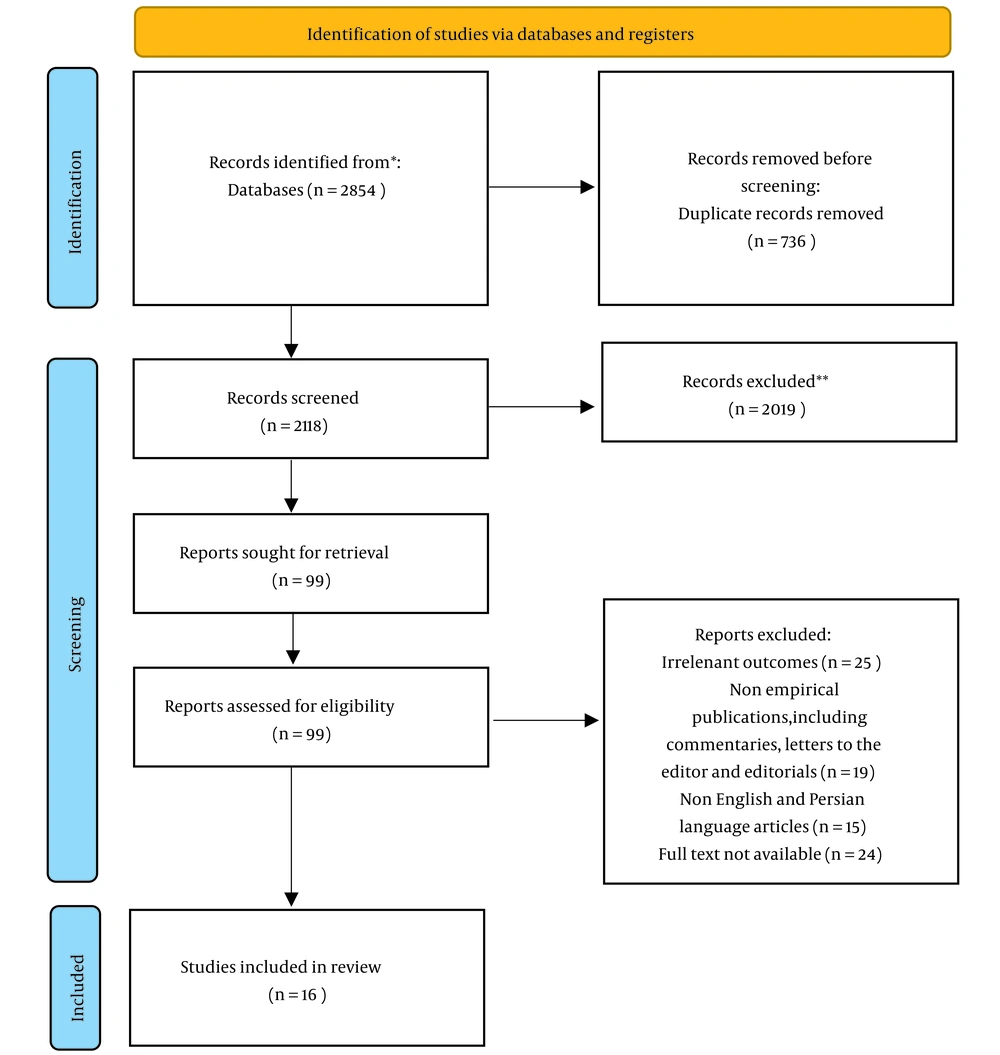
Figure 1.
PRISMA flow diagram (10)
Table 1.Characteristics and Thematic Classification of Included Studies This Table Combines the Core Characteristics of the 16 Included Studies with Their Thematic Classification, as Identified During the Synthesis
| Row | Year | First Authors | Study Type | Sampling Method | Participate | Conclusion |
|---|---|---|---|---|---|---|
| 1 | 2020 | Kilanya (11) | Cross-section | Simple random sampling | 96 | Caregivers of children receiving chemotherapy faced numerous psychosocial difficulties. |
| 2 | 2023 | Alghamdi (12) | Qualitative descriptive | Snowball technique | 17 | The study highlighted significant insights into the psychological, physiological, social, and financial consequences experienced by parents. |
| 3 | 2019 | Carlsson (13) | Explorative | Interview | 15 | These individuals encountered considerable difficulties in resuming their pre-diagnosis lives and managing the emotional trauma and persistent fears associated with their child’s cancer. |
| 4 | 2021 | Yeung (14) | Qualitative descriptive | Semi-structured interview | 15 | Throughout the course of cancer treatment, parents were exposed to numerous stressors; however, the adoption of effective coping mechanisms led to positive psychological outcomes. |
| 5 | 2021 | Ozdemir Koyu (15) | Cross-section | Anxiety and Depression Questionnaire | 172 | It is crucial for nursing professionals to design interventions that assist parents in handling the substantial responsibilities involved in caregiving during their child’s cancer journey. |
| 6 | 2022 | Agbayani (16) | Cross-section | Questionnaire | 51 | Reports from parents indicated the presence of unmet psychosocial needs, which may have long-term implications for health. |
| 7 | 2022 | Benedetto (17) | Cross-section | Questionnaire | 44 | Evidence supported the role of educational interventions in alleviating caregiving burdens, particularly among mothers of children diagnosed with leukemia. |
| 8 | 2019 | Eke (18) | Qualitative | Semi-structured interview | 27 | Parents frequently endured both emotional and financial hardships. Recognizing and implementing supportive measures is vital to help parents navigate the challenges of their child’s illness and medical care. |
| 9 | 2020 | Srivastava (19) | Cross-section | Questionnaire | 101 | Research confirmed a notably high incidence of depression and anxiety among parents whose children were undergoing chemotherapy. Furthermore, the type of cancer emerged as a significant predictor of parental depression, while educational attainment was linked to levels of anxiety. |
| 10 | 2023 | Melesse (20) | Qualitative descriptive | Semi-structured interview | 20 | Effective support strategies include providing targeted information and education, offering psychosocial assistance, enhancing nursing care, encouraging adaptive coping strategies among caregivers, improving access to chemotherapy medications, and strengthening communication with support organizations. |
| 11 | 2021 | Quast (21) | Cross-section | Questionnaire | 124 | Some caregivers reported only minimal distress, and interventions such as cognitive-behavioral therapy and problem-solving skills training were shown to enhance psychosocial functioning by addressing negative cognitive patterns. |
| 12 | 2022 | Chodidjah (22) | Phenomenology | Semi-structured interview | 47 | Healthcare professionals are encouraged to actively support families and adolescents, fostering resilience and positive adaptation during these challenging times. |
| 13 | 2022 | Deribe (23) | Phenomenology | Semi-structured interview | 15 | The overarching goal was to deliver comprehensive psycho-oncological care to parents and improve the guidance available regarding the child’s illness, treatment options, diagnostic procedures, and potential side effects. |
| 14 | 2022 | Mess (24) | Mix method | Questionnaire | 101 | Levels of caregiver anxiety and depression were closely related to the child’s age and functional status; younger children with lower functioning were associated with more severe depressive symptoms in parents. |
| 15 | 2023 | Ochoa-Dominguez (25) | Qualitative | Semi-structured interview | 15 | Despite pronounced psychological difficulties among Hispanic parents of children with breast cancer, there remained a lack of culturally tailored support programs. |
| 16 | 2020 | Colliva (26) | Cohort | Psychosocial assessment tool | 195 | The research also emphasized the complex interplay between patient-related factors such as profound sadness, frequent mood fluctuations, distractibility, or hyperactivity and parental well-being. |
5. Conclusions
Parents whose children are undergoing cancer treatment encounter profound psychosocial difficulties. They frequently endure substantial emotional stress, characterized by persistent fears of relapse, ongoing fatigue, and a sense of social isolation (27). Common challenges include financial strain, job insecurity or loss, and disruptions to family dynamics. Throughout the treatment period, parents tend to focus primarily on their child’s health while simultaneously adapting to an unfamiliar and often overwhelming medical environment (28). Once treatment ends, many parents find it challenging to resume normal routines and continue to grapple with residual psychological impacts (29). The experience of childhood cancer often brings about significant changes in family relationships, daily life patterns, and behavioral responses. Although psychological distress may lessen over time, sustained psychosocial support remains crucial, particularly in addressing ongoing concerns such as perceived risks, exhaustion, social withdrawal, and persistent anxieties (30).
Rosenberg et al. reported that parents of pediatric cancer patients exhibited lower levels of resilience and higher degrees of psychological distress compared to the general population. Reduced resilience was linked to greater psychological symptoms, diminished social support, and weaker family cohesion. As a result, parents with lower resilience were more susceptible to adverse outcomes, including increased psychological distress, recurring sleep problems, and lower satisfaction with their overall health (31). Anxiety is prevalent among parents of children diagnosed with cancer, often stemming from worries about the disease’s prognosis, the side effects of chemotherapy, and fears regarding the potential loss of their child. Studies consistently indicate that depression rates are significantly elevated among these parents compared to those with healthy children (32).
For example, Adu-Assiamah, in a study conducted at Korlov Teaching Hospital, explored the psychosocial burdens faced by parents of pediatric cancer patients. The study identified considerable hardships such as financial difficulties, unemployment, dependence on extended family for childcare, emotional turmoil, and even breakdowns in family structure. Importantly, participation in support groups was found to play a vital role in helping parents adjust and cope with the challenges of treatment (33).
In a similar vein, Carlsson et al. identified two principal themes in the experiences of parents during their child’s cancer therapy: Barriers encountered throughout treatment and enduring emotional struggles following its conclusion. Their findings underscored a notable lack of psychological support available to these parents, highlighting deficiencies within current care frameworks (13). Furthermore, Koumarianou et al. demonstrated that psychosocial interventions, especially cognitive behavioral therapy and problem-solving skills training, are effective in alleviating distress and strengthening coping abilities among parents of children with cancer (34).
Isolation experienced by parents, often due to limitations on daily activities and the increased focus on childcare, has led to reduced social support networks and greater feelings of loneliness. This isolation can trigger a detrimental cycle, worsening psychological distress and further endangering parental mental health. Moreover, financial pressures resulting from higher medical costs and loss of income, whether through decreased work hours or job resignation, have substantially increased the psychological burden on families. These findings are consistent with established theories highlighting the impact of socioeconomic factors on family mental health (35).
Kearney et al. found that parental distress is most acute at the time of a child’s cancer diagnosis but typically diminishes to pre-diagnosis levels over time. However, many parents continue to exhibit symptoms related to post-traumatic stress. The evidence underscores the importance of early detection and continuous assessment of parents’ mental health needs, along with providing access to appropriate interventions to promote overall well-being (36). Additionally, changes in family relationships and marital quality have been identified as significant contributors to parenting challenges. Increased marital conflict and reduced emotional support between partners can compromise childcare effectiveness and exacerbate psychological difficulties for parents. Therefore, it is essential to approach the family as an integrated social system when assessing and delivering support (37).
Targeted psychological interventions, training in adaptive coping strategies, and the development of support networks can help relieve psychological distress. Incorporating these measures into the care plans for children with cancer is vital for improving parental mental health and supporting the child’s treatment process. On the other hand, identifying protective factors such as strong social connections, effective coping skills, and robust psychological resources is crucial for reducing negative psychosocial outcomes among parents (38).
This systematic review reveals that anxiety, depression, and post-traumatic stress disorder (PTSD) are among the most common psychological challenges faced by these parents. These issues arise from ongoing worries about their child’s health, uncertainty about disease progression, and exposure to severe side effects of treatment. The findings reinforce previous studies that have identified anxiety and depression as frequent psychological responses in parents of children diagnosed with cancer.
5.1. Conclusions
Investigations into the psychosocial difficulties encountered by parents of children receiving chemotherapy underscore the diverse range of stressors they must manage throughout their child’s intensive treatment journey. In addition to addressing the physical and clinical demands of chemotherapy, parents are confronted with numerous psychosocial concerns that have a profound impact on their emotional and social health. These issues encompass heightened anxiety and stress associated with treatment protocols, financial strain, obstacles in family communication, and disruptions to social relationships resulting from the child’s illness. Evidence from studies included in this systematic review indicates that parents, particularly during the early phases of treatment and at pivotal moments, experience emotions such as sadness, depression, anxiety, and increased familial tension. Such psychological burdens can diminish parents’ quality of life and adversely affect their mental well-being, especially in the absence of sufficient social support or when financial difficulties are present. Furthermore, negative social experiences and a sense of isolation may intensify these psychological challenges. Consequently, it is crucial to implement supportive measures, ensure access to psychological counseling, and build robust social support networks for these parents. Establishing therapeutic settings that provide both comprehensive information and emotional support can play a significant role in alleviating stress and enhancing overall well-being. It is recommended that mental health policymakers and health systems institutionalize structured support programs, including psychological counseling, peer support groups, and coping skills training, in pediatric cancer treatment centers. Also, future research should focus on designing and evaluating evidence-based psychosocial interventions for parents and examine the impact of these interventions on families’ quality of life.
5.2. Limitations of the Study
This review was targeted at studies in Persian and English, so some influential and high-quality studies may have been missed. Despite a comprehensive search and identification of relevant studies, meta-analysis was not possible for this study because there was no homogeneous and aggregated quantitative data in terms of psychosocial indicators in the included studies. Most of the studies had qualitative designs, diverse conceptual dimensions, different measurement instruments, and heterogeneous outcome variables, which precluded statistical equivalence and calculation of joint effect sizes. Since a prerequisite for meta-analysis is relative homogeneity in design, measurement variables, and indicators, in the absence of these conditions, performing meta-analysis would not only be misleading but may also lead to incorrect and invalid interpretations. Therefore, systematic qualitative analysis was the most accurate and valid approach to answer the research question.

