The Relationship Between Anxiety and Depression Symptoms and Disease Activity in Patients with Inflammatory Bowel Disease

Author(s):
Mehrnaz AsgharnezhadMehrnaz AsgharnezhadMehrnaz Asgharnezhad ORCID1, Saman MaroufizadehSaman MaroufizadehSaman Maroufizadeh ORCID2, Adele IsanazarAdele IsanazarAdele Isanazar ORCID3, Zahra HedayatzadehZahra HedayatzadehZahra Hedayatzadeh ORCID1, Farahnaz JoukarFarahnaz JoukarFarahnaz Joukar ORCID1,*, Mohammadreza NaghipourMohammadreza Naghipour1, Fariborz Mansour-GhanaeiFariborz Mansour-GhanaeiFariborz Mansour-Ghanaei ORCID1,**
1Gastrointestinal and Liver Diseases Research Center, Guilan University of Medical Sciences, Rasht, Iran
2Department of Biostatistics and Epidemiology, School of Health, Guilan University of Medical Sciences, Rasht, Iran
3Kavosh Cognitive Behavior Sciences and Addiction Research Center, School of Medicine, Guilan University of Medical Sciences, Rasht, Iran
Corresponding Authors:

IJ Psychiatry and Behavioral Sciences:Vol. 20, issue 2; e166018
Published online:Jun 02, 2026
Article type:Research Article
Received:Sep 03, 2025
Accepted:May 22, 2026
How to Cite:Asgharnezhad M, Maroufizadeh S, Isanazar A, Hedayatzadeh Z, Joukar F, et al. The Relationship Between Anxiety and Depression Symptoms and Disease Activity in Patients with Inflammatory Bowel Disease. Iran J Psychiatry Behav Sci. 2026;20(2):e166018. doi: https://doi.org/10.5812/ijpbs-166018

Abstract

Background:

Anxiety and depression are common in inflammatory bowel disease (IBD) and may be associated with disease activity.

Objectives:

This study aimed to evaluate the association between psychological factors, specifically anxiety and depression, and disease activity in patients with IBD.

Methods:

In this cross-sectional study conducted between 2022 and 2024, 307 patients with IBD from Guilan Province were analyzed. Eligible participants were adults aged ≥ 18 years who were registered in the Iranian Registry of Crohn’s and Colitis (IRCC) and had diagnoses confirmed by gastroenterologists on the basis of clinical, endoscopic, and histopathological criteria. Patients were consecutively enrolled and classified as having active or inactive disease according to recent hospitalization and validated indices, including the Modified Truelove and Witts Severity Index (MTWSI)/Mayo score for ulcerative colitis (UC) and the Harvey-Bradshaw Index (HBI) for Crohn’s disease (CD). Anxiety and depression were assessed using the Generalized Anxiety Disorder 7-item (GAD-7) and Patient Health Questionnaire-9 (PHQ-9) scales.

Results:

The mean age was 45.40 years; 32.90% of participants were male, and 67.10% were female. The mean disease duration was 11.30 years, and 73.00% had at least 1 comorbidity. Each 1-point increase in the GAD-7 and PHQ-9 scores was associated with 1.38-fold higher odds of active disease (95% CI, 1.24 - 1.54 and 1.25 - 1.54, respectively; P < 0.001). These associations remained significant after adjustment for confounders (adjusted OR for GAD-7, 1.44; 95% CI, 1.27 - 1.65; adjusted OR for PHQ-9, 1.37; 95% CI, 1.22 - 1.54; P < 0.001). These findings indicate that psychological distress is independently associated with IBD activity.

Conclusions:

These findings highlight an association between psychological distress and IBD activity. Given the cross-sectional design, the directionality of this association cannot be established, and reverse causation, whereby active disease may contribute to psychological distress, remains a plausible explanation.

1. Background

Inflammatory bowel diseases (IBDs), including Crohn’s disease (CD) and ulcerative colitis (UC), are chronic inflammatory disorders of the gastrointestinal tract characterized by a relapsing–remitting course and substantial morbidity (1, 2). The global prevalence of IBD has risen steadily, with approximately 5 million individuals currently affected worldwide (3). In Iran, the incidence of IBD has also increased, which has been attributed to low mortality, early-age diagnosis, and the chronic nature of the disease (4). A national study conducted in 2012 reported a prevalence of 35.50 cases per 100000 for UC and 5 cases per 100000 for CD (5). Given the chronic and disabling nature of IBD, investigating disease activity and associated factors in specific geographic regions is essential. Such investigations can enhance the understanding of disease patterns, support health care planning, and guide targeted interventions to improve patient care and resource allocation (6, 7).
The pathogenesis of IBD involves a multifactorial interplay among genetic susceptibility, environmental influences, microbial imbalance, and immune dysregulation; however, its precise etiology remains unclear (8-10). Beyond typical gastrointestinal manifestations, patients frequently experience extraintestinal symptoms such as fatigue, anxiety, and depression (11). Although IBD is primarily defined by physical symptoms, emerging evidence indicates a strong association between psychological comorbidities and disease activity, particularly anxiety and depression (12, 13). In the IBD population, depression affects approximately 22% - 25% of patients and anxiety affects 32% - 35%, nearly double the prevalence observed in the general population (14). These psychiatric conditions are associated with higher rates of disease relapse, increased health care utilization, greater hospitalization, elevated treatment costs, and reduced adherence to therapy (11). Importantly, patients with active IBD report higher levels of anxiety and depression than those in remission (15, 16).
Despite this growing body of evidence, most previous studies have been conducted in Western populations, have used heterogeneous measurement tools, and have often lacked rigorous adjustment for confounding variables such as age, sex, disease duration, comorbidities, and lifestyle factors (17-19). Furthermore, registry-based studies examining the association between psychiatric symptoms and disease activity in Iranian patients with IBD remain scarce, highlighting a substantial gap in regional data (20). Consequently, it remains unclear whether the associations observed in other populations apply to Iranian patients and whether key demographic and clinical factors influence these relationships.

2. Objectives

This study addressed this gap by investigating the association between symptoms of anxiety and depression and disease activity in patients registered in the Iranian Registry of Crohn’s and Colitis (IRCC), adjusting for key demographic and clinical confounders to provide culturally relevant evidence.

3. Methods

3.1. Study Design and Participants

This cross-sectional study was conducted between 2022 and 2024 by the Gastrointestinal and Liver Diseases Research Center (GLDRC) in northern Iran. A total of 307 adult patients with IBD, including 257 with UC and 50 with CD, were recruited from the IRCC (http://clinic.ddrc.ac.ir/IBDregistry), which is affiliated with the GLDRC. All diagnoses were confirmed by gastroenterologists based on clinical, laboratory, endoscopic, and histopathological evaluations.
The study was conducted in accordance with the ethical principles of the Declaration of Helsinki, and written informed consent was obtained from all participants before enrollment. Confidentiality was strictly maintained: All registry and questionnaire data were anonymized before analysis, personal identifiers were removed, and access to raw data was restricted to the research team. Nevertheless, as a cross-sectional study, it may be subject to selection and recall bias. To minimize these biases, validated questionnaires, standardized data collection protocols, and trained research personnel were used. Results were reported in aggregate to prevent individual identification.

3.2. Sampling Method and Sample Size Calculation

Participants were selected from the IRCC using a consecutive sampling approach to ensure comprehensive inclusion of eligible cases. The primary objective was to compare mean anxiety, depression, and related clinical and psychological variables between patients with active and inactive IBD.
To determine the required sample size for multivariable analyses, we applied the 10-events-per-variable (EPV) principle, which recommends at least 10 outcome events for each predictor included in the model to ensure coefficient stability and reduce overfitting. Based on a previously reported 41% prevalence of active disease in similar IBD cohorts (21) and 12 independent variables planned for inclusion in the adjusted model, the minimum required sample size was calculated as 294 patients.
A total of 307 participants were ultimately enrolled, exceeding the minimum requirement. This corresponded to approximately 126 events of active disease (41% of 307), yielding an EPV of approximately 10.5. This satisfied the recommended EPV ≥ 10 threshold and supported the adequacy and stability of the multivariable logistic regression estimates.

3.3. Definition of Active and Inactive IBD

Active IBD was defined as hospitalization for a clinically confirmed disease exacerbation. Disease activity was verified using validated clinical indices, including the Modified Truelove and Witts Severity Index (MTWSI) and Mayo score for UC and the Harvey-Bradshaw Index (HBI) for CD. Final classification was established by gastroenterology specialists integrating clinical presentation, laboratory findings, endoscopy, and histopathology according to international guidelines.
The MTWSI comprises 8 clinical items: number of daily stools, nocturnal diarrhea, percentage of stools with visible blood, fecal incontinence, abdominal pain or cramping, general well-being, abdominal tenderness, and the need for antidiarrheal or narcotic medication. The total MTWSI score ranges from 0 to 21, with higher scores indicating greater disease severity. Many studies define clinical remission as ≤ 4 and severe disease as scores > 10 (22, 23). The Mayo score evaluates stool frequency, rectal bleeding, endoscopic findings, and the physician’s global assessment. Each subscore ranges from 0 to 3, yielding a total score between 0 and 12, with higher scores reflecting greater disease severity (24). The HBI consists of 5 clinical domains: general well-being, abdominal pain, number of liquid stools per day, presence or extent of abdominal mass, and complications, such as arthralgia, uveitis, erythema nodosum, aphthous ulcers, anal fissures, fistulas, or abscesses. Common severity thresholds categorize remission as < 5, mild disease as 5 - 7, moderate disease as 8 - 16, and severe disease as > 16 (25).
Inactive IBD was defined as the absence of disease-related hospitalization and sustained clinical and biochemical remission for at least 3 months. Participants in remission were systematically selected from the IRCC and matched by age and sex to reduce confounding. Disease inactivity was verified through clinical follow-up and laboratory parameters to ensure the stability of remission.

3.4. Data Collection and Variables

Data were collected using structured questionnaires and face-to-face interviews conducted by a trained doctoral researcher to ensure consistency and minimize measurement bias. Demographic and clinical variables included age, sex, marital status, education level, body mass index (BMI), smoking status, alcohol consumption, type and duration of IBD, comorbidities including tuberculosis (TB), hepatitis, HIV/AIDS, diabetes, kidney disease, liver disease, cardiovascular disease, lung disease, depression, anemia, blood disorders, cancer, appendectomy, peptic ulcers, and chronic back pain, family history of IBD, and age at diagnosis.

3.5. Assessment of Anxiety and Depression

Psychological symptoms were assessed using 2 widely validated self-report questionnaires: the Generalized Anxiety Disorder 7-item scale (GAD-7) and the Patient Health Questionnaire-9 (PHQ-9). The GAD-7 is a brief instrument comprising 7 items that capture the frequency of core anxiety symptoms during the preceding 2 weeks (26). Each item is rated on a 4-point Likert scale ranging from 0 ("not at all") to 3 ("nearly every day"), producing a cumulative score between 0 and 21. Higher scores denote greater symptom severity, with a threshold of ≥ 10 commonly applied to identify clinically relevant anxiety (27). The Persian adaptation of the GAD-7 has been validated with robust psychometric performance in Iranian populations, and its internal consistency in the current cohort was high (Cronbach α = 0.830).
The PHQ-9 was used to evaluate depressive symptoms. This tool consists of 9 items reflecting DSM-IV criteria for major depressive disorder (28), also rated on a 0 - 3 Likert scale according to symptom frequency over the previous 2 weeks. The total score ranges from 0 to 27, with higher values corresponding to more severe depressive symptomatology; scores ≥ 10 are indicative of probable depressive disorder (29). The Persian version of the PHQ-9 has been shown to be reliable and valid across diverse Iranian samples, and reliability in our study was acceptable (Cronbach α = 0.847).

3.6. Inclusion and Exclusion Criteria

Eligible participants were adults aged ≥ 18 years with a confirmed diagnosis of UC or CD by a board-certified gastroenterologist and registered in the IRCC. Participants were required to be able to understand and complete the study questionnaires and provide written informed consent.
Individuals were excluded if they were pregnant, had a severe mental illness, were unable to complete the questionnaires, or had concurrent severe medical conditions such as respiratory or renal failure or malignancy. Additional exclusion criteria included conditions or circumstances known to influence sleep, mood, or circadian rhythms, such as restless legs syndrome or engagement in rotating or shift work, as well as the use of medications that could affect mood, cognition, or sleep patterns (eg, antiallergics, corticosteroids at psychiatric doses, anesthetics, or central pain-modulating agents). Participants taking medications known to alter psychological status or those who declined participation were also excluded from the study.

3.7. Statistical Analysis

Continuous variables were summarized as mean (SD) or median (IQR), and categorical variables were summarized as n (%). The normality of GAD-7 and PHQ-9 scores was tested using the Kolmogorov-Smirnov test. Because of non-normality, the Mann-Whitney test was applied to compare scores between the active and inactive groups. The Cochran-Armitage test for trend was used to compare the severity of depression and anxiety. Logistic regression models estimated the association of active disease with anxiety and depression symptoms, reporting crude and adjusted odds ratios (ORs) with 95% confidence intervals (CIs) per 1-point increase in GAD-7 and PHQ-9 scores.
Data analysis was performed using SPSS for Windows, version 16.0 (SPSS Inc, Chicago, IL, USA), and figures were generated with GraphPad Prism, version 8.0.1 (GraphPad Software Inc, San Diego, CA, USA). A 2-tailed P value < 0.050 was considered statistically significant.

4. Results

4.1. Patient Characteristics

The mean age was 45.40 years in the overall IBD group, with mean ages of 45.80 and 43.70 years in the UC and CD groups, respectively. Overall, 32.90% of patients were male and 67.10% were female. With respect to marital status, 19.20% were single and 80.80% were married. Regarding education, 30.30% were illiterate, 40.10% had primary or secondary education, and 29.60% had university-level education. The mean BMI was 25.00 kg/m2 (SD, 4.40). Approximately 83.10% of patients had never smoked, and 5.20% reported alcohol consumption. The mean disease duration was 11.30 years, and the mean age at diagnosis was 34.10 years. A family history of IBD was reported in 6.20% of cases, and comorbidities were present in 73.00% of patients (Table 1).
Table 1.Demographic Characteristics of Patients with Inflammatory Bowel Disease a
VariablesTotal IBD (n = 307)Ulcerative Colitis (n = 257)Crohn's Disease (n = 50)
Age (y)45.40 ± 13.1045.80 ± 13.2043.70 ± 12.10
Gender
Male101 (32.90)85 (33.10)16 (32.00)
Female206 (67.10)172 (66.90)34 (68.00)
Marital status
Single59 (19.20)48 (18.70)11 (22.00)
Married248 (80.80)209 (81.30)39 (78.00)
Ethnicity
Guilak264 (86.00)222 (86.40)42 (84.00)
Other43 (14.00)35 (13.60)8 (16.00)
Education
Illiterate93 (30.30)80 (31.10)13 (26.00)
Primary/secondary123 (40.10)103 (40.10)20 (40.00)
University91 (29.60)74 (28.80)17 (34.00)
BMI (kg/m2)25.00 ± 4.4025.30 ± 4.3023.30 ± 4.40
Smoking status
Never255 (83.10)212 (82.50)43 (86.00)
Former24 (7.80)21 (8.20)3 (6.00)
Current28 (9.10)24 (9.30)4 (8.00)
Hookah use12 (3.90)10 (3.90)2 (4.00)
Alcohol consumption16 (5.20)15 (5.80)1 (2.00)
Disease duration (y)11.30 ± 7.9011.40 ± 8.1010.60 ± 7.00
Age at diagnosis (y)34.10 ± 12.7033.30 ± 12.8033.10 ± 12.20
Family history of IBD19 (6.20)17 (6.60)2 (4.00)
Comorbidity b224 (73.00)185 (72.00)39 (78.00)

a Values are expressed as No. (%) or mean ± SD. Abbreviations: BMI, Body Mass Index; IBD, inflammatory bowel disease; SD, standard deviation.

b Tuberculosis, hepatitis, HIV/AIDS, diabetes, kidney disease, liver disease, heart disease, lung disease, depression, anemia, blood disorders, cancer, appendectomy, peptic ulcers, and chronic back pain.

4.2. Distribution of GAD-7 and PHQ-9 Scores by Disease Activity

As shown in Table 2, among patients with IBD, the prevalence of anxiety was 12.10% in active patients and 0.70% in inactive patients, with a significant difference (P < 0.001). Active patients were also more likely than inactive patients to meet the criteria for depressive disorder (16.60% vs 2.60%; P < 0.001). Similar findings were observed for total scores and severity cutoff scores for both the GAD-7 and PHQ-9 (Table 2 and Figure 1). Similar results were also obtained when analyses were conducted separately for patients with UC and CD.
Table 2.Distribution of Patients with Active and Inactive IBD Across GAD-7 and PHQ-9 Severity Ratings a
VariablesUlcerative ColitisCrohn's DiseaseTotal IBD
Inactive (n = 130)Active (n = 127)P-ValueInactive (n = 20)Active (n = 30)P-ValueInactive (n = 150)Active (n = 157)P-Value
GAD-7
Severity< 0.001 b0.041 b< 0.001 b
No anxiety (0 - 4)122 (93.80)78 (61.40)19 (95.00)22 (73.30)141 (94.00)100 (63.70)
Mild (5 - 9)7 (5.40)35 (27.60)1 (5.00)3 (10.00)8 (5.30)38 (24.20)
Moderate (10 - 14)1 (0.80)10 (7.90)0 (0.00)4 (13.30)1 (0.70)14 (8.90)
Severe (15 - 21)0 (0.00)4 (3.10)0 (0.00)1 (3.30)0 (0.00)5 (3.20)
Mean (SD)1.00 (1.67)3.74 (4.27)0.75 (1.58)3.30 (4.57)0.97 (1.66)3.66 (4.32)
Median (IQR)0 (0.00 - 2.00)3.00 (0.00 - 6.00)< 0.001 c0 (0.00 - 0.75)1.00 (0.00 - 5.25)0.025 b0.00 (0.00 - 2.00)2.00 (0.00 - 6.00)< 0.001 c
PHQ-9
Severity< 0.001 b0.019 b< 0.001 b
None-minimal (0 - 4)123 (94.60)79 (62.20)17 (85.00)17 (56.70)140 (93.30)96 (61.10)
Mild (5 - 9)5 (3.80)29 (22.80)3 (15.00)6 (20.00)8 (5.30)35 (22.30)
Moderate (10 - 14)2 (1.50)10 (7.90)0 (0.00)4 (13.30)2 (1.30)14 (8.90)
Moderately severe (15 - 19)0 (0.00)8 (6.30)0 (0.00)1 (3.30)2 (1.30)9 (5.70)
Severe (20 - 27)0 (0.00)1 (0.40)0 (0.00)2 (6.70)0 (0.00)3 (1.90)
Mean (SD)1.04 (1.85)4.44 (4.91)1.55 (2.33)5.50 (6.66)1.11 (1.92)4.64 (5.28)
Median (IQR)0 (0.00 - 1.25)3.00 (0.00 - 7.00)< 0.001 c0 (0.00 - 3.50)2.00 (0.00 - 8.50)0.018 c0.00 (0.00 - 2.00)0.30 (0.00 - 7.50)< 0.001 c

a Values are expressed as No. (%) unless indicated. Abbreviations: GAD-7, Generalized Anxiety Disorder-7; IBD, inflammatory bowel disease; IQR, interquartile range; PHQ-9, Patient Health Questionnaire-9; SD, standard deviation.

b Cochran-Armitage test for trend.

c Mann-Whitney test.
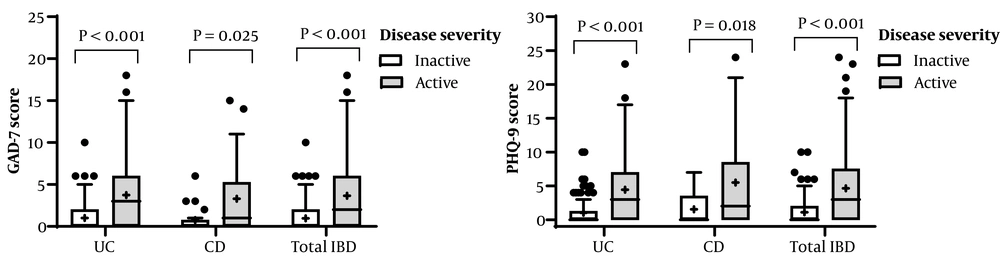
Anxiety and depression scores in patients with active and inactive IBD. Abbreviations: CD, Crohn's disease; GAD-7, Generalized Anxiety Disorder-7; IBD, inflammatory bowel disease; PHQ-9, Patient Health Questionnaire-9; UC, ulcerative colitis. Note: The box plot shows the minimum, first quartile, median, third quartile, and maximum values. Outliers are shown by black dots. The plus sign represents the mean. P values are based on the Mann-Whitney test.
Figure 1.

Anxiety and depression scores in patients with active and inactive IBD. Abbreviations: CD, Crohn's disease; GAD-7, Generalized Anxiety Disorder-7; IBD, inflammatory bowel disease; PHQ-9, Patient Health Questionnaire-9; UC, ulcerative colitis. Note: The box plot shows the minimum, first quartile, median, third quartile, and maximum values. Outliers are shown by black dots. The plus sign represents the mean. P values are based on the Mann-Whitney test.

4.3. Anxiety and Depression Symptoms and Disease Activity

In the unadjusted model, the GAD-7 score was significantly associated with active disease among all patients with IBD. The odds ratio for a 1-point increase in the GAD-7 score was 1.38 (95% CI, 1.24 - 1.54). This association remained significant after adjustment for selected demographic and clinical variables (OR, 1.44; 95% CI, 1.27 - 1.65). Similar ORs were observed separately for patients with UC and CD in both adjusted and unadjusted analyses, although the association for patients with CD in the adjusted analysis was not statistically significant (Table 3).
Table 3.Relationship Between Anxiety and Depression Symptoms and Disease Activity in Patients with Inflammatory Bowel Disease a
VariablesActive Disease
Unadjusted AnalysisAdjusted Analysis
OR (95% CI)P-ValueOR (95% CI) bP-Value
GAD-7 score
Ulcerative colitis1.40 (1.24 - 1.58)< 0.0011.48 (1.28 - 1.71)< 0.001
Crohn's disease1.34 (1.01 - 1.79)0.0491.41 (0.82 - 2.43)0.220
Total IBD1.38 (1.24 - 1.54)< 0.0011.44 (1.27 - 1.65)< 0.001
PHQ-9 score
Ulcerative colitis1.43 (1.27 - 1.62)< 0.0011.40 (1.23 - 1.59)< 0.001
Crohn's disease1.23 (1.02 - 1.49)0.0291.28 (0.88 - 1.85)0.198
Total IBD1.38 (1.25 - 1.54)< 0.0011.37 (1.22 - 1.54)< 0.001

a ORs were calculated for a 1-point increase in GAD-7 and PHQ-9 scores. Abbreviations: CI, confidence interval; GAD-7, Generalized Anxiety Disorder-7; IBD, inflammatory bowel disease; OR, odds ratio; PHQ-9, Patient Health Questionnaire-9.

b Adjusted for age, sex, marital status, ethnicity, education, BMI, smoking status, alcohol consumption, disease duration, family history of IBD, and comorbidities.

In the overall study population, a 1-point increase in the PHQ-9 score was associated with 1.38-fold increased odds of active disease (95% CI, 1.25 - 1.54). In the adjusted analysis, the OR remained statistically significant (OR, 1.37; 95% CI, 1.22 - 1.54). Similar ORs were observed separately for patients with UC and CD in both adjusted and unadjusted analyses, although the association for patients with CD in the adjusted analysis was not statistically significant (Table 3).

5. Discussion

This study, involving 307 patients with IBD, found that 12.80% experienced moderate-to-severe anxiety and 19.20% experienced depression. These prevalence estimates are generally consistent with reports from other populations, although rates vary by geography and the measurement instruments used. Lewis et al. reported anxiety in 30.60% and depression in 40.10% of 242 patients with IBD, underscoring the substantial psychiatric burden in this population (30). Similarly, a study of 2478 Chinese patients with IBD found that 25.50% and 29.70% met criteria for moderate-to-severe anxiety and depression, respectively (31). Importantly, multiple studies consistently demonstrate that patients with active disease have higher rates of psychiatric symptoms than those in remission (21, 32).
Hospitalization and active disease are particularly associated with an elevated psychiatric burden. Patients with IBD who experience anxiety or depression are at greater risk of hospitalization, emergency department visits, readmission, and increased outpatient utilization than those without psychiatric comorbidity (33, 34). This is further supported by a systematic review and meta-analysis confirming that patients with IBD are more likely to develop anxiety and depression than the general population. Moreover, individuals with a history of depression appear to have an increased risk of subsequently developing IBD, suggesting a potential bidirectional relationship (35). Consistent with these findings, our study showed that active IBD was significantly associated with higher GAD-7 and PHQ-9 scores. However, because of the cross-sectional design, the causal direction cannot be established, which represents an important limitation.
Emerging research highlights the microbiota-gut-brain (MGB) axis as a plausible mechanism linking psychiatric symptoms and IBD activity. Certain gut microbiota are associated with alterations in brain function and depressive symptoms in major depressive disorder (36), and disruption of gut-brain pathways in IBD may contribute to psychiatric comorbidities through immune, neural, and inflammatory mechanisms (37). Recognition and management of anxiety and depression remain important for overall patient care and quality of life (38). However, our cross-sectional design does not permit inference that treating these symptoms would directly reduce IBD activity. Prospective and interventional studies are required to determine causal effects.
Psychiatric comorbidities are associated with a worse clinical course in IBD. Prospective cohort studies have shown that depressive symptoms predict an increased risk of symptomatic relapse and shorter remission intervals and that anxiety symptoms are linked to a higher likelihood of flare, the need for corticosteroids, and escalation of therapy (39, 40). Depressive symptoms are associated with a higher likelihood of UC and CD exacerbation, whereas anxiety appears to be more strongly associated with flare activity in CD (41). One potential explanation is that patients with depression may have reduced medication adherence, directly affecting disease control. Additionally, corticosteroid treatment commonly used in IBD can influence mood, further complicating the management of psychiatric symptoms (42). Psychological distress is associated with an increased likelihood of disease activity in IBD through activation of the hypothalamic-pituitary-adrenal axis, disruption of intestinal barrier function, alterations in gut microbiota composition, and enhanced mucosal immune and inflammatory signaling (43). Nevertheless, the presence of these associations does not indicate directionality in our dataset, and reverse causation, whereby disease activity drives psychological symptoms, remains a highly plausible explanation.
Our study also found that, as anxiety severity increased, its correlation with disease activity strengthened in both UC and CD patients, consistent with recent studies demonstrating that higher anxiety and depression scores predict greater clinical disease activity in both UC and CD (31, 38). In multivariable models, depressive symptoms were associated with a 1.78-fold higher risk of disease exacerbation. These results align with a Swiss study of 2870 patients, which found that elevated depressive symptoms predicted symptomatic relapse using the Crohn’s Disease Activity Index for CD and MTWSI for UC, whereas anxiety predicted relapse in CD (41). Similarly, a US-based online cohort demonstrated that baseline Patient Health Questionnaire-8 depression scores predicted an increased risk of flare, hospitalization, and surgery over 22 months in patients with CD (44).
Nevertheless, the cross-sectional design of our study precludes causal inference, leaving the temporal relationship between psychological distress and disease activity unresolved. Active IBD is frequently accompanied by abdominal pain, fatigue, hospitalization, dietary limitations, treatment burden, and other disease-related stressors, all of which may exacerbate anxiety and depressive symptoms. Moreover, factors such as corticosteroid use, biologic therapy, chronic pain, and sleep disturbances may further modulate both psychological distress and disease activity. Consequently, although a robust association was observed, the potential for reverse causation, whereby disease activity drives psychological symptoms, cannot be discounted.
This study has several strengths, including its relatively large and well-characterized cohort, the use of validated psychiatric and clinical indices, and adjustment for a broad range of demographic and clinical confounders, such as age, sex, marital status, education, BMI, smoking, alcohol use, disease duration, family history, and comorbidities. However, the cross-sectional design is a key limitation that precludes causal inference and prevents clarification of whether psychological symptoms precede, accompany, or result from disease activity. Although multiple demographic and clinical factors were adjusted for, some treatment-related variables, such as corticosteroid or biologic therapy, were not consistently available and could not be modeled independently of disease activity. Additional sources of potential residual confounding, such as socioeconomic status, psychiatric history, sleep disorders, and medication adherence, cannot be excluded. Registry-based data may also be subject to occasional entry inconsistencies. Furthermore, psychiatric assessments relied on self-report instruments, and the single regional setting may limit generalizability. In addition, the small number of patients with CD (n = 50) limits the statistical power for subgroup analyses; therefore, all CD-specific findings should be interpreted as exploratory. Collectively, these considerations emphasize the need for multicenter longitudinal studies incorporating objective biomarkers and comprehensive psychiatric evaluation to better establish the directionality of the observed associations.

5.1. Conclusions

This study highlights the intricate interplay between anxiety, depressive symptoms, and disease activity in patients with IBD. The findings demonstrate that anxiety and depressive disorders are markedly more prevalent among patients with active disease than among those in remission, indicating a robust association between psychological distress and clinical disease status. The strong and consistent associations between GAD-7 and PHQ-9 scores and IBD activity, even after adjustment for key demographic and clinical variables, underscore the clinical relevance of incorporating psychological assessment into routine IBD management. These associations suggest that patients with elevated psychological distress may be at higher risk of active disease; however, these relationships must be interpreted with caution because of the study design. Early identification and management of anxiety and depression may improve patient well-being, but longitudinal studies are needed to clarify causal pathways.

Acknowledgments

Footnotes

References

  • 1.
    Barberio B, Zamani M, Black CJ, Savarino EV, Ford AC. Prevalence of symptoms of anxiety and depression in patients with inflammatory bowel disease: A systematic review and meta-analysis. Lancet Gastroenterol Hepatol. 2021;6(5):359-370. [PubMed ID: 33721557]. https://doi.org/10.1016/S2468-1253(21)00014-5.
  • 2.
    Long D. Crohn's disease and ulcerative colitis: From pathophysiology to novel therapeutic approaches. Biomedicines. 2024;12(3):689. [PubMed ID: 38540302]. [PubMed Central ID: PMC10967867]. https://doi.org/10.3390/biomedicines12030689.
  • 3.
    Saberzadeh-Ardestani B, Khosravi AA, Mansour-Ghanaei F, Vahedi H, Baniasadi N, Seyyedmajidi M, et al. Clinical phenotype and disease course of inflammatory bowel disease in Iran: Results of the Iranian registry of Crohn's and colitis (IRCC). Arch Iran Med. 2024;27(4):183-190. [PubMed ID: 38685844]. [PubMed Central ID: PMC11097309]. https://doi.org/10.34172/aim.2024.27.
  • 4.
    Pakdin M, Zarei L, Bagheri Lankarani K, Ghahramani S. The cost of illness analysis of inflammatory bowel disease. BMC Gastroenterol. 2023;23(1). 21. [PubMed ID: 36658489]. [PubMed Central ID: PMC9854042]. https://doi.org/10.1186/s12876-023-02648-z.
  • 5.
    Ghahramani S, Shojaadini H, Akbarzade A, Sadeghi F, Hajianpour V, Nozaie F, et al. Hospital cost of inflammatory bowel disease and its determinants in a multicenter study from Iran. Middle East J Dig Dis. 2023;15(3):167-174. [PubMed ID: 38023468]. [PubMed Central ID: PMC10660313]. https://doi.org/10.34172/mejdd.2023.339.
  • 6.
    M’Koma AE. Inflammatory bowel disease: Clinical diagnosis and surgical treatment-overview. Medicina (B Aires). 2022;58(5):567. [PubMed ID: 35629984]. [PubMed Central ID: PMC9144337]. https://doi.org/10.3390/medicina58050567.
  • 7.
    Olfatifar M, Zali MR, Pourhoseingholi MA, Balaii H, Ghavami SB, Ivanchuk M, et al. The emerging epidemic of inflammatory bowel disease in Asia and Iran by 2035: A modeling study. BMC Gastroenterol. 2021;21(1). 204. [PubMed ID: 33957874]. [PubMed Central ID: PMC8101120]. https://doi.org/10.1186/s12876-021-01745-1.
  • 8.
    Alnafisah K, Alsaleem HN, Aldakheel FN, Alrashidi AB, Alayid RA, Almuhayzi HN, et al. Anxiety and depression in patients with inflammatory bowel disease at King Fahad Specialist Hospital, Qassim Region. Cureus. 2023;15(9):e44895. [PubMed ID: 37814763]. [PubMed Central ID: PMC10560450]. https://doi.org/10.7759/cureus.44895.
  • 9.
    Haneishi Y, Furuya Y, Hasegawa M, Picarelli A, Rossi M, Miyamoto J. Inflammatory bowel diseases and gut microbiota. Int J Mol Sci. 2023;24(4):3817. [PubMed ID: 36835245]. [PubMed Central ID: PMC9958622]. https://doi.org/10.3390/ijms24043817.
  • 10.
    Abdullah Albadrani A, Alshowair M, Al Abdulqader A, Huang V. Risk factor analysis and prevalence of infectious agents in inflammatory bowel disease flares: A retrospective study. Jundishapur J Microbiol. 2025;18(3):1-5. https://doi.org/10.5812/jjm-158623.
  • 11.
    Raman M, Rajagopalan V, Kaur S, Reimer RA, Ma C, Ghosh S, et al. Physical activity in patients with inflammatory bowel disease: A narrative review. Inflamm Bowel Dis. 2022;28(7):1100-1111. [PubMed ID: 34605548]. https://doi.org/10.1093/ibd/izab218.
  • 12.
    Tavakoli P, Vollmer-Conna U, Hadzi-Pavlovic D, Grimm MC. A review of inflammatory bowel disease: A model of microbial, immune and neuropsychological integration. Public Health Rev. 2021;42. 1603990. [PubMed ID: 34692176]. [PubMed Central ID: PMC8386758]. https://doi.org/10.3389/phrs.2021.1603990.
  • 13.
    Harorani M, Karbasi Amel A, Ahmadzadeh A, Dolati E, Masmouei B, Babakhanian M. The effectiveness of mindfulness-based therapy on quality of life, anxiety, and depression in individuals with irritable bowel syndrome: A systematic review and meta-analysis. Middle East J Rehabil Health Stud. 2024;12(3). https://doi.org/10.5812/mejrh-144967.
  • 14.
    Duan S, Yang Y, Cao Y, Chen P, Liang C, Zhang Y. Symptoms of anxiety and depression associated with steroid efficacy and clinical outcomes in patients with inflammatory bowel disease. Front Psychiatry. 2023;14. 1029467. [PubMed ID: 37547213]. [PubMed Central ID: PMC10400767]. https://doi.org/10.3389/fpsyt.2023.1029467.
  • 15.
    Piovani D, Armuzzi A, Bonovas S. Association of depression with incident inflammatory bowel diseases: A systematic review and meta-analysis. Inflamm Bowel Dis. 2024;30(4):573-584. [PubMed ID: 37300511]. [PubMed Central ID: PMC10988103]. https://doi.org/10.1093/ibd/izad109.
  • 16.
    Bisgaard TH, Poulsen G, Allin KH, Keefer L, Ananthakrishnan AN, Jess T. Longitudinal trajectories of anxiety, depression, and bipolar disorder in inflammatory bowel disease: A population-based cohort study. EClinicalMedicine. 2023;59. 101986. [PubMed ID: 37197708]. [PubMed Central ID: PMC10184046]. https://doi.org/10.1016/j.eclinm.2023.101986.
  • 17.
    Zhao E, Yu Q, Ali AI, Mu Y, Shi Y, Zhu L. Effects of standard treatments on depressive/anxiety symptoms in patients with inflammatory bowel disease: A systematic review and meta-analysis. Gen Hosp Psychiatry. 2022;74:118-125. [PubMed ID: 32563588]. https://doi.org/10.1016/j.genhosppsych.2020.06.002.
  • 18.
    Gong G, Xu C, Zhang Z, Zheng Y. Association between depression and anxiety with the risk and flare of inflammatory bowel disease: A systematic review and meta-analysis. Intern Emerg Med. 2025;20(1):35-46. [PubMed ID: 39361221]. https://doi.org/10.1007/s11739-024-03764-8.
  • 19.
    Sugie MM, Azibte GT, Adem A, Limenhe A, Legesse BA, Ayalew ZS. Prevalence of anxiety and depression symptoms among patients with inflammatory bowel disease: A multicenter study. JGH Open. 2025;9(9). e70270. [PubMed ID: 40927042]. [PubMed Central ID: PMC12415347]. https://doi.org/10.1002/jgh3.70270.
  • 20.
    Afshar H, Tabatabaeian M, Roohafza H, Daghaghzadeh H, Feizi A, Sharbafchi M, et al. Psychological status in Iranian patients with ulcerative colitis and its relation to disease activity and quality of life. J Res Med Sci. 2015;20(6):577-584. [PubMed ID: 26600833]. [PubMed Central ID: PMC4621652]. https://doi.org/10.4103/1735-1995.165962.
  • 21.
    Marrie RA, Graff LA, Fisk JD, Patten SB, Bernstein CN. The relationship between symptoms of depression and anxiety and disease activity in IBD over time. Inflamm Bowel Dis. 2021;27(8):1285-1293. [PubMed ID: 33393632]. [PubMed Central ID: PMC8314114]. https://doi.org/10.1093/ibd/izaa349.
  • 22.
    Blesl A, Borenich A, Gröchenig HP, Novacek G, Primas C, Reinisch W, et al. Factors associated with response to systemic corticosteroids in active ulcerative colitis: Results from a prospective, multicenter trial. J Clin Med. 2023;12(14):4853. [PubMed ID: 37510968]. [PubMed Central ID: PMC10382050]. https://doi.org/10.3390/jcm12144853.
  • 23.
    Turner D, Seow CH, Greenberg GR, Griffiths AM, Silverberg MS, Steinhart AH. A systematic prospective comparison of noninvasive disease activity indices in ulcerative colitis. Clin Gastroenterol Hepatol. 2009;7(10):1081-1088. [PubMed ID: 19577010]. https://doi.org/10.1016/j.cgh.2009.06.024.
  • 24.
    Targownik L, Dubinsky MC, Steinwurz F, Bushmakin AG, Cappelleri JC, Tai E, et al. Disease Activity and Health-related Quality of Life Relationships with Work Productivity in Patients with Ulcerative Colitis in OCTAVE Induction 1 and 2 and OCTAVE Sustain. J Crohns Colitis. 2023;17(4):513-523. [PubMed ID: 36271912]. [PubMed Central ID: PMC10115234]. https://doi.org/10.1093/ecco-jcc/jjac161.
  • 25.
    Khanna R, Son S, Zou G, Roshanov PS. Estimation of the Harvey Bradshaw Index from the Patient-Reported Outcome 2 in Crohn's Disease: Results Based on a Large Scale Randomized Controlled Trial. Inflamm Bowel Dis. 2025;31(8):2097-2105. [PubMed ID: 39656815]. [PubMed Central ID: PMC12342735]. https://doi.org/10.1093/ibd/izae281.
  • 26.
    Spitzer RL, Kroenke K, Williams JBW, Löwe B. A brief measure for assessing generalized anxiety disorder: The GAD-7. Arch Intern Med. 2006;166(10):1092-1097. [PubMed ID: 16717171]. https://doi.org/10.1001/archinte.166.10.1092.
  • 27.
    Omani-Samani R, Maroufizadeh S, Ghaheri A, Navid B. Generalized anxiety Disorder-7 (GAD-7) in people with infertility: A reliability and validity study. Middle East Fertil Soc J. 2018;23(4):446-449. https://doi.org/10.1016/j.mefs.2018.01.013.
  • 28.
    Kroenke K, Spitzer RL. The PHQ-9: A new depression diagnostic and severity measure. Psychiatr Ann. 2002;32(9):509-515. https://doi.org/10.3928/0048-5713-20020901-06.
  • 29.
    Maroufizadeh S, Omani-Samani R, Almasi-Hashiani A, Amini P, Sepidarkish M. The reliability and validity of the Patient Health Questionnaire-9 (PHQ-9) and PHQ-2 in patients with infertility. Reprod Health. 2019;16(1). 137. [PubMed ID: 31500644]. [PubMed Central ID: PMC6734346]. https://doi.org/10.1186/s12978-019-0802-x.
  • 30.
    Lewis K, Marrie RA, Bernstein CN, Graff LA, Patten SB, Sareen J, et al. The prevalence and risk factors of undiagnosed depression and anxiety disorders among patients with inflammatory bowel disease. Inflamm Bowel Dis. 2019;25(10):1674-1680. [PubMed ID: 30888037]. https://doi.org/10.1093/ibd/izz045.
  • 31.
    Yu R, Liu C, Zhang J, Li J, Tian S, Ding F, et al. Correlation analysis between disease activity and anxiety, depression, sleep disturbance, and quality of life in patients with inflammatory bowel disease. Nat Sci Sleep. 2023;407 - 421:407-421. [PubMed ID: 37261369]. [PubMed Central ID: PMC10228587]. https://doi.org/10.2147/NSS.S407388.
  • 32.
    Joukar F, Asgharnezhad M, Faraji N, Zeinali T, Hojati A, Maveddati S, et al. The Association Between Depression and Activity of Inflammatory Bowel Disease. Casp J Neurol Sci. 2023;9(2):102-107. https://doi.org/10.32598/CJNS.9.33.390.1.
  • 33.
    Dubinsky MC, Dotan I, Rubin DT, Bernauer M, Patel D, Cheung R, et al. Burden of comorbid anxiety and depression in patients with inflammatory bowel disease: A systematic literature review. Expert Rev Gastroenterol Hepatol. 2021;15(9):985-997. [PubMed ID: 34130572]. https://doi.org/10.1080/17474124.2021.1911644.
  • 34.
    Dong R, Chang P, Zhang B. The interplay of IBD and depression in inpatient length of stay, cost, and complications. Inflamm Bowel Dis. 2023;29(Supplement_1):S69-S70. https://doi.org/10.1093/ibd/izac247.132.
  • 35.
    Bisgaard TH, Allin KH, Elmahdi R, Jess T. The bidirectional risk of inflammatory bowel disease and anxiety or depression: A systematic review and meta-analysis. Gen Hosp Psychiatry. 2023;83:109-116. [PubMed ID: 37172544]. https://doi.org/10.1016/j.genhosppsych.2023.05.002.
  • 36.
    Wang D, Jiang X, Zhu H, Zhou Y, Jia L, Sun Q, et al. Relationships between the gut microbiome and brain functional alterations in first-episode, drug-naïve patients with major depressive disorder. J Affect Disord. 2024;362:578-584. [PubMed ID: 38972643]. https://doi.org/10.1016/j.jad.2024.07.013.
  • 37.
    Wang S, Zhou S, Han Z, Yu B, Xu Y, Lin Y, et al. From gut to brain: Understanding the role of microbiota in inflammatory bowel disease. Front Immunol. 2024;15. 1384270. [PubMed ID: 38576620]. [PubMed Central ID: PMC10991805]. https://doi.org/10.3389/fimmu.2024.1384270.
  • 38.
    Byrne G, Rosenfeld G, Leung Y, Qian H, Raudzus J, Nunez C, et al. Prevalence of anxiety and depression in patients with inflammatory bowel disease. Can J Gastroenterol Hepatol. 2017;2017:6496727-6. [PubMed ID: 29181373]. [PubMed Central ID: PMC5664260]. https://doi.org/10.1155/2017/6496727.
  • 39.
    Fairbrass KM, Gracie DJ, Ford AC. Relative contribution of disease activity and psychological health to prognosis of inflammatory bowel disease during 6.5 years of longitudinal follow-up. Gastroenterology. 2022;163(1):190-203. [PubMed ID: 35339461]. https://doi.org/10.1053/j.gastro.2022.03.014.
  • 40.
    Jordi SBU, Lang BM, Auschra B, von Känel R, Biedermann L, Greuter T, et al. Depressive Symptoms Predict Clinical Recurrence of Inflammatory Bowel Disease. Inflamm Bowel Dis. 2022;28(4):560-571. [PubMed ID: 34096587]. https://doi.org/10.1093/ibd/izab136.
  • 41.
    Mikocka-Walus A, Pittet V, Rossel JB, von Känel R, Anderegg C, Bauerfeind P, et al. Symptoms of depression and anxiety are independently associated with clinical recurrence of inflammatory bowel disease. Clin Gastroenterol Hepatol. 2016;14(6):829-835. [PubMed ID: 26820402]. [PubMed Central ID: PMC12832593]. https://doi.org/10.1016/j.cgh.2015.12.045.
  • 42.
    Marrie RA, Walld R, Bolton JM, Sareen J, Walker JR, Patten SB, et al. Increased incidence of psychiatric disorders in immune-mediated inflammatory disease. J Psychosom Res. 2017;101:17-23. [PubMed ID: 28867419]. https://doi.org/10.1016/j.jpsychores.2017.07.015.
  • 43.
    Ge L, Liu S, Li S, Yang J, Hu G, Xu C, et al. Psychological stress in inflammatory bowel disease: Psychoneuroimmunological insights into bidirectional gut-brain communications. Front Immunol. 2022;13. 1016578. [PubMed ID: 36275694]. [PubMed Central ID: PMC9583867]. https://doi.org/10.3389/fimmu.2022.1016578.
  • 44.
    Kochar B, Barnes EL, Long MD, Cushing KC, Galanko J, Martin CF, et al. Depression is associated with more aggressive inflammatory bowel disease. Am J Gastroenterol. 2018;113(1):80-85. [PubMed ID: 29134965]. [PubMed Central ID: PMC5962285]. https://doi.org/10.1038/ajg.2017.423.

Crossmark
Crossmark
Checking
Share on
Cited by
Metrics

Ordering Reprints

Articles are published under the Creative Commons license stated on each article. No permission or royalty fee is required for uses permitted by that license. CCC handles optional bulk and customized reprint orders. Any quotation covers production and delivery services only, not copyright permission. > Request Reprints from CCC 

Search Relations

Author(s):

Related Articles