


1. Introduction
Globally, mental health concerns among children and adolescents have increased dramatically, with the COVID-19 pandemic acting as a major accelerant. School closures, prolonged social isolation, and disruptions to routine learning have contributed to elevated rates of anxiety, depression, and psychological distress in students. Evidence suggests that more than 70% of school districts worldwide have reported worsening student mental health since the pandemic began (1, 2). However, the capacity of schools to respond remains limited, particularly in low- and middle-income countries (LMICs), where shortages of trained professionals, inadequate funding, and social stigma hinder the provision of school-based psychological services (3, 4, 5).
Thailand exemplifies these challenges. Even before the pandemic, school mental health support in Thailand was insufficient, often placing the burden on teachers to serve as informal counselors despite lacking formal training (6, 7). The transition to online learning further exacerbated existing gaps, with students experiencing increased disengagement and emotional distress, while teachers reported heightened workloads and difficulty maintaining supportive relationships (8, 9, 10, 11).
In this context, empowering teachers to provide basic mental health support, particularly through digital platforms, has become a strategic priority. However, formal mental health training is rarely included in teacher education programs in Southeast Asia. Many in-service teachers also face digital literacy barriers, further limiting their ability to provide virtual psychosocial support (11, 12, 13). There is an urgent need for scalable, evidence-based training programs that can equip teachers with the competencies necessary to respond to student mental health concerns, especially in hybrid or online learning environments.
2. Objective
This study aimed to evaluate the effectiveness of an Online Counseling Competencies Training Program (OCCTP) designed to enhance secondary school advisory teachers’ skills in providing mental health support in digital contexts. Specifically, it assessed whether participants in the intervention group would show significant improvements in digital counseling competencies, including adaptive counseling skills, ethical awareness, and secure technology use, compared with those in a control group.
3. Methods
3.1. Research Design
This study employed a quasi-experimental pre-test/post-test design with a comparison group to evaluate the effectiveness of an OCCTP for secondary school advisory teachers in Thailand. Participants were recruited from 12 secondary schools, with an average of six teachers per school (range = 5 - 13). The study was conducted between August and December 2024.
3.2. Participants and Setting
Participants were recruited from secondary schools under the Secondary Educational Service Area Office in Maha Sarakham Province, Thailand. Inclusion criteria included: (1) age ≥ 22 years; (2) at least three years of experience as a secondary school advisory teacher; (3) ability to communicate in Thai; and (4) willingness to participate in all study components. Teachers unwilling to participate or unavailable during the intervention period were excluded.
Sample size was calculated using G*Power 3.1 software (14) for repeated-measures ANOVA (within-between interaction). A large effect size (f = 0.40; equivalent to Cohen’s d = 0.80) was assumed based on pilot feasibility data (n = 20), which demonstrated substantial improvements in OCCS scores (d = 0.78). Parameters included α = 0.05, power (1 - β) = 0.80, two groups, three measurements, and correlation among repeated measures estimated at 0.50. The required minimum sample size was 54 participants. To account for potential attrition, 60 teachers were recruited. Participants were matched at the individual level based on years of teaching experience, school size, and prior experience in online counseling. Within each matched pair, participants were randomly assigned to the intervention or control group using a computer-generated random sequence to minimize allocation bias (Figure 1).
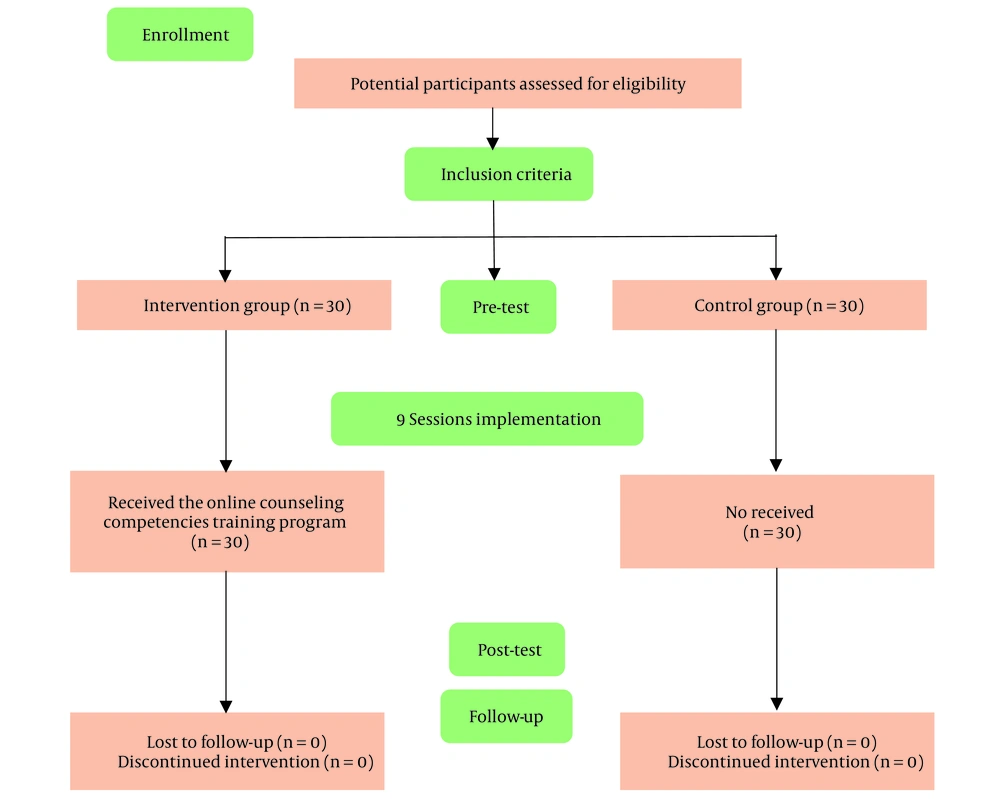
Figure 1.
The flow of participants throughout the study
3.3. Intervention: Online Counseling Competencies Training Program
The OCCTP consisted of nine synchronous online sessions delivered via a secure platform. The program was designed for scale and adaptability in other regions, emphasizing pedagogical rigor and cultural sensitivity. Before implementation, the program was reviewed by three experts in counseling psychology and education. Each session was rated highly appropriate (average score = 4.67/5.00).
The OCCTP comprised nine online training sessions delivered over 12 weeks via a secure platform. Content included adaptive online counseling techniques, ethical guidelines, empathy development, counseling theory, and secure technology integration. Instructional methods included interactive lectures, role-plays, cooperative learning, and case discussions. The control group received no training and continued regular duties. No deviations from the predefined intervention protocol were identified, and all core components were delivered in accordance with the standardized training manual.
After data collection was completed, participants in the control group were offered access to the same training program to ensure equitable treatment.
3.4. Research Instruments
Sociodemographic Questionnaire: A structured form was used to collect data on participants’ gender, age, years of teaching experience, school size, subject specialization, grade-level advisory roles, and prior experience in both face-to-face and online counseling.
Online Counseling Competencies Scale (OCCS): The OCCS was developed from established international guidelines (15, 16, 17). The OCCS contains 15 items across three domains: (1) adaptive online counseling, (2) ethics in digital counseling, and (3) secure technology use. The scale uses a 5-point rating system (1 = strongly disagree to 5 = strongly agree). Interpretation criteria for the OCCS are as follows: lowest (1.00 - 1.49), low (1.50 - 2.49), moderate (2.50 - 3.49), high (3.50 - 4.49), and highest (4.50 - 5.00) (18). The OCCS was further validated using exploratory factor analysis with principal component extraction and varimax rotation. The KMO measure was 0.90, and Bartlett’s test of sphericity was significant (χ² = 875.32, P < 0.001). Three factors, adaptive counseling proficiency, ethics, and secure technology integration, were extracted, explaining 72.6% of total variance. Item-total correlations ranged from 0.62 to 0.88. Cronbach’s alpha in this study was 0.992, indicating excellent reliability without evidence of redundancy. Ceiling and floor effects were minimal (< 5%).
3.5. Data Collection and Procedure
Data collection was carried out by trained research assistants who were not involved in delivering the training program. Due to the nature of the intervention, full blinding of assessors to group allocation was not feasible; however, statistical analyses were performed by an independent analyst blinded to group assignment. Following institutional approval and coordination with the provincial education office, eligible participants were recruited and consented. Baseline data were collected via online questionnaires. Training was delivered over a 12-week period. Immediate post-tests were conducted upon completion of the final session, and follow-up data were collected three months later. To ensure consistency and minimize bias, the same research team conducted all assessments and training facilitation. Participants’ identities were anonymized during data analysis.
3.6. Data Analysis
Data analysis was conducted using the Statistical Package for the Social Sciences (SPSS) Version 26 for Windows (SPSS, Chicago, IL, USA). Descriptive statistics, including frequencies (percentages) and means ± standard deviations, were used to summarize participant characteristics and OCCS scores. The total OCCS score was defined as the primary outcome. Subdomain scores (adaptive counseling, ethics, secure technology use) were analyzed as secondary outcomes. Bonferroni adjustment was applied for multiple comparisons where appropriate. To assess potential clustering effects, the intra-class correlation coefficient (ICC) for baseline OCCS scores was calculated. The ICC was 0.04, indicating minimal between-school variance. Given the small cluster sizes and low ICC, repeated-measures analysis of variance (ANOVA) was considered appropriate for the primary analysis. Repeated-measures ANOVA was conducted to examine changes in OCCS scores across three time points (pre-test, post-test, and three-month follow-up) between the intervention and control groups. Normality assumptions were met. When Mauchly’s test indicated violation of sphericity, Greenhouse-Geisser corrections were applied. The group × time interaction was specified as the primary effect of interest. Effect sizes were reported as partial eta squared (η²p) with 95% confidence intervals. Statistical significance was set at P < 0.05.
4. Results
A total of 60 secondary school advisory teachers participated in the study, with 30 in the intervention group and 30 in the control group. Baseline demographic characteristics, including gender, age, years of teaching experience, school size, and prior online counseling experience, were statistically comparable between the groups (all P > 0.05), ensuring group equivalence (Table 1).
Table 1.Sociodemographic Status of Secondary School Advisory Teachers in the Intervention Group and Control Group a
| Variables | Total | Intervention Group | Comparison Group |
|---|---|---|---|
| Gender | |||
| Male | 23 (38.33) | 13 (43.33) | 10 (33.33) |
| Female | 37 (61.67) | 17 (56.67) | 20 (67.67) |
| Age (years), mean ± SD | 33.70 ± 6.83 | 32.50 ± 7.08 | 34.90 ± 6.46 |
| < 30 | 30 (50.00) | 18 (60.00) | 12 (40.00) |
| 30 - 40 | 18 (30.00) | 7 (23.33) | 11 (36.67) |
| > 40 | 12 (20.00) | 5 (16.67) | 7 (23.33) |
| Work experience (y), mean ± SD | 9.50 ± 5.98 | 8.70 ± 6.26 | 10.30 ± 5.69 |
| < 10 | 42 (70.00) | 23 (76.67) | 19 (63.33) |
| > 10 | 18 (30.00) | 7 (23.33) | 11 (36.67) |
| Size of school | |||
| Special large schools | 23 (38.33) | 13 (43.33) | 10 (33.33) |
| Large schools | 14 (23.33) | 6 (20.00) | 8 (26.67) |
| Medium-sized schools | 13 (21.67) | 6 (20.00) | 7 (23.33) |
| Small schools | 10 (16.67) | 5 (16.67) | 5 (16.67) |
| Affiliated learning areas | |||
| Mathematics | 11 (18.33) | 6 (20.00) | 5 (16.67) |
| Thai language | 8 (13.33) | 5 (16.67) | 3 (10.0) |
| Foreign language | 8 (13.33) | 5 (16.67) | 3 (10.0) |
| Arts education | 7 (11.67) | 4 (13.33) | 3 (10.0) |
| Science and technology | 9 (15.00) | 4 (13.33) | 5 (16.67) |
| Career and technical education | 4 (6.67) | 1 (3.33) | 3 (10.0) |
| Health and physical education | 6 (10.00) | 2 (6.67) | 4 (13.33) |
| Student development activities/guidance | 7 (11.67) | 3 (10.00) | 4 (13.33) |
| Grade level assigned as an advisory | |||
| Grade 1 | 10 (16.67) | 5 (16.67) | 5 (16.67) |
| Grade 2 | 11 (18.33) | 6 (20.00) | 5 (16.67) |
| Grade 3 | 11 (18.33) | 7 (23.33) | 4 (13.33) |
| Grade 4 | 14 (23.33) | 7 (23.33) | 7 (23.33) |
| Grade 5 | 8 (13.33) | 2 (6.67) | 6 (20.00) |
| Grade 6 | 6 (10.00) | 3 (10.00) | 3 (10.00) |
| Experience in providing online psychological counseling services to students | |||
| Yes | 23 (38.33) | 19 (63.33) | 18 (60.00) |
| No | 37 (61.67) | 11 (36.67) | 12 (40.00) |
| Experience in participating in the study and development of online counseling service systems | |||
| Yes | 35 (58.33) | 14 (46.67) | 11 (36.67) |
| No | 25 (41.67) | 16 (53.33) | 19 (63.33) |
Abbreviations: SD, standard deviation.
a Values are presented as No. (%) unless otherwise indicated.
At baseline, both groups had similarly low scores in online counseling competencies (intervention: 2.19 ± 0.22; comparison: 2.16 ± 0.19). After the intervention, the intervention group demonstrated a substantial and statistically significant increase in mean scores to 4.63 ± 0.12, classified as the highest level. These gains were largely sustained at the three-month follow-up (4.54 ± 0.17). In contrast, the comparison group showed no improvement. Their post-test score slightly decreased to 2.00 ± 0.28 and declined further to 1.78 ± 0.22 at follow-up, remaining at the low level throughout (Table 2).
Table 2.Distribution of Online Counseling Competences Among Secondary School Advisory Teachers of the Intervention Group and the Control Group a
| Variables | Intervention Group | Intervention Group Interpretation | Control Group | Control Group Interpretation |
|---|---|---|---|---|
| Pretest | 2.19 ± 0.22 | Low | 2.16 ± 0.19 | Low |
| Posttest | 4.63 ± 0.12 | Highest | 2.00 ± 0.28 | Low |
| Follow-up | 4.54 ± 0.17 | Highest | 1.78 ± 0.22 | Low |
Abbreviation: SD, standard deviation.
a Values are expressed as mean ± SD unless otherwise indicated.
Repeated-measures ANOVA revealed statistically significant effects for time (F = 809.34, P < 0.001), intervention method × time interaction (F = 1266.73, P < 0.001), and group differences (F = 1919.10, P < 0.001) (Table 3). These findings confirm that the intervention group experienced greater and sustained improvement in online counseling competencies relative to the comparison group.
Table 3.Variance of Online Counseling Competences of Secondary School Advisory Teachers Between the Intervention Method and the Duration of the Experiment and Mean Differences After Online Counseling Competencies Training Program Training Between the Intervention Group and the Control Group
| Variables | SS | df | MS | F | P-Value |
|---|---|---|---|---|---|
| Duration of experiment | 45.56 | 1.54 | 29.41 | 809.34 | < 0.001 |
| Duration of experiment × method | 71.308 | 1.54 | 46.04 | 1266.73 | < 0.001 |
| Error (I) | 3.26 | 89.82 | 0.03 | ||
| Intercept | 1499.91 | 1 | 1499.91 | 19677.92 | < 0.001 |
| Group | 146.28 | 1 | 146.28 | 1919.10 | < 0.001 |
| Error | 4.42 | 58 | 0.07 |
Abbreviation: OCCS, Online Counseling Competencies Scale.
5. Discussion
This study demonstrates that the OCCTP significantly enhanced the digital mental health competencies of secondary school advisory teachers in Thailand. The intervention group showed large and sustained improvements in adaptive counseling skills, ethical awareness, and use of secure technology platforms. By contrast, the comparison group showed no meaningful change across any domain. These results confirm the effectiveness of structured, online teacher training for addressing mental health needs in digitally mediated school environments.
These results align with international research. For example, the BEAM program in Australia improved teachers’ confidence and mental health support behaviors through a digital training model (19). A UK-based online simulation similarly increased staff self-efficacy in recognizing and responding to student distress (20). Systematic reviews have concluded that teacher-focused mental health literacy programs are generally effective but often lack digital components (21). Our study adds evidence from Southeast Asia, addressing this gap by focusing specifically on online counseling readiness and systems-based impact.
One of the most promising aspects of the OCCTP is its alignment with long-term sustainability goals in education. Sustainable Development Goal 4.7 emphasizes the importance of inclusive, equitable, and quality education that promotes lifelong learning and well-being. The OCCTP supports this objective by building local capacity among educators to deliver mental health services in hybrid or remote learning environments. This model promotes system resilience by ensuring continuity of care during educational disruptions and extending support to students in rural or underserved communities.
A notable strength of this intervention was its comprehensive design. The program addressed not only technical skills, such as using secure platforms, but also essential soft skills such as empathy, communication, and ethical judgment, which are key elements of sustainable mental health support in schools. The results further suggest that short-term training can yield meaningful improvements that persist for months after program completion, reinforcing the value of such models for long-term teacher development and policy integration.
The strengths of this study include its rigorous quasi-experimental design, use of a validated and reliable instrument (OCCS), and inclusion of a three-month follow-up assessment to evaluate skill retention. The training program was developed with scalability and adaptability in mind, making it suitable for implementation in other low-resource educational contexts.
Nevertheless, several limitations should be acknowledged. First, the quasi-experimental design lacked full randomization, which may have introduced selection bias; however, matched-pair allocation helped mitigate this risk. Second, the relatively small sample size and recruitment from a single province in Thailand may limit the external validity and generalizability of the findings. Although the sample size was calculated a priori, the use of matched-pair allocation and the presence of clustering within schools may have reduced the effective statistical power, potentially limiting the precision of the estimates. Third, reliance on self-reported data may have introduced social desirability bias, highlighting the need for future research to incorporate objective performance-based measures and longer follow-up periods (6 - 12 months). Although repeated-measures ANOVA was appropriate for the present balanced dataset, future studies employing larger and more complex samples may benefit from linear mixed-effects modeling to account for clustering and random effects. The absence of full assessor blinding may have introduced bias, although independent statistical analysis minimized this risk. In addition, the study was not prospectively registered, which may limit transparency compared with registered clinical trials.
An unexpected decline in OCCS scores was observed in the control group across time points. Data verification confirmed that this pattern was not attributable to scoring errors or reverse-coded items. One plausible explanation is reduced engagement or expectancy effects among participants who did not receive the intervention. In non-randomized educational studies, individuals assigned to a no-intervention condition may experience decreased motivation or perceived relevance over time. Future trials should consider including an active control group to minimize attention-related bias and better isolate intervention effects.
Despite these limitations, the findings have meaningful implications for educational policy and mental health planning. Ministries of Education, particularly in middle-income and resource-constrained settings, may consider integrating digital mental health training into pre-service teacher education and national competency frameworks. Such integration could enhance early identification of student mental health needs and reduce disparities in access to school-based support.
Sustained investment in teacher mental health training may also strengthen educational system resilience, enabling schools to respond more effectively to public health crises and technological transitions. As digital learning becomes increasingly embedded in modern education, equipping teachers with counseling competencies represents a practical strategy for promoting student well-being and sustaining supportive learning environments.
5.1. Conclusions
This study provides evidence that a structured OCCTP program can significantly improve the digital counseling competencies of secondary school teachers. Participants who received the intervention demonstrated sustained gains in adaptive counseling skills, ethical awareness, and secure technology use. In contexts with limited access to mental health professionals, training teachers to provide basic support is a scalable and cost-effective strategy. Integrating such programs into national teacher development frameworks may strengthen school-based mental health systems and promote early intervention. Future research should explore the long-term impact of this approach on both teacher performance and student mental health outcomes.


