
1. Background
As students often leave home to pursue higher education, this transition coincides with the peak onset of various psychological and behavioral disorders. Among these conditions, eating disorders (EDs) are a major concern because of their multidimensional effects on physical health, psychological well-being, and social functioning. In Iran, EDs, such as anorexia nervosa and binge eating disorder, are particularly important among adolescents and young adults, with elevated rates reported among female university students, underscoring the need for targeted interventions in this population (1). The cognitive basis of EDs involves maladaptive beliefs about weight, body shape, and eating behaviors, which foster negative self-perceptions and automatic thoughts (2). According to the model proposed by Cooper, Wells, and Todd, beliefs such as “I am unlovable” or “I am a failure” may trigger distressing emotions, including anxiety, depression, and guilt, prompting individuals to engage in compensatory behaviors, such as binge eating, as a short-term coping strategy. Although these behaviors may temporarily reduce emotional discomfort, they can perpetuate the cycle of the disorder and contribute to chronicity and comorbidity (2-4).
This vulnerability may be exacerbated by alexithymia, a key emotional deficit characterized by difficulty identifying, describing, and processing feelings, along with an externally oriented thinking style (5, 6). Individuals with high alexithymia often rely on maladaptive emotion-regulation strategies, such as suppression or avoidance, which may increase the risk of EDs, depression, anxiety, and interpersonal difficulties (3, 4, 6). For example, Nowakowski and McFarlane reported elevated levels of alexithymia in patients with EDs compared with controls, while Franco Adami et al. linked body-shape dissatisfaction to alexithymic traits in 25% of obese individuals, highlighting the potential role of alexithymia in the onset and maintenance of EDs (3, 4).
Recent studies in Iranian populations have further shown that alexithymia positively predicts anxiety and depression in patients with dermatological conditions (7) and is significantly associated with generalized anxiety disorder and maladaptive defense mechanisms among medical students (8). Moreover, a structural model analysis showed that alexithymia affects behavioral addictions, such as mobile phone addiction, indirectly through anxiety, stress, and depression (9). This pattern supports the view that alexithymia may exert adverse effects on mental health largely through emotional dysregulation pathways, a framework that may also extend to EDs.
In contrast, self-differentiation may serve as a protective factor by enabling individuals to maintain an autonomous identity, separate emotional from logical processes at the intrapersonal level, and balance independence with relational intimacy at the interpersonal level (10, 11). This capacity may support adaptive emotion regulation and resilience against stressors, and it may reduce the adverse effects of alexithymia on EDs by promoting rational decision-making and emotional maturity. Empirical evidence supports these associations: alexithymia predicts ED severity, whereas self-differentiation may buffer its effects (6, 10). Interventions such as positive psychotherapy have also reduced alexithymia and ED-related cognitions in at-risk groups (12), and recent studies have supported the mediating role of emotion regulation in pathways linking self-differentiation and EDs (13, 14).
The interplay among alexithymia, self-differentiation, and EDs is especially important among university students in Iran, who may experience academic pressures, cultural expectations regarding body image, and social isolation. These factors may intensify vulnerability to EDs and contribute to broader public health burdens, including somatic comorbidities such as obesity and diabetes. Despite growing evidence, few studies have examined the mediating role of self-differentiation in this context, particularly among students in Tehran, where urban lifestyles may intensify emotional inexpressiveness.
Drawing on recent Iranian research showing that emotional distress mediates the relationship between alexithymia and maladaptive behaviors (9), the present study tested a similar mediational model in which self-differentiation, as an intrapersonal and interpersonal regulatory resource, serves as the intervening variable in the relationship between alexithymia and EDs. Addressing this gap may inform culturally tailored interventions, such as emotion-focused therapies or differentiation-based programs, to enhance mental health, prevent ED persistence, and support the well-being of emerging adults during this formative life stage.
2. Objectives
This study aimed to examine the association between alexithymia and eating disorders among college students, with self-differentiation as a mediator.
3. Methods
3.1. Study Design and Participants
This descriptive-correlational study used path analysis to examine the relationships among the study variables. Participants were students from universities in Tehran. Data were collected during the 2024 - 2025 academic year. Convenience sampling was used, and volunteers were recruited by distributing digital survey links.
The sample size was determined based on recommendations for path analysis and structural equation modeling (SEM), which emphasize a minimum of 200 cases for models of moderate complexity. For this simple mediation model, approximately 5 free parameters were estimated, including 2 path coefficients, 2 error variances, and 1 exogenous variance. Applying a conservative 10:1 ratio, the minimum required sample size was 50. However, to account for potential data loss, non-normality, and improved statistical power, with a target of 80% power at α = 0.05 for detecting medium effects (β = 0.25), a larger sample of 240 participants was targeted. This approach is consistent with recent guidelines in psychological research, in which samples of 200 - 300 are recommended for reliable path analysis in cross-sectional designs (15). A Monte Carlo power analysis conducted in AMOS confirmed that a sample size of 240 provided sufficient power (> 0.85) for detecting the indirect effect, assuming the observed effect sizes from pilot data.
Eligibility criteria were defined to ensure that the sample represented the target population and to reduce potential confounding. The inclusion criteria were as follows: 1) current enrollment at a university in Tehran at the bachelor’s, master’s, or doctoral level, confirmed through the initial screening question; 2) age of at least 18 years, indicating legal capacity to provide informed consent; and 3) voluntary participation confirmed through digital consent.
The exclusion criteria were as follows: 1) omission of more than 10% of items in any questionnaire section, because such missing data could affect the validity of the analyses; 2) self-reported diagnosis of a serious mental disorder, such as bipolar I disorder, schizophrenia-spectrum disorders, or active substance use disorder, because these conditions could independently affect emotion regulation and eating behavior; 3) non-student status; 4) withdrawal of consent before final questionnaire submission; 5) pregnancy, because pregnancy-related physiological changes may affect appetite, body image, and eating behavior; and 6) a history of bariatric surgery or chronic gastrointestinal conditions, such as inflammatory bowel disease or celiac disease, because eating restrictions in these cases may be related to physical health rather than psychological eating patterns.
Of 312 submitted surveys, 240 met the initial eligibility and data-quality criteria and were included in the final analysis. This process helped ensure a sufficiently broad yet analytically reliable sample.
3.2. Ethical Statement
The Ethics Committee of Islamic Azad University, Central Tehran Branch, Tehran, Iran, approved this study (Code: IR.IAU.CTB.REC.1404.068). All participants were required to read an informed consent document before participation and completed the questionnaires anonymously. Participants were free to withdraw from the survey at any stage.
3.3. Measures
3.3.1. Eating Disorder Diagnostic Scale
The Eating Disorder Diagnostic Scale (EDDS), developed by Stice et al. (16), is a validated instrument for assessing eating disorder symptoms. The scale assesses anorexia nervosa, bulimia nervosa, and binge eating disorder, including both full-threshold and subthreshold presentations. It contains 22 items with different response formats, including rating scales, yes/no responses, and frequency-based items. The EDDS has shown strong predictive and convergent validity and performs comparably to structured diagnostic interviews, such as the Structured Clinical Interview for DSM-III-R, in identifying eating pathology. It has also demonstrated strong test-retest reliability, with coefficients ranging from 0.80 to 0.90, and internal consistency coefficients of 0.87 among normal-weight individuals and 0.83 among overweight individuals.
The Persian version of the EDDS has been evaluated in Iran and has shown acceptable reliability and validity for use in clinical and research settings. In a sample of 431 university women, the overall Cronbach’s alpha was 0.85, and the scale showed a significant association with the Eating Attitudes Test-26 (r = 0.62, P < 0.01). The measure showed a four-factor structure similar to the original model, explaining 58% of the variance, supporting its applicability in Iranian settings, particularly among younger populations. In the present study, the Cronbach’s alpha coefficient for the total EDDS score was 0.84, supporting its internal consistency among students in Tehran.
3.3.2. Toronto Alexithymia Scale-20
The Toronto Alexithymia Scale-20 (TAS-20), developed by Taylor (17), consists of 20 items and assesses the degree of alexithymia, or difficulty in experiencing and expressing emotions. Items are rated on a 5-point Likert-type scale. The Cronbach’s alpha coefficient for the total alexithymia score has been reported as 0.85. The internal consistency coefficients for the 3 subscales, namely difficulty identifying feelings, difficulty describing feelings, and externally oriented thinking, were reported as 0.82, 0.75, and 0.72, respectively, indicating satisfactory reliability. In the present study, the Cronbach’s alpha coefficients for the total TAS-20 score, difficulty identifying feelings, difficulty describing feelings, and externally oriented thinking were 0.71, 0.74, 0.69, and 0.68, respectively. Test-retest reliability has also been supported in prior research, with a Pearson correlation coefficient of 0.79 for the total score and coefficients ranging from 0.62 to 0.69 for the 3 subscales over a 2-week interval.
3.3.3. Differentiation of Self Inventory
The Differentiation of Self Inventory was developed by Skowron and Friedlander (18) to assess individuals’ differentiation from their family of origin. It consists of 45 closed-ended items and includes 4 subscales: emotional reactivity, I-position, emotional cutoff, and fusion with others. Items are scored on a 6-point Likert scale. Skowron and Friedlander reported internal consistency coefficients of 0.84 for emotional reactivity, 0.74 for fusion with others, 0.83 for I-position, 0.82 for emotional cutoff, and 0.88 for the total scale score. In another study, Cronbach’s alpha coefficients were reported as 0.73 for emotional reactivity, 0.64 for fusion with others, 0.61 for I-position, 0.75 for emotional cutoff, and 0.69 for the total scale score.
3.4. Statistical Analysis
Descriptive statistics, including means, standard deviations, and Pearson correlation coefficients, were used to analyze the data. Inferential analyses were conducted using path analysis. Data were analyzed using SPSS version 25 and AMOS software.
3.4.1. Sampling Homogeneity Tests
The Kolmogorov-Smirnov test was used to assess whether the residuals of the internal variables, including eating disorder symptoms and self-differentiation, followed a normal distribution. The results did not show significant deviations from normality. The Kolmogorov-Smirnov statistic was 0.052 with P = 0.198 for eating disorder symptoms and 0.048 with P = 0.278 for self-differentiation. These results indicated that the residuals were approximately normally distributed.
Levene’s test was used to examine the homogeneity of variances for the main variables, including alexithymia, self-differentiation, and eating disorders, stratified by gender and age group. The results showed no significant differences in variance by gender (F = 1.24, P = 0.265) or age group (F = 0.89, P = 0.512), indicating stable variability across groups. Scatterplots showed approximately linear relationships among alexithymia, self-differentiation, and eating disorders. Variance inflation factor values were all below 5, with a value of 1.12 for alexithymia and 1.08 for self-differentiation, indicating no serious multicollinearity.
4. Results
The final analysis included 240 students. Of these, 182 participants (75.8%) were female and 58 (24.2%) were male. Regarding age, 142 participants (59.2%) were in the 19 - 26-year age group, 52 (21.7%) were in the 27 - 38-year age group, 41 (17.1%) were in the 39 - 50-year age group, and 5 (2.1%) were in the 51 - 62-year age group. Regarding educational attainment, 92 participants (38.3%) held a bachelor’s degree, 141 (58.8%) held a master’s degree, and 7 (2.9%) held a doctoral degree. Regarding marital status, 49 participants (20.4%) were married, 185 (77.1%) were single, and 6 (2.5%) reported other statuses.
As shown in Table 1, all skewness and kurtosis coefficients for the study variables were within acceptable limits. Therefore, the assumption of normality was satisfied, and the data could be considered approximately normally distributed.
Table 1.
Descriptive Statistics and Homogeneity Test Results for the Research Variables
| Variables | Min | Max | Mean | SD | Range | Skewness | Kurtosis |
|---|---|---|---|---|---|---|---|
| Eating disorders | 45.41 | 198.87 | 107.46 | 22.97 | 153.46 | 0.296 | 0.626 |
| Alexithymia | 8.00 | 83.59 | 47.20 | 11.82 | 75.59 | 0.039 | 0.056 |
| Self-differentiation | 90.10 | 259.80 | 174.89 | 32.12 | 169.70 | 0.047 | -0.158 |
Levene’s test indicated no significant gender differences in variance for eating disorders (F = 0.14, P = 0.710), alexithymia (F = 1.35, P = 0.247), or self-differentiation (F = 0.05, P = 0.819). Similarly, across the 4 age groups (19 - 26 years to 51 - 62 years), no significant variance differences were observed for disordered eating (F = 0.16, P = 0.923), and the other variables showed the same nonsignificant pattern.
As shown in Table 2, eating disorders were positively and significantly associated with alexithymia (P < 0.01). Eating disorders were also negatively and significantly associated with self-differentiation (P < 0.01). The correlation between alexithymia and self-differentiation was negative and significant (P < 0.01). Path analysis was then used to test the proposed model.
Table 2.
Correlation Coefficients of the Research Variables
| Variables | Eating Disorders | Alexithymia | Self-Differentiation |
|---|---|---|---|
| Eating disorders | 1 | 0.172 a | -0.220 a |
| Alexithymia | 1 | -0.638 a | |
| Self-differentiation | 1 |
a P < 0.01.
As shown in Table 3, self-differentiation (P < 0.03, β = -0.25) had a significant effect on eating disorders, whereas alexithymia had no significant direct effect on eating disorders.
Table 3.
Standard Path Coefficients Related to the Model
| Variables | Regression Weights | SE | P |
|---|---|---|---|
| Alexithymia → Eating disorders | -0.01 | 0.55 | 0.91 |
| Self-differentiation → Eating disorders | -0.25 | 0.38 | 0.03 |
| Alexithymia → Self-differentiation | -0.74 | 0.11 | 0.001 |
To examine the mediating role of self-differentiation in the relationship between alexithymia and eating disorders, bootstrapping was used. Indirect effects were calculated across 5000 bootstrap samples with a 95% confidence interval using the bias-corrected approach.
The mediation analysis further indicated that self-differentiation functions as a mediator between alexithymia and eating disorders. The indirect effect of this pathway was positive and significant, suggesting that difficulty expressing emotions may contribute to increased eating disorder symptoms through reduced self-differentiation. The results of the mediation analysis are presented in Table 4 and Figure 1.
Table 4.
Mediation Analysis
| Path | β | Lower | Upper | P-Value |
|---|---|---|---|---|
| Alexithymia → Self-differentiation → Eating disorders | 0.187 | 0.262 | 1.590 | 0.001 |
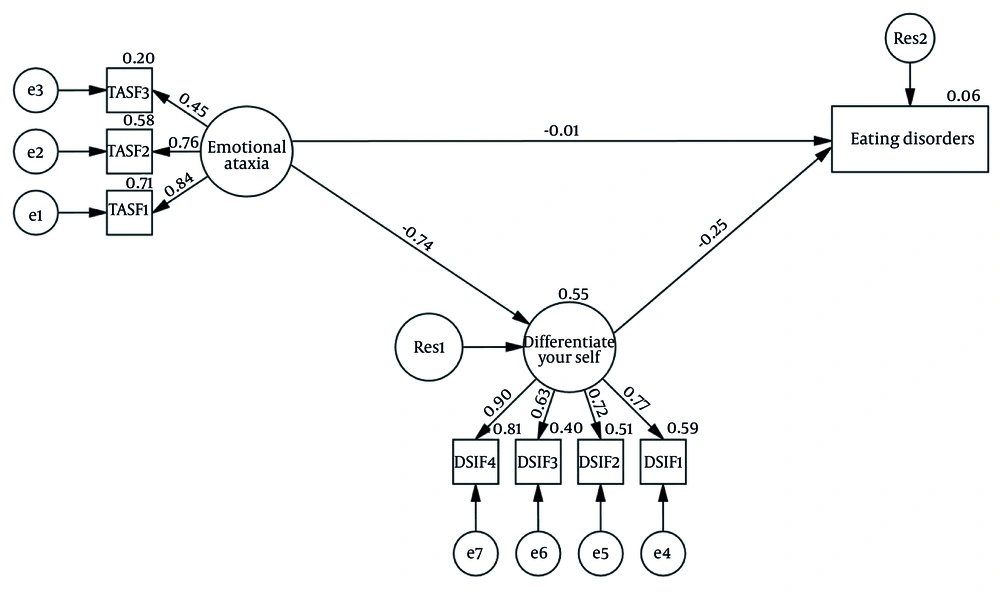
Figure 1.
Structural model of the mediating role of self-differentiation in the relationship between eating disorder and alexithymia
5. Discussion
This study examined the relationship between eating disorders and alexithymia, as well as the mediating role of self-differentiation. The primary hypothesis, proposing that self-differentiation mediates the association between alexithymia and eating disorders, was confirmed. In other words, individuals who have difficulty identifying and expressing emotions typically exhibit lower levels of self-differentiation, which may serve as a mediating mechanism that increases the risk of maladaptive eating behaviors. Self-differentiation enables individuals to preserve their personal identity, maintain balanced emotional relationships with others, and sustain equilibrium between personal autonomy and emotional connectedness. Therefore, reduced self-differentiation may contribute to unhealthy patterns, such as emotional fusion or relational cutoff (19). This finding is consistent with Bowen’s theory, which describes self-differentiation as a central factor in emotion regulation. Accordingly, individuals with low self-differentiation may have difficulty distinguishing emotion from logic and may be more inclined to use maladaptive eating behaviors to cope with negative emotions.
This mediational pattern is consistent with recent evidence indicating that emotional distress, including anxiety, stress, and depression, mediates the relationship between alexithymia and addictive behaviors (9). This suggests a common mechanism through which emotional deficits may translate into dysfunctional coping, with self-differentiation representing a more foundational, personality-level mediator in the context of eating disorders.
The findings also showed that the direct relationship between alexithymia and eating problems was not significant in the path model, whereas the pathway through reduced self-differentiation was significant. This pattern suggests that alexithymic traits may not directly lead to disordered eating; rather, they may weaken an individual’s sense of psychological separateness and self-regulation in relationships. When these internal boundaries are diminished, eating behaviors may become a maladaptive strategy for regulating emotional and relational distress. Therefore, interventions that focus only on improving emotional labeling may be insufficient if they do not also strengthen self-definition and self-regulatory capacities.
The second finding of the present study indicated a positive and significant relationship between alexithymia and eating disorders, consistent with the findings of Lian et al. (14), Muir et al. (6), and other related studies. In essence, higher levels of alexithymia corresponded to greater severity of eating disorder symptoms. However, in the path analysis, the direct effect of alexithymia on eating disorders was not significant. This finding suggests that the influence of alexithymia is expressed indirectly through self-differentiation, as confirmed by the primary hypothesis. Individuals with elevated alexithymia may be more likely to engage in maladaptive eating behaviors, such as emotional binge eating or dietary restriction, under stress or negative emotional states, in an attempt to regulate suppressed affective experiences. This pattern is consistent with psychological theories conceptualizing alexithymia as a vulnerability factor for eating disorders. The non-significant direct path, together with a significant indirect effect, is also consistent with findings in other domains in which the effects of alexithymia on behavioral outcomes are mediated by emotional and interpersonal variables (9). Moreover, established links among alexithymia, anxiety, depression, and immature defenses further support the notion that alexithymia may foster a cascade of emotional difficulties that ultimately manifest as eating pathology when adaptive self-regulatory capacities, such as self-differentiation, are compromised (7, 8).
A deeper interpretation of these findings suggests that difficulty identifying emotions extends beyond a single symptom label. The inability to recognize internal states may increase long-term emotional vulnerability, not only to disordered eating but also to persistent worry, low mood, and maladaptive coping styles (7, 8). Recent Iranian research has shown that emotional difficulties can contribute to mobile phone addiction through increased depression, anxiety, and stress (9). In the present model, self-differentiation appears to function similarly, as a regulatory foundation that may influence whether emotional difficulties are expressed through eating behavior. This interpretation suggests that interventions targeting both identity clarity and emotional recognition may be useful across multiple psychological difficulties and may reduce harmful eating behaviors, as well as related symptoms of distress and hopelessness.
The final finding of the study indicated a negative and significant relationship between self-differentiation and eating disorders. This finding is consistent with Bowen’s theory and the work of Liiwong (20). According to this theoretical perspective, individuals with higher self-differentiation have a greater capacity to manage emotions and stress and may therefore be less vulnerable to unhealthy behaviors such as disordered eating. Bowen conceptualized differentiation as the degree of separation between cognitive and emotional processes and suggested that a person’s level of differentiation reflects the ability to avoid automatic emotional reactions. Differentiation is considered a dynamic and lifelong process rather than a fixed state or final endpoint (20). The protective role of self-differentiation is also indirectly supported by studies showing that the absence of adaptive emotional resources, as reflected in high alexithymia, predicts greater anxiety, depression, and neurotic defense mechanisms (7, 8), whereas self-differentiation may counteract these vulnerabilities.
Several limitations should be considered when interpreting the findings. Because the data were collected at a single time point, causal conclusions cannot be drawn. Although the theoretical model supports a pathway from alexithymia to reduced self-differentiation and then to eating disorder symptoms, reverse or reciprocal relationships cannot be ruled out. For example, disordered eating may also reduce personal clarity and self-regulatory capacity over time. The study also relied on self-report questionnaires, which may be influenced by social desirability or underreporting, particularly when participants are asked about eating difficulties and emotional problems. In addition, the sample was limited to students from universities in Tehran who were recruited through convenience sampling. Therefore, the findings may not be generalizable to students in other regions, non-student populations, or individuals at different stages of life.
Other potentially important variables, such as gender differences, body mass index, socioeconomic background, trauma history, attachment patterns, coping styles, and sociocultural pressure for thinness, were not fully examined. These factors may influence both emotional awareness and eating behavior and may therefore affect the strength or direction of the observed relationships. For example, body mass index is often associated with eating disorder symptoms, and gender may influence alexithymia, self-differentiation, and eating patterns. In addition, the study relied on questionnaire-based assessment rather than clinical diagnostic interviews or real-world behavioral measures of eating. Future longitudinal and experimental studies using more diverse samples and richer clinical assessments are needed to clarify the causal pathways linking emotional awareness, self-differentiation, and disordered eating.
5.1. Conclusions
The present findings suggest that difficulty identifying and describing feelings is related to eating disorder symptoms among college students, primarily through reduced self-differentiation. Alexithymia may not directly cause eating problems; instead, it may weaken the ability to maintain emotional balance, relational boundaries, and personal autonomy. Identifying students with low self-differentiation may help detect individuals at higher risk of developing serious eating-related problems. Programs that strengthen boundaries between self and others, such as family-systems interventions, emotion-awareness training, and campus-based counseling programs, may be useful in this context. Helping young adults tolerate difficult emotions without relying on maladaptive eating behaviors may also reduce anxiety and depressive symptoms and support broader student mental health.