


1. Introduction
Sexual and reproductive health education remains a critical yet often underserviced component of early schooling, essential for delaying or mitigating the consequences of early sexual activity in adolescents (1). In recent years, the rapid expansion of AI tools has introduced transformative possibilities for this field, offering personalized, accessible, and potentially stigma-free spaces for learning sensitive information (2). While traditional school-based sexuality education often faces barriers regarding limited curricula and educator discomfort, AI-facilitated platforms can provide accurate and impartial information that aligns with national standards (3). However, the successful integration of these tools into the classroom depends heavily on the acceptance and readiness of teachers to adopt such advanced technical systems (4).
The Technology Acceptance Model (TAM) has long served as a foundational framework for understanding how users come to accept and use new technologies, primarily through the lenses of perceived usefulness and perceived ease of use (5 - 6). Recent research suggests that for sensitive applications like sexual and reproductive health, the original TAM must be extended to include relational and psychological constructs such as AI trust and attitudes toward using AI (7). Trust is a particularly vital precursor in healthcare-related AI, as users must believe in the reliability and ethical governance of the system before they are willing to engage with it (8). Furthermore, a user’s attitude serves as a critical bridge between their perceptions of the technology and their actual behavioral intention to adopt it (6, 9).
Despite the promising potential of AI chatbots and conversational agents to support sexual and reproductive health education, current literature indicates that their adoption is often hindered by concerns regarding data security, lack of human empathy, and the perceived accuracy of AI-generated responses (9 - 10). Primary school teachers, as the primary implementers of early-stage education, represent a unique group whose perceptions can either facilitate or block the digital transformation of sexual and reproductive health services (11). Understanding the factors that influence their adoption of AI is crucial, as their own self-efficacy and emotional states significantly impact their readiness to integrate AI into a standard school curriculum (4).
The present study aims to examine the adoption of AI for sexual and reproductive health education among primary school teachers using an extended TAM framework. Guided by the hypothesised sequential mediation of AI trust and attitude toward using AI, we explore how teachers’ perceptions of ease of use and usefulness translate into an intention to adopt these tools. Specifically, this research addresses whether high levels of perceived usefulness and ease of use enhance trust in AI systems, which in turn fosters a positive attitude and a subsequent intention to use AI for sexual health instruction. By investigating these relationships, the study seeks to provide actionable insights for policymakers and educators to promote the responsible and inclusive use of AI in enhancing reproductive health equity (1, 12).
2. Literature Review and Conceptual Aevelopment
2.1. The Role of AI in Sexual and Reproductive Health Education
The rapid expansion of AI technologies has introduced transformative possibilities for sexual and reproductive health education, creating learning environments that are personalised, accessible, and potentially stigma-free (2). Traditionally, school-based sexuality education has been hampered by restricted curricula and varying levels of educator comfort, particularly regarding sensitive or taboo topics (13 - 14). In this context, AI-facilitated platforms, such as conversational agents and chatbots, have emerged as vital tools for disseminating accurate and impartial information that aligns with national standards (3).
One of the most significant roles of AI in sexual and reproductive health education is its ability to provide a confidential and non-judgemental space for users to explore sensitive subjects (14 - 15). Research indicates that many individuals, particularly youth and those from minoritised communities, value AI tools like the SnehAI or Layla’s Got You chatbots for their anonymity and 24/7 availability (14, 16). These systems allow users to ask deeply personal questions about contraception, safe sex, and HIV prevention without the fear of social repercussion or embarrassment often associated with face-to-face interactions (17). Furthermore, AI can help make sexual and reproductive health education more inclusive by centering disabled experiences, offering real-time features like captioning and sign language interpretation to ensure that learning is inclusive for individuals with developmental or intellectual disabilities (2).
Beyond direct student education, AI serves as an advanced simulation and training platform for healthcare providers and educators. For instance, cross-sectional studies have utilized generative AI patients to help medical and midwifery students practice clinical communication and written chat dialogues regarding contraception (18). These AI simulations enable learners to encounter various patient scenarios and refine their ability to discuss contraindications and contraceptive methods effectively. Moreover, advanced machine learning models are increasingly used in predictive analytics to identify individuals at high risk for reproductive health issues, such as adolescent pregnancy or STIs, allowing for targeted educational interventions (19 - 21).
Despite these benefits, the integration of AI into sexual and reproductive health education is not without substantial barriers (3, 10). A critical concern is the lack of human empathy and the emotionally neutral nature of AI, which some users perceive as inferior to the support provided by a health professional. There are also ongoing risks related to algorithmic bias and hallucinations, where generative AI may produce inaccurate or outdated information that could lead to negative health outcomes (22 - 23).
Furthermore, the literature highlights significant anxieties regarding data security and privacy, particularly when handling sensitive biological or behavioral data (2, 12, 24). For teachers and policymakers, these risks necessitate a framework of ongoing evaluation and human oversight to ensure that AI systems remain ethical and empowering rather than perpetuating existing inequalities (2, 25). The success of these digital tools ultimately hinges on the trust users place in the technology and their attitudes toward its utility in professional educational settings (5 - 6).
2.2. Extended Technology Acceptance Model
In the foundational framework of the technology acceptance model, perceived ease of use is defined as the degree to which a user believes that using a specific system (26), such as an AI-facilitated tool for sexual and reproductive health, would be free of physical and mental effort. For primary school teachers, the ease of navigating these tools is a primary cognitive precursor that determines how they view the tool’s broader utility. When a technological system is intuitive and user-friendly, it lowers the barriers to engagement, allowing educators to focus on the pedagogical content rather than technical troubleshooting (6).
- H1: Perceived ease of use has a significant positive effect on perceived usefulness.
A user’s attitude represents their overall favourable or unfavourable evaluative affect regarding the use of a specific technology in their professional practice (27). For teachers, the attitude toward using AI is often shaped by the effort-to-reward ratio they experience during the initial stages of interaction (6). Literature suggests that while attitudes are heavily influenced by the benefits of a tool, a system that is difficult to use can lead to frustration and a negative mindset, whereas seamless interaction fosters a more positive internal evaluation of the AI’s utility in the classroom (5 - 6).
Within the specific context of primary education, a teacher’s intention to adopt AI for sensitive subjects like sexual health is directly impacted by the perceived effort required to integrate the tool into a crowded curriculum. If the AI application, such as a conversational agent or chatbot, is perceived as effortless to implement, teachers are statistically more likely to form a concrete intention to use the tool in their future instructional activities (6, 28). Because sexual and reproductive health education involves sensitive, biological, and potentially stigmatised data, the inclusion of AI trust is a necessary extension to the original TAM (2, 12). Trust is built through reliable performance and a sense of user control (29); if an AI tool for sexual health is easy to navigate and provides transparent interactions, users are more likely to perceive the system as reliable and ethically governed (24, 28). Consequently, a high level of perceived ease of use can act as a signal of the system’s intelligence and safety, thereby strengthening the teacher’s trust in the AI’s outputs (6 - 7).
- H2: Perceived ease of use has a significant positive effect on attitudes toward using AI.
- H3: Perceived ease of use has a significant positive effect on the intention to adopt AI.
- H4: Perceived ease of use has a significant positive effect on AI trust.
Perceived usefulness represents the belief that using AI will enhance a teacher’s professional performance and improve learning outcomes for their students (26). In the realm of sexual and reproductive health, AI tools are valued for their ability to provide accurate, impartial information that can address taboo topics in a non-judgemental way (2, 14). When primary school teachers perceive that AI can effectively support their instructional goals and meet the diverse needs of their students, they develop a more favourable attitude toward the technology as a valuable pedagogical assistant.
The ultimate commitment to adopting a digital transformation in the curriculum is driven by the perceived value the technology brings to the learning environment (26). For educators, the usefulness of AI in sexual and reproductive health is tied to its 24/7 availability and its capacity to offer a confidential space for young students to explore health information (10, 15). When teachers believe that these tools will truly benefit their students and improve the efficiency of health education delivery, they are more likely to report a high intention to adopt and integrate these AI systems into their professional practice (6, 28).
In the domain of sexual and reproductive health education, where instructors often encounter discomfort or restricted curricula, AI tools are valued for their ability to provide accurate, impartial, and stigma-free instruction (2). As primary school teachers perceive that an AI system – such as a conversational agent or chatbot – consistently delivers information that aligns with safety standards and pedagogical goals, they are more likely to develop a sense of confidence in the system’s intelligence and professional reliability, thereby strengthening their AI trust (24).
- H5: Perceived usefulness has a significant positive effect on attitudes toward using AI.
- H6: Perceived usefulness has a significant positive effect on the intention to adopt AI.
- H7: Perceived usefulness has a significant positive effect on AI trust.
Sexual and reproductive health education involves the handling of sensitive biological and behavioural data, trust serves as the primary emotional precursor to a teacher's internal evaluation of the technology. When teachers trust that the AI will provide a confidential and non-judgmental space for students to explore taboo subjects, they move beyond viewing it as a mere technical object and instead form a favourable attitude toward its utility and its potential for classroom empowerment (2, 28).
Beyond shaping internal evaluations, trust also plays a direct role in overcoming the hesitance often associated with adopting disruptive or sensitive technologies in the educational sector. In contexts where traditional adoption is hindered by concerns regarding a lack of human empathy or the perceived accuracy of responses, a trustworthy AI system reduces the cognitive and emotional barriers to engagement (10, 24). Consequently, if a teacher believes that the AI is reliable and that its functions are transparently governed, they are statistically more likely to formulate a concrete intention to adopt AI, viewing the tool as a safe and effective pedagogical partner (28, 30).
- H8: AI trust has a significant positive effect on attitudes toward using AI.
- H9: AI trust has a significant positive effect on the intention to adopt AI.
The final commitment to integrating digital transformations into the early school curriculum is ultimately driven by the teacher's attitude toward using AI, which represents their overall psychological evaluation of the tool’s benefits. A positive attitude is fostered when the educator believes that the benefits of AI, such as 24/7 availability and the creation of inclusive, cripped learning environments, far outweigh the technical effort and risks involved (2, 15, 24). Within the framework of the extended TAM, this positive evaluative affect serves as the dominant direct predictor of a teacher’s behavioral intention to adopt AI-facilitated tools for future instructional activities.
- H10: Attitudes toward using AI have a significant positive effect on the intention to adopt AI.
2.3. Sequential Mediation of AI Trust and Attitudes Toward AI Use
In addition to the direct relationships outlined above, our conceptual model proposes a sequential mediation path from cognitive perceptions to behavioral outcomes. Within this framework, AI Trust and Attitudes Toward Using AI do not act in isolation; rather, they form a psychological bridge that translates perceived ease and usefulness into a final commitment to use (2, 28). Specifically, we propose that high levels of perceived usefulness and ease of use enhance a teacher's trust in the AI system, which subsequently fosters a positive attitude, ultimately resulting in a stronger intention to adopt AI for sexual health instruction (6, 10, 21). This sequential flow highlights that the digital transformation of sensitive educational areas requires more than just functional technology; it requires the successful management of the educator’s relational and evaluative states. The research model is presented in Figure 1.
- H11: AI trust and attitude toward using AI sequentially mediate the relationships between perceived ease of use, perceived usefulness, and intention to adopt AI.
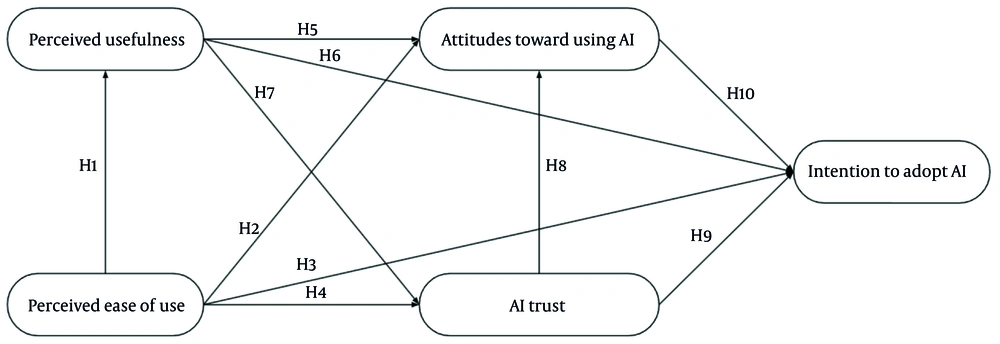
Figure 1.
Conceptual model
3. Methods
3.1. Participants
The target population for this study comprised primary school teachers currently employed in Hanoi, Vietnam. Participants were recruited using a convenience sampling approach via institutional emails and social media platforms. Inclusion criteria required participants to be currently teaching primary school subjects and to be over 18 years of age. All participants provided informed consent prior to starting the survey.
A total of N = 252 primary school teachers completed the survey. The demographic characteristics collected included age, sex, and teaching experience (Table 1). Among the participants, n = 230 (91.3%) identified as female and n = 22 (8.7%) as male. The mean ± SD age of the sample was M = 22.0 ± 4.2 years. Regarding teaching experience, 140 teachers reported less than one year of experience or no prior teaching experience, while 112 teachers reported teaching experience, with a mean ± SD of 4.3 ± 4.8 years.
Table 1.Demographics (N = 252)
| Variables | No. (%) |
|---|---|
| Gender | |
| Male | 22 (8.7) |
| Female | 230 (91.3) |
| Age (y) | |
| 18 - 20 | 48 (19.0) |
| 21 - 30 | 187 (74.2) |
| More than 31 | 17 (6.8) |
| Education | |
| Undergraduate | 81 (32.1) |
| Bachelor’s | 164 (65.1) |
| Master’s/PhD | 7 (2.8) |
| Year of experience (y) | |
| Less than 1 | 140 (55.6) |
| 1 - 5 | 43 (17.0) |
| More than 5 | 69 (27.4) |
| School location | |
| Urban area | 47 (18.7) |
| Rural area | 13 (5.1) |
| Mountainous area | 3 (1.2) |
| Othersa | 189 (75.0) |
| School category | |
| Public | 46 (18.3) |
| Private | 9 (3.6) |
| Othersa | 197 (78.1) |
a Others refers to preservice teachers who are not officially enrolled in any school.
3.2. Measures
Data were collected using a structured, self-administered questionnaire adapted from established technology acceptance literature (Table 2). All psychological constructs were measured using a 5-point Likert scale, ranging from 1 (Strongly Disagree) to 5 (Strongly Agree). Internal consistency and validity measures were determined for all scales to ensure the quality of the measurements.
Table 2.Measurements
| Constructs | Items |
|---|---|
| Perceived ease of use (31) | When teaching sexual and reproductive health education, I feel that… |
| PEU1. AI tools are easy to use. | |
| PEU2. Using AI does not take much effort. | |
| PEU3. AI tools make it easier for me to complete my teaching tasks. | |
| PEU4. I can easily learn how to use AI tools. | |
| Perceived usefulness (31) | When teaching sexual and reproductive health education, I feel that… |
| PU1. AI tools help me get more work done in the same amount of time. | |
| PU2. AI tools help improve the quality of my teaching. | |
| PU3. AI tools are genuinely useful in my teaching. | |
| PU4. AI tools offer helpful features for teaching. | |
| AI trust (32) | AIT1. AI tools are trustworthy. |
| AIT2. I can rely on AI tools. | |
| AIT3. Overall, I trust AI tools. | |
| Attitudes toward using AI (32) | ATT1. I think using AI tools in teaching is a good idea. |
| ATT2. I believe AI tools are beneficial for teaching. | |
| ATT3. I think it makes sense to use AI tools in teaching. | |
| Intention to adopt AI (31) | BI1. I intend to use AI tools in the future. |
| BI2. I plan to use AI tools in my teaching. | |
| BI3. I will use AI tools this semester or next |
3.3. Procedures and Data Analysis
The questionnaire was administered online via Google Form during November, 2025. Participation was voluntary and anonymous. Prior to accessing the questionnaire, participants were provided with a brief introduction defining the AI tools (e.g., generative AI chatbots) relevant to the context of sexual and reproductive health education. The estimated completion time was 15 minutes.
The hypothesized eTAM, integrating the constructs of perceived ease of use, perceived usefulness, AI trust, attitudes toward using AI, and intention to adopt AI, was tested using PLS-SEM. PLS-SEM was employed to simultaneously evaluate the direct and indirect relationships among the latent variables.
Data analysis was conducted using SmartPLS 3.0. We adopted the recommended two-step approach for SEM: (1) Measurement Model Evaluation: Confirmatory Factor Analysis (CFA) was performed to assess the reliability and validity of the observed indicators reflecting the latent constructs. This involved examining factor loadings, Cronbach’s alpha, Composite Reliability, and Average Variance Extracted. (2) Structural Model Evaluation: The structural relationships hypothesized in the eTAM were tested (β coefficients and p values). Model fit was evaluated using standard indices such as the Chi-square (χ2), Standardized Root Mean-Square Residual, d_ULS, d_G, and NFI. Hypothesis testing determined whether the predicted causal relationships were statistically significant (p < .05).
4. Results
4.1. Measurement Model Evaluation
Prior to examining the structural relationships, the measurement model was evaluated for indicator reliability, internal consistency, convergent validity, and discriminant validity. Indicator reliability was supported, as all outer loadings for the constructs AI trust, attitudes toward using AI, behavioral intention, perceived ease of use, and perceived usefulness exceeded the threshold of 0.70, ranging from 0.869 to 0.966 (Table 3).
Table 3.Outer loadings
| Variables | AIT | ATT | BI | PEU | PU |
|---|---|---|---|---|---|
| AIT1 | 0.933 | ||||
| AIT2 | 0.941 | ||||
| AIT3 | 0.910 | ||||
| ATT1 | 0.921 | ||||
| ATT2 | 0.961 | ||||
| ATT3 | 0.944 | ||||
| BI1 | 0.937 | ||||
| BI2 | 0.966 | ||||
| BI3 | 0.959 | ||||
| PEU1 | 0.869 | ||||
| PEU2 | 0.921 | ||||
| PEU3 | 0.926 | ||||
| PEU4 | 0.939 | ||||
| PU1 | 0.905 | ||||
| PU2 | 0.919 | ||||
| PU3 | 0.929 | ||||
| PU4 | 0.913 |
Abbreviations: PEU, perceived ease of use; PU, perceived usefulness; AIT, AI trust; ATT, attitudes toward using AI; BI, intention to adopt AI.
Internal consistency reliability was confirmed with Cronbach’s alpha values between 0.919 and 0.950 and Composite Reliability values between 0.949 and 0.968, all above the recommended 0.70 level (33). Convergent validity was demonstrated by Average Variance Extracted values ranging from 0.836 to 0.910 for all constructs, exceeding the minimum criterion of 0.50 (34) (Table 4).
Table 4.Construct Reliability and Validity
| Variables | CA | CR | AVE |
|---|---|---|---|
| AI Trust | 0.919 | 0.949 | 0.861 |
| Attitude | 0.937 | 0.960 | 0.888 |
| Behavioral intention | 0.950 | 0.968 | 0.910 |
| Perceived ease of use | 0.934 | 0.953 | 0.836 |
| Perceived usefulness | 0.937 | 0.955 | 0.841 |
Abbreviations: CA, Cronbach’s alpha; CR, composite reliability; AVE, average extracted variance.
Discriminant validity was established using the Fornell Larcker criterion, as the square root of each construct’s AVE was greater than its highest correlation with any other latent variable, indicating that the constructs are distinct (34) (Table 5).
Table 5.Discriminant Validity
| Variables | 1 | 2 | 3 | 4 | 5 |
|---|---|---|---|---|---|
| AI Trust | 0.928 | ||||
| Attitude | 0.896 | 0.942 | |||
| Behavioral intention | 0.853 | 0.893 | 0.954 | ||
| Perceived ease of use | 0.748 | 0.777 | 0.752 | 0.914 | |
| Perceived usefulness | 0.709 | 0.756 | 0.732 | 0.833 | 0.917 |
4.2. Structural Model and Hypothesis Testing
The global model fit was assessed using multiple indices provided in the SmartPLS 3 report (Table 6). The Standardised Root Mean-Square Residual (SRMR) for the estimated model was 0.039, which is below the conservative threshold of 0.08 (35), indicating an acceptable fit. Further exact fit measures included the squared Euclidean distance (d_ULS) at 0.945 and the geodesic distance (d_G) at 0.525 (36). The Chi-square (χ2) value was recorded at 515.699, and the Normed Fit Index (NFI) was 0.860. While the NFI is slightly below the ideal 0.90 threshold (37), it is considered acceptable in complex structural models within social science contexts.
Table 6.Model Fit
| Variables | Estimated Model |
|---|---|
| SRMR | 0.039 |
| d_ULS | 0.945 |
| d_G | 0.525 |
| Chi-square | 515.699 |
| NFI | 0.860 |
The structural model exhibited substantial explanatory power, as evidenced by the coefficients of determination (R2). The model accounted for 81.8% of the variance in the intention to adopt AI (R2 = 0.818), which is considered high for behavioral research. Furthermore, the model explained 83.7% of the variance in attitudes (R2 = 0.837), 69.4% in perceived usefulness (R2 = 0.694), and 58.3% in AI trust (R2 = 0.583). These values indicate that the chosen predictors are highly effective in capturing the factors that drive teachers' intentions to integrate AI into sensitive instructional domains (Figure 2).
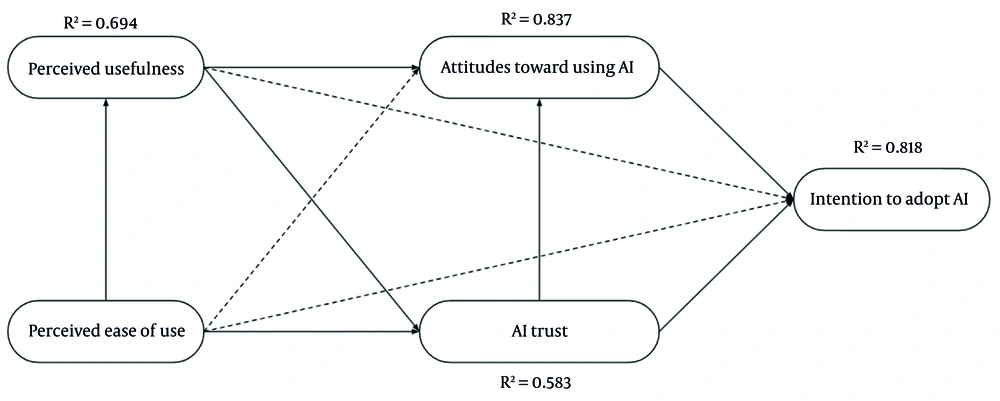
Figure 2.
Structural model
The structural path analysis indicates that the hypothesized relationships exhibit statistically significant effects at the .05 level (Table 7). Consistent with the foundational TAM, perceived ease of use emerged as a strong predictor of perceived usefulness (β = 0.833, t = 15.529, P < 0.001). However, the direct effects of perceived ease of use on attitude toward using AI and behavioral intention to adopt AI were not supported (H2 and H3), as these relationships did not reach statistical significance. In contrast, extending the TAM framework, H4 was confirmed, demonstrating that perceived ease of use significantly influenced AI trust (β = 0.513, t = 4.066, P < 0.001).
With regard to perceived usefulness, the findings supported H5, showing that perceived usefulness had a significant positive effect on attitudes toward using AI (β = 0.166, t = 2.417, P = 0.016). In contrast, perceived usefulness did not exert a significant direct effect on behavioral intention (H6). Nevertheless, H7 was supported, indicating that perceived usefulness significantly predicted AI trust (β = 0.282, t = 2.483, P = 0.013).
AI trust played a central role in shaping user responses. H8 was strongly supported, with AI trust significantly predicting attitudes toward using AI (β = 0.683, t = 6.918, P < 0.001). H9 was also upheld, showing that AI trust had a significant direct effect on behavioral intention to adopt AI (β = 0.240, t = 2.107, P = 0.035). Finally, H10 was confirmed, demonstrating that attitude toward using AI was the most proximal and influential predictor of behavioral intention (β = 0.567, t = 4.131, P < 0.001).
Table 7.Direct Relationships
| Variables | β | t | p | Status |
|---|---|---|---|---|
| H1. PEU → PU | 0.833 | 15.439 | 0.000 | Accepted |
| H2. PEU → ATT | 0.128 | 1.339 | 0.181 | Rejected |
| H3. PEU → BI | 0.067 | 0.848 | 0.396 | Rejected |
| H4. PEU → AT | 0.513 | 4.066 | 0.000 | Accepted |
| H5. PU → ATT | 0.166 | 2.417 | 0.016 | Accepted |
| H6. PU → BI | 0.078 | 1.012 | 0.312 | Rejected |
| H7. PU → AT | 0.282 | 2.483 | 0.013 | Accepted |
| H8. AT → ATT | 0.683 | 6.918 | 0.000 | Accepted |
| H9. AT → BI | 0.240 | 2.107 | 0.035 | Accepted |
| H10. ATT → BI | 0.567 | 4.131 | 0.000 | Accepted |
Abbreviations: PEU, perceived ease of use; PU, perceived usefulness; AT, AI trust; ATT, attitudes toward using AI; BI, intention to adopt AI.
Regarding indirect effects, the data provided strong support for H11, which posited that AI trust and attitude toward using AI sequentially mediate the relationships between cognitive perceptions (perceived ease of use and perceived usefulness) and behavioral intention to adopt AI. Specifically, perceived ease of use exerted a significant indirect effect on behavioral intention through AI trust and attitude (β = 0.199, t = 3.158, P = 0.002). Similarly, perceived usefulness showed a significant indirect effect on behavioral intention via AI trust and attitude (β = 0.109, t = 2.003, P = 0.045). Additionally, a longer mediation chain from perceived ease of use to perceived usefulness, then to AI trust and attitude, and finally to behavioral intention was also significant (β = 0.091, t = 2.035, P = 0.042) (Table 8).
Table 8.Indirect Relationships
| Variables | β | t | p | Status |
|---|---|---|---|---|
| PEU → AT → ATT → BI | 0.199 | 3.158 | 0.002 | Accepted |
| PU → AT → ATT → BI | 0.109 | 2.003 | 0.045 | Accepted |
| PEU → PU → AT → ATT → BI | 0.091 | 2.035 | 0.042 | Accepted |
Abbreviations: PEU, perceived ease of use; PU, perceived usefulness; AT, AI trust; ATT, attitudes toward using AI; BI, intention to adopt AI.
These results suggest that for teachers to move from technical awareness to actual classroom adoption, they must undergo a psychological journey where Trust acts as the gateway to Attitude, which finally triggers the Intention to use AI in sexual health education.
5. Discussion
5.1. Theoretical Implications
This study extends the TAM by demonstrating its applicability to generative artificial intelligence within pedagogical domains characterised by moral sensitivity and emotional complexity. The sustained influence of perceived ease of use on perceived usefulness indicates that, even in controversial or value-laden instructional areas, educators continue to rely on fundamental cognitive evaluations when assessing new technologies. From a theoretical standpoint, this suggests that usability remains a non-negotiable condition for functional appraisal, reinforcing TAM’s explanatory power across both conventional and sensitive educational contexts (5 - 6).
These findings are broadly consistent with previous studies applying the TAM in educational and health-related technology contexts. Earlier research has repeatedly shown that perceived ease of use plays an important role in shaping perceived usefulness, indicating that users tend to evaluate the practical value of a system after assessing how easy it is to operate (5 - 6, 31). Similar relationships have also been observed in studies examining the use of chatbots and AI-based learning tools in health education, where usability helped strengthen positive evaluations of the technology (6). The present results confirm that this core TAM mechanism remains relevant even when the technology is applied in sensitive instructional areas such as sexual and reproductive health education.
Beyond reaffirming core TAM relationships, the study advances theory by uncovering a structured psychological adoption pathway through the sequential mediation of AI trust and attitude. Rather than moving directly from perceived utility to behavioural intention, primary school teachers appear to navigate a layered evaluative process when engaging with AI in sexual and reproductive health education. This finding challenges linear adoption assumptions and positions adoption as an incremental process in which rational judgments must first be stabilised through trust formation before evolving into favourable attitudinal commitments (38).
The elevation of AI trust as a pivotal mediating construct marks an important theoretical shift from instrumental evaluations toward ethical and relational considerations. In environments where algorithmic processes are opaque and data sensitivity is high, trust operates as a prerequisite for positive engagement rather than a by-product of (39). This insight aligns with theoretical perspectives on AI as a “black box” technology, where acceptance depends less on system transparency and more on confidence in governance, safeguards, and institutional accountability (12).
The dominance of attitude as a predictor of intention to adopt AI further suggests that adoption dynamics differ substantially in morally charged educational domains (30). In contrast to productivity-oriented settings where efficiency may dominate decision-making, this study indicates that affective alignment and professional self-concept play a decisive role (40). Consequently, theoretical models of educational technology adoption must account for the emotional labour and ethical responsibility embedded in curriculum delivery, particularly at the primary education level (41).
Finally, the findings contribute to theoretical discussions on inclusive and emancipatory approaches to sexual health education. By conceptualising AI as a neutral and non-judgemental intermediary, the study positions generative AI as a potential mechanism for reducing stigma and discomfort associated with sensitive topics. Theoretically, this reframes AI not merely as a tool for instructional optimisation, but as an enabling interface that supports learner autonomy, privacy, and dignity – dimensions that are often constrained in traditional, human-mediated pedagogical interactions.
5.2. Practical Implications
The prominence of perceived ease of use as an antecedent to perceived value underscores the necessity of experiential, skills-based professional development for teachers (42). Rather than limiting training to conceptual introductions, educational authorities should prioritise immersive, practice-oriented workshops that allow teachers to interact directly with generative AI systems (11). Practical competencies, such as prompt design and output evaluation, are essential to ensuring that AI-generated content remains accurate, developmentally appropriate, and aligned with child protection standards (18, 43).
Generative AI also presents a practical solution to long-standing challenges in delivering sexual and reproductive health education, particularly where cultural norms or personal discomfort restrict open classroom dialogue (1 - 2). By embedding AI-driven conversational tools within school learning ecosystems, institutions can provide pupils with a confidential channel to access reliable information (15). This approach enables students to engage with sensitive material without fear of judgement, while ensuring that content remains consistent with curricular and regulatory frameworks.
Given the central role of AI trust in the adoption process, institutions must actively mitigate concerns arising from the opaque nature of AI systems. Practical measures include the establishment of clear data protection protocols, transparent usage guidelines, and institutional oversight mechanisms (44). Incorporating AI ethics into teacher education is equally critical, with particular attention to recognising and mitigating algorithmic bias that could disproportionately affect learners based on gender, disability, or cultural background (23).
The results also suggest that successful AI integration depends less on technological capability than on teachers’ attitudinal readiness. As generative AI lacks emotional intelligence and contextual sensitivity, it should be positioned as a supportive instructional aid rather than a substitute for professional judgement (45). Effective implementation models should therefore preserve teacher authority, with educators acting as mediators who contextualise AI outputs within appropriate ethical, emotional, and developmental frameworks (46).
Finally, AI offers concrete opportunities to enhance accessibility within sexual and reproductive health education. Schools can utilise adaptive features such as real-time captioning, personalised content pacing, and multimodal output to support learners with disabilities or diverse learning needs . By embedding these functionalities into instructional design, educational systems can move toward more equitable and inclusive health education practices that accommodate the full spectrum of learner identities and abilities (2).
