

1. Background
What makes a lasting marriage and stronger family? Most research studies thus far have tried to investigate the dysfunctions or pathology of families with the hope of shedding light on wrong issues related to families. In this regard, there are plenty of studies on family strength, rather than family dysfunction. In contrast to this line of research, which tries to investigate issues of family dysfunction, other research studies are carried out in the field of positive psychology to find out issues related to family strength. Schumm (1985) proposed a multivariate model for measuring the strength of families (1). On the basis of Schumm’s studies, a 20-item survey was designed to assess family strength characteristics that assessed time spent together, positive interaction/appreciation, open and empathetic communication/conflict resolution, commitment to relationship stability, commitment to relationship growth, and personal worth of self and others (2). It was found that six interconnected elements of family strength may influence the marital satisfaction degree of wives and husbands. In addition, the strength of certain components may significantly predict strength in other components and characteristics; intrinsic religiosity predicted worth, worth predicted commitment to stability and commitment to growth, these two commitments predicted communication/conflict resolution, communication/conflict resolution predicted positive interaction/appreciation, positive interaction/appreciation predicted time of being together, and strengths in almost all characteristics predicted marital satisfaction (3).
As discussed by researchers (1, 4), spiritual/religious aspects of lifestyle are an important element in strong families. Research findings revealed that there exists a correlation between the positive effect of religious and spiritual variables and that of the positive outcomes in families and individuals (3, 5-8). Spirituality has been studied for several decades, and the definition has been debated among researchers. A comprehensive conceptualization of one’s spirituality is spiritual well-being because according to the definition of this construct, meaning and purpose in life is not dependent on a specific religious framework. There are two dimensions in spiritual well-being: one is related to a person’s relationship with a greater power in a system of religious belief and the other is related to a sense of meaning and goal in life (9).
Previous research reported that marital satisfaction is an important dependent variable of family strength characteristics (3). On the other hand, research findings stressed that although low satisfaction is a sign of unstable marriage, this dissatisfaction does not necessarily end up with divorce (10). Dyadic adjustment seems to be a comprehensive conceptualization of quality of marriage since it can be a blanket term to cover either or both marital satisfaction (which have a cognitive basis that involves a relationship of one's circumstances to some standard) and marital happiness (which is based on an effective evaluation) (11). It is an indicator of rate of couple’s adaptation in the relationship with each other and indicates general adaptation and consistency of couple’s behavior in the marital relationship frame (12). Dyadic adjustment is not similar to marital satisfaction, couples that have adjustment, are not necessarily satisfied with their current situation (12). Also, according to previous studies, couples may express satisfaction regarding their marital relationship in spite of inconsistency, maladaptation, and maladjustment within their dyadic life (13). Dyadic adjustment is a process with consequences that can be identified with the rate of couple’s problematic conflicts, interpersonal tensions, individual anxiety, marital satisfaction, coherence integrity, and collaboration about important problems (12). As a common instrument in assessing relationship adjustments, the dyadic adjustment scale (DAS; Spanier, 1976) is used as a means of measuring the marriage quality and similar dyads. It is also valuable for researchers and clinicians as it is short and at the same time multidimensional (14). The revised dyadic adjustment scale (14) was developed according to problems with some of the subscales and individual items, and consists of three scales; marital consensus, marital satisfaction and marital cohesion.
As cultural values, beliefs and norms influence individuals’ view of themselves as well as the construction of love and intimacy (15), using previous reported model of prediction-pattern among family strengths (3), this study aimed to investigate the relationships among spiritual well-being, intervening variables (family strengths), and the dependent variable, dyadic adjustment in an Iranian married sample through structural equation modeling.
2. Objectives
In this study, spiritual well-being was considered as a predictor of family strengths and dyadic adjustment. Personal worth of self and others was considered as a predictor of commitment to stability and commitment to growth. The two areas of commitment were considered as predictors of communication/conflict resolution. Communication/conflict resolution was considered as a predictor of positive interaction/appreciation. Positive interaction/appreciation was considered as a predictor of time spent together. Eventually, spiritual well-being and family strengths were considered as predictors of dyadic adjustment.
3. Materials and Methods
3.1. Design and Data Analyses
In this correlational study, the proposed conceptual model was tested through structural equation modeling (SEM). The psychometric properties of the instruments were estimated through Cronbach’s α coefficient (16), test-retest reliability, and confirmatory factor analysis. Relative chi-square statistic (χ2/DF), goodness of fit index (GFI), comparative fit index (CFI), normed fit index (NFI), and the root mean square error of approximation (RMSEA) were used to investigate the fit indices of the conceptual model. In an acceptable model, the NFI should be more than 0.90, the GFI more than 0.90, the CFI greater than 0.93 (17), and the RMSEA is less than 0.08 (18) and ideally less than 0.05 (19). The upper confidence interval of the RMSEA, however, should not be more than 0.08 (20) and the relative chi-square should be less than 2 or 3 (21, 22).
3.2. Participants and Procedure
Two hundred and sixty-eight (171 females and 97 males) married parent subjects were selected by convenience sampling from three universities (university of Mazandaran, islamic Azad university-Sari branch, Sari agricultural sciences and natural resources university) in Mazandaran, Iran, in the year of 2015. They were all volunteers and were not paid. They all had children (1 - 3; 1.19 ± 0.42) and their average length of marriage was 7.04 years (SD = 3.50; Range = 3 - 27 years). Lower that bachelor’s degree educational level, having no children, and single parenthood, were the exclusion criteria of the study. Before the administration of the instruments, the participants received a brief introduction about the nature of the research, ethical requirements for confidentiality and voluntary participation. In order to avoid influence of their spouse, the participants were asked to fill out the scales alone. Only the subjects who completed the instruments were included in the analysis.
3.3. Instruments
3.3.1. The Spiritual Well-Being Scale (SWBS)
The 20-item SWBS (23) was developed to serve as a global psychological measure of one’s perception of SWB. The scale consists of two scales, the religious well-being scale (RWBS) (10 items), and the existential well-being scale (EWBS) (10 items). The RWB subscale assesses how one perceives the well-being of his or her spiritual life in relation to God. The EWB subscale is considered the social psychological dimension and assesses how well an individual is adjusted to themself, the community and surroundings. Items are rated on a six-point Likert scale from strongly agree to strongly disagree. Responses to items 1, 2, 6, 9, 12, 16 and 18, are reverse scored. Therefore, scores can range from 20 to 120 with higher scores indicating higher levels of SWB (23). The psychometric properties of the SWBS were confirmed in various researches (8). Investigating psychometric properties of the Farsi version of the SWBS in an Iranian population showed reasonable construct validity and internal consistency (χ2= 141.1, df: 53, GFI: 0.93, AGFI: 0.90, CFI = 0.93, RMSEA = 0.06, Cronbach’s α; SWBS = 0.87, RWBS = 0.84, EWBS = 0.84) (5). The internal consistency coefficients (Cronbach’s α) of the SWBS and its subscales, namely religious well-being and existential well-being, in this study were found to be 0.88, 0.80 and 0.83, respectively (n = 298).
3.3.2. The Family Strengths Scale (FSS)
This 20-item survey assessed the family strength variables of time together, positive interaction/appreciation, open and empathetic communication/conflict resolution, commitment to growth, commitment to stability, and personal worth of self and others (2, 3). Items were rated on a five- point Likert scale from strongly agree to strongly disagree. Responses to items 8, 13, 15, 19 and 20 were reverse scored (3). Investigating psychometric properties of the Farsi version of the FSS in an Iranian population resulted in reasonable construct validity and internal consistency (χ2 = 336.8, df: 151, GFI: 0.90, AGFI: 0.89, CFI = 0.93, RMSEA = 0.06, Cronbach’s α; FSS = 0.91, personal worth of self and others = 0.70, commitment to the relationship growth = 0.83, commitment to the relationship stability = 0.60, communication/conflict resolution = 0.87, positive interaction/appreciation = 0.82, time spent together = 0.68) (5). In this study, the internal consistency coefficients (Cronbach’s α) of the FSS and its subscales, namely personal worth of self and others, commitment to relationship growth, commitment to relationship stability, communication/conflict resolution, positive interaction/appreciation, and time together, were found to be 0.89, 0.72, 0.83, 0.64, 0.85, 0.70, and 0.68 respectively (n = 298).
3.3.3. The Revised Dyadic Adjustment Scale (RDAS)
The RDAS, which consisted of 14 items was extracted from the 32-item Dyadic adjustment scale (DAS, Spanier, 1976) and was used to assess the dyadic relationship quality (14). This scale (RDAS) shows the total adjustment score and has three subscales: dyadic consensus, dyadic satisfaction and dyadic cohesion (14). To measure the amount of marital agreement between partners, dyadic consensus is used. The items in the dyadic consensus scale consist of five-point Likert-scale ranging from zero (always disagree) to five (always agree). As an example, one of the items in dyadic consensus asks about making major decisions. The tension or disagreement between partners is measured by dyadic satisfaction. Likewise, the items in this part also use a five-point Likert-scale ranging from zero (All the time) to five (Never). One example from this subscale asks about how often do you and your partner quarrel? Sharing and leisure activities are measured through dyadic cohesion. Two different Likert-point scales are used for this subscale: for one item a five-point Likert scale (0 = never, 4 = every day) is used (e.g. do you and your partner engage in common leisure interests?) and for the other three items a six-point Likert scale (0 = never, 5 = more often) is used (e.g. have a stimulating exchange of ideas). The psychometric properties of the RDAS (reasonable construct validity and Cronbach’s α from 0.80 to 0.90) were confirmed by previous research (12). The Persian version of the instrument was checked for construct validity and reliability, which showed reasonable construct validity and internal consistency (Cronbach’s α = 0.86) (12). The internal consistency coefficients (Cronbach’s α) of the RDAS and its subscales, namely dyadic consensus, dyadic satisfaction and dyadic cohesion in this study were found to be 0.87, 0.77, 0.83 and 0.73, respectively (n = 298).
4. Results
Data analyses were performed using the SPSS 22.0 software, and AMOS 20.0 statistics packages. The age range of participants was 23 - 47 (31.07 ± 4.37 years). The mean age for men was 32.89 years (SD = 4.25) and for women was 30.05 years (SD = 4.11). In the case of the distribution of the educational level, 13% of the participants had PhD, 50% had MA/MSc, and 37% had BA. Since d2 values were not distinctively apart (24), the multivariate outliers were not a problem. The critical ratio of 2.05 for Mardia’s coefficient (4.27) proved the multivariate normality (25). The model was therefore tested using maximum likelihood (ML) estimation and bootstrap procedure (to assess mediation through examining the specific indirect effects within the model, (26) in AMOS.20). Table 1 shows the descriptive statistics, and the matrix of the relationships among the model variables, respectively.
Table 1.Descriptive Statistics and Correlation Matrix of the Model Variables (N = 268)a
| Variables | 1 | 2 | 3 | 4 | 5 | 6 | 7 | 8 | 9 | 10 | 11 | 12 | 13 | 14 |
|---|---|---|---|---|---|---|---|---|---|---|---|---|---|---|
| Existential well-being | 1 | |||||||||||||
| Religious well-being | 0.51** | 1 | ||||||||||||
| Spiritual well-being | 0.94** | 0.77** | 1 | |||||||||||
| Personal worth | 0.63** | 0.42** | 0.63** | 1 | ||||||||||
| Commitment to stability | 0.40** | 0.19** | 0.37** | 0.28** | 1 | |||||||||
| Commit to growth | 0.47** | 0.37** | 0.49** | 0.52** | 0.19** | 1 | ||||||||
| Communication | 0.58** | 0.40** | 0.58** | 0.68** | 0.38** | 0.52** | 1 | |||||||
| Positive interaction | 0.53** | 0.31** | 0.52** | 0.65** | 0.30** | 0.39** | 0.65** | 1 | ||||||
| Time spent together | 0.55** | 0.30** | 0.53** | 0.61** | 0.23** | 0.38** | 0.61** | 0.56** | 1 | |||||
| Family strengths | 0.70** | 0.43** | 0.69** | 0.82** | 0.54** | 0.60** | 0.89** | 0.77** | 0.79** | 1 | ||||
| Dyadic consensus | 0.58** | 0.31** | 0.55** | 0.63** | 0.32** | 0.35** | 0.69** | 0.61** | 0.63** | 0.73** | 1 | |||
| Dyadic satisfaction | 0.51** | 0.22** | 0.46** | 0.50** | 0.39** | 0.30** | 0.60** | 0.59** | 0.51** | 0.65** | 0.62** | 1 | ||
| Dyadic cohesion | 0.44** | 0.21** | 0.41** | 0.51** | 0.18** | 0.33** | 0.47** | 0.46** | 0.52** | 0.55** | 0.50** | 0.44** | 1 | |
| Dyadic adjustment | 0.63** | 0.30** | 0.58** | 0.66** | 0.36** | 0.40** | 0.71** | 0.67** | 0.68** | 0.79** | 0.88** | 0.81** | 0.77** | 1 |
| M | 34.83 | 26.14 | 60.97 | 12.82 | 11.29 | 8.92 | 24.21 | 8.06 | 15.73 | 80.95 | 29.87 | 19.76 | 12.05 | 61.70 |
| SD | 6.98 | 3.70 | 9.43 | 1.83 | 2.32 | 1.10 | 3.62 | 1.42 | 2.85 | 9.98 | 3.66 | 2.59 | 2.92 | 7.61 |
a** P < 0.01; N = 268
As shown in Table 1, there were significant internal correlations among all variables of the model. The correlation coefficient between dyadic adjustment scales (dyadic consensus, dyadic satisfaction, and dyadic cohesion) and existential well-being (r = 0.58, 0.51 and 0.44, respectively) were higher compared to the correlations between each of them and religious well-being (r = 0.31, 0.22 and 0.21, respectively). The correlation coefficients between both dyadic consensus and dyadic satisfaction and communication/conflict resolution (r = 0.69, and 0.60, respectively) were higher than the correlation coefficients of these scales and other family strengths. The correlation coefficient between dyadic cohesion and time spent together (r = 0.52) was higher than the correlation coefficient of this scale and other family strengths. The correlation coefficients between both dyadic consensus and dyadic cohesion and commitment to stability (r = 0.32 and 0.18, respectively) were lower than the correlation coefficients of these scales and other family strengths. The correlation coefficient between dyadic satisfaction and commitment to growth (r = 0.30) was lower than the correlation coefficient of this scale and other family strengths.
Figure 1 shows standardized direct effect coefficients for the relationships among model variables.
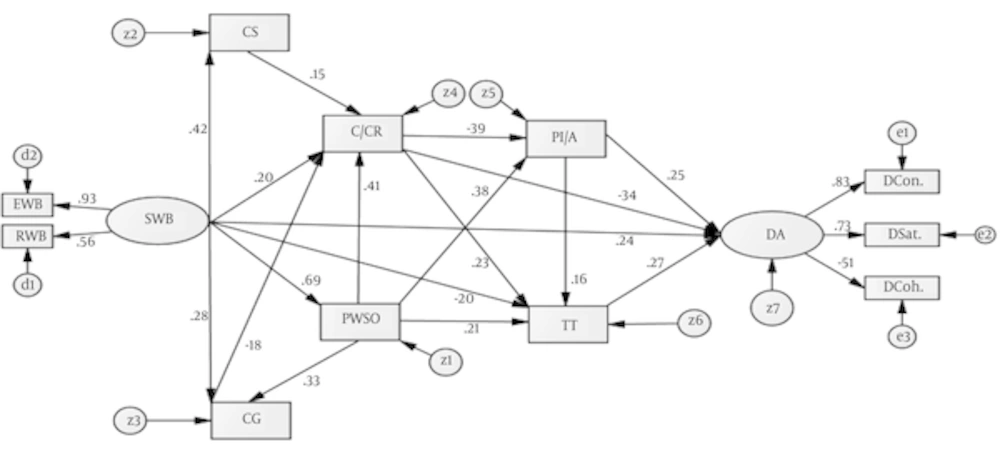
Figure 1.
CS, commitment to stability; CG, commitment to growth; C/CR, communication/conflict resolution; CFI, 0.98; DCon., dyadic consensus; DSat., dyadic satisfaction; DCoh., dyadic cohesion; χ2/DF, 1.77; DA, dyadic adjustment; EWB, existential well-being; GFI, 0.96; NLI, 0.96; PWSO, personal worth of self and others; PI/A, positive interaction/appreciation; P, 0.005; RMSEA, 0.054; Hoelter's index = 253 (0.01); RWB, religious well-being; SWB, spiritual well-being; TT, time spent together.
Results showed that the standardized direct effects of spiritual well-being on positive interaction/appreciation (0.13, P = 0.09), personal worth of self and others on commitment to stability (0.02, P = 0.11) and dyadic adjustment (0.09, P = 0.15), commitment to stability on commitment to growth (0.03, P = 0.13), positive interaction/appreciation (0.03, P = 0.18), time together (0.08, P = 0.10) and dyadic adjustment (.06, P = 0.20), commitment to growth on positive interaction/appreciation (0.04, P = 0.13), time together (0.04, P = 0.15) and dyadic adjustment (0.09, P = 0.06), were not significant. As shown in Figure 1, spiritual well-being has a direct effect on personal worth of self and others (0.69, P < 0.01), commitment to stability (0.42, P < 0.01), commitment to growth (0.28, P < 0.01), communication/conflict resolution (0.20, p < 0.01), time together (0.20, P < 0.01) and dyadic adjustment (0.24, P < 0.01). Personal worth of self and others had a direct effect on commitment to growth (0.33, P < 0.01), communication/conflict resolution (0.41, P < 0.01), positive interaction/appreciation (0.38, P < 0.01) and time together (0.21, P < 0.01). Commitment to stability and commitment to growth had a direct effect on communication/conflict resolution (0.15 and 0.18, P < 0.01, respectively). Communication/conflict resolution had a direct effect on positive interaction/appreciation (0.39, P < 0.01), time together (0.23, P < 0.01) and dyadic adjustment (0.34, P < 0.01). Positive interaction/appreciation had a direct effect on time spent together (0.16, P < 0.01) and dyadic adjustment (0.25, P < 0.01). Time spent together had a direct effect on dyadic adjustment (0.27, P < 0.01).
As shown in Table 2, spiritual well-being has indirect effects on commitment to growth through the mediating role of personal worth of self and others (0.23, CI [0.11, 0.36; P = 0.003], standardized total effect = 0.51), communication/conflict resolution through mediating roles of personal worth of self and others, commitment to stability, and commitment to growth (0.43, CI [0.33, 0.54; P = 0.002], standardized total effect = 0.63), positive interaction/appreciation through the mediating roles of personal worth of self and others, commitment to stability, commitment to growth, and communication/conflict resolution (0.51, CI [0.41, 0.59; P = .005], standardized total effect = 0.51), time spent together through the mediating roles of personal worth of self and others, commitment to stability, commitment to growth, communication/conflict resolution, and positive interaction/appreciation (0.38, CI [0.28, 0.49; P = 0.003], standardized total effect = 0.58), and dyadic adjustment through the mediating roles of personal worth of self and others, commitment to stability, commitment to growth, communication/conflict resolution, positive interaction/appreciation, and time spent together (0.50, CI [0.41, 0.63; P = .003], standardized total effect = 0.74). The results showed that personal worth of self and others had no effect on commitment to stability but had an indirect effect on communication/conflict resolution through the mediating role of commitment to growth (0.06, CI [0.02, 0.13; P = 0.003], standardized total effect = 0.47), positive interaction/appreciation through mediating roles of commitment to growth and communication/conflict resolution (0.18, CI [0.11, 0.29; P = .002], standardized total effect = 0.56), time spent together through the mediating roles of commitment to growth, communication/conflict resolution, and positive interaction/appreciation (0.20, CI [0.11, 0.32; P = 0.003], standardized total effect = 0.41), and dyadic adjustment through the mediating roles of commitment to growth, communication/conflict resolution, positive interaction/appreciation, and time spent together (0.41, CI [0.29, 0.51; P = .003], standardized total effect = 0.41). Commitment to stability had an indirect effect on positive interaction/appreciation through the mediating role of communication/conflict resolution (0.06, CI [0.02, 0.10; P = 0.003], standardized total effect = 0.06), time spent together through mediating roles of communication/conflict resolution and positive interaction/appreciation (0.04, CI [0.01, 0.09; P = 0.003], standardized total effect = 0.04), and dyadic adjustment through the mediating roles of communication/conflict resolution, positive interaction/appreciation, and time spent together (0.08, CI [0.03, 0.13; P = .004], standardized total effect = 0.08). Commitment to growth had an indirect effect on positive interaction/appreciation through the mediating role of communication/conflict resolution (0.07, CI [0.02, 0.12; P = 0.007], standardized total effect = 0.07), time spent together through the mediating roles of communication/conflict resolution and positive interaction/appreciation (0.05, CI [0.02, 0.11; P = 0.004], standardized total effect = 0.05), and dyadic adjustment through the mediating roles of communication/conflict resolution, positive interaction/appreciation and time spent together (0.09, CI [0.03, 0.16; P = 0.005], standardized total effect = 0.09). Communication/conflict resolution had an indirect effect on time spent together through the mediating role of positive interaction/appreciation (0.07, CI [0.02, 0.12; P = 0.004], standardized total effect = 0.30), and dyadic adjustment through the mediating roles of positive interaction/appreciation and time spent together (0.18, CI [0.11, 0.26; P = 0.003], standardized total effect = 0.52). Positive interaction/appreciation had an indirect effect on dyadic adjustment through the mediating role of time spent together (0.04, CI [0.02, 0.09; P = 0.003], standardized total effect = 0.29). The conceptual model explained 23% of the distribution of dyadic adjustment.
Table 2.The Standardized Indirect and Total Effect Coefficients of the Model (BC 95%)
| Variable | Standardized Indirect Effect | Standardized Total Effect |
|---|---|---|
| On the PWSO | ||
| SWB | 0.69 | |
| On the CS | ||
| SWB | 0.42 | |
| On the CG | ||
| SWB | 0.23 | 0.51 |
| PWSO | 0.33 | |
| On the C/CR | ||
| SWB | 0.43 | 0.63 |
| PWSO | 0.06 | 0.47 |
| CS | 0.15 | |
| CG | 0.18 | |
| On the PI/A | ||
| SWB | 0.51 | 0.51 |
| PWSO | 0.18 | 0.56 |
| CS | 0.06 | 0.06 |
| CG | 0.07 | 0.07 |
| C/CR | 0.39 | |
| On the TT | ||
| SWB | 0.38 | 0.58 |
| PWSO | 0.20 | 0.41 |
| CS | 0.04 | 0.04 |
| CG | 0.05 | 0.05 |
| C/CR | 0.07 | 0.30 |
| PI/A | 0.16 | |
| On the DA | ||
| SWB | 0.50 | 0.73 |
| PWSO | 0.41 | 0.41 |
| CS | 0.08 | 0.08 |
| CG | 0.09 | 0.09 |
| C/CR | 0.18 | 0.52 |
| PI/A | 0.04 | 0.29 |
| TT | 0.26 | |
| On the DCon. | ||
| SWB | 0.61 | 0.61 |
| PWSO | 0.34 | 0.34 |
| CS | 0.06 | 0.06 |
| CG | 0.07 | 0.07 |
| C/CR | 0.43 | 0.43 |
| PI/A | 0.24 | 0.24 |
| TT | 0.22 | 0.22 |
| DA | 0.83 | |
| On the DSat. | ||
| SWB | 0.54 | 0.54 |
| PWSO | 0.30 | 0.30 |
| CS | 0.05 | 0.05 |
| CG | 0.07 | 0.07 |
| C/CR | 0.38 | 0.38 |
| PI/A | 0.21 | 0.21 |
| TT | 0.19 | 0.19 |
| DA | 0.73 | |
| On the DCoh. | ||
| SWB | 0.45 | 0.45 |
| PWSO | 0.25 | 0.25 |
| CS | 0.05 | 0.05 |
| CG | 0.06 | 0.06 |
| C/CR | 0.32 | 0.32 |
| PI/A | 0.18 | 0.18 |
| TT | 0.16 | 0.16 |
| DA | 0.61 |
5. Discussion
The purpose of the present study was to test a structural model of hypothesized relationships between spiritual well-being, intervening variables of personal worth of self and others, commitment to relationship stability, commitment to relationship growth, positive interaction/appreciation, communication/conflict resolution, time spent together, and the dependent variable of dyadic adjustment.
The results confirmed that spiritual well-being can be a strong indicator of personal worth of self and others. As mentioned in the literature, intrinsic religiosity was found to be a strong indicator of personal worth of self and others (3). It has also been reported that intrinsic religiosity is an attribute of a person, who has religious experiences and engages in internal/external gains and as a member of that religious community, he/she gains some internal beliefs of personal worth (3). As spiritual well-being includes both existential and religious aspects of spirituality (9), this result can confirm the feeling of personal worth of self and others in a dyadic relationship through spiritual well-being. According to the results of the present study, spiritual well-being has a direct effect on personal worth of self and others, commitment to stability, commitment to growth, communication/conflict resolution, time together, and dyadic adjustment, and also has a positive effect on positive interaction/appreciation through the mediating role of personal worth of self and others, commitment to stability, commitment to growth, and communication/conflict resolution, indirectly. The results showed that spiritual well-being has an indirect effect on commitment to stability through the mediating role of personal worth of self and others, communication/conflict resolution through the mediating role of personal worth of self and others, commitment to stability, and commitment to growth, time together through the mediating role of personal worth of self and others, commitment to stability, commitment to growth, communication/conflict resolution, and positive interaction/ appreciation, and dyadic adjustment through the mediating role of personal worth of self and others, commitment to stability, commitment to growth, communication/conflict resolution, positive interaction/appreciation, and time together.
Inconsistent with previous findings (3), the results of the present study revealed that personal worth of self and others had no effect on a person’s level of commitment to the relational stability of their marriage. However, as shown in Figure 1 and Table 2, personal worth of self and others had a positive effect on a couple’s commitment to relationship growth. Since personal worth of self and others include three areas of worth, namely, self-worth, valuing their spouse and feeling valued by a spouse, this result seems to state that if a person feels personal worth, feels good about his/her spouse, and believes his/her spouse values him/her, he/she may be more motivated to grow the quality of his/her marriage. According to the results of this study, personal worth of self and others has a positive direct effect on commitment to growth, communication/conflict resolution, positive interaction/appreciation, time spent together and dyadic adjustment. As shown in Figure 1 and Table 2, personal worth of self and others had a positive total effect on dyadic adjustment through the mediating role of commitment to growth, communication/conflict resolution, positive interaction/appreciation, and time spent together, indirectly.
The results of the present study also indicated that both commitment to stability and commitments to growth have a positive effect on communication/conflict resolution as noted by some researchers (3). Strong commitment and sense of worth positively affect a couple's ability to negotiate and resolve areas of conflict. As shown in Figure 1 and Table 2, both commitment to stability and commitment to growth had a positive effect on positive interaction/appreciation, time together and dyadic adjustment, indirectly.
The results also confirmed the positive effect of communication/conflict resolution on positive interaction/appreciation, time together and dyadic adjustment. The positive effect of communication/conflict resolution on positive interaction/appreciation, confirms that strength in the areas of worth, commitment, and communication/conflict resolution can affect the quality of couple’s interaction. According to the results of the present study, communication/conflict resolution can affect time spent together through positive interaction/appreciation, and dyadic adjustment through positive interaction/appreciation and time spent together. It seems, through feeling personal worth of self and others and commitment to the relationship, couples may be more motivated to communicate based on mutual openness, honesty, respect and kindness.
The results also indicated that couples’ level of time spent together can increase when they are strong in the previous intervening variables. Generally, the findings revealed that high spiritual well-being, valuing each other, commitment to each other and communicating well as well as enjoying and spending time together all increase couple’s degrees of dyadic adjustment. These results consisted of a previous hierarchical model of hypothesized relationships between intervening variables of intrinsic religiosity, personal worth of self and others, commitment to relationship stability, commitment to relationship growth, positive interaction/appreciation, communication/conflict resolution, and time spent together, and the dependent variable of marital satisfaction (3). The statistical population and non-equal sample size of male and female participants are the limitations of the present study. Of course, more studies are needed with different measures and in different populations (e.g. different socioeconomic levels, different cultures and sub-cultures, investigating the conceptual model based on gender and family life cycle difference) to provide a comprehensive theoretical explanation.

