


Dear Editor
The rising prevalence of stress and psychological distress among university students has become a major public health concern, with significant implications for academic performance, social functioning, and long-term mental health outcomes (1). Many university stress-management strategies focus mainly on individual coping and neglect the broader social, institutional, and policy factors that affect student well-being. This limitation reduces the effectiveness and sustainability of campus mental health efforts. This letter argues that applying the Social Ecological Model (SEM) provides a useful framework for conceptualizing and implementing multilevel interventions to address student stress across intrapersonal, interpersonal, institutional, community, and policy contexts. It further highlights how a multilevel SEM-based approach can strengthen campus mental health strategies by integrating individual coping interventions with social support, institutional resources, and supportive policy environments.
Multilevel Interventions Through a Social Ecological Perspective
At the intrapersonal level, stress-reduction strategies focus on strengthening individual coping skills and psychological resilience. González-Valero et al. (2) found that mindfulness-based interventions, cognitive behavioral techniques, and stress-management training can help students regulate emotions and reduce perceived stress. These interventions target internal cognitive and emotional processes and may empower students to independently manage stress-related challenges (3). Through mindfulness-based stress reduction (MBSR), students learn to manage emotions, reduce negative feelings, and achieve mental balance (3). An 8-week MBSR program significantly decreased perceived stress and symptoms of anxiety and depression (4). MBSR is a public health, group-based approach to supporting university students’ mental health and well-being with critical coping tools, enabling them to manage stress independently. MBSR aligns with intrapersonal factors in the SEM by targeting internal cognitive and emotional processes and offering a group-based approach to enhance student well-being (Figure 1).
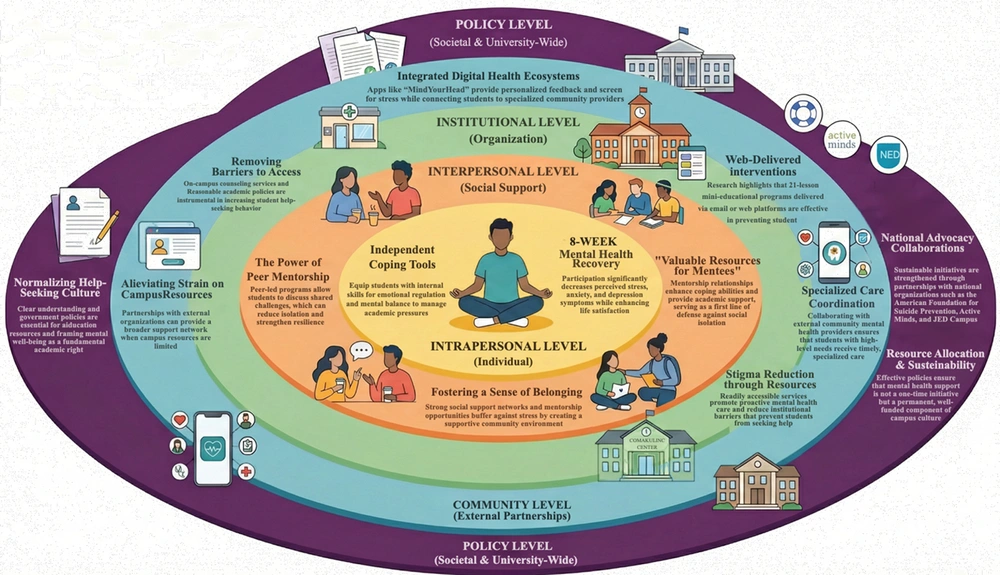
Figure 1.
Stress-reduction interventions conceptualized across the levels of the Social Ecological Model.
The interpersonal level focuses on social factors that influence stress, such as relationships with peers, family, and mentors. Social support networks, including peer support programs and mentorship opportunities, have effectively reduced stress by fostering a sense of belonging and community. Peer mentoring programs allow students to discuss shared challenges, exchange experiences, and offer mutual support. Oduwaye et al. (5) found that mentorship relationships enhance students’ coping abilities and reduce isolation, thereby building resilience to stress. Peer mentors, with academic support, became valuable resources for mentees. This finding highlights the crucial role of social support in buffering against stress, particularly for students who may feel isolated (6).
At the institutional level, a university’s policies and resources are pivotal in creating a supportive mental health environment. Key interventions, such as on-campus counseling services and flexible academic policies, help reduce institutional barriers to mental health support. Moreover, research shows that accessible counseling services increase student help-seeking behavior (1). Kattelmann et al. (7) assessed the effectiveness of a web-delivered intervention developed through a community-based participatory research process, in which 21 mini-educational lessons and email messages were developed for stress management. They found that the web-delivered intervention was effective in preventing or addressing stress in university students (7). To improve accessibility, enhanced counseling services and flexible policies may foster a supportive environment by reducing stigma and barriers to accessing mental health resources.
At the community level, interventions involve partnerships with external organizations to provide additional support for students’ mental health. These collaborations broaden the range of services available to students, especially when campus resources are limited. Choi et al. (8) emphasized that such partnerships can alleviate strain on on-campus resources and offer students access to a broader support network. They developed a mental well-being web application that provided personalized feedback and tailored psychoeducation and resources to support help-seeking among university students. They used the home page of MindYourHead to screen for mental health issues, including stress, and partnered with external mental health services that collaborate with community mental health providers to ensure that students with higher levels of need have access to specialized care (8).
At the policy level, university and government policies are vital for ensuring the availability and accessibility of mental health resources. Harris et al. (9) suggested that institutional policies that normalize mental health support and expand access to counseling services may improve help-seeking behavior among students. University mental health policies that promote and normalize well-being are essential for creating a supportive campus culture. The Royal College of Psychiatrists (10) emphasized that clear policies can encourage students to access mental health services because they normalize the importance of mental well-being in academic settings. Collaborative efforts with organizations such as the American Foundation for Suicide Prevention and local agencies, including Active Minds and JED Campus, can further strengthen and sustain these initiatives, ensuring comprehensive mental health support for students (9).
Despite the potential benefits of multilevel interventions, universities may face several implementation challenges, including limited mental health resources, variations in institutional capacity, and persistent stigma surrounding help-seeking behaviors (11). Addressing these barriers requires sustained institutional commitment and collaboration among academic, health, and community stakeholders (12).
In practice, universities can operationalize a multilevel approach by combining individual stress-management programs with peer-support initiatives, accessible counseling services, and institutional policies that promote mental health awareness and help-seeking. Coordinated implementation across these levels may enhance the effectiveness and sustainability of campus mental health promotion. However, evidence on individual stress-management programs is mixed, suggesting that interventions focusing solely on personal coping may have limited long-term impact when broader environmental and institutional stressors remain unaddressed.
Implications for Campus Mental Health Promotion
Universities play a critical role in shaping environments that influence student stress. Campus mental health promotion should move beyond isolated individual-level interventions and adopt integrated, multilevel strategies that strengthen coping skills while fostering supportive social and institutional contexts (13). Interventions such as mindfulness training, stress-management programs, and peer support initiatives can enhance coping, reduce isolation, and promote a sense of belonging. Embedding these approaches within broader institutional commitments, such as accessible counseling services, stigma-reduction initiatives, and supportive policies, may help create more sustainable and student-centered mental health promotion strategies.
Acknowledging limitations in the evidence is crucial. Many studies on campus mental health interventions are limited to single institutions or specific cultural contexts, often from Western countries, which may limit their generalizability. Cultural, institutional, and policy differences can affect applicability, underscoring the need for research in diverse educational settings. Variations in intervention design, implementation, and evaluation complicate comparisons. Future studies should explore how multilevel interventions can be adapted across different university contexts.
Conclusions
Addressing stress among university students requires moving beyond isolated individual-level interventions toward integrated strategies that operate across multiple levels of influence. The SEM provides a valuable framework for understanding how individual coping skills, social relationships, institutional resources, and supportive policies interact to shape student well-being. Universities that adopt coordinated multilevel approaches may be better positioned to create sustainable campus environments that promote mental health, reduce stigma, and support students’ academic and personal success.
