
1. Introduction
Individuals with mild physical disabilities may experience unique and often overlooked psychological difficulties. Although research directly comparing visible and mild disabilities is scarce, the relative invisibility of mild disability can create distinct challenges. According to the International Classification of Functioning, Disability and Health (ICF), mild disability is defined by a physiological functioning score of 5 - 24 (1). Although such impairments may not substantially limit daily functioning, they can cause significant and persistent psychological discomfort. In adolescents, this challenge is compounded by their developmental stage. Adolescence involves substantial physical, social, emotional, and cognitive changes, with identity formation as a core developmental task (2, 3). When identity formation intersects with physical disability, these challenges may be magnified. Research has documented psychological problems among adolescents with physical disabilities (4).
A key factor that may intensify this struggle is the social position occupied by these adolescents. They may exist in an ambiguous space, neither clearly labeled as disabled nor considered fully healthy. The concept of liminality captures this condition: individuals live on the threshold between culturally recognized states of health and illness, in a state of prolonged ambiguity (5). For adolescents, whose identity is already in flux, this liminal position may intensify psychological discomfort. Despite this, few studies have explored the subjective inner world of this population, particularly that of adolescents with mild disabilities whose difficulties may remain unseen (6). The present study addresses this gap using George Kelly's Personal Construct Theory (PCT).
The central concept in PCT is the construct, a perceptual lens through which individuals interpret the world, make predictions, and guide behavior. According to Kelly, people actively construct subjective reality based on personal interpretations (7). A core principle is that every personal construct is bipolar (6); accordingly, the self has two defining poles: the ideal self and the undesirable self. For adolescents situated between the categories of "healthy" and "disabled," these poles may become distorted or rigid. Drawing on PCT and the concept of liminality, we propose that these adolescents may develop not a confused identity but a "brittle self-structure": a defensive, outwardly positive self-presentation that masks underlying vulnerability and depends strongly on external validation. Identifying and mapping these poles may help participants develop a more flexible self-narrative. Ravenette pioneered the adaptation of PCT for children and adolescents (8), using drawings as developmentally appropriate tools (8); subsequent researchers have used these methods with people with disabilities (9, 10).
Within the PCT framework, assessment and treatment are not strictly distinct; discovering one's constructs may itself be therapeutic (11). However, traditional verbal methods may fail to capture the nuanced and often contradictory constructs of adolescents with mild physical disabilities. The technique presented here, adapted from Moran's Ideal Self Drawing technique (12), was designed to address this gap. By integrating drawing with structured construct elicitation, it serves as both an assessment tool and a space for self-reflection, with the aim of helping adolescents externalize their self-perceptions and move toward greater self-awareness.
2. Case Presentation
2.1. Methodology
Given the exploratory nature of our research questions and the limited empirical attention to this population, we used a qualitative descriptive-exploratory design grounded in PCT. This approach enabled rich, detailed descriptions of idiographic meaning-making systems rather than the testing of predetermined hypotheses. Consistent with the Personal Construct Psychology (PCP) tradition, the process of eliciting constructs was itself considered potentially therapeutic (7, 9).
2.2. Participants
Participants were selected using purposive sampling, a strategy that prioritizes depth of understanding over breadth of generalization (13). Inclusion criteria required that adolescents: 1) have a mild physical disability according to the ICF framework (score 5 - 24) (1); 2) hold an official disability identification card from the State Welfare Organization of Qom; and 3) be willing to participate. Adolescents with moderate or severe physical disabilities, intellectual disabilities, or significant communication impairments that would impede the interview process were excluded. The final sample consisted of eight adolescents (4 girls and 4 boys), with a mean age of 15.6 years (range, 14 - 17 years) (Table 1).
Table 1.
Participants' Characteristics
| Participant | Sex | Age (y) | Type of Disability | Values |
|---|---|---|---|---|
| 1 | Male | 15 | Mild spinal deformity | Congenital |
| 2 | Male | 17 | A defect in the right leg | Congenital |
| 3 | Male | 16 | Three fingers missing from the right hand | Acquired |
| 4 | Male | 14 | Short left leg | Congenital |
| 5 | Female | 17 | Spinal defect | Congenital |
| 6 | Female | 15 | Missing middle fingers and toes | Congenital |
| 7 | Female | 17 | Short left arm | Congenital |
| 8 | Female | 14 | Missing toes of the right foot | Acquired |
2.3. Procedure
Data were collected in individual, face-to-face sessions conducted by the corresponding author, a trained rehabilitation counselor. Each session lasted 60 - 90 minutes and took place in a quiet, private room at the counseling center. The procedure, adapted from Moran's technique (12), comprised four sequential steps designed to progressively externalize, map, and reflect on the two defining poles of the self.
2.3.1. Step 1: Eliciting Undesirable-Self Constructs
Participants were given a blank A4 sheet and asked to draw a person, with no further specification, to allow free projection. After completing the drawing, they were told, "Now, imagine this is a person you would not wish to be like." The researcher then asked nine standardized open-ended questions. The exact wording of each question is provided in the Appendix. Briefly, the nine questions addressed self-perception, perceived social evaluation, interpersonal functioning, social comparison, aspirations and dreams, goal-directed behavior, anxieties and concerns, negative behaviors, and desired change. Participants wrote their answers directly next to the drawing, creating an integrated visual-textual map of their undesirable self.
2.3.2. Step 2: Eliciting Ideal-Self Constructs
The procedure was repeated with a second blank sheet. This time, participants were instructed, "Now, imagine this is a person you would wish to be like." The same nine questions were asked, oriented toward the ideal self. This mirroring procedure explicitly established the bipolar dimensions of each participant's personal constructs, for example, "isolated" versus "sociable" or "hopeless" versus "hopeful." Throughout both steps, the researcher maintained a neutral, nonjudgmental stance and encouraged elaboration without suggesting correct or incorrect responses.
2.3.3. Step 3: Integration and Collaborative Construct Exploration
This step marked the transition from elicitation to collaborative reflection. Both drawings were placed side by side in front of the participant, providing a tangible visual representation of the two self-poles. The researcher then presented a new sheet with a horizontal line representing a continuum from the "Person I do not wish to be like" (point 1) to the "Person I wish to be like" (point 7). Participants were asked to perform three tasks: mark the position of the undesirable-self figure, mark the position of the ideal-self figure, and mark the position of their actual self on the same continuum. This visual placement provided a quantifiable index of self-perception relative to the two poles.
2.3.4. Step 4: Repositioning and Final Reflection
After the collaborative exploration, the researcher asked, "Having thought more about all of this, and having discussed these two people and yourself, which of these two people do you feel your actual self is closer to right now?" Participants then marked their position again on the continuum. This final mark was not treated as a correction but as a visual representation of the reflective process and any resulting shift in self-construal. The session concluded with a debriefing discussion.
2.4. Data Analysis
Textual data from participants' written responses were analyzed using thematic content analysis, following the directed content analysis approach outlined by Hsieh and Shannon (14). The nine thematic domains served as a pre-existing organizing framework while allowing new inductive themes to emerge. Analysis proceeded through five stages: 1) data immersion through repeated reading of transcribed responses organized by participant, self-pole, and domain; 2) initial coding of meaning units into preliminary codes; 3) category development through comparison and grouping of codes; 4) theme identification, with particular attention to constructs appearing across multiple domains and both self-poles; and 5) cross-case integration of self-positioning data with thematic findings to construct a holistic account of each participant's construct system and observed shifts. To enhance the credibility of the analysis, an independent researcher with expertise in qualitative methods reviewed a random sample of 20% of the coded constructs and the emerging themes. Disagreements were discussed until consensus was reached.
Each discrete descriptive term or phrase provided by a participant in response to a question was counted as one construct. If a participant offered multiple descriptors within a single domain (eg, "weak, unhappy, ugly" in response to "Self-perception"), each descriptor was counted separately because it represented a distinct bipolar dimension. Constructs appearing in more than one domain were counted in each domain in which they appeared because the context of the domain shapes the construct's meaning within the participant's system. For the self-positioning data, the visual continuum was treated as a 7-point Likert-type scale. The distance between the initial (Step 3) and revised (Step 4) marks was measured to the nearest 0.5 interval. The direction of the shift, toward the undesirable- or ideal-self pole, was also recorded.
2.5. Trustworthiness and Ethical Considerations
Several strategies were used to enhance trustworthiness, guided by Lincoln and Guba's criteria (15). Credibility was strengthened through participant-drawn visual anchors, which served as a form of member checking during collaborative exploration and allowed participants to verify the researcher's interpretations in real time. Dependability was supported by the standardized four-step protocol administered consistently across participants. Confirmability was addressed through a reflexive journal in which the researcher documented personal assumptions, reactions, and potential biases throughout data collection and analysis. The researcher consciously adopted a stance of "disciplined naivety," striving to let participants' own words and constructions guide the inquiry. Transferability was addressed through rich, detailed descriptions of participants, procedures, and context, allowing readers to assess applicability to their own settings. Consistent with the idiographic nature of PCP research, the goal was not statistical generalization but transferable insight for theory and clinical practice.
This study was approved by the Ethics Committee of the University of Social Welfare and Rehabilitation Sciences, Tehran, Iran (approval code: IR.USWR.REC.1398.211). Written informed consent was obtained from all participants and their legal guardians before data collection. Participants were informed about the voluntary nature of participation, their right to withdraw at any time, and the measures taken to protect confidentiality. All identifying information was removed from the data, and participants are referred to by codes P1-P8. Given the sensitive nature of the topic, the participants' age, and the fact that the researcher was male, female participants were offered the option of having a trusted companion, such as their mother, present during the session to ensure comfort. All female participants declined this option and preferred a private, one-on-one session. The researcher therefore maintained strict professional boundaries and a nonintrusive stance throughout. Participants were also monitored for signs of distress, and a protocol was in place for referral to psychological support services if needed.
2.6. Results
2.6.1. Elicited Personal Constructs
Across all eight participants, 175 undesirable-self constructs and 180 ideal-self constructs were generated. Tables 2 and 3 summarize the constructs and their frequencies for both self-poles. Frequencies are presented separately for girls and boys to provide a complete description of the sample; however, with only four participants per group, no inference regarding gender differences in the broader population can be made. These frequencies are descriptive characteristics of this sample only. Construct frequencies refer to the total number of descriptors generated by all eight participants within each thematic domain. Because individuals could provide multiple descriptors, the sum of frequencies exceeds the number of unique constructs.
Table 2.
Personal Constructs Related to the "Person I Wish Not to Be Like" (Undesirable Self) a
| Row | Topic | Constructs | No. of Constructs in Girls | No. of Constructs in Boys |
|---|---|---|---|---|
| 1 | Opinion about self | Weak, unhappy, ugly, unmotivated, disabled, low self-confidence, inferiority | 10 | 8 |
| 2 | Others' opinion about him/her | Angry, irritable, weak, sensitive, hopeless, taciturn, docile, dependent, passive, shy | 15 | 11 |
| 3 | Communication | Bad, weak, entitled, unhappy, aloof, shy | 12 | 10 |
| 4 | Comparison | Appearance, ability, being active, being sociable | 8 | 9 |
| 5 | Dreams | Being healthy, successfulness, self-confidence, progress, undergoing plastic surgery | 10 | 8 |
| 6 | Goals | Purposeless, continuing education, helping others | 8 | 11 |
| 7 | Concerns | Appearance, defects, lack of success, fear of others' judgment, fear of loneliness, fear of losing significant others | 12 | 9 |
| 8 | Bad habits | Lazy, fearful, shy, highly sensitive | 9 | 10 |
| 9 | Changes | Temperament, self, own appearance, place of residence | 8 | 7 |
| Total | 9 | 175 | 92 | 83 |
a N = 8; Frequencies represent the total number of discrete descriptors generated by all participants within each domain.
Table 3.
Personal Constructs Related to the "Person I Wish to Be Like" (Ideal Self) a
| Row | Topic | Constructs | No. of Constructs in Girls | No. of Constructs in Boys |
|---|---|---|---|---|
| 1 | Opinion about self | Intelligent, reasonable, lovely, self-respect, successful, self-confident | 11 | 10 |
| 2 | Others' opinion | Lovely, successful, patient, handsome, happy, attractive | 10 | 9 |
| 3 | Communication | Warm, positive, friendly, easy-going, kind | 11 | 10 |
| 4 | Comparison | Success, appearance, abilities | 9 | 10 |
| 5 | Dreams | Health, going to university, having a good job, helping others | 10 | 8 |
| 6 | Goals | Helping, success in studies, success in sports | 10 | 12 |
| 7 | Concerns | Fear of loss, fear of loneliness, failure | 12 | 10 |
| 8 | Bad habits | Attention to detail, stubbornness, excessive sensitivities, strictness | 11 | 9 |
| 9 | Changes | Enhanced concentration, appearance, place of residence, more attention to self | 10 | 8 |
| Total | 180 | 94 | 86 |
a N = 8; Frequencies represent the total number of discrete descriptors generated by all participants within each domain.
A finding of particular interest was the persistence of "fear of loneliness" and "fear of loss" across both self-poles. This pervasive preoccupation was illustrated in participants' accounts. One boy (P3, aged 16 years) described his undesirable self as someone who "has no friends, others don't seem to see him. always alone." When envisioning his ideal self, the same participant stated that his greatest concern was "losing the people who finally see him." Similarly, a female participant (P5, aged 17 years), while describing her undesirable self, stated, "She has nobody. she is alone in a crowd," and then described her ideal self's deepest concern as "that one day I will lose the ones who love me." This pattern recurred across multiple participants, suggesting that these fears may represent a deep-seated preoccupation that transcends the feared-ideal dichotomy.
2.6.2. Self-positioning
Participants' visual representations of their actual self in relation to the two elicited self-poles provided a concrete index of self-perception. Visual inspection of Figure 1 shows that all four female participants' initial placements were clustered between points 5 and 7 on the continuum, whereas three of four male participants placed themselves at points 3, 4, and 5.
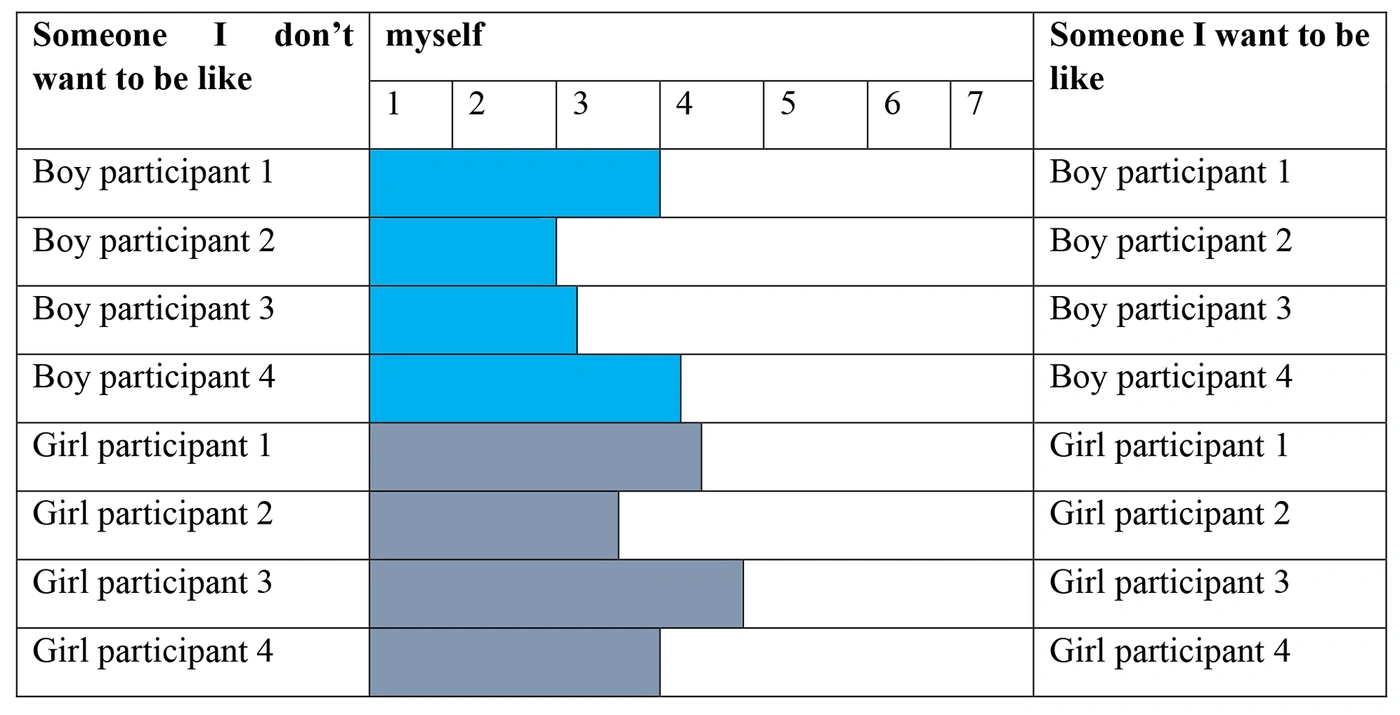
Figure 1.
Initial self-positioning between the undesirable self and the ideal self
A comparison of Figures 1 and 2 shows that all eight participants adjusted their self-positioning after the reflective exploration, moving slightly farther from the ideal-self pole. This shift was observed in every case, although its magnitude varied across individuals (range, 0.5 - 2.0 points on the 7-point scale). This observation cannot be attributed causally to the procedure in the absence of a control condition and is presented as a descriptive finding that warrants further investigation.
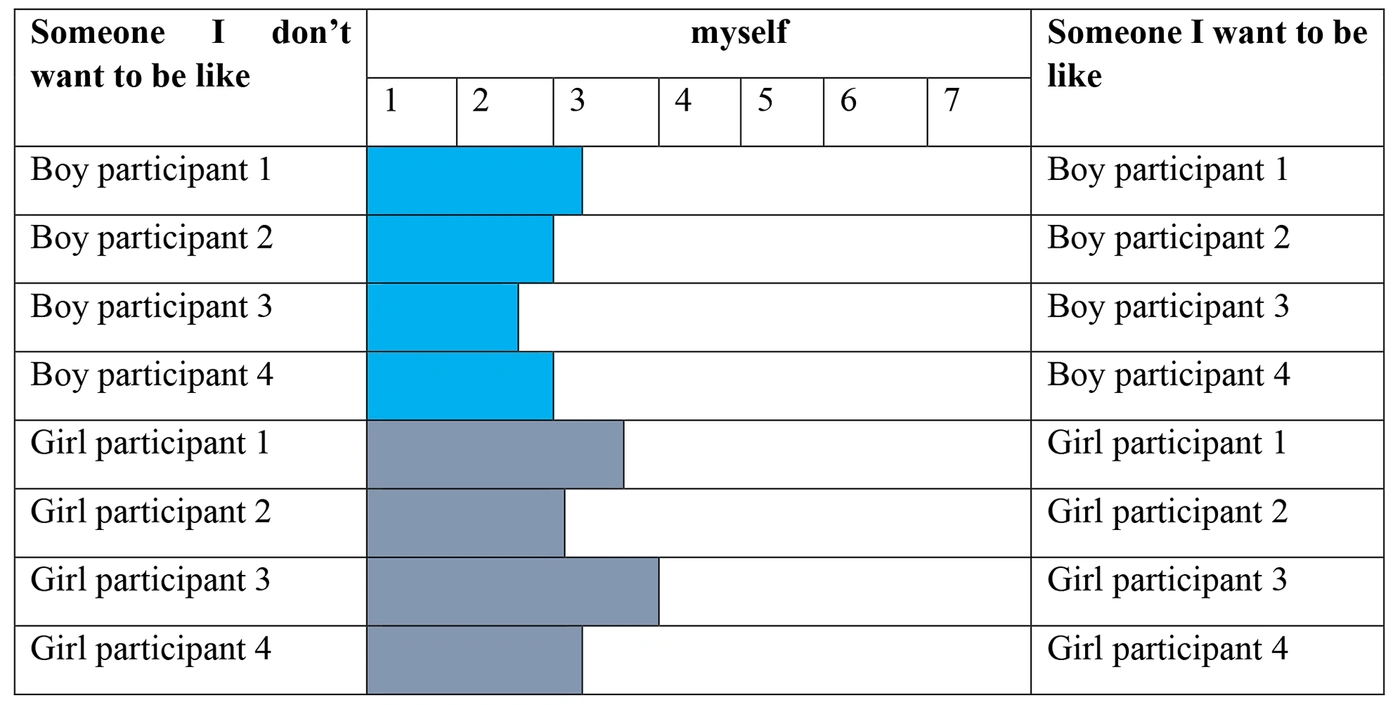
Figure 2.
Revised self-positioning after construct exploration
3. Discussion
This study aimed to identify the personal constructs of adolescents with mild physical disabilities and to understand how they perceive their actual selves in relation to their ideal and undesirable selves. The adapted Ideal Self Drawing Technique elicited rich bipolar constructs and was associated with shifts in self-perception across all participants. These findings have implications for understanding the psychological landscape of a population living in social and existential liminality.
A particularly striking finding was the recurrence of "fear of loneliness" and "fear of loss" across both the undesirable- and ideal-self poles. The pervasiveness of this theme suggests that these fears may reflect a deep-seated preoccupation that is fundamental to adolescents' meaning-making and may shape even their aspirations. This finding aligns with the theory of liminality underpinning this study (5). Individuals in a liminal state, suspended between culturally recognized categories, may experience profound social disconnection and existential uncertainty. The pervasive fear of loss and loneliness may therefore represent a phenomenological expression of living in this ambiguous space, in which one is neither fully included nor entirely excluded, leading to an internalized expectation of isolation. This interpretation is further supported by quantitative evidence showing that adolescents with physical disabilities experience higher levels of loneliness than typically developing peers and that loneliness is strongly associated with reduced quality of life (16, 17).
Our findings extend this literature by suggesting that this fear is not merely a current state but also a projected, anticipated future woven into the fabric of identity. This interpretation is consistent with research showing that experiences of social exclusion can affect social functioning and personality expression (18). Adolescence is also a period of heightened vulnerability.
A notable visual pattern emerged in the self-positioning data. Female participants initially placed themselves farther from the undesirable-self pole than did male participants. Given the very small number of participants in each gender group (n = 4), this pattern is presented as a descriptive observation specific to this sample, not as evidence of gender differences in the broader population. With this caveat, the observed clustering provides tentative empirical support for our proposed concept of a "brittle self-structure." The girls' initially high placements may reflect not genuine self-esteem but a defensive self-presentation intended to distance the self from a profoundly unattractive undesirable state. This interpretation is consistent with literature suggesting that girls with disabilities face compounded social pressures, potentially leading to a heightened need for social approval and a more fragile, externally validated sense of self (19). As others have noted, elaborate aspirations and a rigidly positive self-view do not necessarily translate into greater well-being and may widen the perceived gap between actual and ideal selves, a known predictor of distress (20, 21). Interestingly, this pattern appears to contrast with findings from the broader disability literature indicating that males with disabilities tend to have a more positive self-concept than females (21).
The finding that female participants in our study placed themselves closer to their ideal selves, whereas prior quantitative research has reported lower general self-concept among females, lends further support to our interpretation. This discrepancy suggests that the seemingly positive self-rating observed in the present study may reflect a brittle, defensive self-structure rather than genuine, integrated self-esteem. Moreover, the aforementioned study found that, despite lower self-concept among females with disabilities, a positive relationship existed between their actual and ideal selves, which may indicate acceptance of congenital defects as a challenge to integration into the mainstream. Thus, a high placement on the visual scale in our study does not necessarily indicate psychological well-being and may instead function as a coping strategy for managing a deeply felt and painful social reality.
This interpretation is further supported by Ogilvie's concept of the "undesired self." Ogilvie proposed that subjective well-being is more strongly predicted by perceived distance from the undesired self than by proximity to the ideal self (22). Paradoxically, an excessively large distance from the undesired self can signal denial of disowned aspects of the self, creating a fragile self-structure that is vulnerable to threat. The pattern observed here, in which some participants showed a large initial distance from the undesired self, is consistent with this framework.
The shift in self-positioning in Step 4 requires cautious interpretation. Although this pattern was consistently observed, it cannot be causally attributed to the reflective procedure without a control condition. Alternative explanations, including demand characteristics, social desirability, and measurement variability, remain equally plausible. One possible interpretation, consistent with PCT, is that this movement tentatively reflects the beginning of an acknowledgment of previously disowned aspects of the self, representing a step toward a more comprehensive and flexible construct system, which Kelly associated with psychological health. In this sense, the shift can also be understood through Kelly's concept of "constructive alternativism," in which individuals are afforded the opportunity to reinterpret their experiences and reconstruct their self-narratives.
The process of externally visualizing, verbalizing, and discussing the undesirable self within the safe, egalitarian space characteristic of PCP methodology (11) may have facilitated a momentary reappraisal of self-positioning. This interpretation aligns with research on the potential therapeutic benefits of expressive writing and visual arts interventions (23), which have been associated with improvements in emotional and physical health outcomes (24). Future research should investigate whether such shifts are sustained over time and whether they correlate with improvements in psychological well-being.
3.1. Limitations
Several limitations should be acknowledged. First, the small sample size (n = 8) fundamentally limits transferability. As with qualitative PCP research generally, the aim was idiographic depth rather than statistical generalization. Any patterns observed, including those related to gender, are specific to this group and cannot be generalized. Second, construct categorization was performed by a single researcher, although credibility was enhanced through independent review of 20% of the data. Future studies should use multiple independent coders. Third, the study did not systematically assess participants' emotional responses during the repositioning process. Fourth, the gender of the first author (male) may have introduced social desirability bias, particularly in the initial self-positioning of female participants, who may have presented a more socially approved image that was more distant from the undesired self to a male interviewer. Fifth, we did not include a measure of psychological well-being or distress, which would have allowed exploration of the clinical significance of the observed self-positioning patterns. Finally, the cross-sectional design precludes conclusions about causality or the durability of the observed shifts.
3.2. Conclusions
Research methods grounded in Personal Construct Psychology offer a unique approach to investigating the inner world of adolescents. The constructs elicited through the adapted Ideal Self Drawing Technique provide rich material for counseling based on a personal construct model. Prior research has largely neglected the dynamic interplay among actual, ideal, and undesired selves, likely because of methodological challenges in measuring such discrepancies (25). The present study addressed this gap by enabling participants to visually and verbally map their self-positioning and by leveraging the bipolar nature of constructs to build self-awareness. The technique merits further investigation as both an assessment tool and a catalyst for self-reflection in this vulnerable population. Future research should examine its utility in clinical settings, its potential integration into therapeutic interventions, and its applicability to other adolescent populations facing identity challenges, such as those with chronic illnesses or those from minority backgrounds.