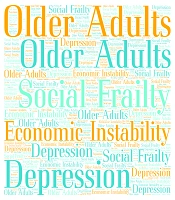
Cover image of the article: Ageing Under Humanitarian and Economic Crises in Iran: Psychological Risks, Social Frailty, and Resilience

Image Credit:Iran J Psychiatry Behav Sci

Ageing Under Humanitarian and Economic Crises in Iran: Psychological Risks, Social Frailty, and Resilience

Authors

Mohammad Taha Saadati RadMohammad Taha Saadati Rad ORCID1, 2, Seyed Ebrahim Seyed AlaviSeyed Ebrahim Seyed Alavi ORCID1, Kamaledin Alaedini ShoormastiKamaledin Alaedini Shoormasti ORCID2,*, Maryam Sefidgarnia AmiriMaryam Sefidgarnia Amiri ORCID2, 3
1Department of Aging, Iranian Research Center on Aging, University of Social Welfare and Rehabilitation Sciences, Tehran, Iran
2Psychiatry and Behavioral Sciences Research Center, Addiction Institute, Mazandaran University of Medical Sciences, Sari, Iran
3Department of Psychiatry, Faculty of Medicine, Psychiatry and Behavioral Sciences Research Center, Addiction Institute, Mazandaran University of Medical Sciences, Sari, Iran
*Corresponding Author: Department of Psychiatry, School of Medicine, Psychiatry and Behavioral Sciences Research Center, Addiction Institute, Mazandaran University of Medical Sciences, Sari, Iran. Email: k.alaedini@yahoo.com

IJ Psychiatry and Behavioral Sciences:Vol. 20, issue 3; e172387
Published online:Aug 25, 2026
Article type:Brief Report
Received:May 29, 2026
Accepted:Aug 08, 2026
How to Cite:Saadati Rad MT, Seyed Alavi SE, Alaedini Shoormasti K, Sefidgarnia Amiri M. Ageing Under Humanitarian and Economic Crises in Iran: Psychological Risks, Social Frailty, and Resilience. Iran J Psychiatry Behav Sci. 2026;20(3):e172387. doi: https://doi.org/10.5812/ijpbs-172387

Abstract

Background:

Iran’s rapid population ageing coincides with economic instability, recurrent disasters, and post-pandemic service disruption, potentially exacerbating depression, anxiety, loneliness, social frailty, and barriers to care.

Objectives:

To synthesize evidence on psychological vulnerability and resilience among older adults in Iran during overlapping crises.

Methods:

This focused narrative review searched PubMed/MEDLINE for records published from January 2015 through July 2026 and consulted authoritative sources from the World Health Organization and the United Nations. Iranian evidence was prioritized, and transferable international evidence was used when country-specific data were unavailable.

Results:

Iranian studies have reported socioeconomic inequalities in depression and anxiety, loneliness, social frailty, disaster vulnerability, and pandemic-associated isolation. Sanctions have reduced access to certain medicines. Family support and community networks are protective but may be weakened by migration, financial strain, and disruptions in services.

Conclusions:

Age-inclusive responses across mental health, primary care, disaster preparedness, digital inclusion, and social protection are warranted. However, direct longitudinal evidence linking specific crises to mental health outcomes remains limited.

1. Background

Healthy ageing depends on physical and psychological capacity, social relationships, supportive environments, and equitable care. In Iran, adults aged 65 years or older comprised approximately 8% of the population in 2024, and the population aged 60 years or older is projected to reach 17.6% by 2035 (1, 2). This demographic transition coincides with inflation, sanctions, disasters, and persistent disruption related to COVID-19. Financial insecurity may exacerbate anxiety and depression; disrupted access to medicines may worsen illness and distress; displacement and bereavement may increase loneliness; and digital exclusion may limit access to telehealth, emergency information, and social contact. Vulnerability therefore reflects interactions among crisis exposure, socioeconomic position, health status, social support, and resilience.

2. Objectives

To synthesize Iran-specific and transferable evidence on psychological vulnerability, social frailty, and resilience among older adults facing humanitarian and economic pressures.

3. Methods

This focused narrative review was updated in July 2026. PubMed/MEDLINE was searched for English-language records published from January 2015 through July 2026 using combinations of the terms Iran/Iranian, older adults/ageing, depression, anxiety, loneliness, social frailty, disaster, sanctions, medicine access, digital health, social support, and resilience. The World Health Organization and United Nations websites were searched for demographic and policy reports. Eligible sources addressed adults aged 60 years or older, ageing policy, or crisis-related psychosocial and service-access mechanisms. Duplicates, sources unrelated to later life, and items without empirical or policy content were excluded. Iranian studies were prioritized; broader evidence is explicitly identified as extrapolated. One author screened and extracted evidence, and another verified source retention and thematic allocation. Findings were grouped into demographic/care-system, psychological/social, disaster/digital, and resilience domains.

4. Results

Table 1 links each claim to its evidence base. Iran-specific evidence is strongest for psychological distress, social support, disaster vulnerability, and access to medicines; however, evidence for crisis causality and digital exclusion is weaker.
Table 1.
Evidence-to-Claim Map for Vulnerability and Resilience Domains
DomainIran-Specific EvidenceInterpretation / Evidence Limit
Demographic/care pressureAbout 8% were aged ≥ 65 in 2024; ≥ 60-year-olds may reach 17.6% by 2035 (1, 2). Sanctions reduced the availability of selected noncommunicable disease medicines (3).Care disruption is a plausible pathway to distress, but older-adult-specific causal estimates are unavailable.
Psychological/social riskLower socioeconomic status was associated with more anxiety and depressive symptoms; loneliness and depression were linked with social frailty (4, 5, 6). Nursing home residents described intensified isolation during COVID-19 (7).Most evidence is cross-sectional or qualitative.
Disaster/digital exclusionIranian older adults described personal and social disaster vulnerabilities and experience-based coping (8).Digital evidence is mainly international; low income, disability, and limited literacy may impede access to telehealth and emergency information (9).
ResilienceIn Tehran, social support was associated with better mental health (10).Family and community networks may protect well-being but can be strained by migration and financial hardship.

5. Discussion

The evidence suggests a convergent pathway: economic and humanitarian pressures disrupt material resources and continuity of care, whereas social disconnection and ageism shape psychological outcomes. The strongest Iran-specific findings are socioeconomic inequalities in anxiety and depression (4), associations between depression and social frailty (6), and the importance of loneliness and social support (5, 10). Evidence that sanctions reduced the availability of selected medicines supports a service-access mechanism but does not establish a direct mental health effect among older adults (3).
Policy should integrate behavioral health into routine ageing and emergency response systems. Primary care can conduct brief screening for depression, anxiety, loneliness, cognitive concerns, and interruptions in access to medicines, with referral pathways that remain functional during crises. Disaster plans should identify people living alone or those dependent on essential medicines and address mobility, sensory, cognitive, and digital barriers. Communication should remain available through both nondigital and accessible digital channels. Social participation, family support, senior day services, and community outreach should be strengthened rather than treating older adults solely as passive aid recipients.
Iran's primary care infrastructure and efforts toward age-responsive universal health coverage provide practical entry points (11). These can be aligned with healthy-ageing priorities and action against ageism (12, 13). Transferable lessons include the need to integrate mental health, continuity of access to medicines, and social support planning. Sanctions architecture, family structures, and governance arrangements remain context-specific.

5.1. Study Limitations

This was not a systematic review. The search was limited to English-language PubMed/MEDLINE records and selected organizational websites, creating potential publication, language, and selection bias. Much of the Iranian evidence is cross-sectional or qualitative, digital evidence is partly extrapolated, and longitudinal studies of crises are scarce. The synthesis therefore supports plausible pathways and policy priorities rather than causal estimates.

5.2. Conclusions

Older adults in Iran face intersecting psychological, social, and care-access risks during crises. The evidence supports integrated mental health screening, continuity of essential care, age-inclusive disaster planning, accessible communication, and reinforcement of family and community support. Effect sizes and delivery models require context-specific evaluation.
Footnotes

  • AI Use Disclosure:For translation purposes, DeepSeek was used to a minor extent in the Abstract section.

  • Authors' Contribution:Study concept and design: K. A. Sh. and M. T. S. R.; Analysis and interpretation of data: M. T. S. R.; Drafting of the manuscript: M. T. S. R.; Administrative, technical, and material support: M. S. A.; Study supervision: K. A. Sh.

  • Conflict of Interests Statement:The authors have no conflict of interest.

  • Data Availability:The dataset presented in the study is available on request from the corresponding author during submission or after publication.

  • Funding/Support:No funding was received for this study.

References

  • 1.
    United Nations Department of Economic and Social Affairs, Population Division. United Nations Department of Economic and Social Affairs, Population Division. New York: United Nations; 2024, [cited 2026 Aug 26]. World Population Prospects 2024. Available from: https://population.un.org/wpp/.
  • 2.
    Aghamohamadi S, Hajinabi K, Jahangiri K, Asl IM, Dehnavieh R. Population and mortality profile in the Islamic Republic of Iran, 2006 - 2035. East Mediterr Health J. 2018;24(5):469-476. [PubMed ID: 30043966]. https://doi.org/10.26719/2018.24.5.469.
  • 3.
    Kheirandish M, Varahrami V, Kebriaeezade A, Cheraghali AM. Impact of economic sanctions on access to noncommunicable diseases medicines in the Islamic Republic of Iran. East Mediterr Health J. 2018;24(1):42-51. [PubMed ID: 29658620]. https://doi.org/10.26719/2018.24.1.42.
  • 4.
    Azizabadi Z, Aminisani N, Emamian MH. Socioeconomic inequality in depression and anxiety and its determinants in Iranian older adults. BMC Psychiatry. 2022;22(1). 761. [PubMed ID: 36471352]. [PubMed Central ID: PMC9721087]. https://doi.org/10.1186/s12888-022-04433-w.
  • 5.
    Moshtagh M, Salmani F, Moodi M, Miri MR, Sharifi F. A perspective on the sense of loneliness and its determinants in Iranian older people. Psychogeriatrics. 2022;22(2):252-258. [PubMed ID: 35048470]. https://doi.org/10.1111/psyg.12809.
  • 6.
    Delbari A, Abolfathi Momtaz Y, Bidkhori M, Ghavidel F. Association between mental health and sleep condition with social frailty: evidence from Ardakan Cohort Study on Aging (ACSA). Aging Ment Health. 2024;28(12):1801-1807. [PubMed ID: 38961749]. https://doi.org/10.1080/13607863.2024.2372475.
  • 7.
    Asgari Z, Darvishpour A. The older adults' experiences of living in the nursing home during the COVID-19 pandemic: a qualitative study in Iran. Nurs Open. 2023;10(5):3122-3131. [PubMed ID: 36565157]. [PubMed Central ID: PMC9880649]. https://doi.org/10.1002/nop2.1562.
  • 8.
    Khankeh H, Daddoust L, Ebadi A, Sahaf R, Nakhaei M, Asgary A. The vulnerability of the Iranian elderly in disasters: qualitative content analysis. Iran J Nurs Midwifery Res. 2018;23(5):402-408. [PubMed ID: 30186347]. [PubMed Central ID: PMC6111662]. https://doi.org/10.4103/ijnmr.IJNMR_127_17.
  • 9.
    Dykgraaf SH, Desborough J, Sturgiss E, Parkinson A, Dut GM, Kidd M. Older people, the digital divide and use of telehealth during the COVID-19 pandemic. Aust J Gen Pract. 2022;51(9):721-724. [PubMed ID: 36045630]. https://doi.org/10.31128/AJGP-03-22-6358.
  • 10.
    Tajvar M, Grundy E, Fletcher A. Social support and mental health status of older people: a population-based study in Iran-Tehran. Aging Ment Health. 2018;22(3):344-353. [PubMed ID: 27976913]. https://doi.org/10.1080/13607863.2016.1261800.
  • 11.
    Jebeli SSH, Rezapour A, Rosenberg M, Moradi-Lakeh M. Measuring universal health coverage to ensure continuing care for older people: a scoping review with specific implications for the Iranian context. East Mediterr Health J. 2021;27(8):806-817. [PubMed ID: 34486717]. https://doi.org/10.26719/emhj.21.040.
  • 12.
    World Health Organization. World Health Organization. Geneva: World Health Organization; 2021, [cited 2026 Aug 26]. Global report on ageism. Available from: https://www.who.int/publications/i/item/9789240016866.
  • 13.
    World Health Organization. World Health Organization. Geneva: World Health Organization; 2021, [cited 2026 Aug 26]. Decade of healthy ageing: baseline report. Available from: https://www.who.int/publications/i/item/9789240017900.

Copyright

Copyright © 2026, Saadati Rad et al. This open-access article is available under the Creative Commons Attribution 4.0 (CC BY 4.0) International License (https://creativecommons.org/licenses/by/4.0/), which allows for unrestricted use, distribution, and reproduction in any medium, provided that the original work is properly cited.

Similar Articles

31
Mar
2026
Does Experiencing the COVID-19 Pandemic Affect Death Anxiety in Iranian Older Adults? A Survey-Based Cross-sectional Study

Does Experiencing the COVID-19 Pandemic Affect Death Anxiety in Iranian Older Adults? A Survey-Based Cross-sectional Study

Ayoub Nafei,
Ronak Ghafori,
Marjan Haghi,
Fereshteh Rezaie,
Masoudeh Babakhanian,
Arya Hamedanchi

Nafei A, Ghafori R, Haghi M, Rezaie F, Babakhanian M, et al. Does Experiencing the COVID-19 Pandemic Affect Death Anxiety in Iranian Older Adults? A Survey-Based Cross-sectional Study. J Kermanshah Univ Med Sci. 2026;30(1):e169774. doi: https://doi.org/10.5812/jkums-169774

1
Oct
2025
Psychosocial Stresses and Its Social Determinates: A Population-Based Survey in Tehran, Iran

Psychosocial Stresses and Its Social Determinates: A Population-Based Survey in Tehran, Iran

Fardin Alipour,
Hassan Rafiey,
Mohammad Sabzi Khoshnami,
Mehdi Basakha,
Mehdi Noroozi

Alipour F, Rafiey H, Sabzi Khoshnami M, Basakha M, Noroozi M. Psychosocial Stresses and Its Social Determinates: A Population-Based Survey in Tehran, Iran. Iran J Psychiatry Behav Sci. 2025;19(4):e162170. doi: https://doi.org/10.5812/ijpbs-162170

30
Dec
2012
The Elderly Population in Iran: An Ever Growing Concern in the Health System

The Elderly Population in Iran: An Ever Growing Concern in the Health System

Maryam Noroozian

Noroozian M. The Elderly Population in Iran: An Ever Growing Concern in the Health System. Iran J Psychiatry Behav Sci. 2012;6(2):. doi:

21
Jan
2026
Resilience Among Healthcare Workers Facing a Severe Crisis; The COVID-19 Outbreak Experiences at Referral Hospitals in Tehran, Iran

Resilience Among Healthcare Workers Facing a Severe Crisis; The COVID-19 Outbreak Experiences at Referral Hospitals in Tehran, Iran

Fatemeh Sadat Bateni,
Negar Kiani Yousefzadeh,
Mohsen Vahedi,
Aishatu Yusha'u Armiya'u,
Atefeh Abedini,
Mohammadreza Salehi
,et al.

Bateni FS, Kiani Yousefzadeh N, Vahedi M, Armiya'u AY, Abedini A, et al. Resilience Among Healthcare Workers Facing a Severe Crisis; The COVID-19 Outbreak Experiences at Referral Hospitals in Tehran, Iran. J Arch Mil Med. 2026;14(1):e168609. doi: https://doi.org/10.69107/jamm-168609

18
Oct
2026
Social Determinants of Health and Psychological Distress Among Female-Headed Households in a Marginalized Urban Population of Zahedan, Iran (AI-generated illustration)

Social Determinants of Health and Psychological Distress Among Female-Headed Households in a Marginalized Urban Population of Zahedan, Iran

Narjes Sargolzaei,
Amir Agheli Moghadam,
Reyhaneh Darvishi

Sargolzaei N, Agheli Moghadam A, Darvishi R. Social Determinants of Health and Psychological Distress Among Female-Headed Households in a Marginalized Urban Population of Zahedan, Iran. Zahedan J Res Med Sci. 2026;28(4):e174089. doi: https://doi.org/10.5812/zjrms-174089

More by these authors

Mohammad Taha Saadati RadPubMedScholar
Seyed Ebrahim Seyed AlaviPubMedScholar
Kamaledin Alaedini ShoormastiPubMedScholar
Maryam Sefidgarnia AmiriPubMedScholar
Share
Cited by
Metrics