


1. Introduction
Schizophrenia is a mental disorder with genetic, neurodevelopmental, and environmental history (1). Previous researches on the pathophysiology of this psychiatric disorder were mostly focused on abnormal neurotransmitter receptor functions (1). Fatty acids are one of the most important components of the neural cell membrane and play an important role in cell signaling system. They serve to some extentfor making new synaptic connections, growth of axons and dendrites, as well as apoptosis of the membranes (2, 3). Arachidonic acid (AA) and docosahexaenoic acid (DHA) make up 80 - 90% of neural tissues. They cannot be made by human body and therefore should be converted from other fatty acids (e.g. linolenic and alpha linolenic acids) or should be ingested as a part of the diet (2, 3). In the brain, phospholipase A2 (PLA2) and phospholipase C are responsible for the release of AA and DHA from phospholipids (2, 3).
The activity of PLA2 is increased in schizophrenic patients; however, the exact mechanisms and the role of increased activity are not clear (4-8). One of the suggested mechanisms is the accelerated breakdown of phospholipids due to the increased activity of PLA2 which can lead to a reduced AA level in the neural membranes. The levels of AA and DHA is reduced in the phospholipids of cell membrane in schizophrenic patients (9, 10). Evidence indicates that a skin test using methyl nicotinate (niacin ester derivative) can suggest a possibly reduced AA level in the cell membranes through the mechanism by which niacin may act (via niacin receptors) on immune cells and mediate the synthesis of prostaglandins. This inflammatory response can cause skin vasodilatation and redor (flushing) which is about four times greater in healthy control subjects compared with schizophrenic patients (10-13). Some studies also showed that skin flush response to niacin is more impaired in the relatives of schizophrenic patients indicating the genetic aspect of schizophrenia (14, 15). However, there have been controversies in this regard (16) and it is not known whether this phenomenon can be generalized to other psychiatric disorders. On the other hand, there are very few studies on the results of skin niacin test among other psychiatric and neurodevelopmental diseases such as depression, bipolar, and autism disorders (17-20), and the results have been controversial. Therefore, further studies are required to better demonstrate the properties of the niacin skin test as a diagnostic test for schizophrenia in order to differentiate from other psychiatric disorders.
There is not enough reports on the skin niacin test among schizophrenic patients in comparison with their relatives and other psychiatric disorders, especially in our society (i.e. Iranian subjects). Also, it is not clear at which concentration and time point the test would have the optimal properties. Therefore, this study aimed to compare the niacin skin flush response with different concentration and at different time points among four groups of Iranian subjects including patients with schizophrenia and their first degree relatives, bipolar disorder patients and healthy controls.
2. Materials and Methods
2.1. Patients and Settings
This diagnostic trial was conducted at the Noor university hospital in Isfahan, Iran, from January to September 2014. Subjects such as hospitalized adult (18 to 65 years old) with schizophrenia and bipolar disorder diagnosed according to the DSM-IV TR criteria (21) were included. Normal healthy subjects without a psychiatric history and first degree relatives of schizophrenic patients with an overall similar age and sex distribution were also selected as controls. Subjects with dermatological lesions, asthma or allergic disease, diabetes, chronic hypertension, vasculitis, substance use disorders (except cigarette smoking), pregnancy, and patients taking any oral medication that could affect the metabolism of prostaglandins such as nonsteroide anti-inflammatory drugs or corticosteroids were excluded from the study. The sample size was calculated as 25 cases in each group considering type I error probability of 0.05, study power of 0.8, and expecting a difference of at least 0.8 of standard deviation (SD) between groups in skin flush response. The study was approved by the ethics committee of the Isfahan University of Medical Sciences which follows the declaration of Helsinki on biomedical research, and informed consent was obtained from the patients and their families for participating in the study. The study protocol was registered at the ClinicalTrials.gov (NCT02458924).
2.2. Assessments
Demographic data and disease attributes were collected by reviewing patients’ documents. In all subjects, skin niacin test was performed using two concentrations including 0.5 ml solutions of 0.01 M and 0.1 M diluted methyl nicotinate. The two solutions were applied for one minute on the inside of the different forearms of each individual. Skin response was assessed by a single physician every 5 minutes for 20 minutes after removal of the substance. The outcome assessor was not blinded to the applied solution dosages. The strength of the flushing reaction was classified as 0 = no redness, 1 = faint redness, 2 = distinct redness, and 3 = extreme or maximum redness (Figure 1) according to the previous studies (11). Patients were followed up for up to one hour after the test, for any potential severe adverse reaction.
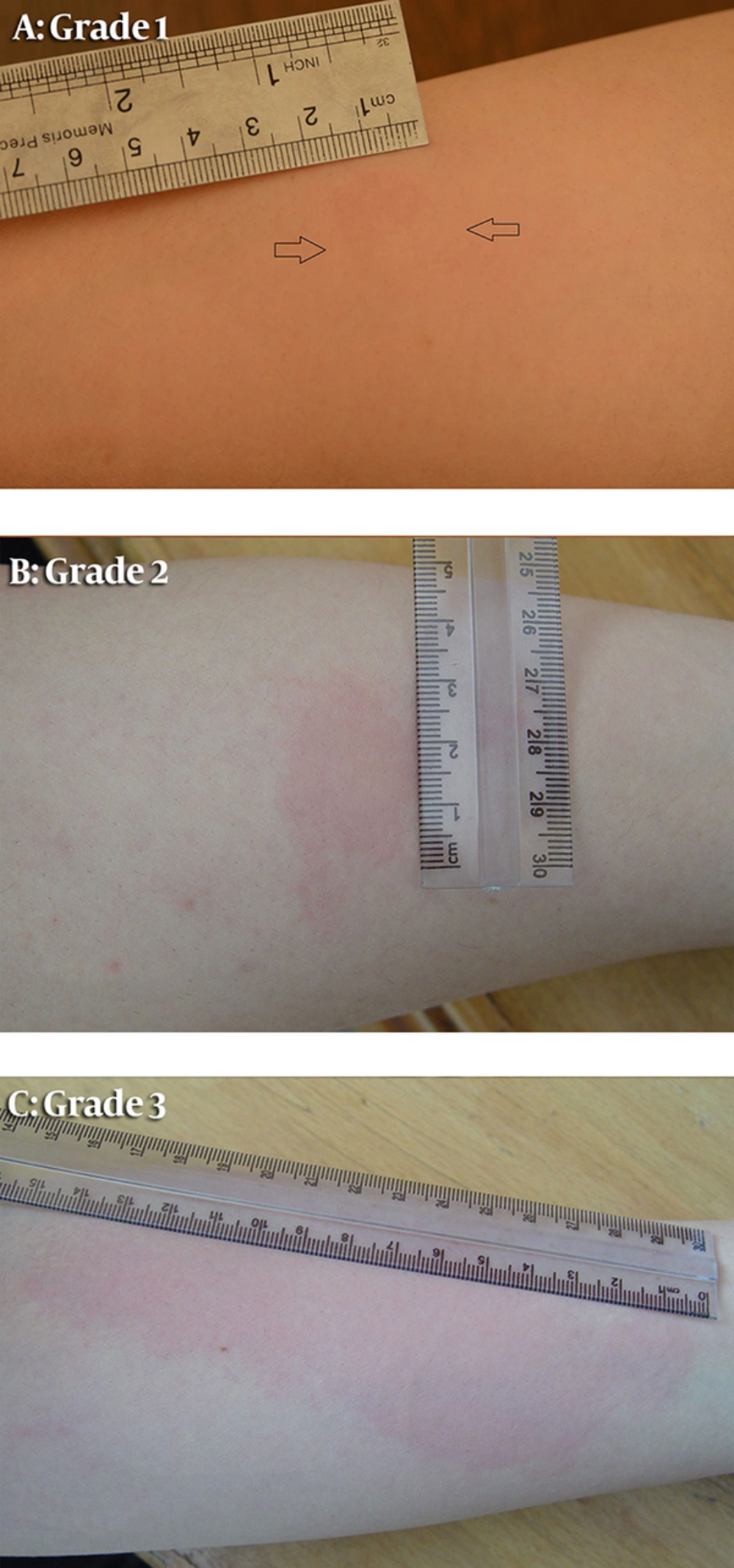
Figure 1.
Skin Flush Response to Niacin Grading: A, grade 1; B, grade 2; C, grade 3 (11)
2.3. Statistical Analysis
Data were analyzed using the SPSS software for windows version 16.0 (SPSS Inc., Chicago IL., USA). Data are presented as mean ± standard deviation (SD), number (%), and median [interquartile range (IQR) 25% - 75%]. There were two different concentrations of the solution and four assessment times. Therefore to summarize the data, first we conducted a Freidman test to find a set point time. Subsequently, no further significant change was observed in the skin response score. The analyses for each solution was performed separately. Then, skin flush response to niacin at the set point time was compared among the groups using the Wilcoxon test followed by Mann-Whitney U test with Bonferroni adjustment for each two pairs. The Chi-square test was applied for comparing qualitative data among the groups. The sensitivity, specificity, positive predictive value (PPV), and negative predictive value (NPV) of different skin response scores were calculated for each solution. In order to find factors associated with skin flush response, multiple logistic regression models were conducted at the best cut-off value of skin flush response. P value of < 0.05 was considered statistically significant in all analyses.
3. Results
A total of 100 subjects, 25 in each group, were studied. Subjects’ attributes are summarized in Table 1. There was no difference among the studied groups regarding age or gender (P > 0.05). Frequency of prescribed classical and atypical antipsychotic drugs was higher in schizophrenia than the bipolar disorder group (P < 0.05).
Table 1.Demographic Data and Disease Attributesa
| Schizophrenia, n = 25 | Relatives, n = 25 | Bipolar Disorder, n = 25 | Normal Controls, n = 25 | P Value | |
|---|---|---|---|---|---|
| Age, y | 33.9 ± 6.6 | 38.0 ± 10.4 | 34.0 ± 10.9 | 36.1 ± 10.8 | 0.372b |
| Gender | |||||
| Male | 14 (56.0) | 11 (45.8) | 8 (32.0) | 11 (45.8) | 0.400c |
| Female | 11 (44.0) | 13 (54.2) | 17 (68.0) | 13 (545.2) | |
| Disease duration, y | 12.8 ± 6.1 | - | 11.2 ± 8.7 | - | 0.467b |
| Antipsychotic consumption | |||||
| Classical antipsychotics | 12 (48) | - | 4 (16) | - | 0.003c |
| Atypical antipsychotics | 22 (88) | - | 12 (48) | - | 0.036c |
aData are presented as mean ± SD or number (%).
bIndependent sample t-Test.
cChi-square Test.
3.1. Skin Flush Response to the 0.01 M and 0.1 M Methyl nicotinate Solutions
Skin flush response to the 0.01 M and 0.1 M methyl nicotinate solutions are presented in Tables 2 and 3, respectively. The Friedman test showed a significant difference in skin flush response among the evaluation set point times; this difference was present in each study group and also in either of the 0.01 M and 0.1 M methyl nicotinate solutions (all P values < 0.05). In order to compare pairs of evaluation times, the Wilcoxon test was performed showing difference in flush response up to 10 minutes after the skin test (Table 4). Accordingly, the set point for skin flush response to both solutions was considered 10 minutes after the test. By using 10 minutes set point times and either of the solutions, the Kruskal-Wallis Test showed a significant difference among the four study groups regarding skin flush response score (P < 0.001). Subsequent pair-wise analysis with Mann-Whitney U test (and with Bonferroni adjustment) showed that this difference exists only between schizophrenic group and other three groups (all P values < 0.001), but there was no significant difference between bipolar disorder group and healthy control using either of solutions (both P values > 0.05), Figure 2.
Table 2.Skin Flush Response to the 0.01 M Solution of Methyl Nicotinate in the Study Groups at Different Evaluation Timesa
| Group | Grade | Evaluation Time, min | ||||
|---|---|---|---|---|---|---|
| 5 | 10 | 15 | 20 | P Valueb | ||
| Schizophrenia | 0 | 8 (32) | 6 (24) | 5 (20) | 5 (20) | < 0.001 |
| 1 | 15 (60) | 14 (56) | 14 (56) | 14 (56) | ||
| 2 | 2 (8) | 4 (16) | 5 (20) | 5 (20) | ||
| 3 | 0 | 1 (4) | 1 (4) | 1 (4) | ||
| Relatives | 0 | 1 (4) | 1 (4) | 0 | 0 | 0.002 |
| 1 | 5 (20) | 1 (4) | 1 (4) | 1 (4) | ||
| 2 | 16 (64) | 20 (80) | 21 (84) | 21 (84) | ||
| 3 | 3 (12) | 3 (12) | 3 (12) | 3 (12) | ||
| Bipolar | 0 | 2 (8) | 0 | 0 | 0 | 0.003 |
| 1 | 3 (12) | 2 (8) | 1 (4) | 1 (4) | ||
| 2 | 20 (80) | 23 (92) | 24 (96) | 24 (96) | ||
| 3 | 0 | 0 | 0 | 0 | ||
| Normal | 0 | 1 (4) | 0 | 0 | 0 | 0.012 |
| 1 | 2 (8) | 1 (4) | 0 | 0 | ||
| 2 | 20 (80) | 21 (84) | 22 (88) | 22 (88) | ||
| 3 | 2 (8) | 3 (12) | 3 (12) | 3 (12) | ||
aData are presented as number (%).
bFriedman Test.
Table 3.Skin Flush Response to the 0.1 M Solution of Methyl Nicotinate in the Study Groups at Different Evaluation Timesa
| Group | Grade | Evaluation Time, min | ||||
|---|---|---|---|---|---|---|
| 5 | 10 | 15 | 20 | P Valueb | ||
| Schizophrenia | 0 | 3 (12) | 3 (12) | 2 (8) | 2 (8) | < 0.001 |
| 1 | 10 (40) | 5 (20) | 6 (24) | 6 (24) | ||
| 2 | 12 (48) | 16 (64) | 16 (64) | 16 (64) | ||
| 3 | 0 | 1 (4) | 1 (4) | 1 (4) | ||
| Relatives | 0 | 0 | 0 | 0 | 0 | < 0.001 |
| 1 | 2 (8) | 0 | 0 | 0 | ||
| 2 | 19 (76) | 16 (64) | 16 (64) | 16 (64) | ||
| 3 | 4 (16) | 9 (36) | 9 (36) | 9 (36) | ||
| Bipolar | 0 | 0 | 0 | 0 | 0 | < 0.001 |
| 1 | 1 (4) | 0 | 0 | 0 | ||
| 2 | 23 (92) | 19 (76) | 19 (76) | 19 (76) | ||
| 3 | 1 (4) | 6 (24) | 6 (24) | 6 (24) | ||
| Normal | 0 | 0 | 0 | 0 | 0 | < 0.001 |
| 1 | 0 | 0 | 0 | 0 | ||
| 2 | 20 (80) | 14 (56) | 14 (56) | 14 (56) | ||
| 3 | 5 (20) | 11 (44) | 11 (44) | 11 (44) | ||
aData are presented as number (%).
bFriedman Test.
Table 4.Wilcoxon Test for Pair-Wise Comparisons Between Different Skin Flush Response Evaluation Times in the Study Groupsa
| Evaluation Times Using Different Solutions, min | |||||||
|---|---|---|---|---|---|---|---|
| 0.1 M Solution | 0.01 M Solution | ||||||
| Group | 5 | 10 | 15 | 5 | 10 | 15 | |
| Schizophrenia | 10 min | 0.014 | 0.014 | ||||
| 15 min | 0.008 | 0.317 | 0.059 | 0.157 | |||
| 20 min | 0.008 | 0.317 | > 0.999 | 0.059 | 0.157 | > 0.999 | |
| Relatives | 10 min | 0.008 | 0.046 | ||||
| 15 min | 0.008 | > 0.999 | 0.014 | 0.157 | |||
| 20 min | 0.008 | > 0.999 | > 0.999 | 0.014 | 0.157 | > 0.999 | |
| Bipolar | 10 min | 0.014 | 0.025 | ||||
| 15 min | 0.014 | > 0.999 | 0.034 | 0.317 | |||
| 20 min | 0.014 | > 0.999 | > 0.999 | 0.034 | 0.317 | > 0.999 | |
| Normal | 10 min | 0.014 | 0.046 | ||||
| 15 min | 0.014 | > 0.999 | 0.059 | 0.317 | |||
| 20 min | 0.014 | > 0.999 | > 0.999 | 0.059 | 0.317 | > 0.999 | |
aData are presented as P values of the Wilcoxon test with significant level was set at < 0.05.
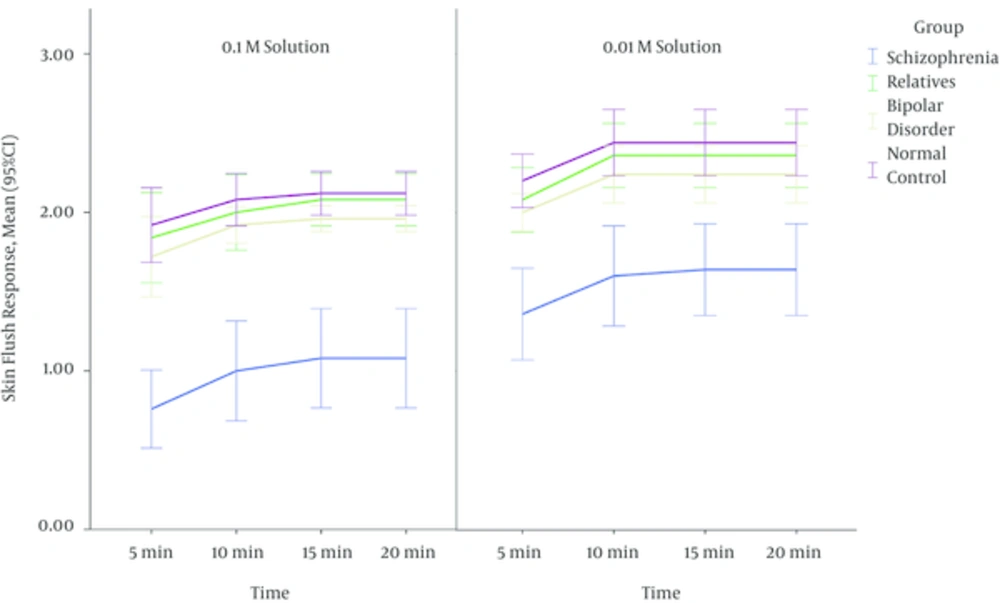
Figure 2.
Trend of Changes in Skin Response (Rated from 0 to 3) for the 0.01 M (Left) and 0.1 M (Right) Solutions of Methyl Nicotinate.
3.2. Diagnostic Accuracy of the Skin Niacin Test
All of the non-schizophrenic cases had grade of > 1 response to the 0.1 M solution of methyl nicotinate at 10 minutes after the test. There were three schizophrenic patients with no response to the 0.01 M solution who responded to the 0.1 M solution. With the 0.01 M solution, only five non-schizophrenic cases had grade of ≤ 1 response at the set point. Accordingly, this cut-of value was considered for calculating diagnostic accuracy of the skin niacin test in differentiating between schizophrenia patients and non-schizophrenic cases. Because increasing the set point to 15 minutes would increase the specificity of the test, accuracy was calculated for both set points. As presented in Table 5, the 0.01 M solution provided better sensitivity and NPV while the 0.1 M solution provided better specificity and PPV at either of set points. Moving the set point to 15 minutes did not change accuracy of the 0.1 M solution, but increased the specificity and PPV. The sensitivity and slightly the NPV in regards to 0.01 M solution has also been decreased.
Table 5.Accuracy of the Skin Niacin Test with Response Grade of ≤ 1 for Differentiating Between Schizophrenia and Non-Schizophrenic Cases
| Evaluation Time, min | Solution, M | Sensitivity | Specificity% | PPV% | NPV% |
|---|---|---|---|---|---|
| 10 | 0.01 | 80.0 (59.3 to 93.1) | 93.3 (85.1 to 97.8) | 80.0 (59.3 to 93.1) | 93.3 (85.1 to 97. 8) |
| 0.1 | 32.0 (15.0 to 53.5) | 100 (95.1 to 100) | 100 (62.9 to 100) | 81.5 (72.1 to 88.8) | |
| 15 | 0.01 | 76.0 (54.9 to 90.6) | 97.3 (90.7 to 99.6) | 90.5 (69.6 to 98.5) | 92.4 (84.2 to 97.1) |
| 0.1 | 32.0 (15 to 53.5) | 100 (95.1 to 100) | 100 (62.9 to 100) | 81.5 (72.1 to 88.8) |
Abbreviations: PPV, positive predictive value; NPV, negative predictive value.
aData are presented as % (95% confidence interval).
3.3. Potential Factors Associated with Skin Flush Response to Niacin
Logistic regression analysis including all subjects found no association between age or gender and skin response to niacin. Among schizophrenia and bipolar disorder patients, there was no association between age, gender, disease duration, or drug history and skin response to niacin. In each group of schizophrenia and bipolar disorder patients, also there was no association between disease subtypes and skin response to niacin.
4. Discussion
Our study was aimed to assess the skin flush response to niacin in schizophrenia and bipolar disorder patients, and also to determine the skin niacin test properties in patients with schizophrenia compared with patient with bipolar disorder and healthy subjects. The results demonstrated that niacin skin flush response is impaired in schizophrenic patients. Such impairment was not observed in schizophrenics’ first degree relatives. Our data also revealed that the minimum required time for the stable skin response to niacin was 10 to 15 minutes; longer time provides better specificity. Also, we found that the 0.01 M and 0.1 M solutions provide different accuracy along with better sensitivity for the 0.01 M solution compared to better specificity for the 0.1 M solution of methyl nicotinate.
The increased activity of PLA2 found in schizophrenic patients, which reduces the level of AA and cause the phospholipids to breakdown in the neural membranes, is believed to be responsible for reduced vasodilator responses to niacin (4-7). However, the study by Frieboes et al. found no association between schizophrenia and the PLA2 genes (cPLA2 and sPLA2) (22). Studies using genome-wide linkage analysis as well as other studies have tried to identify the genetic basis influencing niacin flush response in schizophrenia (22-24). The results of these studies are in agreement with the consistent findings of previous studies that a subgroup, but not all, of the schizophrenic patients has impaired flush response to niacin (18, 25, 26). Accordingly, the skin flush response may be an endo-phenotype, rather than an absolute diagnostic marker, in schizophrenia. In this regard, some studies have tried to find characteristics of such endo-phenotype, e.g. through clinical presentations of the patients. Nilsson et al. reported an association between niacin-nonresponse and lower cognitive tests’ performance as well as an inverse correlation between delay in niacin response and psychomotor function and IQ (27). Messamore also reported greater functional impairment among patients with reduced niacin sensitivity (28). In a study by Smesny et al. on first-episode schizophreniform psychosis or schizophrenia patients, niacin sensitivity was inversely correlated with negative symptoms (29). These investigators further reported that first-episode patients, but not multi-episode patients, had impaired skin flush response as compared to controls (30). These results are not, however, consistently reported in previous studies. In our study, there was no association between negative symptoms and niacin sensitivity. Differences among the studies are related to the small sample size in studies and differences in the studied populations. Concerning lack of data, further studies are required to investigate if a specific clinical phenotype is associated with impaired niacin sensitivity and to better determine the niacin non-sensitive endo-phenotype by combining genetic and clinical data.
There have been some controversies among the previous studies data on skin flush response to niacin in schizophrenics’ relatives. Lin et al. demonstrated impaired flush response to niacin in patients’ relatives (31). These investigators further found more impairment in families with more than one sibling with schizophrenia (multiplex families) compared to those families with one patient (simplex families). The data indicate that genetic background affects the flush response to niacin (14). In contrast to these studies, and consistent with our findings, the study by Smesny et al. found no impaired niacin skin response in relatives of schizophrenic patients (16). As the studies with larger sample size have revealed a familial aggregation in skin flush response to niacin, the controversy is probably due to the small sample size in study of Smesny et al. (16) as well as in our study.
The results of our study show that the niacin skin test is a valuable diagnostic tool for schizophrenic patients. With the 0.1 M concentration of methyl nicotinate solution and at 10 minutes after the test, we found a 100% specificity and a PPV of ≤ 1 for the skin niacin flush grade. Although the 0.01 M solution provided better sensitivitybut it was not significant and was reduced with increasing evaluation time. This finding is consistent with the above-mentioned endo-phenotype theory. Other studies have reported a sensitivity from 49.2% to 90% and specificity from 65% to 92.5% (18, 25, 26). Differences among studies are due to usage of various solutions’ concentrations and different response evaluation times. In our study, the 0.01 M solution at 15 minutes after the test has provided the best results. In the study by Liu et al., also the greatest degree of differentiation occurred at the 0.01 M concentration, but with the rating time point of 10 minutes (18). However, in the study by Change et al., the differentiation was better using 0.1 M compared to 0.01 M or 0.001 M concentrations of niacin (14). The skin flush response evaluation method also can affect the test properties and the optimal solution concentration and evaluation time point (29). For a test to be valuable, other properties such as reliability are important and has to be taken into consideration. Concerning lack of data, further studies are required in this regard.
There are some factors that may affect skin flush response in schizophrenic patients. Smesny et al. found an influence of age and gender on niacin sensitivity; with male gender and older age associated with a weaker flush response. The effect of gender is probably mediated by the effects of sex hormones on vasomotor function and prostaglandin metabolism (32). However, there is no other obvious report on the influence of age and gender on skin niacin test and we found no association in this regard. Our schizophrenic patients received at least one antipsychotic agent, and it was not possible to precisely analyze the effect of drug therapy on niacin skin response. Previous data on these subjects has been controversial. Some studies suggested that medications may not cause any alteration in niacin skin response; however, there are studies which have reported the changes in niacin response with such psychiatric medications (33). For example, Tavares et al. reported a reduced PLA2 activity and increased skin flush response to niacin after eight weeks of antipsychotic treatment in schizophrenic patients (5). Also, there has been concern regarding smoking history which may affect the skin niacin response, though Liu et al. reported the response to be independent of smoking behavior (18). Future studies, in case of using a larger size of patients and healthy subjects, other potential factors that may have effects on the skin flush response to niacin ought to be investigated carefully.
There are some limitations to our study. The sample size of our study was small and it was not possible to precisely evaluate factors associated with skin flush response to niacin. Although we used a widely applied method of skin niacin response evaluation (11), observer was not blinded to the applied solutions’ dosage and only one observer assessed the responses. Using blinded assessment of skin response by more than one observer provide better clarification in regards to the diagnostic value of the test. Also, more objective measures (e.g. optical reflection spectroscopy) can provide more consistent and quantitative data in this regard which is suggested for future studies.
4.1. Conclusion
Niacin skin response is impaired in patients with schizophrenia which can be used as a complementary diagnostic test in psychiatric workups. We found that by using 0.1 M concentration of the methyl nicotinate solution and examination of 15 minutes after the test, the niacin skin test (non-responsiveness) will have a high diagnostic accuracy (100% specificity and PPV) in differentiating schizophrenia from other conditions. However, the 0.01 M solution has an overall better diagnostic accuracy in terms of high sensitivity and specificity. This test may be helpful for early and accurate diagnosis of schizophrenia, which is the first step towards prevention. Further studies are required to better collect the niacin non-sensitive endo-phenotypes and to also investigate the clinical applications of the findings.

