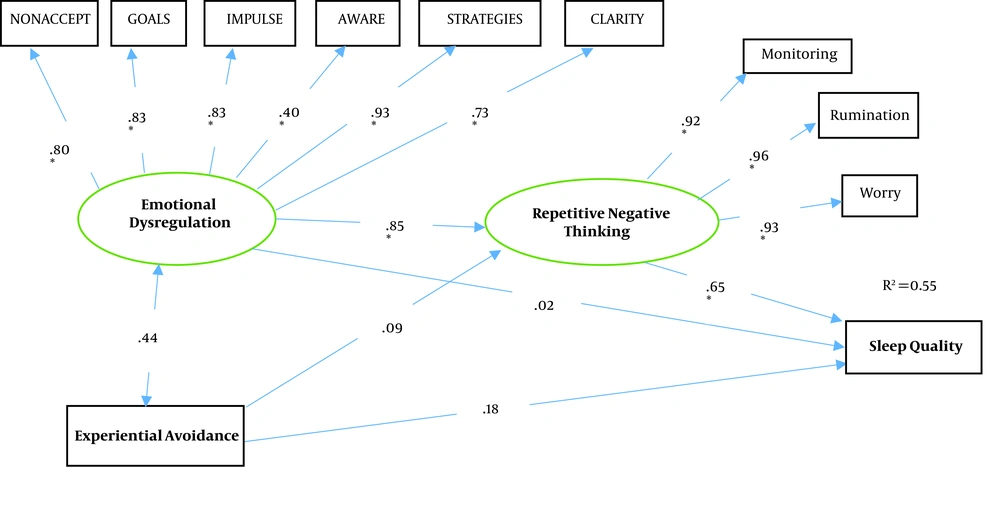
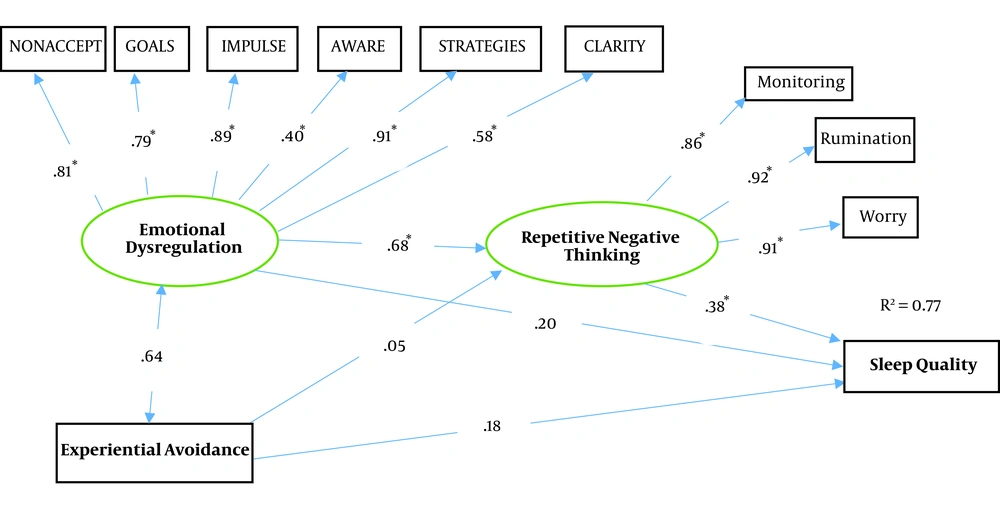
The results of the present study demonstrated that emotional dysregulation and sleep quality correlated in both samples, but the intensity of this relationship in patients with insomnia disorders was more noticeable. Accordingly, it can be concluded that emotional dysregulation leads to reduced sleep quality. In a longitudinal study (
30), the relationship between emotional dysregulation and sleep quality was addressed and the results indicated that emotional dysregulation correlated with the onset and maintenance of insomnia. In addition, it was concluded that emotional dysregulation could predict the possibility of insomnia in the future. However, the effect size was reported to be very low. The results of another study showed that there was a negative relationship between emotional dysregulation and sleep quality (
31). People with emotional dysregulation always try to monitor their behavior and since the monitoring process requires energy, attention, and cognitive engagement (
32), it can result in cognitive arousal and reduced sleep quality. The results of the present study revealed that emotional dysregulation did not have direct effects on sleep quality in both samples.
In models provided by Harvey (
33) and Espie (
34) it has been emphasized that patients with insomnia disorders have emotional dysregulation, but the mechanisms of the effects of emotional dysregulation on sleep have not been clearly expressed. However, the results of the present study demonstrated that emotional dysregulation did not have direct effects on sleep quality in both samples. Hence, it seems that the effects of emotional dysregulation on the quality of sleep are not direct because the results of the present study revealed that emotional dysregulation affected sleep quality through repetitive negative thoughts.
Moreover, the results of the present study indicated that experiential avoidance correlated with sleep quality. In other words, a rise in experiential avoidance leads to reduced sleep quality in people with and without insomnia. The results of the present study in another section showed that experiential avoidance did not have direct effects on sleep quality.
In a study conducted on a sample of 327 patients with insomnia by Li, the relationship between experiential avoidance and sleep quality was addressed and the results showed that experiential avoidance correlated with sleep quality and experiential avoidance could predict sleep quality. Furthermore, it was shown that the direct effect of experiential avoidance on sleep quality was measured 0.19 (
35). The results of the present study indicated that the correlation between experiential avoidance and sleep quality exceeded this value in both samples (0.36).
From the perspective of acceptance and commitment therapy, the experiential avoidance results in efforts at suppressing feelings, thoughts, and other inner experiences. In addition, it is believed that lack of mental flexibility lays the groundwork for emotional disorders (
36), while another research indicates that there is a relationship between emotional disorders and sleep disorders (
37). On the other hand, avoidance of inner thoughts and experiences increases physiological arousal and negative emotions (
38), thereby leading to reduced sleep quality.
In addition, the results of the present study revealed that experiential avoidance did not have direct effects on sleep quality in both samples. Thus the repetitive negative thoughts were considered to find the mediator in this relationship. The results showed that repetitive negative thoughts did not act as a mediator in the relationship between experiential avoidance and sleep quality. Therefore, it is recommended that further studies should be conducted to find a suitable mediator in this relationship.
In addition, the results of our study revealed that repetitive negative thoughts and sleep quality strongly correlated in both samples and it was found that repetitive negative thoughts had direct effects on sleep quality. Hence, it can be concluded that with the increase of repetitive negative thoughts, the sleep quality is reduced. The results of a study indicated that rumination affected sleep quality (
39). On the other hand, the results of another study on a sample of 242 patients with insomnia revealed that anxiety and rumination played roles in the quality of sleep of patients with insomnia (
40).
In fact, these repetitive negative thoughts result in cognitive, emotional, and physiological arousal. However, some researchers (
41) believe that repetitive negative thoughts have a strong correlation with physiological arousal. In general, the results of our study showed that the repetitive negative thoughts acted as a mediator in the relationship between emotional dysregulation and sleep quality. Similarly, Slavish and Graham-Engeland showed that sleep quality, depression, and anxiety correlated through rumination (
42). In a study performed about the relationship between sleep quality and factors such as cognitive processes, arousal and emotional dysfunction, it was shown that the role of rumination in this relationship was more noticeable. The results also indicated that rumination acted as a response style for emotion regulation, while cognitive processes lead to insomnia when one’s approach is rumination for emotional regulation (
43).
5.1. Limitations
Since the present study was conducted among employees at Kermanshah University of Medical Sciences and patients with insomnia who visited the Sleep Disorders Research Center under the supervision of Farabi Hospital based in Kermanshah for cure in 2016, extreme caution should be exercised in generalizing the results to other communities due to the different social and cultural conditions. We suggest that these variables be studied in other populations and be examined in longitudinal studies.
5.2. Conclusions
Given the results of the present study, it can be concluded that emotional dysregulation leads to sleep disturbances when there are repetitive negative thoughts. Accordingly, the role and importance of repetitive negative thoughts should be taken into consideration by therapists to treat insomnia.