


1. Background
A large number of psychiatric patients are hospitalized. It is predicted this number will increase by 15% in 2020 (1). The purpose of these hospitals and their nurses is to ensure the safe and efficient provision of activities for patients in variable conditions (2, 3).
Many patients are injured because of an event or a series of events and physical and emotional conditions, leading to injury or life threats. The number of these incidents is more than the acceptable level (4, 5). Damages to patients are related to the defect in patient safety, leading to prolonged hospitalization, temporary or permanent disorders, or disability in patients (6).
Patient safety includes the prevention of any injury, side effects, or damages caused by the process of care (6, 7). Patient safety issues in general wards are often associated with the processes of care, like the investigations and treatment (5), while in inpatient mental health wards, it depends on the type of patients' disruptive behavior, like susceptibility to violence, psychological and verbal violence and sexual harassment (8-12). The patient safety incidents are different in psychiatric wards than in the general wards; however, medication and diagnostic errors and falling may have similarities (13, 14). Nevertheless, patient safety phenomenon in inpatient psychiatric wards is not clear.
Nurses comprise the largest and vital member of health service providers and play an important role in providing and improving care and patient safety (15, 16). Related studies on the experiences of nurses about patient safety in inpatient psychiatric wards are limited.
The results of a study showed that psychiatric care means maintaining safety and respecting for patients, encouraging healthy behaviors, lack of personal understanding of the behavior of patients, reliable reporting, and interactive training (17). In a qualitative study, some participants considered patient safety as a series of adverse events in inpatient mental health wards, such as suicide, and some others considered it as providing high-quality care and access to appropriate services (8). An investigation of the meaning of work in inpatient psychiatric wards showed that the staff was in control but they also lacked control (18). In a study, nurses' experiences of caring for patients with self-harm were explained in two main categories: Patient-nurse challenging and collaborative relationship and promoting well-being by performing nursing interventions (19). The results of another study showed that in the workplace, nurses use a wide range of interventions to maintain safety and prevent patients' violence (20).
2. Objectives
According to the limited number of studies on patient safety from the perspective of Iranian nurses and given the importance of their role in this field, this study focused on nurses' opinions and experiences of patient safety in inpatient psychiatric wards.
3. Materials and Methods
3.1. Design
This qualitative study was accomplished by the approach of conventional content analysis.
3.2. Setting and Participants
The study set consisted of eight acute care wards at three psychiatric hospitals in Iran. The study participants included supervisors, head nurses, and registered nurses (RNs) who had worked for three years or more in the psychiatric wards. No restriction was given to their age and gender and the selection of participants was purposive and based on experience and willingness to participate in the study.
The interviews were often conducted in acute psychiatric wards at a time of day when participants could take part in an interview with the peace of mind to achieve a perfect description of what happens regarding the phenomena.
3.3. Data Collection
The method of data collection was semi-structured interviews, conducted from October 2015 to September 2016. In this study, 19 interviews were conducted with 19 participants and three interviews were repeated; each interview lasted between 30 and 70 minutes. At the beginning of the interview, to learn more about the participants, a warm conversation started and then specific semi-structured and in-depth questions were asked with the aim of discovering nurses' experiences of patient safety to achieve deep information in this regard. Participants were encouraged to share their experiences in situations where patient safety is provided or jeopardized. The interview guide was developed as follows:
- How do you experience patient safety in your work shifts?
- How do you assess patient safety in your care?
- What factors are related to patient safety?
Explorer and in-depth questions were asked to seek answers to the above questions, and the interviews were recorded with the permission of the participants. During the process of data collection and analysis, reflections related to data were noted and used in subsequent interviews. Data gathering continued to data saturation. Saturation is achieved when a new category does not appear and the category reaches saturation in terms of their features and dimensions. The interviews were conducted by one researcher and four other members of the research team monitored the process of data collection and analysis.
3.4. Data Analysis
The method for data analysis was a manifest content analysis, followed by latent content analysis inspired by Graneheim and Lundman 2004 (22). First, interviews were transcribed word by word and studied several times to get an overall sense. Next, hints and important topics in the text were extracted in the form of open codes while taking the explicit and hidden content of meaning categories into account. These codes were classified according to broader categories based on differences and similarities (data reduction to describe the phenomenon and to achieve a greater comprehension) and the abstraction process continued until the themes were extracted (22). The data were managed using software MAXQDA10. At the end of the analysis, two themes and eight categories were obtained. Table 1 represents the themes, categories, and examples of codes.
Table 1.Themes and Categories Extracted from the Content Analysisa
| Theme/Category | Examples of Codes |
|---|---|
| Vigilant care | |
| Warning of high-risk patients | Coding high-risk patients |
| Identifying patients with provocation | |
| Reporting patients with suicidal thoughts | |
| Attention to patients at the reception time | |
| Curious attention | Monitoring patients' difficulty with getting to sleep |
| Attention to suspicious behavior of the patient | |
| Being sensitive to patients' habits change | |
| Monitoring patients responsibly | |
| Early intervention | Separating problematic patients' room |
| Using medications to control patients | |
| Prevention of stimulating patients | |
| Care of vulnerable patients | Care of handicapped patients |
| Prevention of sexual abuse | |
| Close observing | |
| Confronting with dangerous concealment | Sleepy and confuse patient care |
| Searching for patients frequently | |
| Continuous control of patients' mattresses and bed | |
| Sudden visits of the ward | |
| Access control | Checking the patient's personal belongings |
| Protection of access to dangerous equipment | |
| Control of toiletries | |
| Control of detergent | |
| Objective observation | Protection of the access to medicines |
| Continuous visit of patients | |
| Visiting with caution | |
| Visiting due to noise | |
| Continuous observation | Presence at the time of breakfast and medication |
| Monitoring patients in the bathroom | |
| Checking the monitor screen frequently | |
| Monitoring patients with suicidal thoughts | |
| Hospitalizing critically ill patients nearby the nursing station |
a The latent theme: Intelligent care and protection from risk creators.
3.5. Rigor
A peer check was used to provide credibility. Thus, audio files and transcripts of the interviews were given to three members of the research team. They investigated encoding and classification and discussed the disagreement to reach an agreement in-person meetings. For transferability, experienced male and female nurses were selected from three different psychiatric hospitals. For data credibility, data analysis was performed at the same time as data collection. The member check was used to give participants the written feedback of extracted codes and theme and receive their comments. Then, the created themes were discussed in a joint meeting with participants and some of them were revised.
3.6. Ethical Consideration
This study was approved by the Research and Ethics Committee of the University of Social Welfare and Rehabilitation Sciences. Ethics in research, such as informed consent, maintenance of anonymity, and participants' authority to leave the study at any desired time, were observed.
4. Results
One of the participants did not attend the study because of the transfer from the center. Finally, the number of participants was 19 at the end of the study. The individual characteristics of the participants are presented in Table 2.
Table 2.Characteristics of Participants (N = 19)
| Group | Median or No. (%) |
|---|---|
| Age, y | 38 |
| Gender | |
| Female | 9 (47) |
| Male | 10 (53) |
| Position | |
| Supervisor | 2 (11) |
| Head nurse | 4 (21) |
| Registered nurse | 13 (68) |
| Work experience in the profession, y | |
| Supervisor | 20 |
| Head nurse | 16 |
| Registered nurse | 11 |
| Work experience in inpatient psychiatric wards, y | |
| Supervisor | 18 |
| Head nurse | 13 |
| Registered nurse | 9 |
| Highest educational level obtained | |
| Bachelor | 13 (69) |
| Masters' degree | 6 (31) |
Nurses' experiences are reflected based on the main theme, including “intelligent care and protection from risk creators.” Two themes and eight related categories were emerged including “vigilant care (warning of high-risk patients, curious attention, care of vulnerable patients, early intervention) and “close observing (confronting with dangerous concealment, access control, objective observation, continuous observation)”. Figure 1 presents a conceptual model of patient safety in inpatient mental health wards.
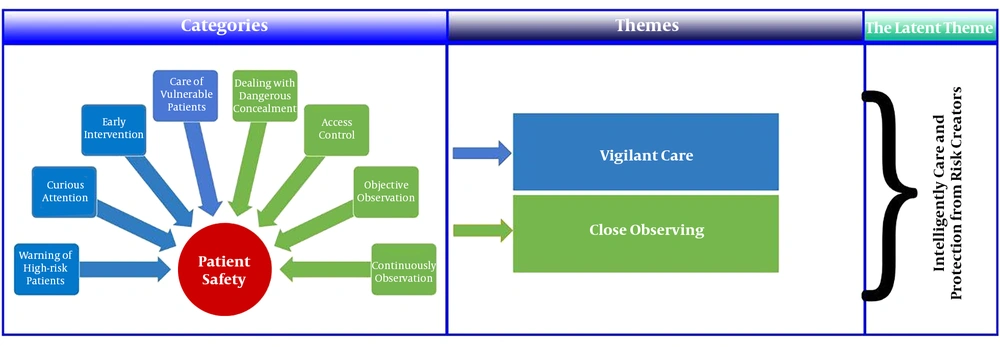
Figure 1.
A conceptual model of patient safety provided by nurses in psychiatric wards
4.1. Vigilant Care
4.1.1. Warning of High-Risk Patients
According to most of the participants, the nature of patient safety is identifying and taking care of high-risk patients. It is necessary to identify patients who have severe problems and at any moment may create risks for themselves and others. It will lead to paying special attention to these patients and preventing the occurrence of safety incidents for them. According to this method, nurses identify high-risk patients based on patients' records in terms of their disease and high-risk behaviors at the time of admission.
“At the time of hospitalization, the status of the patient is checked in terms of suicide, medication allergy, escape, assault, provocations and aggression, history of medication abuse, and seizure disorder; in general, patients are identified with regard to safety issues” (Head nurse 1).
4.1.2. Curious Attention
Most of the participants interpreted patient safety as curious attention. They believed that attention with curiosity, vigilant care to changing habits, and monitoring patients responsibly inform them about the changes that can lead to adverse events in patients and provide opportunities for prevention. Therefore, one of the most important moments is at midnight because the ward environment is not busy and patients' high-risk behaviors occur. The nurses believed that this time needs more attention.
“I am personally sensitive to after twelve o'clock at night and inspect the room with my flashlight. I monitor the sleep pattern of the patients walking along the corridor in order to know why they are still awake.” (Nurse 2)
4.1.3. Care of Vulnerable Patients
Most participants stated that vulnerable patients, such as the elderly or patients with certain limitations requiring more care for their safety.
“I always take a patient with the disability to the cafeteria as the first or last person to take care of him and protect against damages.” (Head nurse 3)
4.1.4. Early Intervention
The psychiatric nurses need timely and appropriate interventions to prevent adverse events in patient safety. The timely use of prescribed medications or other non-pharmacological interventions can prevent the occurrence of dangerous behaviors in psychiatric patients.
“In the case of patients trying to escape, suicide, and destroy the equipment, I certainly inject PRN to ensure the safety of the ward and decrease their motivation to behave dangerously.” (Nurse 11)
Some simple actions are effective in the prevention of incidents. The environment of the psychiatric ward is like a dormitory in which there are a number of patients with different tastes and ideas. Therefore, appropriate measures are needed to prevent some controversy.
“If two patients have controversy, we will separate them into different rooms to prevent their controversy.” (Head nurse 2)
4.2. Close Observing
4.2.1. Confronting with Dangerous Concealment
Patients with thoughts of harming oneself and others and conceal dangerous and illegal instruments are considered to be troublesome. It must be prevented by means of various measures.
“There is a tear in the mattress, I must check it whether there is a dangerous thing, such as a knife, inside it or not. Once I saw a knife inside the tear of a patient's mattress that could be dangerous” (Nurse 7)
4.2.2. Access Control
Nurses shared their experiences and stated that the number of tools available to patients is capable of becoming dangerous. Therefore, patients' access to these tools must be controlled carefully using preset programs.
“I prevent the patients from having dangerous things; for example when counting the spoons, the patients may sharpen them like a dirk. Once one patient used a sharp spoon to pierce through a patient's temple and the patient went into a coma immediately.” (Nurse 12)
Some female patients have cosmetics. Nurses stated that such patients must be controlled carefully.
“Female patients have cosmetics. When they want to use the pencil sharpener, I prevent them carefully and do it myself because they may harm themselves by the pencil sharpener.” (Head nurse 4)
Medications as the potential factors can be dangerous at times and patients abuse personnel's neglect to access them. Some patients are dependent on certain types of medications and have a severe tendency to them. Patients who have suicidal thoughts may also use medications to attempt a suicide.
“If a patient is very dangerous in terms of the safety, I will inform my colleagues to be careful when they want to give medications to the patient because he/she may overuse them or use them wrongly.” (Supervisor 2)
4.2.3. Objective Observation
Participants believed that none of the methods is as effective as a direct observation to consider the status of the patients. In spite of the installation of cameras in the ward, direct observation of the patient is very important.
“I cannot trust in the camera because it is not obvious through a camera whether a patient is falling or not; therefore, the direct observation is much better.” (Supervisor 2)
One of the important points is the personnel's carefulness and taking care of possible events in the patient's room, especially during the night. Some incidents take place away from the eyes of the personnel.
“I check the status of the patients every 20 minutes or half an hour at night. When two patients speak loudly, I try to calm them down.” (Nurse 8)
4.2.4. Continuous Observation
Participants stated that one of the key points about the safety of patients in inpatient psychiatric wards is a continuous observation of the patients; lack of supervision can lead to adverse events. For example, patients who attempt suicide can use personnel's negligence and opportunity for self-harm.
“The last year, the personnel neglected to check the monitor screens regularly and a patient hung himself in the isolation room.” (Supervisor 1)
The patients closer to nursing stations are continuously observed and are more manageable.
“I hospitalize the patients with suicidal thoughts and those who may provoke the others in the room in front of the nursing station to monitor them permanently.” (Head nurse 2)
5. Discussion
Patient safety is one of the most important and controversial issues in inpatient psychiatric wards. Nurses have a considerable role in this regard. In this study, from the perspective of nurses, patient safety was understood in terms of two themes “vigilant care” and “close observing.”
The participants considered “vigilant care” as an effective factor in patient safety. They believed that attention with curiosity, being sensitive to patients' changing habits and suspicious behavior could be useful in identifying risk factors and providing the necessary opportunity for nurses to deal with dangerous behaviors. In line with this study, the findings of a study conducted by Bowers et al. showed that the personnel's sensitivity and attention could decrease suicides by 80% and the attempt to jump out of the hospital buildings by 1.2% (23).
Warning of high-risk patients' category demonstrates the importance of paying attention to high-risk patients. Nurses report these issues to their colleagues and inform them of patients' conditions. This sensitivity and attention can lead to the production of information on patients, which can be used for their safety. Kanerva et al. (2) stated that active transfer of information on patients and enhancing the communication between nurses can increase their awareness of safety issues related to the patients (24).
The theme of “Vigilant care” also includes two other categories: Early intervention and care of vulnerable patients. From the perspective of nurses, “early intervention” can be performed by a series of simple steps and without the use of medication, such as the use of therapeutic communication skills with patients or taking simple measures, such as separating the room of patients who have different tastes and paranoid thoughts. Hallett et al. stated that skilled personnel could prevent patients' violence effectively; in addition, he believed that détente, communication, knowledge and experience, and the timing of intervention are effective in the prevention of violence in inpatient mental health wards (25). Nurses must pay special attention to patients' conditions and their susceptibility to dangerous behaviors to take necessary measures accordingly. The measures may include separating the patient's room or the use of medication to control the patient. In fact, it is an example of early intervention. Thus, Al-Sughayir reported that 63-90% of psychiatric patients use PRN medications as part of clinical management and 74% of them receive them routinely (24).
The care of vulnerable patients is another category of the vigilant care theme, for example, for patients with a history of falling that must be considered carefully. Abraham stated that having a history of falling for psychiatric patients is one of the risk factors for falling again (26).
The theme of “close observing” is divided into four categories: Confronting with dangerous concealment, access control, objective observation, and continuous observation. One of the categories is access control that can prevent the unwanted access of patients to potentially dangerous tools because some patients may use common tools, such as bed linen, for their dangerous behaviors. Moreover, patients' access to spaces and tools must be limited and controlled. The results of a study conducted by Mills et al. indicated that 23% of patients attempting suicide use razor (27). Stanley and Brown stated that one of the interventions to prevent suicide is limiting the access to dangerous tools (28).
Confronting with dangerous concealment is very important. Care of hiding tools or materials by patients is important in inpatient mental health wards because psychiatric patients conceal dangerous tools according to their symptoms associated with thoughts of harming themselves and others. The results of a study conducted by Bowers et al. indicated that during continuous observation of the personnel, it was found that a suicide attempt could be done by patients through hiding the rope under pajamas, suddenly running in the bathroom, and locking the door before the personnel's access to the patient (23).
Objective observation and continuous observation categories are a subset of the close observing theme. The participants considered it essential for nurses to observe patients objectively and directly; in addition, they should not neglect the continuous observation of patients. In line with these results, Ray et al. argued that continuous observation and individual supervision are effective in patient safety related to the risk of harming oneself or others in acute psychiatric wards (29). Bowers et al. stated that there is a set of methods, including special supervision by personnel, to prevent high-risk behaviors (23).
5.1. Limitation
Lack of tendency to mention some experiences that remind participants of unpleasant feelings and forgetting some events over time are some of the limitations of this study.
5.2. Conclusion and Implications
The results of the nurses' experiences in this study proposed intelligent care and protection from risk creators for patient safety. The participants considered confronting with dangerous concealment and access control as factors affecting patient safety. This type of protection requires knowledge and skills, the appropriate number of nurses, and convenient facilities. In addition, intelligent care is based on the identification of risk factors in patients; this type of care also needs proper knowledge and skills. Nurses acquire the ability to protect vulnerable patients and perform intelligent care during the working period based on the experiences that unfortunately sometimes bring undesirable and irrecoverable consequences.
Hence, it is suggested that the necessary skills and knowledge are included in the curriculum of nursing education so that students and nurses acquire the abilities before starting work in the psychiatric wards. Patient safety can be improved using the appropriate number of nurses in acute psychiatric wards and the use of new technologies to protect the safe access to patients and control them. In addition, it is suggested that further studies are done on the protective measures to improve patient safety and care of patients in inpatient mental health wards.

