


1. Background
Trauma is considered as one of the main causes of death and disability worldwide (1, 2) and the leading cause of death (3). Trauma is the second leading cause of death in Iran after cardiovascular diseases (4).
According to the national trauma data bank in 2014, lower extremity trauma with a prevalence of 36.99% was the most common type of trauma. The death and mortality arising from this trauma has been 15.39% (5). A large number of individuals with lower extremity trauma survive, but a significant number of them are affected by physical disabilities and mental problems during the treatment process and even after it (6, 7). The most common mental disorders after organs trauma are posttraumatic stress syndrome, depression, anxiety, mental distress, and alcohol abuse (8). Mental disorders causing such a trauma usually diminish over time. A longitudinal study indicated that the prevalence of mental disorders in individuals with lower limb trauma was reduced from 48% to 42% during 3 to 12 months after the incident (9). Seaborg et al. (2012) found that the severity of physical and mental disorders in patients with trauma is reduced after 5 years of trauma, but the prevalence of these disorders is still significantly more than the other individuals in the society (10). Soberg (2015) found that 10 years after the trauma, the prevalence of mental disorders in injured individuals was similar to others in the society, but their physical health was worse (11). Therefore, paying sufficient attention to physical and mental disorders is necessary even for several years after the trauma.
Sexual function is one of the main physical and mental concerns of each individual (12) that may be impaired after lower extremity trauma (13). Physical and mental disorders are also considered the major causes of sexual dysfunction (14, 15). Shulman et al. (2015) reported the prevalence of sexual dysfunction in lower extremity trauma to be 11% to 47% in the first 3 months after the incident and about 20% in the first year (16). Harvey-Kelly (2014) also reported the prevalence of sexual dysfunction to be 52.1% in males with pelvic trauma. They also showed that all aspects of these individuals’ sexual function were reduced significantly (17).
The patients’ physical problems and disabilities are usually most considered during the treatment of lower extremity trauma and the treatment of their mental disorders, but their sexual problems are not much considered. However, the prevalence of sexual dysfunction is high in Iran and in the world; various studies indicated the prevalence of 20% to 40% for sexual dysfunction in Iran and 25% to 65% in Europe and the United States (18-21). Nonetheless, the types of sexual dysfunction caused by lower extremity trauma have not been well- defined.
2. Objectives
This study aimed at comparing male sexual dysfunction before and after lower extremity trauma.
3. Materials and Methods
3.1. Study Design and Settings
This research is a prospective cross sectional study. The study population was patients with lower extremity trauma who were admitted to the surgical unit of Kowsar hospital in Semnan from June 2014 to August 2015.
3.2. Participants
Available sampling method was used in the present study. The sample consisted of 150 individuals. The inclusion criteria were as follow: full consciousness, the ability to respond to the questionnaire, absence of pain at the time of completing the questionnaire, lack of risk of chronic diseases, no history of mental and sexual dysfunction, being married, and having just one lower extremity trauma. Exclusion criteria included infection of surgical area, bedsore, staying in the hospital for more than 2 weeks, bereaved patients, and the incidence of new trauma during the study.
3.3. Measures
3.3.1. A Demographic and Incident Questionnaire
The researcher made a 2-part questionnaire. In the demographic part, the questions inquired about age, number of children, duration of marriage, education level, and occupation. In the incident part, the questions inquired about the reason of trauma, the place of trauma, the time, and the reason of the incident.
3.3.2. International Index of Erectile function (IIEF)
Rosen et al. (1997) introduced IIEF. This questionnaire has 15 questions in Likert scale, which assigns 0 to 5 scores to each question, allocating a total of 75 scores. The subscales of the questionnaire are sexual desire (0 - 10 score), erectile function (0 - 30 score), satisfaction with sexual intercourse (0 - 15 score), orgasm (0 - 10 score), and overall satisfaction with sexual intercourse (0 - 10 score), respectively (22). Mehrban et al. approved the validity and reliability of the questionnaire for use in Iranian population in 2006 (23).
3.4. Data Analysis
The data were analyzed with SPSS software, edition 19. Then, demographic characteristics and the features of the incidents were presented using descriptive statistics (frequency, frequency percentage, mean, and standard deviation). Pearson correlation coefficients and Chi-square test were conducted to demonstrate the correlations between sexual dysfunction with demographic variables. Then, the changes of sexual dysfunctions of the participants were determined in the 3 stages of sampling using Friedman statistic test. The changes of sexual dysfunctions were investigated using the Wilcoxon test as follow: before the incident with 1 month after the incident; before the incident with 3 months after the incident; and 1 month before the incident with 3 months after the incident.
3.5. Ethical Considerations
The present study was approved by the ethics committee of Semnan University of Medical Sciences (No: 92.299762). Participation was voluntary and confidential.
3.6. Study Procedure
The researcher introduced himself to the patients and presented them with the approval of ethics committee of Semnan University of Medical Sciences. Then, he explained the study procedure to the patients. After the announcement of the patients’ willingness to participate in the study, they filled the informed consent forms. Then, demographic and incident information questionnaire and international index of erectile function were given to the patients and they were asked to complete the demographic and incident information questionnaires based on their current condition and to fill the IIEF questionnaires based on their own sexual function status 1 month before the incident. Two stamped postal envelopes with 2 series of IIEF questionnaires were provided to the patient to complete in 1 and 3 months after the trauma; the patients were asked to mail the questionnaires to the address written at the back of the envelopes. The researcher also contacted the patients 1 and 3 months after the trauma to check the eligibility criteria and remind them to complete the questionnaire.
4. Results
Overall, 153 male patients participated in the study. The mean age of the participants was 38.55 ± 12.84, and the average length of their marriage was 13.33 ± 12.5 years. The participants had the average number of 1.82 ± 1.56 children. Most participants (32%) had a diploma and others held other academic degrees. In addition, most of the participants (52.9%) were workers and others were working in other occupations (Table 1). The results of the Pearson correlation coefficients revealed a statistically significant correlation between age, years of marriage, and number of children with sexual dysfunction score (P < 0.05). This means that older age, longer marriage duration, and more number of children, increased the severity of the disorder. The results of the Chi-square test also revealed a statically significant correlation between the level of education and occupation with the severity of sexual dysfunction (P < 0.05), meaning that the intensity of sexual disorders was lower in those participants with higher-level education and better occupations.
Table 1.Demographic and Lower Limb Trauma Variablesa
| Variables | Frequency |
|---|---|
| Age, y | 38.55 ± 12.48 |
| Child number, No | 1.82 ± 1,56 |
| Marriage history, y | 13.33 ± 12.54 |
| Educational status | |
| Primary education | 31 (20.3) |
| Primary and junior high school | 35 (22.9) |
| Diploma | 49 (32) |
| Higher education | 38 (24.9) |
| Type of job | |
| Government’s employee | 16 (10.4) |
| Proletarian | 81 (52.9) |
| Student | 1 (0.7) |
| Driver | 3 (2) |
| Tradesman | 9 (5.9) |
| Retired | 17 (11.1) |
| Others job | 26 (17) |
| Cause of trauma | |
| Traffic accidents | 54.2 |
| Non-traffic accidents | 45.8 |
| Trauma spot | |
| Hip | 14 (9.2) |
| Right or left thigh | 31 (20.3) |
| Right or left knee | 27 (17.6) |
| Right or left tibia | 48 (31.4) |
| Right or left ankle | 18 (11.8) |
| Right or left toes | 15 (9.8) |
| Time of incidents | |
| 6 - 12 | 66 (43.1) |
| 12 - 18 | 60 (39.2) |
| 18 - 24 | 22 (14.4) |
| 24 - 6 | 5 (3.3) |
| Mode of trauma | |
| Motorcycle | 34 (22.2) |
| Car | 36 (23.5) |
| Truck | 8 (5.3) |
| Fall | 26 (17.0) |
| Downfall of Things | 31 (20.3) |
| Other classifiable | 18 (11.7) |
aValues are expressed as No. (%) or mean ± SD.
The cause of the incident in 54.2% of the cases was traffic accidents. Most types of lower extremity trauma (31.4%) were related to the injuries of the left and right legs and the lowest type was related to hip trauma (9.2%). The event occurred in the morning in 43.1%, and in 3.3% it occurred at midnight; 23.5% of the lower extremity trauma were caused by car accidents (Table 1). The curves of the trends of the sexual dysfunction changes showed that all the subsets of the disorders had a sharp increase by the end of the first month. Nevertheless, their progress has fallen until the end of the third month after the accident. Furthermore, the curves indicated that the severity of any of the following classes of sexual dysfunction did not return to pretrauma period (Figure 1).
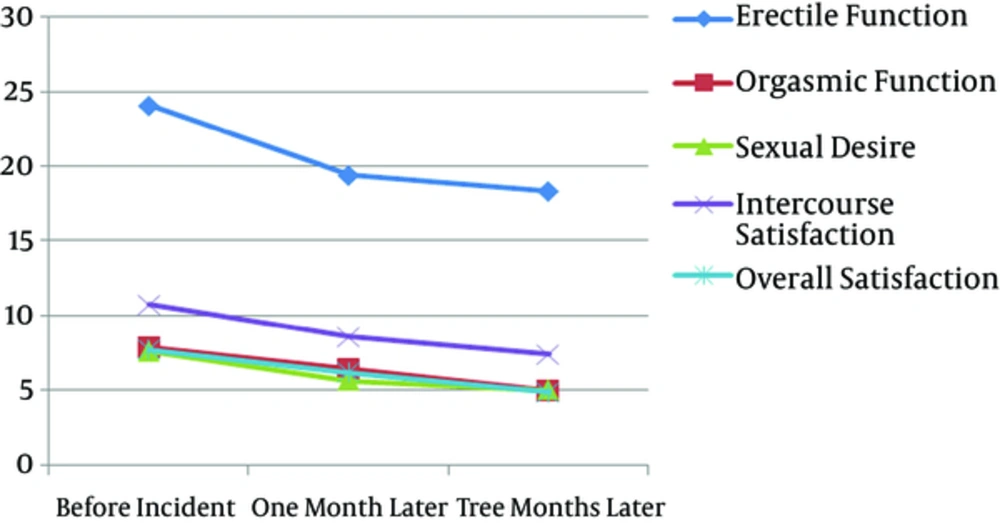
Figure 1.
The Mean Scores of IIEF Subscales Changes Before and After Lower Extremity Trauma
The results of the Friedman test revealed a significant difference in 3 stages among all the subscale IIEF (Table 2). The results of the Wilcoxon test indicated that the changes of sexual dysfunctions were significantly different before the incident with 1 month and 3 months after the incident in all the IIEF subscales (P = 0.000). However, the changes of sexual dysfunction was not significantly different 1 month after the incident with 3 months after the incident in all cases, except the intercourse satisfaction (P > 0.05).
Table 2.Sexual Dysfunction Before, One and Three Months After Lower Limb Trauma
| Times Domain and Clinical Interpretation | Before the Incident | One Month Later | Three Months Later | P Value | |
|---|---|---|---|---|---|
| Erectile Function | Severe dysfunction | 10 (6.5) | 15 (9.8) | 18 (11.8) | 0.000a |
| Moderate dysfunction | 0 | 2 (1.3) | 15 (9.8) | ||
| Mild to moderate dysfunction | 3 (2) | 28 (18.3) | 26 (17) | ||
| Mild dysfunction | 36 (23.5) | 83 (54.2) | 49 (32) | ||
| No dysfunction | 104 (68) | 25 (16.3) | 45 (29.4) | ||
| Orgasmic Function | Severe dysfunction | 10 (6.5) | 15 (9.8) | 14 (9.2) | 0.000a |
| Moderate dysfunction | 6 (3.9) | 14 (9.2) | 22 (14.4) | ||
| Mild to moderate dysfunction | 11 (7.2) | 38 (24.8) | 33 (21.6) | ||
| Mild dysfunction | 41 (26.8) | 52 (34) | 58 (37.9) | ||
| No dysfunction | 85 (55.6) | 34 (22.2) | 26 (17) | ||
| Sexual Desire | Severe dysfunction | 11 (7.2) | 14 (9.2) | 10 (6.5) | 0.000a |
| Moderate dysfunction | 2 (1.3) | 17 (11.1) | 26 (17) | ||
| Mild to moderate dysfunction | 12 (7.8) | 57 (37.3) | 38 (24.8) | ||
| Mild dysfunction | 60 (39.2) | 53 (34.6) | 62 (40.5) | ||
| No dysfunction | 68 (44.4) | 12 (7.8) | 17 (11.1) | ||
| Intercourse Satisfaction | Severe dysfunction | 10 (6.5) | 15 (9.8) | 11 (7.2) | 0.000a |
| Moderate dysfunction | 3 (2) | 13 (8.5) | 16 (10.5) | ||
| Mild to moderate dysfunction | 13 (8.5) | 63 (41.2) | 45 (29.4) | ||
| Mild dysfunction | 81 (52.9) | 43 (28.1) | 53 (34.6) | ||
| No dysfunction | 46 (30.1) | 19 (12.4) | 28 (18.3) | ||
| Overall Satisfaction | Severe dysfunction | 9 (5.9) | 15 (9.8) | 13 (8.5) | 0.000a |
| Moderate dysfunction | 4 (2.6) | 16 (10.5) | 13 (8.5) | ||
| Mild to moderate dysfunction | 10 (6.5) | 46 (30.1) | 53 (34.6) | ||
| Mild dysfunction | 78 (51) | 53 (34.6) | 56 (36.6) | ||
| No dysfunction | 52 (34) | 23 (15) | 18 (11.8) |
aThe results of the Friedman test revealed a significant difference in 3 stages among all the subscale of IIEF.
5. Discussion
Trauma, diseases, and injuries can cause sexual dysfunction in males and even in their spouses (24, 25). However, a few studies have been conducted in Iran about the effects of trauma, especially lower extremity trauma, on sexual health. Therefore, male sexual dysfunctions were assessed before and after lower limb trauma in this study.
The incidence of sexual dysfunction showed a significant increase in the participants after lower extremity trauma. Mild to severe sexual dysfunction were between 8.5% and 17.6% in all subcategories of the IIEF before the incidence of trauma. The incidence was almost the same as sexual dysfunctions in other studies. In Papagiannopoulos (2015), the incidence of erectile dysfunction has been reported to be 15% to 20% (26), and it was 21.1% in Foruzannia study (27).
The results of the present study revealed a significant increase in the incidence of sexual dysfunction 1 month after the lower extremity trauma compared to before the event. In the first posttraumatic month, compared to before the event, the rate of moderate to severe erectile function disorder showed an increase from 8.5% to 29.4%, orgasmic function disorder from 17.6% to 67%, sexual desire disorder from 16.4% to 57.6%, intercourse satisfaction disorders from 17% to 59.5%, and overall satisfaction dysfunction from 14% to 50.4%. Other studies have reported the incidence of high sexual dysfunction after pelvic trauma and lower extremity trauma. For example, in a review of studies, Blaschko (2014) found that the incidence of erectile dysfunction was 25% to 45% after pelvic fractures in different studies (28). Also, Harvey-Kelly (2011) reported this quantity in males to be 35.9% in the other review studies (17). In another review study, Koraitim (2013) reported the incidence of sexual dysfunction to be 44% in patients with hip fractures (29). In the present study, the prevalence of disorders has increased to more than 50% in the other subgroups of the IIEF, except in erectile function disorders. The normal condition of erectile function in more than 70% of the patients showed that most participants in the study had not been physiologically banned from sexual activities and other reasons were involved in the incidence of these disorders. It seems that, in our study, the causes of sexual dysfunction in the first posttraumatic month were pains from trauma, sedative drugs, performing surgical procedures, being away from the family, fear and worry about the future, particularly the future job, disruption of order of the work and daily activities, the failure of the lower part of the body as an effective organ in sexual activity, and most importantly, not receiving the necessary training on how to perform sexual activities appropriate to the disease. The results revealed a significant increase in the incidence of sexual dysfunctions in the third posttraumatic month of the lower limb trauma compared to before the event. The rate of mild to severe erectile function disorder increased from 8.5% to 38.6%, orgasmic function disorder from 17.6% to 45.2%, sexual desire disorder from 16.4% to 48.3%, intercourse satisfaction disorder from 17% to 47.1%, and overall satisfaction disorder from 14% to 51.6% in the third posttraumatic month compared to before it. However, the results showed a decline in the severity of sexual dysfunction in the third month compared to the first posttraumatic month. It seems that the reduction of stress arising from trauma and physical improvement of patients have been very effective in the reduction of an average of sexual dysfunctions severity in the third month; and the results of McCarthy (2003) and Soberg (2015) has confirmed it. In their studies, they found that the prevalence of mental disorders in individuals with lower extremity trauma was reduced in the months after the event (9, 11). The results also revealed no significant difference in the incidence of sexual dysfunction in all subcategories of IIEF, except intercourse satisfaction in the first posttraumatic month of lower limb extremity trauma compared to the third posttraumatic month. This finding is worrying considering the average age of 38.5% of the participants in the study. Because most of the participants were at the peak age of sexual functioning, and a sharp drop in their long-term sexual functions could cause adverse consequences such as mental disorders, disheartening relationship with their spouse, the desire to divorce, tendency to be unfaithful, tendency to drugs and alcohol, and other irritating substances of sexual activity (18).
It seems that one of the causes of such findings in the present study was the low education level of the participants in the study, as more than 75% of the participants had no college education. Perhaps, after the trauma, these individuals would not be able to learn about their needs through the study of literature and the electronic resources. They probably won’t refer to the counselors. In addition, more than half of the participants were workers. Workers are usually active. They have regular patterns of sleeping, waking, working, and resting. Therefore, it was likely that they suffered from some depression, which had a negative impact on their sexual function.
As one of the first reports from Western Asia, especially the Persian Gulf region, the current study added something new to the literature. However, the study had a cross sectional design and lacked female participants, thus, conducting further studies on this topic is suggested.
5.1. Conclusions
Many males with lower extremity trauma are at risk of sexual dysfunction. These dysfunctions may continue for months after the trauma. Lower extremity trauma occurs in young and middle age individuals and these ages are the climax of sexual activity of each person. Lack of attention to these dysfunctions can have adverse consequences for individuals, families, and the society. Thus, health care providers should evaluate, support, and if needed, treat sexual dysfunction in patients from the first days after the lower extremity trauma. Also, other members of the treatment team and family members of these patients should learn the required trainings to help these patients.



