


1. Background
Mental rotation is the ability to imagine how a misoriented object would emerge if it was rotated away from the existing orientation (1). In Parson’s hand rotation task, participants should judge the laterality of the pictures or hands in various rotation angles (2). Typically, error rates and reaction times increase as a function of the rotation angle of the stimulus, indicating that participants engage in a cognitive process of mental rotation. Moreover, mental rotation is a complex cognitive process and is associated with core psychological process such as perception, speed of spatial processing, executive function, and working memory (1). At electrophysiological level, ERP studies have found a modulated positive wave of about 300 - 700 ms, rotation-related negativity (RRN), reflecting the mental rotation process, with decreasing amplitudes for increasing angles of rotation (3, 4).
Using hand rotation tasks, studies have shown that patients with schizophrenia were slower and less accurate than controls. However, they displayed the same decrease in reaction time and accuracy with increasing the angles of rotation in control participants (5-8). Moreover, inaccuracy in the test of hand rotation was associated with speed of information processing and executive dysfunction in patients with schizophrenia (9). In an ERP study, Mazhari et al. (2013) (10) found significantly reduced rotation-related negativity amplitude for mental rotation effect in patients with schizophrenia. Altogether, the above-mentioned studies showed an impaired mental rotation of hand at both behavioral and neural levels.
Factors associated with schizophrenia, particularly medication effects, and positive and negative symptoms influence patients' performances, making interpretation become difficult. These factors potentially affect task performance and are not easy to separate from the effects of basic psychopathology. As cognitive impairments show the underlying genetic risk for schizophrenia, it is important to study the unaffected first-degree relatives of the patients as they have some common genetic vulnerability without presenting the similar experimental problems. Although there are evidences of impaired performance of schizophrenia in mental rotation tasks, to our knowledge, no study has examined this ability in first-degree relatives of the patients.
Mental rotation can be fractioned into sub-processes that are responsible for inspection and active manipulation of internal representations (1). In fact, it is well recognized that mental rotation is closely interrelated to working memory ability (11). Deficits in working memory are among the most replicated findings in schizophrenia and considered as a core feature of this disorder (12, 13). Moreover, the working memory deficits have been found in healthy first-degree relatives of schizophrenia (14, 15).
2. Objectives
Therefore, it is worthy to study the mental rotation in the first-degree relatives of schizophrenia patients. This study compared the performances of schizophrenia patients and their unaffected relatives to that of a control group on the hand rotation task to shed further light on the nature of cognitive functioning in the relatives of schizophrenia patients.
3. Materials and Methods
3.1. Participants
A group of 25 patients with schizophrenia (20 Males) selected from the outpatients of a psychiatric hospital, and 25 first-degree relatives (17 Males) of the patients participated in this study. All patients had DSM-IV criteria for a lifetime diagnosis of schizophrenia. They were examined, using the positive and negative syndrome scale (PANSS) for schizophrenia (16). Patients continued their antipsychotic medications, and the mean chlorpromazine (CPZ) equivalent dose was 401 mg (17). Patients did not have a history of electroconvulsive therapy within six months prior to the testing time.
The control group consisted of 25 individuals (20 Males) screened for a personal and family history of psychotic illnesses. Exclusion criteria for all participants were a history of head injury, neurological disorders, and current substance abuse. All participants were right-handed and had normal vision. After explaining the experiment, a written informed consent was obtained from all the participants. The Ethics Committees of Kerman University of Medical Sciences, Iran, approved the study.
3.2. Hand Rotation Task (HRT)
The Parson’s classical hand-rotation task was applied. 2 In this task, the laterality of the pictures, representing right or left hands in different rotation angles is judged by participants. The participants were seated on a chair in front of a table. The stimuli included line drawings of the right and left hands in palm and back view (Figure 1), presented in random order. Hand pictures were rotated in six various orientations (0°, 60°, 120°, 180°, 240°, and 300°). Every picture was repeated five times, resulting in 120 trials (6 × 2 × 2 × 5). The participants were required to judge as accurately and quickly as possible if it was a picture of the right or left hand by pressing the right or left button. Accuracy rate and response time were registered by key press. A score below 75% indicates an inability to perform MI accurately.
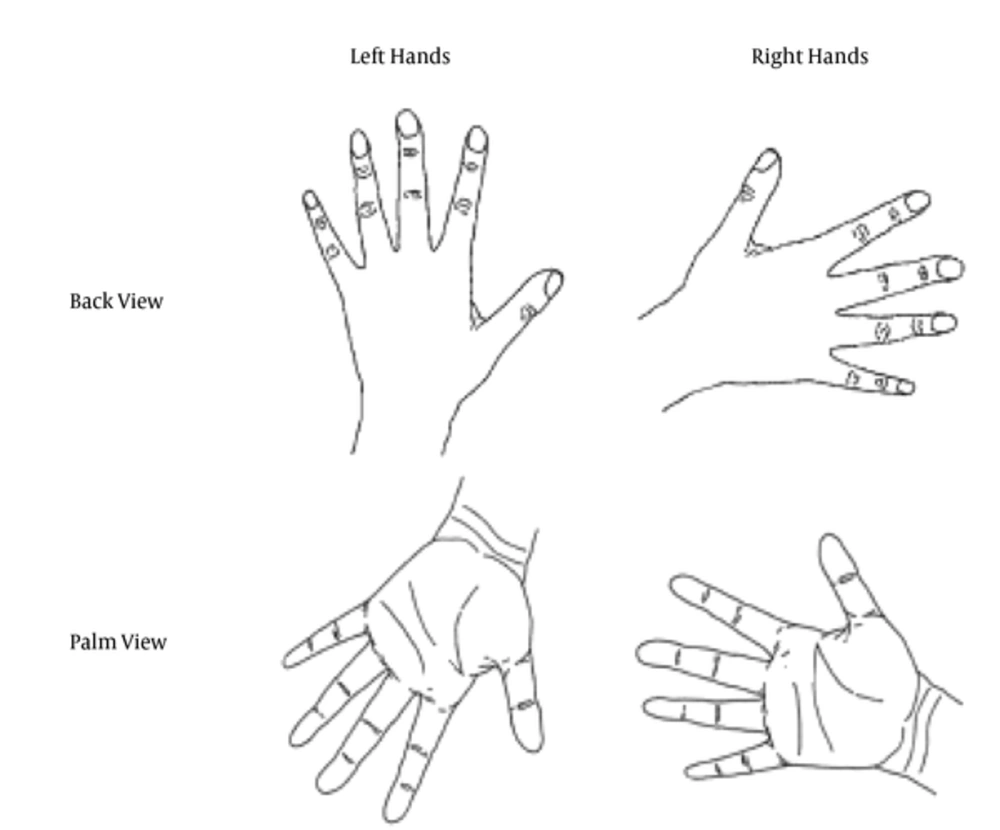
Figure 1.
Examples of the Line Drawings of the Left and Right Hands Viewed from the Palm and the Back with Different Rotation Angles (0°, 60, 120°, 180°, 240°, 300°)
3.3. Data Analyses
Analysis of variance (for continuous variables) and Chi-square (for dichotomous variables) were used to examine between-group differences in demographic variables.
Because our focus was on the difference between performances of the three groups, various rotations were collapsed into two angles of rotation: Small rotation angle (0°, 60°, and 300°), and large rotation angle (120°, 180°, and 240°). A repeated-measures ANOVA with group (patient, relatives, control) as between-subject, and hand rotation angles (small, large) as within-subject were used to examine accuracy and response time of HRT between groups in different angles.
4. Results
Table 1 demonstrates the demographic characteristics of the total study sample. The three groups did not significantly differ in sex, age, and years of education. Table 2 displays the means and SD of the accuracy rates and response times of the study participants.
Table 1.The Demographic and Clinical Characteristics of the Participants
| Patients | Relatives | Controls | P | |
|---|---|---|---|---|
| Age | 33.4 ± 8.2 | 35.2 ± 10.6 | 33.4 ± 9.1 | 0.8 |
| Sex, No. (%) of male | 20 (80) | 17 (68) | 20 (80) | 0.1 |
| Education, y | 10.6 ± 4.2 | 12.4 ± 3.6 | 12.0 ± 1.8 | 0.2 |
| Handedness | 95.3 ± 6.6 | 97.7 ± 1.2 | 98.7 ± 1.2 | NS |
| Length of illness | 10.5 ± 4.9 | - | - | - |
| Mean chlorpromazine equivalent, mg | 401 ± 180.9 | - | - | - |
| PANSSa-positive | 23 ± 6.7 | - | ||
| PANSS-negative | 13 ± 7.4 | - |
aPositive and negative syndrome scale.
Table 2.The Means and SD of the Accuracy Rate and Response Time of Performance on the Hand Rotation Task
| Patients | Relatives | Controls | |
|---|---|---|---|
| Accuracy (total) | 67.9 ± 14.2 | 79.3 ± 13.2 | 87.7 ± 9.2 |
| Small angle | 73.6 ± 14.5 | 84.0 ± 10.7 | 91.5 ± 8.3 |
| Large angle | 62.3 ± 15.7 | 74.6 ± 17.6 | 83.8 ± 10.9 |
| Response time (total) | 1796 ± 309 | 1772 ± 291 | 1543 ± 193 |
| Small angle | 1685 ± 264 | 1656 ± 326 | 1397 ± 217 |
| Large angle | 1936 ± 350 | 1859 ± 307 | 1689 ± 186 |
4.1. Response Accuracy
The mean accuracy rates among the two degrees of rotations were calculated (Table 2).The results of repeated measure ANOVA revealed a significant effect of group (F 1, 65) = 13.6, P < 0.001, η2 = 0.3), suggesting that accuracy rates were significantly different between the three groups. Bonferroni corrected post-hoc comparisons indicated significant differences between the patients and both relatives and controls (all P<0.009), and a significant difference between relatives and controls (all P < 0.03) on both small and large angles (Figure 2). There was a significant main effect of the stimulus angle (F (1, 65) = 61.6, P < 0.001, η2 = 0.48), indicating a decrease in accuracy with increased angle of rotation. The interaction effects between group and the stimulus angle were not significant (F (2, 65) = 0.73, P = 0.48, η2 = 0.02), suggesting similar performances of the three groups across different stimulus angles.
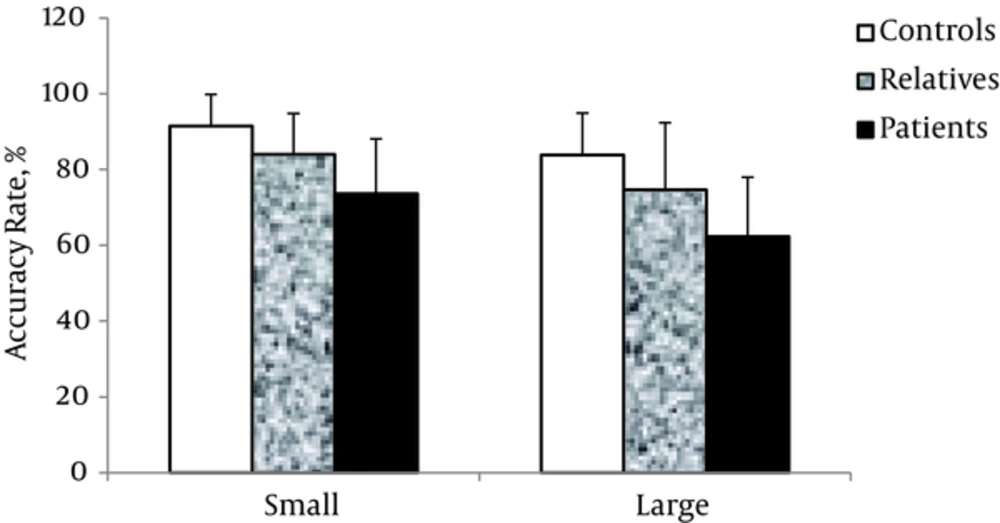
Figure 2.
The Mean Accuracy Rate (with SEM) of Performance on Hand Rotation Task in the Three Groups
4.2. Response Time
The analyses were repeated for response times among the two angles of rotation (Table 2). The results revealed a significant effect of group (F (1, 67) = 6.4, P = 0.003, η2 = 0.16), indicating that response times were significantly different between the three groups. On both angles of rotation, post-hoc comparisons indicated significant differences between the patients and controls (all P < 0.004), while the difference between patients and relatives was not significant (all P > 0.3). Moreover, a significant difference was obtained between relatives and controls (all P < 0.004). There was a significant main effect of the stimulus angle (F (1, 67) = 161.3, P < 0.001, η2 = 0.70), indicating that response times significantly increased with increased angle of rotation. The interaction effects between groups and the stimulus angle were not significant (F (1, 67) = 161.3, P = 0.2, η2 = 0.70), suggesting a similar performance of the three groups across different stimulus angles (Figure 3).
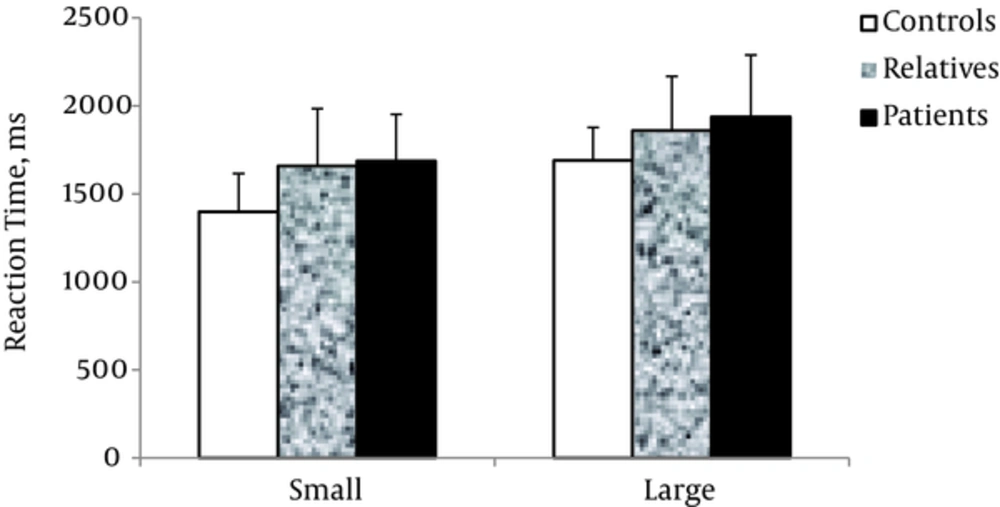
Figure 3.
The Mean Reaction Time (with SEM) of Performance on Hand Rotation Task in the Three Groups
5. Discussion
This study aimed to compare mental rotation abilities in schizophrenia patients and their first-degree relatives and to that of the controls, measured with HRT. In agreement with previous studies, our results demonstrated that the pattern of performances of patients was similar to that of the controls (same effects of angle of rotation). However, the patients displayed higher error rate and slower response time compared to controls, which was similar to the findings reported by other studies (5-10). These results suggest that patients with schizophrenia have difficulty to accurately manipulate mental representations of hands.
This was the first study to demonstrate the expected pattern of an intermediate level of performance on HRT for first-degree relatives of schizophrenia patients compared to that of schizophrenia patients and the control group. Our results revealed that the pattern of performance of the relatives was similar to that of the controls (same effects of angle of rotation), suggesting that their ability was preserved. However, the relatives exhibited longer response time and higher error rate compared to controls, making it difficult to conclude that mental rotation was preserved in relatives of schizophrenia patients. These results suggest that relatives of schizophrenia patients experienced difficulty in performing mental imagery tasks, and above all in accurately manipulating mental representations of hands. Inconsistent with our finding, Oertel et al., (2009) (18) found higher vividness of mental imagery in relatives of schizophrenia patients, using a self-report questionnaire mental imagery (QMI). The reason for this discrepancy is that they examined explicit mental imagery, while we examined implicit mental imagery. It should be mentioned that the explicit imagery tasks and self-report instruments could not tap into cognitive processes that underlie mental imagery (19). In contrast, we used an implicit imagery task in which individuals were not asked to engage in the imagery, but to solve a tangential task (laterality of the hand).
Spatial working memory is a crucial cognitive process among those involved in mental hand rotation, which requires both online maintenance and manipulation of spatially representations of hands (11). Indeed, information about a mental rotation act should be processed from the long-term to the working memory. The image should not only be transformed within working memory (e.g., by rotating a visual image), but also has to be maintained. An impaired spatial working memory could lead to the breakdown of behaviors guided by internal representation such as mental rotation. Spatial working memory impairments have been well documented in schizophrenia and suggested as an effective endophenotype marker (15-20). Moreover, spatial working memory impairments have been reported in the unaffected relatives of schizophrenia patients, supporting the fact that these impairments may reflect a genetic risk for schizophrenia (14, 15). Unfortunately, we did not assess the spatial working memory in our study, so future studies should examine its impairment and relation to mental rotation in relatives of schizophrenia patients. However, a firm conclusion cannot be drawn yet, and more pending studies examining both working memory and mental rotation processes are available.
It is difficult to draw direct neurophysiological conclusions from behavioral measures, which tap into the multi cognitive processes. However, this finding may reflect the disruption in primary motor cortex and/or posterior parietal cortex in the pathophysiology of schizophrenia. Posterior parietal cortex is crucial for goal-directed movements and updating spatial representation as a consequence of those actions (6, 21). Studies have suggested that dysfunction of the posterior parietal cortex results in some cognitive impairment in schizophrenia such as impaired spatial attention, deficits in motor control and motor imagery (22, 23). Behavioral, fMRI and TMS studies demonstrate that motor areas, particularly primary motor cortex play an important role in mental imagery (19). Interestingly, the meta-analyses demonstrated that motor symptoms were more prevalent in unaffected first-degree relatives of patients with schizophrenia than in the healthy controls, suggesting that motor symptoms may be associated with the genetic risk of developing schizophrenia (24, 25).
These findings have an important implication. Potentially, the finding of deficit in mental rotation in the first-degree relatives of schizophrenia patients is of interest. This deficit cannot be the result of factors associated with the disorder, like distractibility because of active psychotic symptoms, lack of motivation, medication effects, or lower education levels. Also, the relatives in our study had a mean age of 35 that is above the peak age of risk for schizophrenia. Overall, it seems that mental rotation is a trait than a state marker, indicating an underlying vulnerability to the disorder and its relation to genetic liability to develop schizophrenia.
One limitation of our study was sampling bias, as it may be possible that only high functioning relatives agreed to participate. This situation is somewhat common in most studies, but its resolution is beyond the scope of the study.
In conclusion, we demonstrated that implicit mental imagery may be an independent symptom and a trait marker for schizophrenia. This finding that the mental rotation is not preserved in relatives of schizophrenia supports the previous findings of subtle neurobiological and cognitive changes in high-risk groups.


