


1. Background
Researchers believe that athletic competence and performance are related to athlete’s psychological characteristics during competitions rather than his/her long-term physical exercises (1). Psychological aspects play an important role in sport events; the current study discussed some psychological characteristics of team athletes such as sport self-efficacy, sport attributional style, and creativity. Understanding and explaining past episodes of success and failure could help to develop and improve individual`s ability as a sport performer, called causal attribution (2). Another variable discussed here is self-efficacy that is the athlete’s belief in his ability to perform his specific athletic skills successfully (3). Hardy et al. (4), defined sport self-efficacy and sport-confidence as micro- and macro-level of self-confidence, respectively. The micro-level of self-confidence is connected with specific skills in practice, while sport-confidence focuses chiefly on the global level of self-confidence (4). The next variable studied in the current study was creativity. According to Torrance, creativity involves four basic elements: (1) Fluency: the capability of producing various and numerous ideas, (2) Elaboration: concentration on details, (3) Originality: the capability of innovating new, strange, and unusual ideas, and (4) Flexibility: the ability to make new ideas using different methods (5). In the attribution theory, individuals attributing to success or failure of their actions are presumed to influence subsequent performance expectations (self-efficacy) (6). Bandura developed a further rationale for the existence of an attribution-efficacy link by arguing that attributions are an integral part of efficacy percepts (7). Despite such proposals, the attribution/efficacy is not studied comparatively, particularly in sport and exercise domains (7). Causal attributions are believed to influence motivation and performance via the mediator role of self-efficacy (6). Recent studies showed that increasing self-efficacy in athletes could definitely improve their creativity, (1) and their athletic performance (8). Since there is a relationship between sport attributional styles and self-efficacy, and also between self-efficacy and creativity, it can be concluded that there is a relationship between sport attributional styles and creativity. Evidence showed that successful creators generally have various self-serving tendencies associated with self-serving bias in an attribution (9). According to all these facts and relationships, the current study aimed at providing a theoretical model of relationships between sport attributional styles, sport self-efficacy, and creativity in elite team athletes based on structural equation modeling.
2. Objectives
The current study aimed at providing a theoretical model of relationships between sport attributional styles, sport self-efficacy, and creativity in elite team athletes based on structural equation modeling.
3. Materials and Methods
3.1. Research Method
A correlational study was conducted using structural equation modeling by AMOS version 23.
3.2. Population, Sample, and Sampling
The study population involved elite athletes (n = 2853; 863 females and 1990 males) playing in the highest rank of competitions (such as a super league, top league, or first-class league) in different sport teams including basketball, football, and handball.
Based on preliminary results, a standard deviation (SD) of 0.73 was obtained in elite team athletes for creativity (the major variable of the study) with a reliability of 95%. By assigning 0.1 point error, a sample size of 192 elite team athletes was calculated.
Based on the male and female ratio in sport teams of the study population, the same ratio was applied to select sample composition, including 134 males and 58 females. They were randomly selected from different sport clubs in Tehran, Iran, in 2014.
3.3. Instruments
3.3.1. Sport Confidence Questionnaire
This questionnaire was developed by Vealey and Knight, consisting of 14 questions. The items are scores based on a seven-option Likert scale (from 1 = completely not sure to 7 = completely sure) (10). This questionnaire includes three subscales (sport confidence in physical skills and training, sport confidence in cognitive efficiency, and sport confidence in resilience).The average of these three subscales shows the general self-confidence of each athlete. SCQ was validated in Iran by Abdolalizade et al. (10). Internal consistency of the whole scale using Cronbach’s alpha was 0.99 (10). Abdolalizade et al. (10), confirmed construct validity of SCQ using factor analysis. In the current study, Cronbach’s alpha coefficient of the total scale was 0.85.
According to some researchers, sport self-efficacy, and sport-confidence are the micro and macro-level of self-confidence, respectively (4); therefore, this questionnaire can be used to measure sport self-efficacy.
3.3.2. Creativity Questionnaire
Based on creativity theory by Torrance, CQ was developed by Abedi in Persian (5). It consists of four subscales including fluency, elaboration, originality, and flexibility with 60 three-item questions. Items show low, medium, and high levels of creativity (one for low, two for medium, and three for high). The total score range 60 to 180. Questions 1 - 22 cover fluency, 23 - 33 elaboration, 34 - 49 originality, and 50-60 are about flexibility. Using test-retest in a junior high school in Tehran, the reliability of CQ for fluency, originality, flexibility, and elaboration was 0.85, 0.82, 0.84, and 0.80, respectively (5). Haghighat found the construct validity of 0.72, by correlating its scores with measure of Torrance creativity (verbal form) (11). In the current study, internal consistency of the total scale, using Cronbach’s alpha, was 0.95.
3.3.3. Sport Attributional Style Scale
SASS, which measures six attributional dimensions in sport, was developed by Hanrahan et al. (12), to determine a more validated and clearer attributional style in sport. The original SASS (long-form) includes 16 items, out of which eight are related to the athletic successes and eight items are about athletic failures. All 16 items are involved in seven parts. The first part is related to reasons of athletic successes and failures. Parts 2 to 7 are about internal-external, stable-unstable, global-specific, internal controllable-uncontrollable, external controllable-uncontrollable, and intentional-unintentional dimensions of sport attributional styles, respectively. The items are scored based on a seven-option Likert scale (from 1 = never to 7 = completely sure). The scoring is in reverse order for negative events (13). Reliability of this scale, using test-retest, ranged 0.60 to 0.82 (average 0.73) (12). Construct validity of the scale was confirmed by correlating scores on the dimensional subscales with measures of achievement motivation (the Willis scales of competitive motives), physical self-esteem (the self-rating scale of Fleming and Courtney), and sport competition anxiety scale (12). Hanrahan et al. (12), believed that SASS had an acceptable reliability and validity in sport. SSAS was validated in Iran by Zoljanahi et al. (14). In the current study, Cronbach’s alpha coefficient of the total scale was 0.94.
4. Results
Demographic characteristics of elite team athletes are shown in Table 1.
Table 1.Demographic Characteristics of Elite Team Athletes
| Variable | No. (%) |
|---|---|
| Age | |
| 18 - 20 | 043 (22.0) |
| 21 - 23 | 064 (33.0) |
| 24 - 26 | 048 (25.0) |
| 27 - 30 | 037 (20.0) |
| Gender | |
| Male | 121 (63.0) |
| Female | 071 (37.0) |
| Sport field | |
| Basketball | 054 (28.0) |
| Football | 112 (58.0) |
| Handball | 026 (14.0) |
| Sporting background (y) | |
| 5 or less | 006 (3.0) |
| 5 - 8 | 115 (60.0) |
| 9 - 12 | 043 (22.0) |
| 13 - 16 | 020 (10.0) |
| 16 or more | 008 (5.0) |
| Marital status | |
| Married | 024 (11.0) |
| Not married | 168 (89.0) |
| Educational level | |
| Diploma | 054 (28.0) |
| Associate’s degree | 013 (7.0) |
| Bachelor’s degree | 050 (26.0) |
| Undergraduate student | 057 (30.0) |
| Master’s degree | 018 (9.0) |
As shown in Table 2, after failure and after success, the mean value of internal controllable-controllable factor was higher than the other factors of sport attributional style. Besides, the mean value of components of fluency and flexibility was higher than the other factors of creativity
Table 2.Descriptive Indicators of the Study Variables
| Variable | Mean (SD) | Minimum Value | Maximum Value |
|---|---|---|---|
| Internal-external | |||
| After failure | 4.2 (1.4) | 1.8 | 6.9 |
| After success | 4.7 (1.4) | 1.9 | 7.0 |
| Stable-unstable | |||
| After failure | 4.0 (1.2) | 1.8 | 6.9 |
| After success | 4.7 (1.2) | 1.8 | 7.0 |
| Global specific | |||
| After failure | 4.1 (1.1) | 1.8 | 6.8 |
| After success | 4.5 (1.3) | 1.8 | 7.0 |
| Internal controllable-controllable | |||
| After failure | 4.4 (1.0) | 2.3 | 6.8 |
| After success | 4.8 (1.2) | 2.3 | 7.0 |
| External controllable-controllable | |||
| After failure | 4.1 (0.9) | 2.0 | 6.6 |
| After success | 4.3 (1.1) | 1.0 | 6.6 |
| Intentional-unintentional | |||
| After failure | 4.3 (1.0) | 1.3 | 6.5 |
| After success | 4.6 (1.0) | 1.1 | 7.0 |
| Fluency | 2.2 (0.4) | 1.2 | 3.0 |
| Elaboration | 2.0 (0.4) | 1.2 | 3.0 |
| Originality | 2.1 (0.4) | 1.1 | 2.9 |
| Flexibility | 2.2 (0.5) | 1.0 | 3.0 |
| Sport confident | 4.8 (1.0) | 2.2 | 7.0 |
In order to evaluate research hypotheses, the fitness of two models (measurement model and structural model) for team athletes after success and after failure was analyzed using structural equation modeling method. After some revisions by AMOS, measurement models (factor analysis models) well fitted the data, but only the structural models, which were based on the study hypotheses and last measurement models, were presented here.
χ2/df, confirmatory fit index (CFI), the Tucker-Lewis index (TLI), the standardized root mean square residual (SRMR), and the root mean square error of approximation (RMSEA) indices were used to evaluate structural models in sport teams after success and after failure. Some references suggest that χ2/df should be < 3 to adopt the model (15). CFI and TLI ≥ 0.9, RMSEA ≤ 0.09, and SRMR ≤ 0.10 indicated that model was properly fit (16).
The results indicated that structural models (Figures 1 and 2), well fitted the data and standard coefficients of all components and indices (questions) were significant (P < 0.05). Furthermore, there were positive and significant direct coefficients between sport attributional style and sport self-efficacy (after success, after failure), and direct coefficients between sport self-efficacy and creativity (after success, after failure), and indirect coefficients between sport attributional style and creativity (after success, after failure) (P < 0.05); only the direct coefficients between sport attributional style and creativity were insignificant (P = 0.297 after success an P = 0.640 after failure).
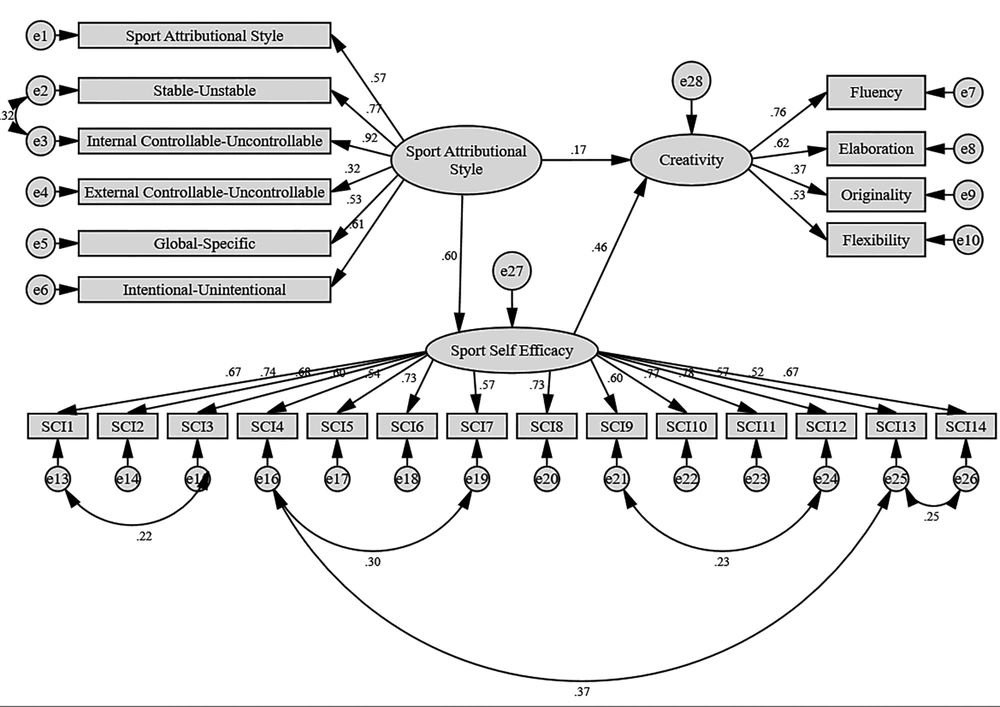
Figure 1.
Structural model for sport teams after success (standard coefficients); χ2/df = 1.9 (χ2 = 470.6, df = 57), CFI = 0.9, TLI = 0.9, SRMR = 0.07, RMSEA = 0.07.
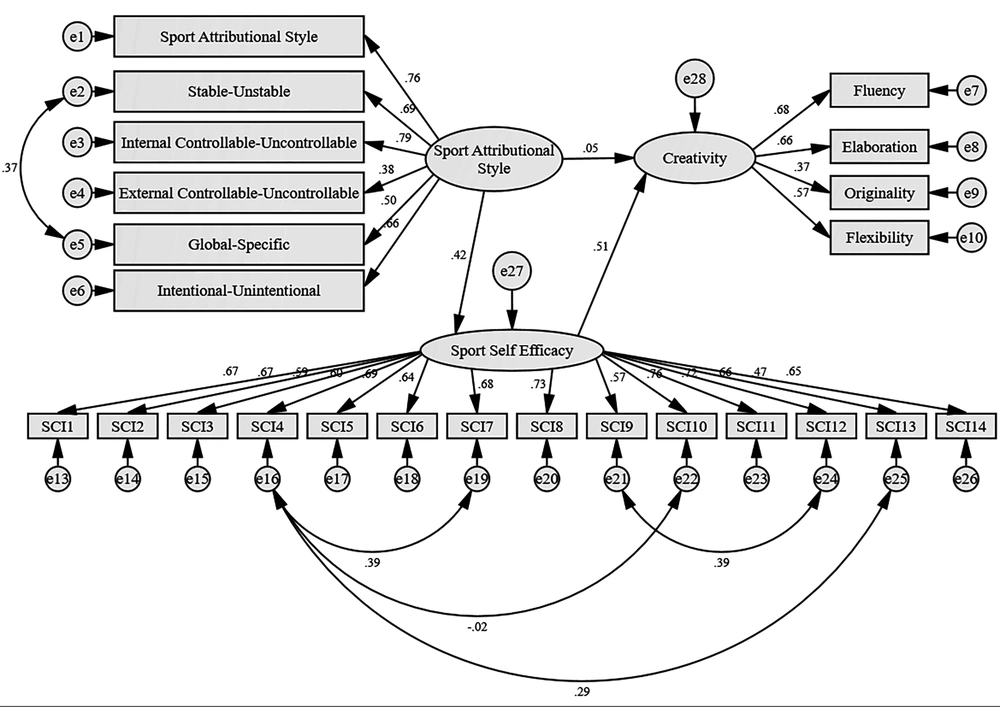
Figure 2.
Structural model for sport teams after failure (standard coefficients); χ2/df = 2.1 (χ2= 426.9, df = 56), CFI = 0.9, TLI = 0.9, SRMR = 0.08, RMSEA = 0.08.
5. Discussion
According to some studies that found structural relationships among sport attributional style, self-efficacy, and creativity, the current study proposed a structural model of relationships between the study variables to verify it by structural equation modeling in elite team athletes. Based on the results, there was a positive significant relationship between sport attributional style (after success, after failure) and sport self-efficacy in elite team athletes. This finding can be justified by the model of self-serving attributional bias. This bias was previously shown among some players (17). In other words, according to this model, athletes gave internal, stable, and global attributions for their own or their team’s success and gave external, unstable, and specific attributions for their failures and this bias protected self-confidence (17). Also, according to Pederson et al., the athletes from more successful teams had higher internal, stable, controllable, and intentional attributions (17). Moreover, success increases self-efficacy (18); therefore, the current study could claim a positive relationship between sport attributional style (after success) and sport self-efficacy. This finding was also confirmed through the Weiner success motivation model (19). Weiner believed that success was more related to internal stable reasons (such as ability) than external, unstable ones (such as chance), which increase self-efficacy of individuals in future. Moreover, the current study findings were in harmony with the results of Coffee et al., that indicated following more successful performances, attributions to stability and generalizability were associated with main effects upon efficacy, in a positive direction (20). Also, Weiner believed that failure due to external and unstable attributions was not an indicator for future failure (21); therefore, these attributions after failure protected self-efficacy.
Furthermore, the current study results showed a positive indirect relationship between sport attributional style (after success and after failure) of elite team athletes and their creativity in which sport self-efficacy played a mediating role consistent with the results of Bandura showing that causal attributions influenced motivation and performance via the mediator role of self-efficacy (6). Besides, evidence showed that successful creators generally had various self-serving tendencies associated with self-serving bias in an attribution (9). Successful creators use adjectives such as assertive, self-confident, and egotistical when describing themselves (9). Ralf showed that pessimistic attributional style (after failure) decreased creativity due to a decrease in self-confidence (22).
In the current study, the hypothesis on a significant relationship between sport attributional style (after success and after failure) of elite team athletes and their creativity was not confirmed. The probable reasons include the mediating role of variables and factors such as sport self-efficacy. In Other words, as the current findings showed, sport attributional style of team athletes had a positive relationship with creativity due to the mediating role of sport self-efficacy.
5.1. Limitations and Further Directions
There were some limitations in the current study. First, data were collected by only one tool; therefore, to avoid personal inadequacy, the participants may have not been given sufficient, accurate information. Second, as there are different sport attributional styles for various fields of sports and since concentrating on team competitions puts limitations on generalizing the current study results, it is suggested that future studies be conducted in other fields of sports. Suitable sport attributional styles are also recommended from early childhood by coaches and parents to increase self-efficacy and creativity in young children that could improve their internal motivations in future.
5.2. Conclusions
The current study showed a positive significant relationship between sport self-efficacy and sport attributional styles. Moreover, sport self-efficacy had a mediating role between sport attributional styles and creativity. Thus, identifying structural relationships between these variables is of great benefit to promote athletes’ mental health.

