The main purpose of this study was to develop a model similar to human inhalant addiction since, despite the high prevalence of this drug among humans, a proper model has not been yet established in laboratory animals. The administration route and dose are of great importance, as neurochemical and behavioral responses to drugs are associated with the rate of increase in drug dosage and maximum concentration (
23).
Differences in pharmacokinetics between the routes of administration increase in meth bioavailability and effects. Meth absorption into the bloodstream was found to be slower in subcutaneous dosing than in the intraperitoneal route. Although intraperitoneal dosing of meth is rapid compared to subcutaneous dosing, the hepatic first-pass effect limits the absorbed meth dose. In addition, the overall pattern of meth effect on locomotor activity is related to the administration route and dose, which influence the serum concentration and time of behavioral effects. For instance, a significantly longer duration of traveled distance was reported in subcutaneous meth administration than in intravenous and intraperitoneal dosing (
11). Although most animal studies use passive and extravascular injection (e.g. i.p. or s.c.), these routes are not reported among human drug abusers (
24).
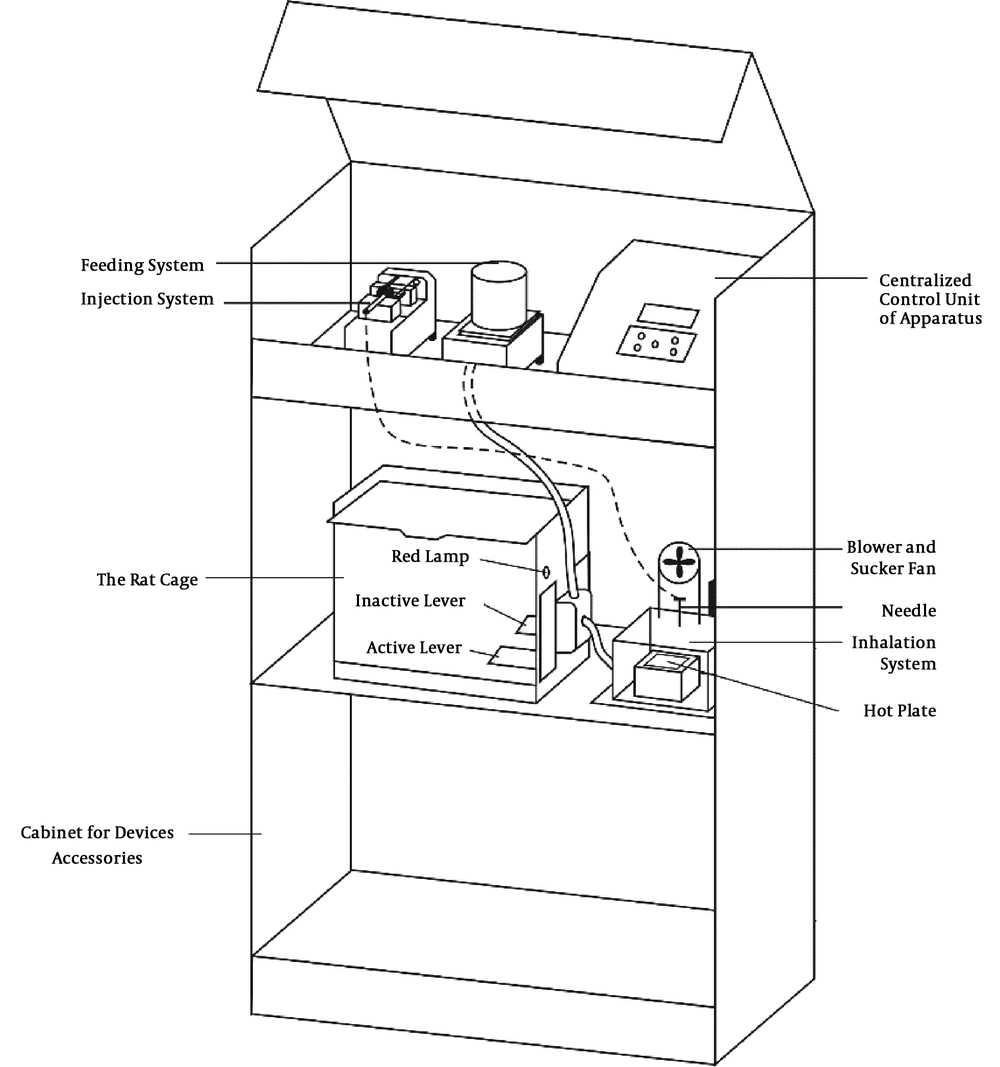
One of our goals was to manufacture an apparatus, which can be used with a non-invasive technique in animal studies and neuroscience research to reduce the stress of surgery and injection in laboratory animals and to increase the validity of animal experiments. The lack of pain, fear, and stress induction in animals can lead to non-interference of hormones with the test (a standardized test) and the production of more accurate results (
25).
Several studies have demonstrated the effects of stress on the metabolism of xenobiotics (
26). Stress hormone release, which was increased by approximately 50% or more, could change the neurochemical, physiological, and psychological status of animals and affect their responses to drug treatment (
27). Therefore, the removal of a major stress-related factor, e.g., injection, can positively influence the experimental findings.
According to substantial evidence, Corticotropin-Releasing Factor (CRF) is a major factor in emotional dysregulation associated with drug dependence due to the activation of the Hypothalamic-Pituitary-Adrenal (HPA) axis and brain stress systems in the extended amygdala (
28). Repeated neonatal maternal separation (an early life stress model in rodents) enhanced locomotor activity and stereotyped responses to meth at relatively low doses (
29). Therefore, the elimination of stressors in animals is essential in addiction studies.
According to an established model of surgical stress, this type of stress can induce depression, anxiety-like behaviors, and oxidative stress in the brain (
30). Preclinical studies have shown that stress can reinstate nicotine, cocaine, heroin, meth, and ethanol self-administration (
31). Therefore, the impact of stress is important on experimental outcomes.
In contrast to traditional studies, mental and physical stress can improve drug use acquisition and increase the risk of addictive behaviors. According to a study by Seo et al., repeated restraint stress weakened the acquisition of meth-induced CCP in the meth conditioning phase (
32). In a study by Stuart and Robinson, strategies avoiding restraint could reduce major stress and improve the welfare of laboratory animals via refinement. These animals were in a more positive affective state and had lower levels of stress hormones and aversive behaviors. The injection procedure itself showed little or no aversion, particularly in well-handled animals, and restraint was the major stressor used for the injection (
27).
In the development of this modified method, we dissociated between the effects of injection-related discomfort and physical restraint-associated stress and reduced stress associated with routine injections. In this non-invasive method, substances are administered with minimum stress effects. In this model, by pressing the active lever, the animal recognizes the drug as it enters its cage in the form of vapor and inhales it. It seems that drug abuse and addiction can be established in laboratory animals using this method. However, because of the failure to observe the symptoms of tolerance and drug-seeking behaviors, which are the important symptoms of human addiction, it is necessary to adapt these models for human addiction.
Indeed, developing animal models should be more in line with the characteristics of human diseases. Therefore, the best way to develop animal models of addiction is self-administration, through which the animal itself uses the drug. Through time, with the progression of addiction, its dosage increases according to its needs due to tolerance. In this method, addiction and recurrence-related behaviors are investigated. The intracranial and intravenous self-administration methods are very difficult techniques and require fixation of the cannula and catheter on top of the animal’s head and in the internal jugular vein behind the neck, respectively. The main advantage of non-invasive self-administration is that it does not involve any surgical procedures, thereby reducing the possibility of inflammatory responses. This finding is of great importance, as inflammatory responses are potential therapeutic targets and neuroimmune activation is involved in physiological responses to drug intake (
33).
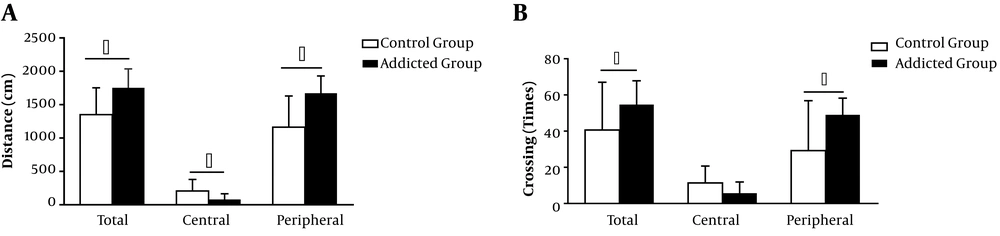
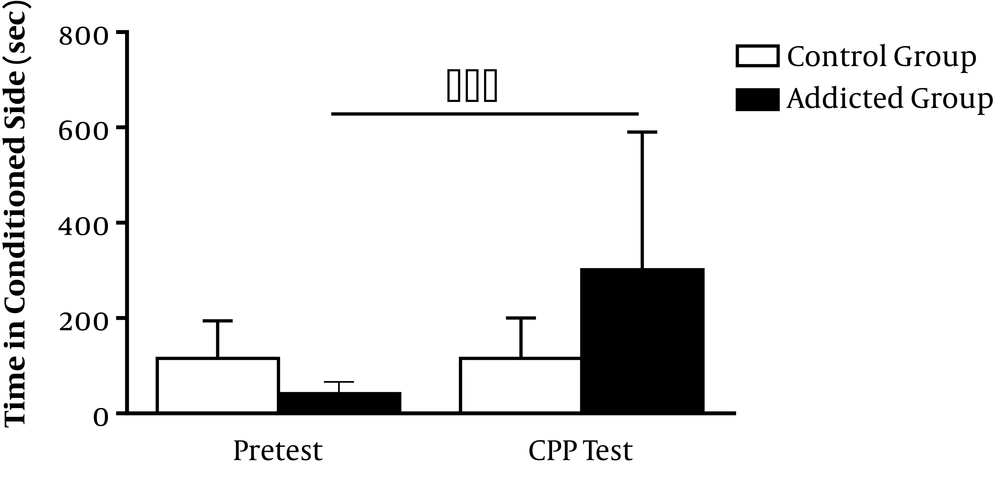
The inhalation route of meth self-administration is related to the increased CPP and locomotor physical activity, similar to observations in animals exposed to meth via injection, oral intake, and imposed inhalation (
34-
37). The present study is in agreement with earlier research, which revealed that meth is a psychomotor stimulant that increases locomotor activity when administered at low doses (
38). Similarly, Hall et al. (
21) showed that meth increased locomotor activity in the open field. According to a review study by Prut and Belzung (
39), the anxiogenic effect of meth is indicated by a reduction in the time spent in the central part of the open field or crossing the central part of the apparatus.
The present results, together with previous findings, indicate the development of CCP following repeated administration of meth (
40). As reported in various studies, the potential of meth to induce reinstatement of drug reward-related behaviors is related to its capacity for the activation of the mesolimbic dopamine system. The enhancement of dopaminergic neurotransmission results in glutamate (Glu) release in the prefrontal cortex. Accordingly, the increase in Glu is attributed to meth-induced reinstatement. The medial prefrontal cortex, which is part of the mesocorticolimbic system, facilitates major glutamatergic projection to the nucleus accumbens and ventral tegmental area to regulate dopamine release and simultaneously receive dopaminergic inputs from the ventral tegmental area and nucleus accumbens, which are crucial for the rewarding effect of meth (
41).
Moderate and low meth doses may increase locomotion, whereas high doses lead to numerous locomotor activation phases. The induced increase in locomotion is attributed to the dopaminergic mechanism. Different subtypes of dopamine receptors may be involved in receptor activation and consequently multiphasic locomotor activation in response to high meth doses. For inducing the optimal effects of drugs, such as meth, simultaneous activation of dopamine receptors (D1 and D2) is necessary.
Acetylated cyclase is activated, as dopamine binds to the D1 receptor. Subsequently, the resulting cyclic adenosine monophosphate (cAMP) stimulates protein kinase A enzyme and triggers post-synaptic neurons to improve excitability. On the other hand, adenylate cyclase activity is inhibited by stimulating the membrane-bound D2 receptor. Subsequently, the level of intracellular cAMP and postsynaptic neuron excitability can decrease. The mesolimbic brain region is speculated to regulate the response to low doses of meth, while the nigrostriatal pathway can mediate the response to high postsynaptic neuron excitability (
42).
In addition to behavioral tests mentioned above, the serum level of meth confirmed inhalation addiction. Higher peak levels of the drug in the plasma are associated with intraperitoneal administration (
43), whereas the nasal route of administration has great effects on the brain in promoting behavioral activation despite the low level of meth in the blood (
44).
We can conclude that meth inhalation is an effective self-administration route. It presents a promising approach to examine neural and behavioral outcomes in a noninvasive protocol. It is necessary to determine the effects of inhalation self-administration on meth-related complications, such as the brain and respiratory disorders.
5.1. Recommendations for Future Studies
The analysis of plasma corticosterone concentrations and comparison with other methods of drug self-administration are suggested for future studies.