
1. Background
Mental health issues are over-represented in the transgender community. The researches show transgender people are more than three times as likely to experience major psychological distress than the typical population in general (1). Transgender is a term used to describe individuals who exhibit gender-nonconforming roles and behaviors, or those who transcend typical gender paradigms. As they transcend their present and defined the role of society, they are subject to many discrimination, so transgressions are one of the most vulnerable groups in the community that experiences more psychosocial and health problems than other social groups (2). Research findings show that six in every one hundred thousand people are transgender (3), and one man in 100,000 and one woman in 300,000 are transgender (4). According to the report by the American Psychology Association (2005), one man in 300,000 and one woman in 200,000 applied for gender change surgery (5).
Some of the studies have shown that transgender persons experience disproportionate levels of bullying, harassment, stigma, prejudice, discrimination, humiliation, physical attacks, exclusion of friends and family, and other types of peer victimization (6-8). Young transgender are more at risk of mental health concerns and tolerated depression, anxiety, and suicidal ideation compared to non-transgender (8). in the Valentine and Shipherd’s study that was the health of transgender people, they examine 77 studies published between 1997 and 2017 which reported mental health outcomes in TG populations (9). Among transgender adults, symptoms of depression, suicide, substance use disorders, anxiety, and distress are on the rise (10).
Meyer’s minority stress model states that mental health distress is influenced by a stressful social environment and is the result of social production. The model has three processes, namely external stressors such as discrimination and violence (2) and interactive proximal stressors include anticipation or expectations that external stressors will occur (and internal stressors that are rooted in internalizing negative and fanatic attitudes (10, 11). This study attempts to answer the following questions:
1. What are the transgender’ s mental experiences of gender duality?
2. What are transgender’ s mental experiences in social and familial interactions?
3. What strategies do transgender use when facing threats to mental health?
4. What are dual-gender consequences for the transgender in the social life world?
2. Objectives
There is limited information on the mental health status of transgender persons and the pressures associated with being transgender in Iran. Due to cultural and intellectual taboos in Iranian society, transgender suffers from many problems. Thus, the main aim of the present research is to study the transgender’s mental experiences in the social life world.
3. Methods
The present research employed a qualitative grounded theory approach to studying transgender’s social and personal challenges and the psychological problems they experience.
Unstructured in-depth interviews were used for data collection procedures to collect the necessary data. The participants’ consent was obtained for recording the interviews. Each interview lasted about 40 minutes to 90 minutes depending on the participants’ interest in responding and the quality of the responses.
The population in this study included the transgender in the cities of Yazd, Tehran and Mashhad, nine transgender from Yazd, 11 from Tehran, and 5 from Mashhad, who were different in gender, age, education, gender situation, and marital status, were interviewed. Two methods of sampling, purposive (snowball) sampling, and theoretical sampling, were used for the data collection procedure. Thus, the interview procedure reached theoretical saturation with 25 interviewees.
The recorded interviews were typed for the data analysis. Theoretical coding was performed in three open, axial, and selective coding manners. The data were initially simplified and chunked. The transcribed data were carefully segmented into analytically meaningful units. At the open coding stage, the codes were extracted, and similar concepts were placed under the same label. At the axial coding stage, categories are related to the subcategories to determine the relationship between the categories obtained from open coding and related subcategories to the kernel category, so that a theory can be devised.
Three techniques were used to examine the acceptability of participants’ views. First, the interview transcripts were returned randomly to some of the participants to ensure that the interpretations of the results were true about the view. Second, an analytical comparison was used. We refer to the raw data to compare and evaluate the constructed theory with the raw data. Finally, the interview transcripts were and their summaries were checked by the research associate for codification. The codes made by the researcher and her associate were then compared, and discrepancies were removed to make the views go together.
The participants were introduced by the social emergency center in Yazd, welfare center in Mashhad, and Shahid Navab Safavi Welfare Center in Tehran. In Yazd, the transgender were interviewed through snowball sampling, but in Mashhad and Tehran, they participated in the study after the completion of official ceremonies at the welfare centers. some cases did not consent to be interviewed or believed that such research could not help them. The researcher did her best to adhere to the ethical principles in the interviews. The interviewees were ensured that what they say would not take any legal trouble for them, and the interview would be done only with those who fully consent about it. The participants were also informed of the aim of the study, the method of research, confidentially of responses, and the reporting process. To ensure confidentiality, personal information about the participants was not reported, and no one else but the researcher could have access to such information.
4. Results
In this section, the participant’s demographic characteristics are presented, and then their responses to the research questions are analyzed qualitatively (Table 1). In this section, the results of the study are presented in a very simple language based on the grounded theory method. The analysis of the main findings or main categories forms the foundation of the grounded theory.
Table 1.
Distribution of Participants in Terms of Birth Sex, Age, Education, Surgical Status and Marital Status
| Variables | Values |
|---|---|
| Birth sex | |
| Boy | 21 |
| Girl | 3 |
| Age | |
| Minimum | 22 |
| Maximum | 46 |
| Education | |
| Under diploma | 5 |
| Diploma | 12 |
| Bachelor | 6 |
| MA | 2 |
| Sex change | |
| Woman to man | 4 |
| Man to women | 14 |
| Marital status | |
| Single | 18 |
| Married | 3 |
| Widow | 4 |
4.1. Gender-Mental Dimensions
4.1.1. The Duality of Gender Self-Concept
Self-concept is the image one person, a man or a woman, has of himself/herself. The person learns to think, behave, and feel in a certain way because that is a man or a woman. The transgender experience conflict or duality between their body and mind as they grow sexually. This conflict changes their characters into shaking, fragile and unstable personalities. They live a different gender role in their lives. They are uneasy and feel anatomical mismatch, and wish to get rid of their sex organ to live the other gender. They experience humility, pain, fear, disgust, suffering, discomfort, suffocation, illness, and a lot of other trouble. They want to suppress such characteristics through the request for hormone prescription, surgery, injuring sex organs, or other ways to change sexual characteristics to look like the other gender.
“… I was upset I didn’t have breasts. I hated the organ. I even committed suicide for it, to get rid of it….” (interview no. 24).
4.1.2. The Duality of Gender Presentation
A dual appearance with the tendency to having the characteristics of the opposite sex in clothing, hairstyle, behavior, walking style, and talking manner but having to comply with the expectations of the society face the transgender people with mental distress. They wear a disguise in isolation and unfamiliar social space and play the characteristics of the opposite sex in clothing, hairstyle, behavior, walking style, and talking manner. However, in known social settings, they behave in the way they are socially expected to avoid social pressure.
As transgender themselves express, they show a dual-gender appearance, one is their own internal desire to be themselves, and the other is because of the pressure of the society (family, friends, …). Such duality occurs because the physical movement, clothing, walking style, talking manner, and types of used make-ups of the dissatisfied people with their gender do not match the typical behaviors of the gender. Therefore, the public cannot put such people into one of the two genders very easily.
“… I like the girl’s clothing, but I have to wear boys\ clothes for my family. It’s very hard, and I don’t like it….” (interview no. 2).
4.1.3. Dual Gender Performance
People perform either the masculine role or the feminine role that society expects. However, transgender people think they are playing both roles alternately. They change the roles between apparent gender and their Ideal and desirable gender. They say they are pressed heavily by the people around in displaying their real identity and have no chance to show their real gender. So they play the opposite gender in their solitude. They say they are caught between being a boy and a girl, and make their identity through dual roles and behaviors. They challenge the social conceptualization of manhood and womanhood. They face different physical hurts, disgrace, notoriety, and incredibility by playing dual roles, and their social identity is damaged. They use words such as inversion, unusualness, and dumbness to express their identities. They lack personality stability, dignity, and do not know themselves, so they start daydreaming.
“… I’ve got no idea. If only I knew who I am, it would be better. I could then live like others, a normal life ….” (interview no. 8).
4.2. Gender-Interaction Dimension
4.2.1. Family Interactions
When transgender show dual behaviors and roles at home, they face negative reactions from the parents. Parents have reluctant to accept what is contrary to custom. They use insults and bad humiliating words when addressing transgender children, which puts them in unsuitable psychological situations. They don’t pay attention to their children’s feelings, thoughts, and behaviors. they would ignore the child’s demands and would discriminate between their children. They cut relations with their children. They deny the reality, trying to hide the problem, so they simply scare the children away from home. Even the families that accept such children usually face many problems such as social pressure, humiliation.
“… I don’t play the role of the boy at home and always do girlish things. My family does not like it and always reprimand me for it. They always catch me guilty, and limit me…” (interview no. 19).
“… Because I didn’t do the chores properly, they were angry with me. They discriminated between me and other kids. They would buy my sisters and brothers things but not for me. They say if I want that, I should change my behavior…” (interview no. 7).
4.2.2. Friendly Interactions
Transgender different behaviors make it hard for them to have relations with their friends. They usually receive labels, humiliating looks, and insulting tags from their friends. These reactions drive them away to loneliness and exclusion, resulting in mental distress and low life quality.
“… Many people cut off their relations with me when they learn about my conditions. I’m isolated in a way….” (interview no. 22).
Another danger that the transgender face in friendly relations is sexual depravity and sexual harassment. They say when they lose the affective and financial supports of the family and friends, they are caught by mischievous people who drive them to sexual abuse. Then they think that they should only have sexual relations to find friends and make interaction. Such relations are cut off when the sexual need is met.
“… Friends propose sex, even I had a proposal from the patrol guided police …” (interview no. 6).
4.2.3. School Interactions
Many transgender people experience hard times at schools. They report sexual abuse, face destruction, security, lack of concentration, injustice, deprivation, low self-confidence, and fall of relations. A boy who behaves girlishly in a boys’ school, or a girl who behaves boyishly in a girls’ school, is ridiculed, insulted, and annoyed physically and psychologically by his/her classmates. These factors can decrease the transgender academic efficiency and relations with peers and teachers, even sometimes lead to school burnouts. They lose their interest in, and opportunity for education. These conditions provide the grounds for mental and physical harassment, and ultimately they are expelled from school or university for these conditions.
“… The guys bothered me a lot in the university. They backbite me so much so that I failed four semesters, and the problems were, so that didn't continue it ….” (interview no. 2).
“… The teacher always made a difference between me and other students. He was always suppressing me. He didn’t pay any attention to me ….” (interview no. 25).
4.2.4. Lack of Social Opportunities
Transgenders are afraid of the stunning looks of others sat, so they try not to be present in such assemblies. Thus They move away from social activities, and gradually feel worthless and depressed. One of the biggest concerns of the transgenders is their deprivation of social opportunities for education, job career, marriage, etc. Transgender feel deprived of society than ordinary people. They believe that they are experiencing widespread discrimination and lack of access to health care, housing, education, employment, and other social services. They are deprived of special supportive measures, such as when they are at high risk, physical harm, and sexual violence. They even feel insecure when they are with the police. They are deprived of their basic right.
“… Sometimes I wish I were just an ordinary person so I didn’t all these constraints. It seems I have nothing ….” (interview no. 17).
One of the biggest concerns of transgender is occupational instability. They are not able to find the right job because of their appearance. They are forced to do anything and experience a number of jobs. Among those who find jobs, men to women often experience jobs such as nursing, selling, and women to men who are also experiencing a variety of free jobs.
"… I worked in a hairdresser’s before. I liked the job, but when the customers learned about my situation, the trouble began, so my employer fired me….” (interview no. 13).
4.3. Mental Distress
Mental distress is a lived experience that reveals the contradiction between the body and the mind in transgender prevent them from talking and behaving like normal people. They always have to pretend to be the other gender. They cannot find good companions, make normal relationships with others to talk about their problems, so they experience discrimination, deprivation, stigma, rejection, and eventually, their psychological conflicts are intensified. An interviewee said,
“… I have been always alone. I could not make relation with anybody. I was always detained in my room. They didn’t let me talk to anybody….” (interview no. 12).
The life of a transgender is associated with a feeling of sadness and discomfort. Psychosocial problems increase depression in them. Anxiety and stress, failures, discontent with themselves, life and society, loss of self-confidence, and so on make them depressed.
“… What they told me would hurt me. The difference made me depressed. I was annoyed by them asking me why I was different. I was shattered from inside….” (interview no. 17).
Transgender often suffer from nervousness, flare-up, and strife with others, which are made by social and cultural factors that exist around them. Their unknown identity and the difference between them and others make them angry. They complain about not having a comfortable life.
“… I got angry very easily because I could talk to nobody. I felt uneasy among men and women. They were hurting me in a way or other….” (interview no. 25).
4.4. Gender Strategies
4.4.1. Cut Sex Organ
Transgender hate their primary gender characteristics. They like to get rid of their primary gender traits in any way. One of the actions that they use to get rid of their sex organs, for the pressure and restriction imposed by the family to cut off and harm their sex organ. Also, social labeling, deprivation, social isolation, and social discrimination the transgender face, cause mental distress, and cut their sex organ.
“… No job, no family, nobody to help me. I was devastated so I decided to injure my body….” (interview no. 20).
No doubt, Transgender face different challenges during their lifetime. The disorder they suffer from affects different aspects of their life, including emotional and psychological dimensions, so they finally decide to change their sex.
“… I said to myself why I was different. Why don’t I have any feeling for women? Why is my body this way? When I looked at myself, I detested myself. I hated myself. It hurt me a lot. So I decided to have operation….” (interview no. 13).
4.4.2. Gender Isolation
It was revealed through the interviews with the participants that transgender also experience family strife and isolation from friends, job group, and the like as another strategy to encounter the problems. They avoid presence in formal and informal social meetings. Unlike ordinary people who go to public places like parks, green spaces, public transport, etc., they move to a corner at home to avoid public presence. Therefore, they feel isolation, loneliness, disability, social disappointment, and social intolerance.
“… when my family noticed my situation, they told me that they could not bear me. I was disgracing them. They asked me to leave home. They said that they want no child like me. We crossed your name off our IDs. I was made to leave the town. What can you expect society when you find your family behaves you like that? The society is worse. There are many places where I was not heard or attended….” (interview no. 17).
4.4.3. Gender Anonymity
Many people who suffer from this disorder leave their previous life, job, relations, friends, and family for their prejudice and miscommunication to start another life in another place where nobody knows about their gender background. They know that if their gender situation is revealed, the prejudgments, labels, and deprivations would begin. So they behave very anonymously.
“… The situation was too bad to bear. Besides my family’s bother, I was getting mad by the neighbors. I first decided to do suicide, then I left the town….” (interview no. 10).
4.5. Gender Consequences
4.5.1. Social Problems
The above issues are problems that transgender face from family to the community. Many transgender say that because they lose the support of their families and relatives, generally, their emotional and financial supporters, they are trapped by the people who seek sexual abuse.
“… Friends propose sex, even I had a proposal from the patrol guided police …” (interview no. 6).
The loss of financial and emotional supporters put the transgender at risk of deviations and abnormality. One of these dangers is the tendency of individuals for drugs and addiction.
“… Since I felt I can prove my manhood to others by smoking and addiction, I began smoking a lot. Then I got addicted to drugs….” (interview no. 9).
Another suffering among the transgender is the issue of suicide. The psychological pressures and numerous restrictions that the transgender face half of them, are enough to motivate them to suicide.
“… When I was a soldier, I was annoyed a lot by other guys there. They ridiculed me, threatened me. That was a tough situation. So I decided to suicide….” (interview no. 14).
4.6. Theoretical Basis of the Research
In this section, the main purpose of this research, namely, the psychosocial health of the transgender, is offered in the form of a more complete and abstract model (Figure 1). Based on the paradigmatic model, we can say that the feeling of mental and social duality and sexual distress make causal conditions for mental distress. Social interactions have acted as interventional conditions. In general, transgender experience many psychosocial harms at both individual and social levels. They adopt certain strategies when they face these conditions. These strategies can be categorized in the form of sex change and then attempt to cut body organs, suicide, isolation, change of life, addiction, alcohol consumption, and change of workplace. The transgender identity is followed by social consequences, addiction, suicide, distraction, and lack of healthy social interactions.
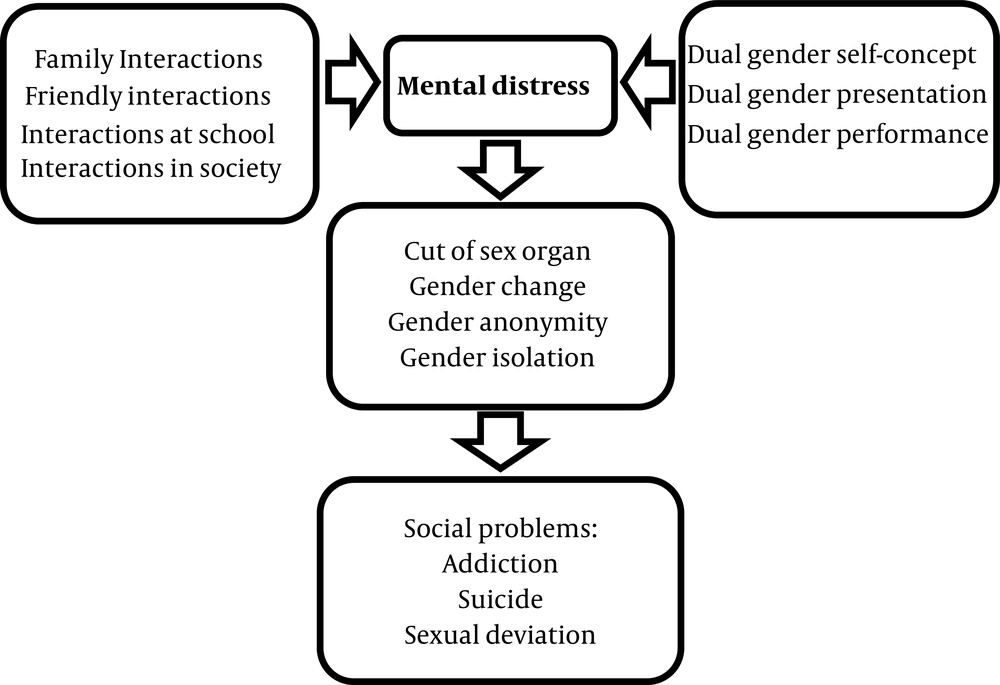
Figure 1.
Overview of themes
5. Discussion
The present study examined the psychological experiences of transgender from both gender and interactive dimensions. The results show that the main problem of the transgender is that, because of their biological conditions, they feel contradiction and duality in their identity, and are doubtful in identifying it. They do not have an appropriate understanding of their characteristics. As a result, transgender identity means the conflict in identity because transgender cannot easily respond to their gender questions. Transgender’s confusions in gender identity are along with the feeling of suffering, depression, and stress. Their psychological problems are doubled when a satisfying relationship with the family, friends, and others change to suspicion and negative judgments, labels, discrimination, and rejection. Lack of a supportive system, lack of social capital, biological and physical problems are all leading to weakening the mental health of the transgender. The disgrace, deprivation, rejection, and discrimination increase mental distress such as depression, frustration, anxiety, interpersonal sensitivity for the transgender, and worsen their internal suffering. The present research results are reminiscent of Meyer’s approach. He shows that discrimination, victimization, and stigma are important factors in mental distress among transgender (12). The researches by Valentine and Shipherd (10), Ho and Mussap (1), and Connolly, et al. (9) confirm to increase interpersonal sensitivity, anxiety, depression, and discrimination with psychological distress and risky sexual practices (13, 14).
In these conditions, the escape from the past is normal behavior among the transgender that they show to get back their lost trust and self-esteem. They believe that as long as they are connected with the past, they will not be able to complete their new lives. Hence the escape from the past is a strong desire in them. These difficulties gradually reduce the ability of such people to express themselves and adapt to the community and carry them to the margin. A number of deviant behaviors grow in them such as suicide, escape from home, and seeking out illegitimate sexual relations. This finding is in line with Czajkowski’s finding (15). He found that in different societies, classical values, biases, and clichés impose a prejudiced attitude to the transgender. Such prejudices prepare the grounds for many personal and social problems. Poteat et al. (7), and Grossman and D’Augelli’s studies (2) confirm this result. They found that the increase of dependence, reduction of self-esteem, reduced life quality and increased sense of vulnerability are the consequences of this disorder.
There are several reasons why transgender have more intense psychological distress. To describe this phenomenon, Butler used the term gender trouble. To her, the transition to another gender is a crisis in life (Butler, 2006). In her view, through imitation, the system of rewards and sanctions, and obedience of cultural and linguistic agreements, we learn to stylize our bodies and gestures, dress, walk, and talk to project ourselves as women or men. If the surface of transgender bodies exhibits the stereotyped traits of masculinity and femininity, their behavior is seen as expressing their authentic gendered selves. Since transgender is unable to adjust to the roles and functions of the accepted gender, the discrimination and abuse against them also occur. Hence, gender enforcement outside the heterosexual discourse norms will lead to the deprivation of social rights, punishment, and violence (Seidman, 2013).
5.1. Conclusions
In Iran, mainstream society does not accept others beyond the male-female gender norms. Those who live beyond this continuum judged by gender stereotypes and are subject to mental problems and deprivation of access to resources and social benefits. Therefore, it is suggested that the development of proper culture be moderated the inappropriate, deviated interpretations about transgender and replaced by more realistic attitudes. Education and media have a pivotal role in providing specific cultural values for the public. Educating the families and the society, and preparing media programs can be effective in changing the current attitudes and replacing them with more humane and moderate opinions about the identity of the transgender.