1. Introduction
Novel psychoactive substances, also known as designer drugs, impose a major health risk and an economic threat worldwide. The extent of this problem has escalated exponentially in the recent years because of the parallel and exponential growth of the information and communication technology, and the electronic commerce (e-commerce) phenomenon (1-3). The chemical substance 25b-NBOMe (Figure 1), also known as “N-Bomb” or “Smiles” signifying its high potency, is a phenethylamine derivative used for its “psychedelic” properties as a potent hallucinogen. It is a synthetic hallucinogenic compound; it belongs to the versatile spectra of novel psychoactive substances (NPS) (4). 25b-NBOMe is a serotonergic agonist via acting on the 5HT2A receptors located in the nervous system. The hallucinogenic effect can manifest at tiny doses of micrograms, as little as 250 - 500 µg. Therefore, this substance or similar substances has been either banned or controlled in many regions of the world (5-8). Two other related compounds (Figure 1), 25c-NBOMe and 25i-NBOMe, are even more potent and more popular worldwide (7, 8).
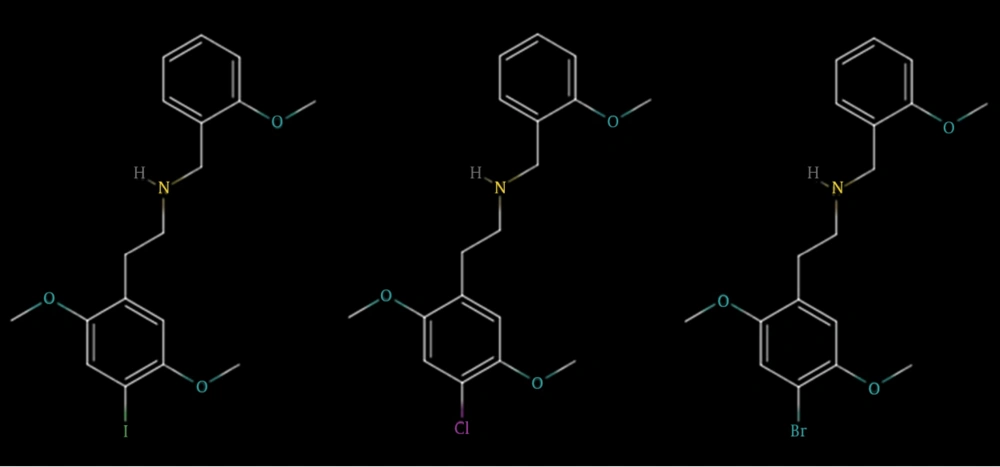
Figure 1.
The most popular variants of NBOMe variants: 25i (left), 25c (middle), and 25b (right). These compounds differ from each other in relation to the atomic position of the halogen (I, Br, and Cl).
Data from Google trends in the United Kingdom show a steady and persistent interest in 25b-NBOMe since 2010; there was also a sudden increment (spike) of interest occurring in October 2014. Comparable trends data showed a similar pattern worldwide. Another more potent and more popular related compound is 25I-NBOMe. This compound seems to be more popular on the internet (surface web) according to the data retrieved from Google trends (Figure 2). These three NBOMe compounds differ primarily from each other in their halogen (Bromine, Chlorine, and Iodine) atom included within its molecule.
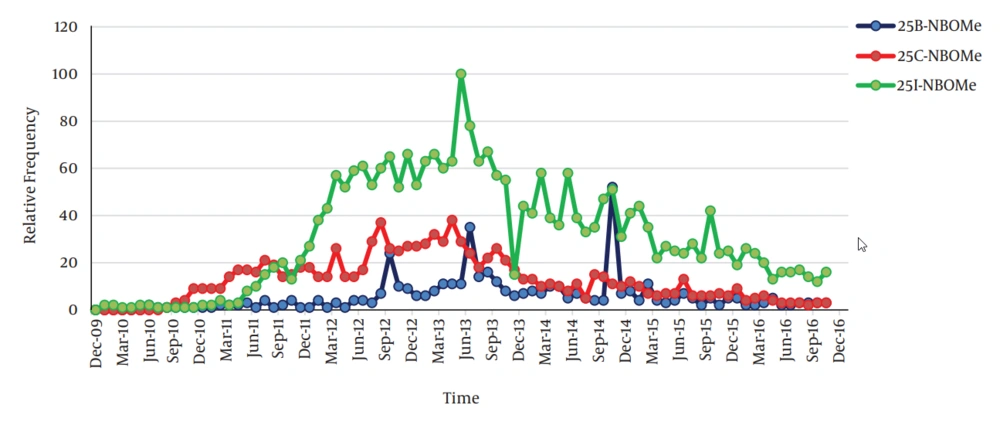
Figure 2.
Data from Google Trends (2009 - 2016): Popularity of NBOMe Products
Based on a literature review of case reports of interest (Table 1) on the PubMed/Medline database, NBOMe compounds seem to be used for recreational purposes, psychedelic/hallucinogenic experiences, and suicidal intentions (Suzuki et al., 2014); a couple of male-female ended in death (Walterscheid et al., 2014). The majority of users were males (84.6%), aged 15 to 23, although one victim of intoxication was a Chinese individual at the age of 31 years, representing a statistical outlier (Tang et al., 2014). The majority of NBOMe (ab) users were Caucasians from the United States (61.5%). Polypharmacy (poly-substance use) was calculated to be quite high (69.3%), and most cases ended in death (69.3%) despite receiving medical interventions. These fatalities were clustered in 2013, 2014, 2015, and 2016. The majority of these cases required admittance to emergency and intensive care units for life support, hydration, intubation and assisted ventilation. The less severe cases of intoxication were effectively managed using intravenous hydration, benzodiazepines (intravenous), anticholinergic agents, and other symptomatic and supportive measures (9-18).
Table 1.
NBOMe Intoxication and Fatality Incidents: Summary of Case Reports of Interest
| Date of Publication | Author | Age and Gender | Life Status (Outcome) | Country | Type of NBOMe |
|---|---|---|---|---|---|
| 2015 | Kueppers and Cooke | 23 F | Death | Australia | 25 I |
| 2013 | Rose et al. | 18 M | Intoxication | The US | 25 I |
| 2015 | Lowe et al. | 15 M | Death | The US | 25 I |
| 2014 | Suzuki et al. | 18 M | Potential suicide | The US | 25 I |
| 2016 | Byard et al. | 19 M | Death | Australia | 25 B |
| 2015 | Andreasen et al. | 22 M | Death | Denmark | 25 C |
| 2015 | Shanks et al. | 18 M | Death | The US | 25 B |
| 2014 | 16 M | The US | 25 I | ||
| 2014 | Walterscheid et al. | 21 M | Death | The US | 25 I |
| 2014 | 15 F | The US | 25 I | ||
| 2014 | Poklis et al. | 19 M | Death | The US | 25 I |
| 2014 | Tang et al. | 17 M | Intoxication | China | 25 B |
| 2014 | 31 M | Intoxication | 25 B, 25 C |
The literature review for this manuscript was carried out across medical and paramedical databases including PubMed, cochrane library, Scopus, Google Scholar, and unpublished (grey) literature. In compliance with the classification system imposed by the oxford centre for evidence-based medicine, this manuscript level-of-evidence is categorized to be level-4 (19).
2. Case Presentation
This case presentation revolves around an unfortunate young male, Mr. A E, a seventeen-year-old male. He was a healthy male and a high school student in his senior year. He had no health problems, no cardiovascular system, and no previous history of cardiac arrhythmias. He was neither hypercholesteremic nor possessed a related disturbance in the lipids profile or lipid metabolism. His physique was excellent, having a body mass index (BMI) of 19.4, which is perfect for his age. Furthermore, there was no family history of cardiovascular risks or diseases, no history of ischemic heart disease or cardiac arrhythmias. There was no prior history of sudden death within his family.
The patient is a known substance user of a variety of NPS, particularly psychostimulants and hallucinogens. He started experimenting with NPS as early as the age of fifteen with some family members (cousins) and friends. These “recreational” events used to take place in the home environment while his parents were away. Moreover, he experimented with a variety of amphetamines and amphetamine-type stimulants, including the renowned NPS known as Captagon (20). These substances were also taken together with the use of hookah, alcohol, and cigarettes. Other substances included methamphetamine, DMHA (octodrine), and 25c-NBOMe.
There was no previous incident of severe intoxication, apart from the “usual” psychedelic and the hallucinogenic experience, which was once described by him as “the clearest moments of my mind, I felt connected with the entire universe”. His parents were completely unaware of their son’s use of these substances. During one of the weekends in October 2014, he invited some friends while his parents were abroad; each one of them partied and took few (2-3) tablets of 25b-NBOMe sublingually. Within a half hour, he started to experience the hallucinogenic effects, and within few hours, his condition was described by his friends as “different from the usual”. They did not call for the medical emergency personnel for it yet, thinking that it was a transient state. Some moments passed, approximately an hour, and he started to have some convulsive episodes that alarmed his friends. He became pale and cyanosed; at this time his friends decided to call for an ambulance, which arrived within few minutes to their location. It is imperative to correlate this case of death with a peaked popularity of 25b-NBOMe during October-2014. Data from Google Trends has revealed that the relative interest of internet users in 25b-NBOMe has reached its highest popularity worldwide, and for the entire period from 2009 to 2016 (Figure 2).
The paramedics found him unresponsive, and they attempted to resuscitate him using basic life support techniques in parallel with advanced cardiac life support (ACLS) protocols. His electrocardiograph (ECG) revealed the presence of various arrhythmias. Despite the dedicated professional resuscitation efforts using ACLS and cardiac defibrillation, these arrhythmias eventually propagated towards ventricular fibrillation (VF), which led to a cardiac arrest. He was later declared dead inside the ambulance and before the arrival to the emergency unit of the nearby hospital. The cause of death, based on the forensic pathologist and toxicology report, was attributed to cardiac arrest. Toxicology analysis revealed that the concentration of 25b-NBOMe detected in postmortem cardiac blood was 3.14 ng/mL.
3. Discussion
The phenethylamine derivative known as 25b-NBOMe is a dangerous hallucinogen. In the published medical literature, there have been some similar reported cases of intoxication. The majority of NBOMe victims were from the developed world, particularly the United States, United Kingdom, Australia, Canada, and Europe. There is a significant paucity of data on the substance spread and use and in the developing world.
This case occurred in an individual who has been habitually exposed, in retrospect, to this substance for dozens of times. However, it ended up with an unfortunate and tragic death. Hence, it is vital to study this substance in detail, including its chemical characterization, pharmacodynamics and pharmacokinetics, the metabolic pathways inside the body, and idiosyncratic reactions. To date, there has been no medicinal use of this substance worldwide due to its high potency and toxicity.
This case is unique in relation to the 25b-NBOMe substance abuse by this young man; there have been no prior episodes of intoxication or severe adverse reactions including allergic ones. It can be assumed that the cause of death can be either as a result of an idiosyncratic reaction or due to the presence of certain undisclosed miscellaneous chemicals or contaminants other than this phenethylamine derivative, or an improperly labeled dose of these taken street-designed tablets. These “medicinal” psychostimulants are synthesized illicitly, hence named street drugs or designer drugs.
It is very critical to study the pharmacologic properties of 25b-NBOMe, including its pharmacodynamics and pharmacokinetics. Chemical characterization of 25b-NBOMe from different street “designers” is vital to reach a certain and comparative chemical profile (signature) of the substance itself and associated potential miscellaneous ingredients and contaminants, the postulation of the central mechanism of action, and effects on the vasomotor center and the cardiac tissues. Furthermore, there should be the identification of the potential sporadic idiosyncratic reactions among different individuals across different age groups, sex, and ethnicities. These analytic studies can be done via chromatography, spectrometry, and receptor-ligand binding assays. Additionally, it is vital and critical to raising the awareness, in the media and on the internet, about the hazards and these sudden death incidents among the population.
Needless to say, the use of parallel data from trends’ database predicted a possible rise in interest of internet users in these substances. These trends databases can be analyzed using statistical and data-crunching methods. Data mining of trends’ data in collaboration with information technology specialists will mark a promising milestone in the field of NPS phenomenon by creating an efficient and early warning system for this purpose.