A Fourteen-day Experience with Coronavirus Disease 2019 (COVID-19) Induced Acute Respiratory Distress Syndrome (ARDS): An Iranian Treatment Protocol

Author(s):
Hamidreza JamaatiHamidreza Jamaatia, Farzaneh DastanFarzaneh Dastana, b,*, Payam TabarsiPayam Tabarsic, Majid MarjaniMajid Marjanic, Ali SaffaeiAli Saffaeid, Seyed MohammadReza HashemianSeyed MohammadReza Hashemiana,*
aChronic Respiratory Diseases Research Center, National Research Institute of Tuberculosis and Lung Diseases (NRITLD), Shahid Beheshti University of Medical Sciences, Tehran, Iran.
bDepartment of Clinical Pharmacy, School of Pharmacy, Shahid Beheshti University of Medical Sciences, Tehran, Iran.
cClinical Tuberculosis and Epidemiology Research Center, National Research Institute of Tuberculosis and Lung Diseases (NRITLD), Masih Daneshvari Hospital, Shahid Beheshti University of Medical Sciences, Tehran, Iran.
dStudent Research Committee, Department of Clinical Pharmacy, School of Pharmacy, Shahid Beheshti University of Medical Sciences, Tehran, Iran.
Corresponding Authors:

IJ Pharmaceutical Research:Vol. 19, issue 1; 31-36
Published online:Jan 31, 2020
Article type:Original Article
Received:Feb 29, 2020
Accepted:Feb 29, 2020
How to Cite:Jamaati H, Dastan F, Tabarsi P, Marjani M, Saffaei A, et al. A Fourteen-day Experience with Coronavirus Disease 2019 (COVID-19) Induced Acute Respiratory Distress Syndrome (ARDS): An Iranian Treatment Protocol. Iran J Pharm Res. 2020;19(1):e124431. doi: https://doi.org/10.22037/ijpr.2020.113337.14239

Abstract

Introduction

In December 2019, the city of Wuhan in Hubei Province, China, became the center of an outbreak of pneumonia of unknown cause. On January 7, 2020, the Chinese health officials confirmed the identification of a novel coronavirus (COVID-19). COVID-19 from Wuhan in China is currently causing concern in the medical community as the virus is spreading around the world. So far, 102,242 cases of COVID-19 have been clinically confirmed and 3,497 deaths have occurred till March 7, 2020. COVID-19 has a significant burden worldwide as a pandemic disease. The clinical presentation of COVID-19 pneumonia may present from mild to severe illness including Acute Respiratory Distress Syndrome (ARDS). Remarkably, the critically ill patients with COVID-19 are more likely to develop ARDS regarding the cytokine cascade activation over a short period of time (1, 2). The most common complication is ARDS, which is seen in the COVID-19 patients with high mortality rates.

Experimental

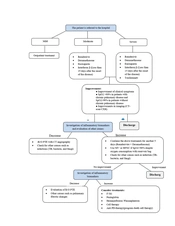
On February 19, 2020, Iran reported its first confirmed cases of COVID-19 and Dr. Masih Daneshvari Hospital was selected as a referral center for COVID-19 cases. The hospital was equipped with a special set-up to admit COVID-19 cases. On February 20, 2020, seven patients were admitted to the hospital with the confirmed COVID-19. In the first 30 h, four cases COVID-19 who were referred from the other hospitals and admitted in the intensive care unit (ICU) died due to severe ARDS. Because of the rapid progression of ARDS, an expert panel was held on 22 February 2020, consisting of all intensivists, infectious disease specialists, pulmonologists, internal medicine specialist, cardiology specialist, and clinical pharmacy specialist. Finally, an internal protocol was developed to manage the COVID-19 induced ARDS according to WHO recommendations and NIH guidelines (3). Different therapeutic regimens were employed on this protocol based on the ARDS severity and the patients’ special characteristics. This protocol is shown in Figure 1.
Of the 231 suspected cases of COVID-19 admitted to the hospital during two weeks, 72 patients were admitted to ICU with diagnosis confirmed by RT-PCR. In total, mortality in the ICU was 25% (n = 18) among ARDS patients over two weeks (Table 1).
Twenty-four patients recovered and were transferred to the ward. Thirty patients were under treatment in ICU. Totally, 29 patients expired during two weeks including 18 cases in ICU. The timeline of two-week events is depicted in Figure 2.
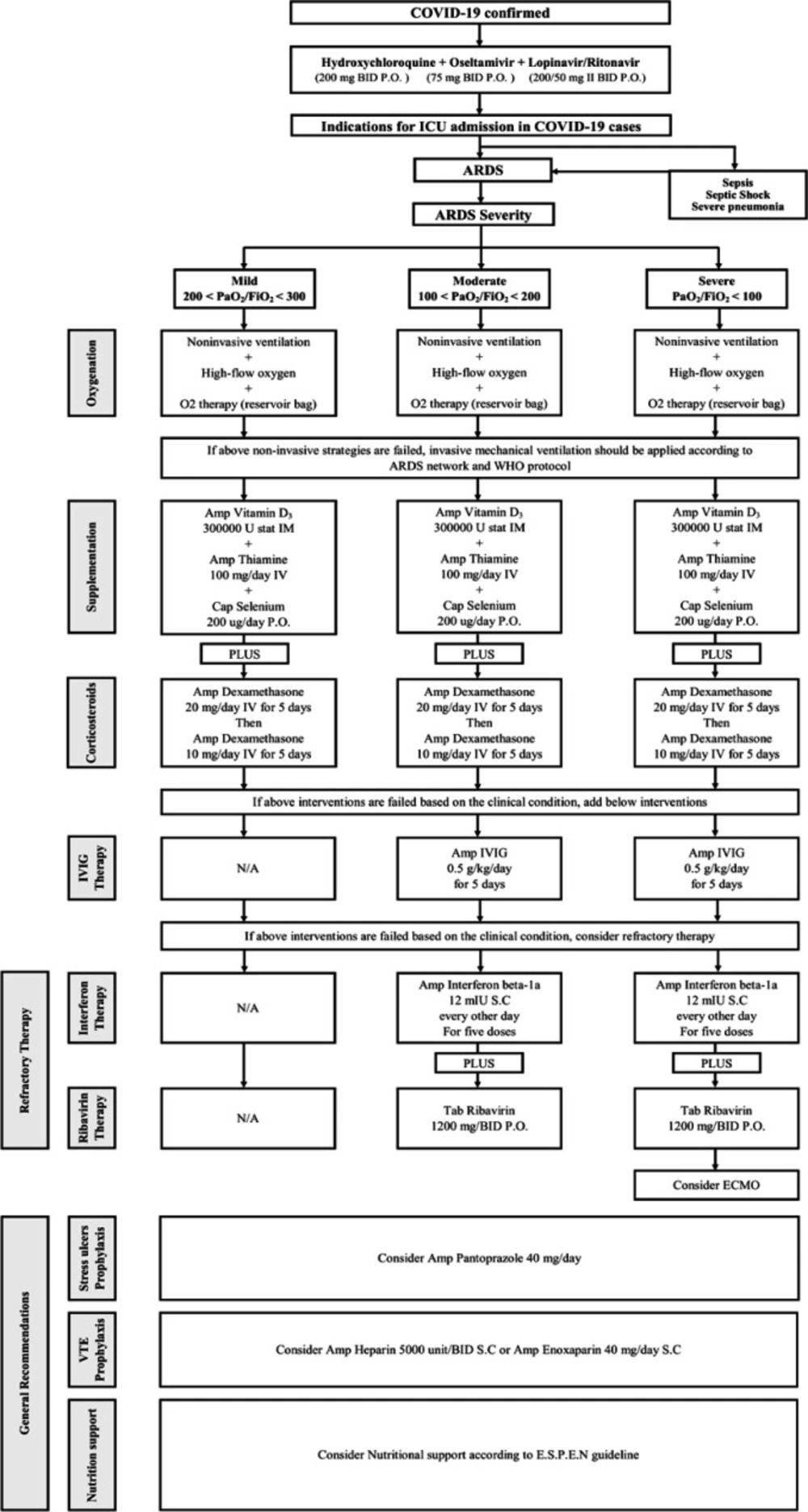
Treatment protocol of COVID-19 induced rapid acute respiratory distress syndrome. ARDS: Acute Respiratory Distress Syndrome; ECMO: Extracorporeal Membrane Oxygenation; IVIG: Intravenous immunoglobulin; VTE: Venous Thromboembolism; WHO: World Health Organization
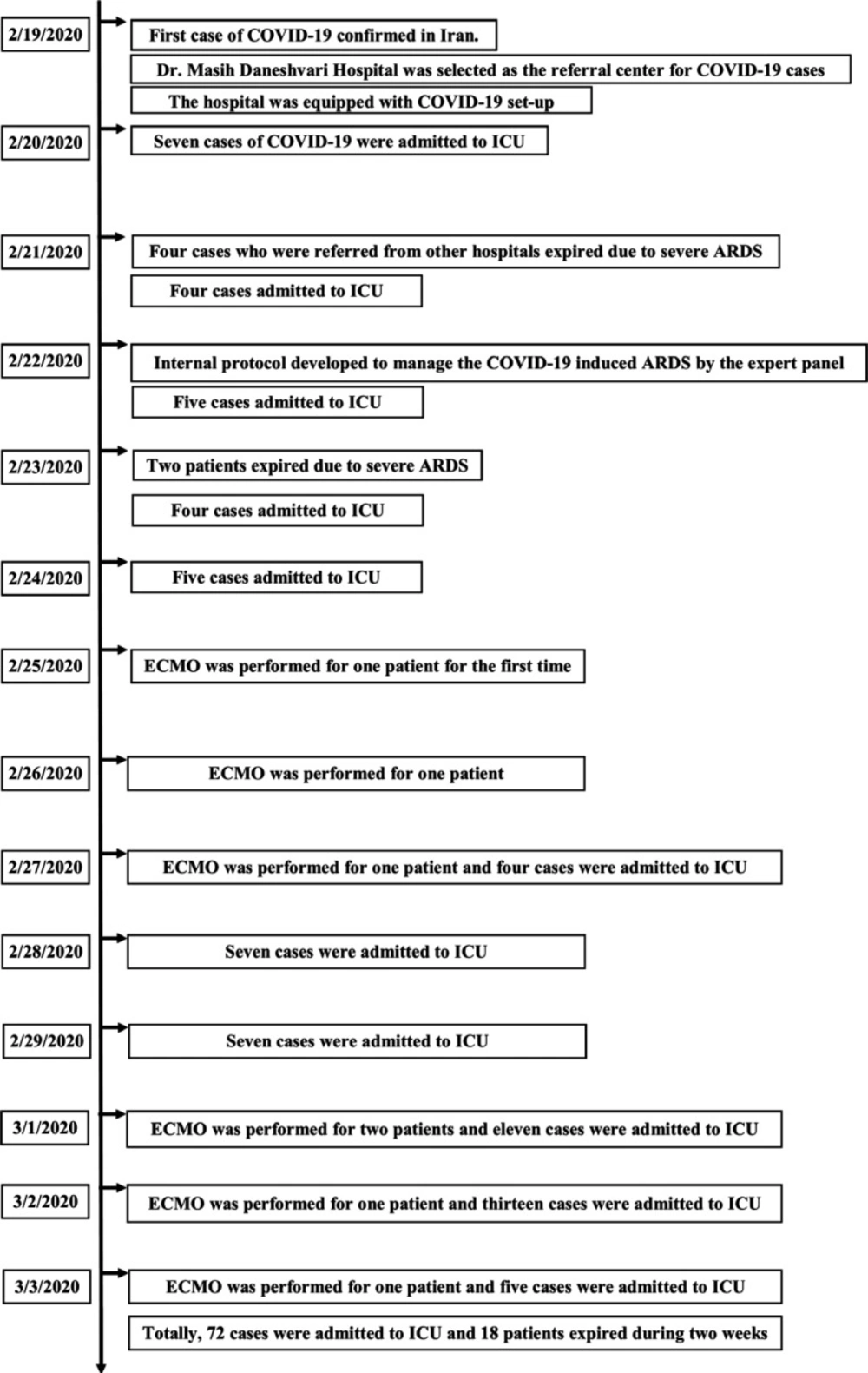
Figure 1

Treatment protocol of COVID-19 induced rapid acute respiratory distress syndrome. ARDS: Acute Respiratory Distress Syndrome; ECMO: Extracorporeal Membrane Oxygenation; IVIG: Intravenous immunoglobulin; VTE: Venous Thromboembolism; WHO: World Health Organization

The timeline of two-week events in Dr. Masih Daneshvari Hospital
Figure 2

The timeline of two-week events in Dr. Masih Daneshvari Hospital

Table1Fourteen days mortality at a glance
Non-Survivor (%)Survivor (%)Number (%)Group
3 (16.7)18 (33.3)21 (29.2)Mild ARDS
4 (22.2)31 (57.4)35 (48.6)Moderate ARDS
11 (61.1)5 (9.3)16 (22.2)Severe ARDS
18 (100)54 (100)72 (100)Total

Results and Discussion

Protocol Recommendations
The patients’ vital signs, CBC, serum creatinine, urea, urine output, CRP, LFT, bilirubin, coagulation parameters, ABG, and regular chest imaging must be closely monitored.
All of the patients were administered hydroxychloroquine, oseltamivir, and lopinavir-ritonavir before admission to ICU based on the Ministry of Health protocol and recent data regarding COVID-19 treatment (4, 5).
Oxygenation
Oxygen therapy, non-invasive ventilation or invasive mechanical ventilation are considered based on O2 saturation according to the WHO recommendations and NIH guidelines. The patients were categorized into three groups based on PiO2/FiO2. According to Berlin criteria, mild, moderate, and severe ADRS are defined as PiO2/FiO2 between 200 and 300, 100 and 200, and less than 100, respectively. Invasive mechanical ventilation should be applied to ARDS patients with persistent hypoxemia.
Supplementation
We recommend the administration of vitamin D3, thiamine, and selenium in the ARDS patients according to our protocol. Vitamin D deficiency is associated with greater cellular inflammation and cytokine release at 48 h after ARDS development. Thiamine deficiency is also a risk factor for ARDS development based on several published trials, whereas selenium has a beneficial role in oxidative stress pathways.
Steroid therapy
As we have faced with the rapid progression of ARDS in our cases, the administration of corticosteroid is recommended for all our patients to inhibit the inflammation process in ARDS. High doses of dexamethasone as 20 mg daily from day 1 to 5, then 10 mg daily from day 6 to 10 were administered in all stages of ARDS, even in the mild cases. This approach was applied based on the study done by Villar et al. and the rapid progression of ARDS in our cases in order not to lose the time (6).
Immunoglobulin Therapy
IVIG is administered in the cases that failed with the above strategies. IVIG has controversial effects on the patients with respiratory coronavirus. IVIG is applied to treat some diseases, especially primary immune deficiencies, autoimmune neuromuscular disorders, and respiratory failure regarding sepsis. It is considered as an effective agent in the cases of coronavirus associated fulminant myocarditis (7, 8).
Interferon beta-1a and Ribavirin Combination
Combination therapy with interferon Beta-1a and ribavirin in all refractory cases is administered based on data regarding coronavirus treatment and Ebola experiences.
Extracorporeal membrane oxygenation (ECMO) and Refractory Therapy
ECMO is a specialized, resource-intensive, and expensive form of life support. However, it is associated with severe complications including nosocomial infection and hemorrhage. ECMO can serve as a life-saving rescue therapy for refractory respiratory failure in the setting of ARDS, such as that induced by coronavirus disease 2019 (COVID-19) (9).
Other therapies
Stress ulcer prophylaxis, venous thromboembolism prophylaxis, and nutrition management are applied to all of the patients.
References

  • 1.
    Chen N, Zhou M, Dong X, Qu J, Gong F, Han Y, Qiu Y, Wang J, Liu Y, Wei Y, Xia J, Yu T, Zhang X, Zhang L. Epidemiological and clinical characteristics of 99 cases of 2019 novel coronavirus pneumonia in Wuhan, China: a descriptive study. Lancet. 2020;395:507-13. [PubMed ID: 32007143].
  • 2.
    Bellani G, Laffey JG, Pham T, Fan E, Brochard L, Esteban A, Gattinoni L, van Haren F, Larsson A, McAuley DF, Ranieri M, Rubenfeld G, Thompson BT, Wrigge H, Slutsky AS, Pesenti A, Investigators ftLS, Group tET. Epidemiology, patterns of care, and mortality for patients with acute respiratory distress syndrome in intensive care units in 50 countries. JAMA. 2016;315:788-800. [PubMed ID: 26903337].
  • 4.
    Colson P, Rolain JM, Lagier JC, Brouqui P, Raoult D. Chloroquine and hydroxychloroquine as available weapons to fight COVID-19. Int. J. Antimicrob. Agents. 2020;2020:105932.
  • 5.
    Sahraei Z, Shabani M, Shokouhi S, Saffaei A. Aminoquinolines against Coronavirus disease 2019 (COVID-19): chloroquine or hydroxychloroquine. Int. J. Antimicrob. Agents. 2020;2020:105945.
  • 6.
    Villar J, Ferrando C, Martínez D, Ambrós A, Muñoz T, Soler JA, Aguilar G, Alba F, González-Higueras E, Conesa LA, Martín-Rodríguez C, Díaz-Domínguez FJ, Serna-Grande P, Rivas R, Ferreres J, Belda J, Capilla L, Tallet A, Añón JM, Fernández RL, González-Martín JM, Aguilar G, Alba F, Álvarez J, Ambrós A, Añón JM, Asensio MJ, Belda J, Blanco J, Blasco M, Cachafeiro L, del Campo R, Capilla L, Carbonell JA, Carbonell N, Cariñena A, Carriedo D, Chico M, Conesa LA, Corpas R, Cuervo J, Díaz-Domínguez FJ, Domínguez-Antelo C, Fernández L, Fernández RL, Ferrando C, Ferreres J, Gamboa E, González-Higueras E, González-Luengo RI, González-Martín JM, Martínez D, Martín-Rodríguez C, Muñoz T, Ortiz Díaz-Miguel R, Pérez-González R, Prieto AM, Prieto I, Rivas R, Rojas-Viguera L, Romera MA, Sánchez-Ballesteros J, Segura JM, Serna-Grande P, Serrano A, Solano R, Soler JA, Soro M, Tallet A, Villar J. Dexamethasone treatment for the acute respiratory distress syndrome: a multicentre, randomised controlled trial. Lancet Respir. Med. 2020;8:267-76. [PubMed ID: 32043986].
  • 7.
    Lee KY. Pneumonia, acute respiratory distress syndrome, and early immune-modulator therapy. Int. J. Mol. Sci. 2017;18:E388. [PubMed ID: 28208675].
  • 8.
    Pyrc K, Bosch BJ, Berkhout B, Jebbink MF, Dijkman R, Rottier P, van der Hoek L. Inhibition of human coronavirus NL63 infection at early stages of the replication cycle. Antimicrob. Agents Chemother. 2006;50:2000-8. [PubMed ID: 16723558].
  • 9.
    Henry BM. COVID-19, ECMO, and lymphopenia: a word of caution. Lancet Respir. Med. 2020;2020:1.

Similar Articles

3
Mar
2021

COVID-19 Treatment in Medan, Indonesia: A Case Report

Wulan Fadinie

Fadinie W. COVID-19 Treatment in Medan, Indonesia: A Case Report. J Cell Mol Anesth. 2021;6(2):e150290. doi: https://doi.org/10.22037/jcma.v6i2.33927

10
Jun
2020

Management of Critically Ill Patients with COVID-19: What We Learned and What We Do

Ata Mahmoodpoor,
Kamran Shadvar,
Ali Akbar Ghamari,
Mojtaba Mohammadzadeh Lameh,
Roghayeh Asghari Ardebili,
Masood Hamidi
,et al.

Mahmoodpoor A, Shadvar K, Ghamari AA, Mohammadzadeh Lameh M, Asghari Ardebili R, et al. Management of Critically Ill Patients with COVID-19: What We Learned and What We Do. Anesth Pain Med. 2020;10(3):e104900. doi: https://doi.org/10.5812/aapm.104900

31
Jul
2020

Approaches for the Treatment of SARS-CoV-2 Infection: A Pharmacologic View and Literature Review

Hajar Mohammadi Barzelighi,
Bahram Daraei,
Farzaneh Dastan

Mohammadi Barzelighi H, Daraei B, Dastan F. Approaches for the Treatment of SARS-CoV-2 Infection: A Pharmacologic View and Literature Review. Iran J Pharm Res. 2020;19(3):e124629. doi: https://doi.org/10.22037/ijpr.2020.113821.14506

30
Mar
2022
Iran J Pharm Res

National Research Institute of Tuberculosis and Lung Disease (NRITLD) Protocol for the Treatment of Patients with COVID-19

Maryam Sadat Mirenayat,
Atefeh Abedini,
Arda Kiani,
Alireza Eslaminejad,
Parisa Adimi naghan,
Majid Malekmohammad
,et al.

Mirenayat MS, Abedini A, Kiani A, Eslaminejad A, Adimi naghan P, et al. National Research Institute of Tuberculosis and Lung Disease (NRITLD) Protocol for the Treatment of Patients with COVID-19. Iran J Pharm Res. 2022;21(1):e123947. doi: https://doi.org/10.5812/ijpr.123947

9
Jul
2021

Invasive Airway "Intubation" in COVID-19 Patients; Statistics, Causes, and Recommendations: A Review Article

Mostafa Mohammadi,
Alireza Khafaee Pour Khamseh,
Hesam Aldin Varpaei

Mohammadi M, Khafaee Pour Khamseh A, Varpaei HA. Invasive Airway "Intubation" in COVID-19 Patients; Statistics, Causes, and Recommendations: A Review Article. Anesth Pain Med. 2021;11(3):e115868. doi: https://doi.org/10.5812/aapm.115868


Crossmark
Crossmark
Checking
Share on
Cited by
Metrics

Ordering Reprints

Articles are published under the Creative Commons license stated on each article. No permission or royalty fee is required for uses permitted by that license. CCC handles optional bulk and customized reprint orders. Any quotation covers production and delivery services only, not copyright permission. > Request Reprints from CCC 

Search Relations

Author(s):

Related Articles