
1. Background
Radiopharmaceuticals have become indispensable tools in modern nuclear medicine, enabling both noninvasive diagnostic imaging and targeted radionuclide therapy. Among therapeutic strategies, bone-targeting agents have attracted particular attention because skeletal metastases are common in cancers such as prostate and breast carcinoma. In this context, bisphosphonates represent a well-established class of compounds with strong affinity for hydroxyapatite in bone tissue, enabling selective localization in areas of high bone turnover. Their chemical structure, characterized by a P-C-P backbone, provides excellent chelation capability for radiometals, making them suitable candidates for developing bone-seeking radiopharmaceuticals (1, 2).
Although technetium-99m (99mTc) remains the radionuclide of choice for single-photon emission computed tomography imaging, there is increasing interest in therapeutic radionuclides that can be paired with diagnostic isotopes in theranostic strategies (3-5).
Radiolabeled bisphosphonates have been extensively investigated for both imaging and therapy. Complexes labeled with 99mTc have long been used in bone scintigraphy, whereas therapeutic radionuclides such as rhenium-186 (186Re) and 188Re have shown promising results for palliating bone pain associated with metastatic disease. Among these radionuclides, 188Re is particularly attractive because of its high β- energy (Eβmax ≈ 2.12 MeV), which enables effective tumor cell killing, and its simultaneous γ emission (155 keV), which allows imaging and dosimetric evaluation.
Despite these advantages, the development of stable and efficient rhenium-based radiopharmaceuticals remains challenging. Rhenium chemistry is more complex than technetium chemistry because of its multiple accessible oxidation states and relative resistance to reduction. Therefore, robust chelating systems capable of stabilizing rhenium in lower oxidation states are essential. Although bisphosphonates are effective for bone targeting, they may not always provide optimal coordination environments for rhenium, necessitating the incorporation of additional donor groups or hybrid ligand systems (6). In addition, 188Re is readily available from a long-lived tungsten-188/rhenium-188 (188W/188Re) generator system, offering logistical advantages similar to those of the widely used molybdenum-99/technetium-99m (99Mo/99mTc) generator (5).
The chemistry of rhenium closely resembles that of technetium; however, rhenium is generally more resistant to reduction and requires carefully optimized labeling conditions to achieve stable complex formation (7, 8). Therefore, the design of appropriate chelators is critical for successful radiolabeling and in vivo stability. Chelators containing soft donor atoms, such as sulfur and nitrogen, have demonstrated strong affinity for rhenium in low oxidation states (9).
In recent years, sulfur-containing ligands have emerged as promising candidates for rhenium coordination chemistry. Xanthate-based ligands are characterized by a strong metal-binding ability through sulfur donor atoms, which have high affinity for soft metal centers such as reduced rhenium species. These ligands have been widely studied in coordination chemistry and have demonstrated the ability to form stable complexes with transition metals. Their structural versatility also allows functional modification and the introduction of additional donor atoms, such as nitrogen and oxygen, to enhance chelation strength and kinetic stability.
Combining xanthate moieties with other functional groups offers a strategic approach to designing multifunctional ligands for radiopharmaceutical applications. By integrating nitrogen and oxygen donor atoms into a sulfur-rich framework, chelators can be created that form highly stable complexes with rhenium while maintaining favorable pharmacokinetic properties. Such hybrid systems may also be adapted for conjugation with biologically active molecules, including bisphosphonates, to achieve targeted delivery to specific tissues such as bone.
In this context, the development of novel ligands that combine the strong metal-binding properties of xanthates with additional coordinating functionalities represents a promising direction in radiopharmaceutical chemistry. The MAX ligand investigated in this study was designed to provide a multidentate coordination environment incorporating sulfur, nitrogen, and oxygen donor atoms. This structural arrangement is expected to enhance complex stability with 188Re and improve radiolabeling efficiency under mild conditions (10).
Bisphosphonates such as alendronate exhibit strong binding affinity for calcium-rich hydroxyapatite surfaces in bone and are widely used for targeting skeletal metastases. In radiopharmaceutical chemistry, bifunctional approaches that combine a radiometal chelator with a bisphosphonate group have attracted attention for theranostic applications. Alendronate was selected as a representative bisphosphonate model because of its strong affinity for hydroxyapatite crystals in bone tissue and its extensive use in skeletal-targeting applications. The phosphonate functional groups of alendronate provide high mineral-binding capability, making it suitable for investigation as a potential carrier for therapeutic radionuclides.
2. Objectives
In the present work, the synthesized MAX ligand was first radiolabeled with 188Re and subsequently associated with alendronate to investigate the feasibility of forming a bone-seeking therapeutic complex (11). By examining the coordination behavior of this novel ligand system, the study contributes to the ongoing development of effective and versatile radiopharmaceutical platforms for therapeutic and theranostic applications, with potential future integration into bone-targeting strategies involving bisphosphonate conjugates.
3. Methods
3.1. Materials
Chloroacetamide, carbon disulfide (CS2), potassium hydroxide, ethanol, methanol, stannous chloride dihydrate (SnCl2·2H2O), ascorbic acid, and all solvents were of analytical grade and were used without further purification. Alendronate sodium trihydrate, a clinically established nitrogen-containing bisphosphonate, was used as the bone-targeting moiety in this study. This compound was obtained in analytical-grade purity from a commercial pharmaceutical supplier and used without further purification. Sodium perrhenate (188ReO4-) was obtained by eluting a 188W/188Re generator with sterile normal saline from PARS-Isotope Company of Iran (12). The activity of 188ReO4- was measured using a dose calibrator (Isomed, Germany) and was 500 - 600 mCi.
Ultraviolet (UV) spectra of the compounds were obtained using a Varian Cary 3 spectrometer. Radiochromatographic analysis was performed using silica gel ITLC chromatography paper from Agilent Technologies (United States). NMR analysis was performed using a Bruker DRX-300 MHz NMR spectrometer, and FTIR analysis was performed using a VECTOR 22 FTIR spectrometer.
The experiment was performed in 2 stages. In the first stage, the procedure was conducted with natural rhenium to assess the initial amounts of materials. In the second stage, the procedure was continued with 188Re. In the first stage, the amounts of chemical materials were selected as follows: ascorbic acid, 3 - 5 mg; SnCl2, 1 - 4 mg; alendronate, 5 - 25 mg; MAX, 2 - 7 mg; and pH, 4 - 6. The reaction temperature was selected between room temperature and 100°C.
3.2. Synthesis of Xanthate Intermediate
The xanthate compound was prepared as previously reported (13). Briefly, 100 g of KOH was added to a flask, and 300 mL of methanol at 65°C was added dropwise. After dissolution was complete, the reaction temperature was adjusted to 30°C, and 100 mL of CS2 was added. The formation of potassium xanthate was indicated by the appearance of a yellow precipitate, which was filtered, washed with cold methanol, recrystallized, and dried under vacuum (14). Potassium xanthate salt (1) was obtained as yellow crystals with a yield of 94%. The resulting material was crystallized from diethyl ether and hot ethanol and dried under a UV lamp for 1 day. Yellow crystals with a melting point of 224 - 226°C were formed.
3.3. Synthesis of Methoxy Amido Xanthate
The MAX ligand was synthesized by reacting the prepared xanthate intermediate with chloroacetamide in an aqueous medium. The reaction mixture was stirred under mild heating and monitored by thin-layer chromatography. Upon completion, the product was extracted with dichloromethane, dried over anhydrous sodium sulfate, and purified to obtain a white crystalline solid.
3.4. Ligand Characterization
Fourier-transform infrared spectroscopy was used to confirm the presence of characteristic functional groups, including amide (C=O) and xanthate (C=S) vibrations. Structural confirmation was further achieved using 1H and 13C NMR spectroscopy (14). At this step, UV spectroscopy was also performed to evaluate the labeling process.
3.5. Radiolabeling with 188Re
Radiolabeling was performed by adding generator-eluted sodium perrhenate (188ReO4-) to an aqueous solution of the MAX ligand. Stannous chloride was used as the reducing agent to convert rhenium to a lower oxidation state suitable for chelation. In selected experiments, ascorbic acid was added as a radiolytic stabilizer. The reaction mixture was incubated at 100°C for 20 - 30 minutes (8).
3.6. Association of 188Re-MAX With Alendronate
After radiolabeling the MAX ligand with 188Re, alendronate sodium was added as a bone-targeting bisphosphonate component. Different amounts of alendronate (5 - 25 mg) were evaluated to optimize complex formation and radiochemical stability. The reaction mixture was incubated at 100°C for 15 - 20 minutes under gentle stirring.
3.7. Optimization of Labeling Parameters
The effects of ligand concentration, pH (4-8), the amount of reducing agent, and the presence of ascorbic acid on labeling efficiency were systematically evaluated. Optimal conditions were defined as those yielding maximum radiochemical purity with minimal formation of free perrhenate or reduced hydrolyzed rhenium species (8).
3.8. Radiochemical Purity Assessment
Radiochemical purity was determined using ITLC-SG. Two mobile phases, acetone and saline, were used to separate free 188ReO4-, colloidal rhenium, and the 188Re-MAX complex. The radioactivity distribution was measured using a gamma counter, and radiochemical purity was expressed as a percentage of total activity.
4. Results
4.1. Ligand Characterization
The MAX ligand was prepared by reacting chloroacetamide with xanthate in water as the solvent. White crystalline precipitates with a melting point of 118 - 120°C were formed. The ligand contains oxygen, sulfur, and nitrogen atoms as lone-pair donor atoms. Its schematic representation is presented in Figure 1.

Figure 1.
Schematic of the synthesis and structure of methoxy amido xanthate
The FTIR spectrum is shown in Figure 2A. The peak observed in the 2800 - 2900 cm-1 region was attributed to C-H stretching vibrations. The strong peak at 1650 cm-1 was attributed to the C=O stretching vibration of the amide group. Absorption peaks at 1100 cm-1 and 750 cm-1 corresponded to the asymmetric and symmetric stretching vibrations of CS2, respectively. The peak related to free amine functional groups (NH2) appeared at 3350 cm-1. In addition, the peak corresponding to C-N bond vibrations appeared at 1250 cm-1. These peaks indicate the successful synthesis of the MAX chelator.
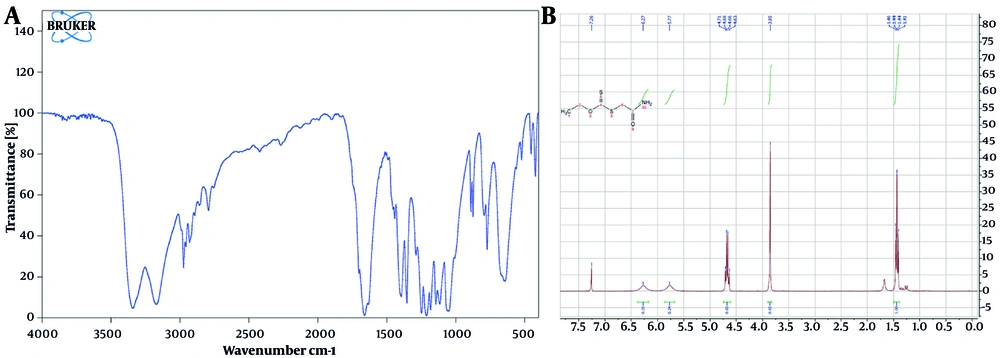
Figure 2.
A, FTIR spectra of the synthesized MAX; B, NMR spectra of the synthesized MAX
The NMR spectrum is shown in Figure 2B. The peak at 1.44 ppm corresponded to the CH3 group connected to CH2. The peak at 3.85 ppm corresponded to CH2 bound to sulfur. Peaks at 5.77 and 6.27 ppm were related to the hydrogens of the NH2 group. In addition, the peak at 4.66 ppm was related to CH2 connected to CH3, and the peak at 7.26 ppm was related to the CDCl3 solvent. The NMR peaks confirmed the synthesis of the MAX chelating molecule (15).
4.2. Optimization of 188Re Labeling
Radiolabeling efficiency was strongly influenced by pH and reducing-agent concentration. Maximum labeling yields (> 90%) were achieved at pH 5 - 6, consistent with previously reported rhenium-based systems (6, 8). At lower pH values, protonation of donor atoms reduced chelation efficiency, whereas higher pH values promoted hydrolysis of reduced rhenium species.
Different alendronate amounts, ranging from 5 to 25 mg, were investigated to optimize the secondary association step with the 188Re-MAX complex. At low amounts (5 mg), incomplete association and lower radiochemical stability were observed. Increasing the alendronate amount improved radiochemical performance, with the best results obtained at approximately 8 mg, at which radiochemical purity exceeded 90%. Further increases above 10 mg did not significantly improve labeling efficiency and slightly reduced reproducibility in some experiments, possibly because of excess phosphonate competition or changes in solution composition. Therefore, 8 mg was selected as the optimal amount for subsequent experiments. The addition of ascorbic acid significantly enhanced radiochemical stability by reducing radiolysis, particularly at higher activity levels (16).
At this stage, alendronate labeling was also performed. After MAX synthesis and 188Re labeling, different amounts of alendronate, ranging from 5 mg to 20 mg, were added to 188Re-MAX (12 mg MAX + 80 - 100 mCi 188Re) to adjust the alendronate amount and achieve 96% radiochemical purity. The optimal amount was 8 mg of alendronate.
Reaction parameters, including ascorbic acid, SnCl2, pH, temperature, and alendronate, were evaluated by ITLC. The results are shown in Table 1.
Table 1.
Effect of Ascorbic Acid, SnCl2, pH, Temperature, and Alendronate on Radiochemical Purity (80 - 100 mCi 188Re; N = 3)
| MAX (mg) | Ascorbic acid (mg) | SnCl2 (mg) | pH | Alendronate (mg) | Temperature (°C) | Radiochemical purity | No. |
|---|---|---|---|---|---|---|---|
| 4 | 3 | 3 | 4 | 5 | Room temperature | 10 ± 1% | 3 |
| 6 | 4 | 4 | 4 | 10 | Room temperature | 10 ± 2% | 3 |
| 6 | 3 | 4 | 4 | 5 | 100 | 50 ± 1.2% | 3 |
| 10 | 5 | 4 | 5 | 20 | 100 | 40 ± 2% | 3 |
| 12 | 4 | 6 | 5 | 10 | 100 | 80 ± 3% | 3 |
| 12 | 4 | 6 | 5 - 6 | 8 | 100 | 95 - 96 ± 0.6% | 3 |
The expected interaction mechanism is based on coordination and electrostatic association between the reduced 188Re-MAX core and the phosphonate-containing alendronate molecule. Because of the multidentate nature of bisphosphonates, the final product may consist of a ternary-associated complex and/or partially transchelated rhenium species.
4.3. UV Spectroscopy
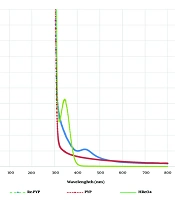
The UV-visible spectra are presented in Figures 3 and 4. Figure 3 shows the absorption spectra of natural ReO4-, MAX, alendronate, MAX + alendronate, and the complex at 4 hours.
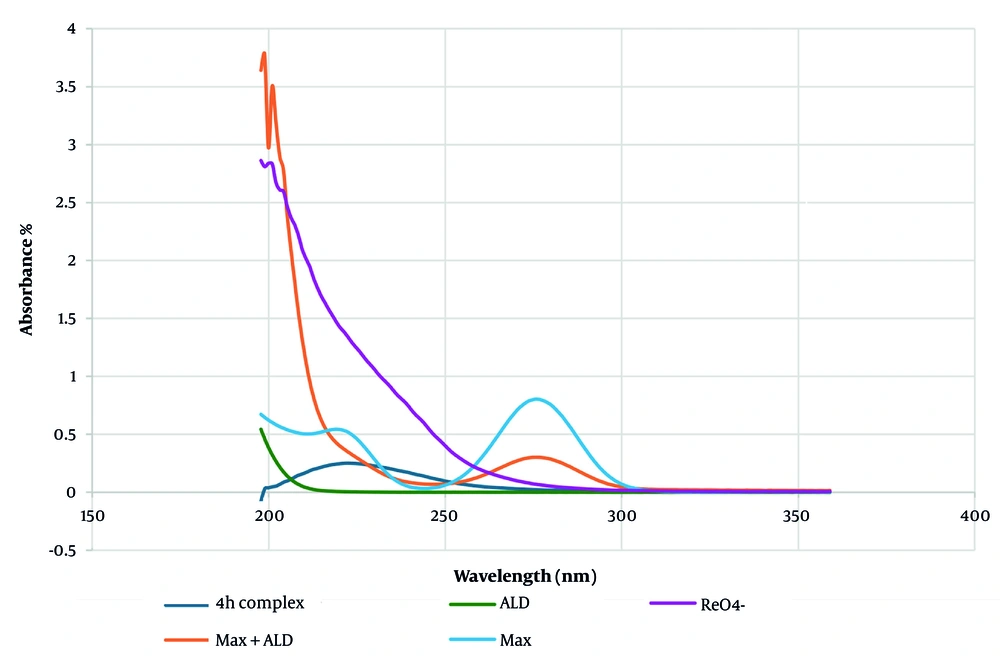
Figure 3.
UV spectrum of ReO4-, alendronate, MAX, MAX + alendronate, and the complex (188Re + MAX + alendronate)
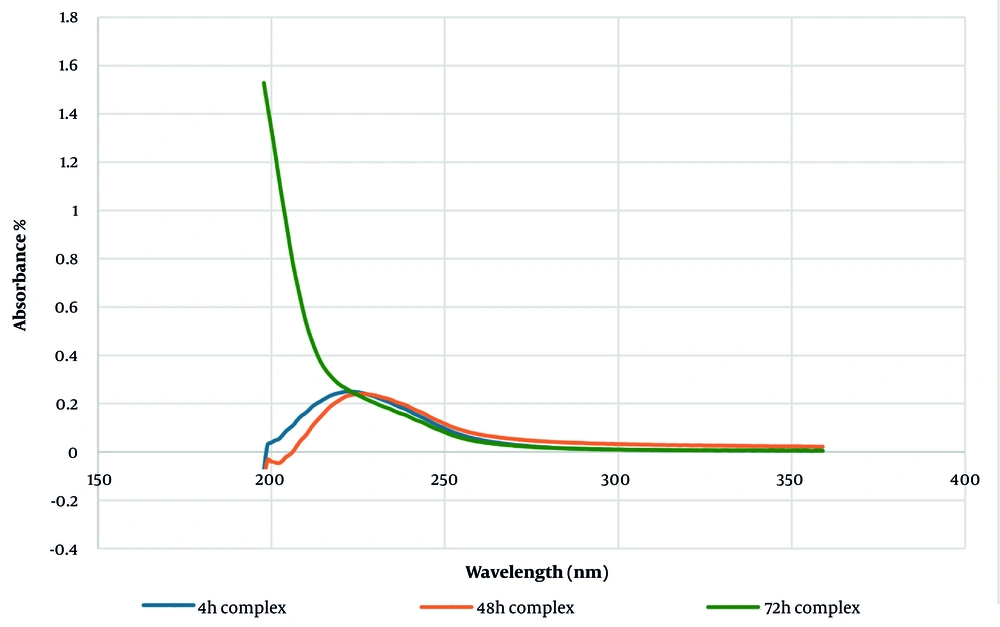
Figure 4.
UV spectrum of the complex (188Re + MAX + alendronate) at 4, 48, and 72 hours
In the MAX and MAX + alendronate spectra, a peak was observed at 275 nm. In the complex, this peak disappeared and shifted to 225 nm, as shown in Figure 4. This phenomenon was attributed to ligand-to-metal charge transfer from the ligand to the solvent in the complex and stabilized the bond between ReO4- and MAX (17).
UV spectra were obtained at different time points, as shown in Figure 4. The complex remained stable for 48 hours after production, whereas degradation was evident at 72 hours. Stability up to 48 hours is comparable with the half-life of 188Re; therefore, 188Re-MAX was considered stable during its effective period.
4.4. Radiochemical Purity
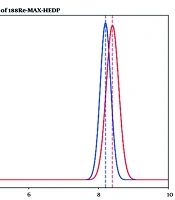
Figure 5A and B show the ITLC analysis of the complex using a two-solvent system consisting of acetone and saline. Figure 5A shows acetone as the mobile phase. The complex (Rf = 0) and 188Re2O4 (Rf = 0) remained at the spotting site, whereas free 188ReO4- (Rf = 1) moved to the solvent front, allowing determination of the percentage of 188ReO4-. Figure 5B shows saline as the mobile phase. Free 188ReO4- (Rf = 1) and the compound (Rf = 1) moved with the solvent front, whereas 188Re2O4 (Rf = 0) remained at the spotting site, allowing determination of the percentage of 188Re2O4. Radiochemical purity was calculated using Formula 1:
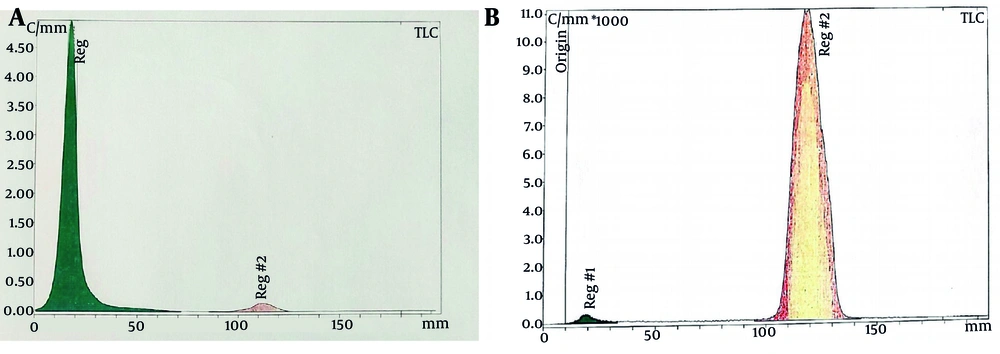
Figure 5.
A, ITLC of the 188Re-MAX-alendronate complex with acetone as the mobile phase; B, ITLC of the 188Re-MAX-alendronate complex with 0.9% saline as the mobile phase
Formula 1:
ITLC analysis demonstrated radiochemical purity exceeding 90% under the optimized conditions, with minimal free perrhenate detected. These results indicate the formation of stable 188Re-MAX and 188Re-MAX-alendronate complexes suitable for further biological evaluation and therapeutic application (1, 7). The Rf values for 188Re-MAX and 188Re-MAX-alendronate were the same.
Using Formula 1, the radiochemical purity was 98 ± 0.6% for 188Re-MAX and 96 ± 0.5% for 188Re-MAX-alendronate.
5. Discussion
The successful labeling of MAX with 188Re under mild conditions demonstrates the effectiveness of sulfur- and nitrogen-containing donor atoms in stabilizing reduced rhenium species. Compared with traditional rhenium chelation systems, which often require elevated temperatures or more complex coordination frameworks, the MAX ligand enabled efficient labeling with a high radiochemical yield. This finding is particularly significant given the relatively challenging reduction chemistry of rhenium compared with that of technetium. The optimal pH range of 5 - 6 reflects a balance between ligand deprotonation and the prevention of hydrolysis. The requirement for a controlled SnCl2 concentration further highlights the importance of precise reduction chemistry in rhenium labeling.
In this work, alendronate labeling remained stable for 48 hours, which is comparable with the half-life of 188Re. Therefore, 188Re-MAX-alendronate can be considered stable over its effective period, which is a promising feature for bisphosphonate labeling. Although biological stability studies were not included in this work, the high in vitro radiochemical purity and stability in the presence of ascorbic acid suggest that the complex may be suitable for further preclinical evaluation.
The present findings demonstrate that the MAX ligand can support efficient in vitro radiolabeling of 188Re under mild conditions and may provide a useful platform for future radiopharmaceutical development. However, the current evidence is limited to analytical and radiochemical observations, and additional biological stability and preclinical evaluation studies are required before therapeutic or theranostic applicability can be established. Although the toxicity of MAX was not assessed in this study, Schick et al. (18) reported that xanthate derivatives displayed antitumor activity against transformed fibroblasts and lymphoma cells in combination with monocarboxylic acids.
The incorporation of alendronate was intended to introduce potential bone-targeting capability through the high affinity of bisphosphonate groups for hydroxyapatite. However, direct evaluation of bone affinity was not performed in the present work. Hydroxyapatite-binding assays, serum stability studies, cellular uptake experiments, cytotoxicity assays, and in vivo biodistribution analyses are required to confirm skeletal targeting performance and biological stability. Therefore, the current study should be considered a preliminary radiochemical investigation, whereas biological validation remains the subject of future work.
5.1. Conclusions
Methoxy amido xanthate was successfully synthesized and radiolabeled with 188Re under mild conditions. Alendronate was also labeled with 188Re-MAX. Optimization of key labeling parameters resulted in high radiochemical yields and purity. Given the favorable physical properties of 188Re and the strong chelation observed, the 188Re-MAX complex demonstrated favorable radiochemical properties and warrants further biological evaluation, including toxicity, stability, biodistribution, and dosimetric studies, before therapeutic application can be considered. Future studies will focus on hydroxyapatite-binding evaluation, in vitro serum stability, biodistribution, and dosimetric assessment to confirm the bone-targeting and theranostic potential of the 188Re-MAX-alendronate system. Although noticeable degradation was observed at 72 hours, the complex remained stable for at least 48 hours, corresponding to approximately 2.8 physical half-lives of 188Re (T1/2 = 16.9 hours).