Fulltext
The full text is available in PDF.
International Cardiovascular Research Journal
An annual journal in scientific affiliation with the Cardiovascular Research Center, Shiraz University of Medical Sciences
Image Credit:Int Cardiovasc Res J
Authors
Background:: Obstetricians regard maternal age of 20 to 35 years as the optimal age for pregnancy. Adolescent pregnancy and pregnancy at the ages of 35 years and above are associated with higher risks. Pregnancy is pro-arrhythmic and rarely precipitates ventricular arrhythmias.
Objectives:: QT dispersion is an index of heterogeneity of ventricular repolarization and a predictor of propensity of ventricular arrhythmias. In this study, this index was used to find any relationship between maternal age and ventricular arrhythmia risk.
Methods:: This study was performed among a group of healthy pregnant ladies between 36 and 40 weeks of gestation. An ECG was taken from each patient. QT dispersions were calculated on a computer screen with high magnitude. The results were then divided into three groups based on the age of the participants. The first, second, and third groups included the women below 20, between 20 and 35, and over 35 years, respectively. The three groups were compared using Kruskal-Wallis test.
Results:: The mean QTd was 61.77 ms (± 16.61) in the first group, 64.15 ms (± 18.65) in the second group, and 55.95 ms (± 23.04) in the third group. Although QTd was prolonged in all, no significant difference was observed among the three groups regarding QTd.
Conclusions:: Our results showed QT prolongation in pregnancy, but showed that maternal age did not affect the heterogeneity of ventricular repolarization and propensity of ventricular arrhythmias in pregnancy.
© 2017, Author(s). This open-access article is available under the Creative Commons Attribution 4.0 (CC BY 4.0) International License (https://creativecommons.org/licenses/by/4.0/), which allows for unrestricted use, distribution, and reproduction in any medium, provided that the original work is properly cited.
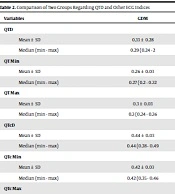
Zarkesh M, Hoseini Nouri SA, Tabrizi M, Nazari E, Latifi A, et al. Is There Any Correlation Between QT Dispersion and Echocardiographic Indices in Term Neonates with and Without Maternal Gestational Diabetes Mellitus?. J Compr Ped. 2023;14(3):e132915. doi: https://doi.org/10.5812/compreped-132915
Wahab A, Alvi S, B. Panwar R, Budania S. A Study of QT Dispersion as a Prognostic Indicator in Acute Myocardial Infarction. Int Cardiovasc Res J. 2017;6(1):e12824. doi:
Oni Heris S, Rahimi B, Farid aalaee G, Hajahmadi M, Sayyadi H, et al. QT Dispersion after Thrombolytic Therapy. Int Cardiovasc Res J. 2017;8(4):e11681. doi:
Keshavarzi F, Rezaei M, Iranfar S, Fakheri T, Nankali A, et al. Advanced maternal age relationship with pregnancy complications. J Kermanshah Univ Med Sci. 2011;15(3):e79358. doi:
Zangeneh M, Veisi F, Malekkhosravi S, Rezavand N, Nankali A, et al. Electrocardiographic changes in healthy and preeclamptic pregnant women. J Kermanshah Univ Med Sci. 2012;16(4):e78789. doi:
Last Update: 1 week ago
Last Update: 1 week ago
Last Update: 1 week ago
Last Update: 4 hours ago
Last Update: 8 hours ago
Last Update: 5 days ago
