
1. Background
Human resources are amongst the main core building blocks of health systems (1). The recommended composition of nursing teams is 60 to 40, meaning that up to 40% of nursing staff can be selected from people with less education and preparation. Due to a shortage in the number of nurses, using individuals with different skill levels for providing patient care not only helps better and more fully meet patients’ needs, but also reduces the need for expert nurses (2).
Nursing assistants were introduced as health workforces to cooperate with registered or licensed nurses and perform patient care tasks based on their skills and competence and under the supervision of nurses, indicating the scope of their performance. These tasks include assisting the patient with nutrition, daily activities, going to the toilet, etc., and performing pulse and temperature monitoring and blood sugar checking (3).
Nursing assistants are always considered as parts of the health system, but their recruitment has been recently increased (4, 5) mainly because of the increased need of nurses’ for help, shortage of nursing staff, and the changing scope of nursing duties (e.g., an increase in technical skills and roles and paperwork in the workplace of nursing specialists). It is thought that nursing assistants can perform tasks that do not require the levels of education and skills of a nurse, which helps nurses spend more time doing nursing care that requires a high level of experience (3).
However, confusion in role and differences in mental models and educational levels create barriers to teamwork and communication between nurses and nursing assistants (6, 7). On the other hand, the inability to communicate and delegate authority and work in a team can lead to poor outcomes for the patient (8). The recruitment of nursing assistants is contentious (9). While some researchers believe that the role is blurring, the lack of understanding about the respective roles of nurses and nursing assistants, inadequate supervision by nurses, inappropriate delegation of tasks, and boundary rivalry are high between the two groups (5, 9).
Due to the lack of a study on the experiences and perceptions of the nurses and assistant nurses working in the Ganjavian Hospital of Dezful on the role of nursing assistants, we decided to conduct a qualitative study in this field. This study was based on the naturalistic research paradigm with a qualitative design. Qualitative research is mostly used for the issues that are less approachable by quantitative methods and suffer from a lack of sufficient and proper information (10).
By extracting the content of interviews, it is possible to help clarify the strengths and weaknesses of the roles of nurses in the Ganjavian Hospital and provide the results to the hospital’s managers for boosting their knowledge about the current situation and helping them take appropriate action.
2. Objectives
Considering changes in the clinical setting of our hospital due to the presence of nursing assistants, a qualitative study was necessary to discover the facts of the current situation based on nurses’ and nursing assistants’ experiences.
3. Methods
3.1. Sampling Procedure
Inclusion criteria included having experiences with the concept of nursing assistance and willingness and ability to convey those experiences. Assistant nurses with at least six months of experience in different wards of Ganjavian Hospital constituted the main group of participants in the study. Exclusion criteria were participants’ withdrawal and interview fatigue.
Nurses and nursing assistants in different wards of the hospital were selected from different shifts based on the inclusion criteria by the purposeful sampling method. In this method, sampling continued until reaching the data saturation stage (11). Finally, interviews were conducted with 21 participants from different wards of the hospital. The participants were initially given a form to gather demographic details (e.g., age, gender, number of shifts per month, etc.).
3.2. Data Collection Procedure
Data were collected using unstructured interviews with the following key questions: (1) would you please describe your experiences of the role of nursing assistant in the ward (asked from the nurses); (2) would you please describe your experiences as a nursing assistant working with nurses in the ward (asked from nursing assistants)?
Exploratory questions such as “can you explain more?” and “what do you mean?” were used based on the participants’ responses. The interviews were held during different shifts with variable durations. Note-taking was used for a number of cases who did not consent to their voice being recorded. Original interviews were kept in a confidential file.
This qualitative study was conducted using a conventional content analysis approach as there was no data on potential codes and categories. The study was performed in the Ganjavian Hospital of Dezful from January to April 2019.
3.3. Measurement of Variables
At the beginning of the interview, the participant’s demographic information, including age, gender, and organizational status, were recorded. The interviews were then analyzed.
To assess credibility, interview transcripts were distributed among the participants to be verified. For dependability and confirmability, an external observer who was qualified in conducting qualitative research was granted access to the interview questions, tapes, transcripts, notes, analyzed data, and extracted meanings, codes, and themes. Transferability was ensured by considering diversity during the selection of participants and comparing the study’s results with those of other studies (12).
3.4. Data Analysis
Data analysis was performed with a conventional content analysis approach. This method is used to categorize qualitative data in the studies that aim to describe a phenomenon (13). The data analysis process was based on the method of Graneheim and Lundman (2004). The initial analysis and data coding of each interview were performed before conducting the next interview.
Recorded interviews were eventually transcribed verbatim and analyzed before the next interview. During the data analysis process, the analysis unit was initially identified (which was the entire text of each interview in this study). Meaning units were then identified (i.e., the phrases derived from the participants’ statements on various aspects of the original concept). Coding was then performed by compressing the meaning units and converting them into codes. The codes were summarized and categorized to form categories. Finally, the categories formed themes based on their similarities and differences (14).
3.5. Ethics Considerations
This study was conducted after obtaining an ethical approval code (IR.DUMS.REC.1397.044). Informed consent was obtained from the participants for audio-recording the interviews. At the beginning of each interview, the participants were briefed on the purpose and methods of the study and requested to give their consent for participation and permission to record the interview. The participants were ensured of the confidentiality of their data.
4. Results
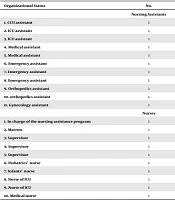
In this study, 10 nurses and 11 nursing assistants were interviewed. Table 1 presents the demographic characteristics of the participants.
Table 1.
The Demographic Characteristics of the Participants
| Organizational Status | No. | Age (y) a |
|---|---|---|
| Nursing Assistants | ||
| 1. CCU assistant | 1 | 20 |
| 2. ICU assistant | 1 | 23 |
| 3. ICU assistant | 1 | 25 |
| 4. Medical assistant | 1 | 20 |
| 5. Medical assistant | 1 | 25 |
| 6. Emergency assistant | 1 | 28 |
| 7. Emergency assistant | 1 | 30 |
| 8. Emergency assistant | 1 | 30 |
| 9. Orthopedics assistant | 1 | 27 |
| 10. orthopedics assistant | 1 | 30 |
| 11. Gynecology assistant | 1 | 23 |
| Nurses | ||
| 1. In charge of the nursing assistance program | 1 | 33 |
| 2. Matron | 1 | 45 |
| 3. Supervisor | 1 | 42 |
| 4. Supervisor | 1 | 50 |
| 5. Supervisor | 1 | 44 |
| 6. Pediatrics’ nurse | 1 | 24 |
| 7. Infants’ nurse | 1 | 36 |
| 8. Nurse of ICU | 1 | 24 |
| 9. Nurse of ICU | 1 | 23 |
| 10. Medical nurse | 1 | 28 |
a Mean ± SD for nursing assistants and nurses were 25.63 ± 3.64 and 34.90 ± 9.97 respectively.
The results of interview analyses led to the extraction of the main category as “displeasure with the position”. Table 2 presents the main categories and subcategories extracted.
Table 2.
Theme Extraction Process
| Themes | Frequency |
|---|---|
| Displeasure with the position | |
| Reluctance to work | |
| Continuous work | 10 |
| Top-down views of nurses | 9 |
| Frustration over not receiving demands | 11 |
| Lack of encouraging perspectives | 11 |
| Having a small role in assisting nurses | |
| Unclear job description | 11 |
| Low accuracy | 10 |
| Tendency to deviate from the role | 8 |
4.1. Having a Small Role in Assisting Nurses
The three main subcategories, including "unclear job description", "low accuracy”, and “tendency to deviate from the role” indicated that their role as a member of the care team was weak.
4.2. Unclear Job Description
Several issues reveal the unclear job description established for nursing assistants. First of all, the fact that only a part of their job description is fulfilled, including the part dealing with items such as checking the vital signs, changing the patients’ position, bottle chest drainage and cleaning, making the patients’ beds, etc. The second, they often perform tasks that fall beyond their job description, such as dressing wounds, administering injectable drugs, and suctioning. Third, the hospital has a crucial role in defining the scope of nursing assistants’ duties, such as mandating the fulfillment of certain duties depending on the ward and the patient’s age and severity of illness.
One hospital supervisor said: “We call them patient transporters because most of their job is to transport patients; nevertheless, they have become sensitive to this title”. A neonatal ward nurse said: “Nursing assistants do not only help us, but many of their duties are about helping the general service. When their shifts coincide with the general service, the service personnel get happier than us. They are actually a help for service personnel”. An emergency department nursing assistant also stated: “We are an assistant to everyone. We are the practical nurses, service personnel, and patient transporters, because we are doing all sorts of tasks”.
4.3. Low Accuracy
This category indicates that the poor performance of nursing assistants in various areas, their low attention to correctly check vital signs and timely report abnormalities, their lack of knowledge about the correct performance of duties, and ignoring the side effects of the oral medications given to the patient have decreased nurses’ trust to them.
An adult ICU nurse said: “We have a nursing assistant here who always reports the vital signs higher than they really are, and there is one who always reports them lower, or sometimes they don’t even report abnormal vital signs that need our intervention. We monitor them to see who does his/her job correctly and then assign them tasks based on that”.
4.4. Tendency to Deviate from the Role
The interview results show that issues such as the similarities of their curriculum with that of nursing courses, learning content beyond the job description determined by the ministry of health, having clinical work experience in out-of-hospital institutions, learning nursing practice through observation in the ward, etc. have led to expectations from nursing assistants to be able to do beyond their job description and their tendency to deviate from the main job description of a nursing assistant.
A head nurse of the labor department discussed nursing assistants’ clinical work experience and its effect on their work: “The nursing assistant says that she works out of the hospital in a private center and does everything there. She expects me to let her do perineal suturing, which is not her duty at all, or asks to insert urinary or peripheral venous catheters”.
4.5. Reluctance to Work
The four categories of “continuous work”; “frustration over not receiving demands”, “lack of encouraging perspective”, and “top-down views of nurses” show that nursing assistants may not have much motivation to work.
4.6. Continuous Work
Issues such as everyday presence at work, difficulty in taking a leave, and impossibility to rest at work due to the lack of manpower make nursing assistants lose the motivation of the early days of employment.
One CCU nursing assistant said about the difficulty in taking a leave: “I started my work from last April until this September; that is, I’ve worked for six months without a day off. Plus, if I want to go on a leave, my colleague has to come to work both in the morning and afternoon shifts, which is a lot of pressure, and when I come back, I have to work instead of her both the morning and afternoon shifts too, so I rather not go on a leave. Well, that itself causes fatigue to remain in the body”.
4.7. Top-Down Views of Nurses
This category indicates that issues such as giving orders, humiliating talk, summons with ugly words, and shouting have become sources of stress and lack of motivation for nursing assistants.
Regarding the humiliating attitudes of nurses, a nursing assistant working in the internal ward said: “Nurses encourage us to perform some nursing duties such as dressing and suctioning whenever they need to, but during, like, breakfast, they remind us that we are just nursing assistants and nothing more, just to suppress us”.
4.8. Frustration Over Not Receiving Demands
This category indicates that nursing assistants’ requests are ignored by authorities. Items such as the head nurse not paying attention to the monthly staff recommendation schedule, not agreeing to exchange nursing assistants between wards, poor hospital cooperation in paying finances, and failure to change the status from the corporate to government employment have caused them frustration in obtaining their demands.
“Some nursing assistants asked to change their wards but received poor treatment from their supervisors”, a labor nursing assistant continued to explain: "I have applied for relocation several times lately. I went to the matron, but she said, 'I've told you to wait and not disturb me'. What does it mean 'not disturb me'? I’ve come to solve my problem, to get a solution, an advice or opinion, but instead, I hear ‘don’t disturb me’, this means for me no good and causes discouragement".
4.9. Lack of an Encouraging Perspective
The nurses’ assistants stated that the lack of financial incentives, the lack of a commendation plaque, the lack of verbal appreciation, and the highlighting of mistakes would undermine their motivation and enthusiasm for work.
A nursing assistant working in the emergency department said: “We do our own work and many other side jobs of the department and expect them to grant us a few more overtime hours, which is at least pleasant for us, but they don’t do that”.
5. Discussion
Displeasure with the position as the main theme of the study showed that nurses and assistant nurses were both dissatisfied with the organizational position of nursing assistants in the hospital for some reasons.
One of the main categories extracted in this study was having a small role in assisting nurses, which demonstrated nursing assistants’ unclear job description, low accuracy, and tendency to deviate from the role assigned to them.
Transparency is a key factor in inter-professional collaboration (15). Formal job descriptions often differ from the actual job expectations. Job description is a formal framework that determines the job position and can include specific tasks, responsibilities, and broad goals, competencies, and knowledge. Job expectations are a set of tasks that managers have in mind for employees, which are generally not stated when writing contracts with them (16). It appears that the unclear job description of nursing assistants in hospitals despite having written ministerial job descriptions is due to the particular needs of different wards, patients’ variable conditions and ages, and the lack of some job categories, such as a patient transporter job. This poor role definition can be a source of conflict in team job performance and reduce the effectiveness of the care services provided to the target population (15). Defining the specific roles and responsibilities of the job is the main power of an institution for successful staff management and to clearly determine responsibilities (16). Therefore, hospital authorities should identify the particular roles that should be performed by nursing assistants in addition to their main duties as per their job description and brief them on these expectations at their debut to resolve the conflicts arising from the lack of transparency.
The results also showed that due to nursing assistants’ inaccurate job performance in some areas, nurses could not practically trust them, undermining their assisting role in nursing. This issue may indicate that the professional competency of nursing assistants in the hospital has not received enough attention. Clinical competency is defined as the application of technical and communication skills, knowledge, clinical reasoning, emotions, and values in the clinical setting (17). Therefore, the evaluation of clinical competency is essential for ensuring the achievement of minimum professional standards by nursing assistants and their preparation for playing roles (18).
Nursing assistants’ tendency to deviate from the roles assigned to them demonstrates their small role in assisting nurses. The purpose of division of tasks in patient care is to expedite the performance and improve the quality of care. It is therefore essential that all members of health teams understand the importance of teamwork and that each member should perform the tasks assigned to him/her in the best possible way. One of the factors facilitating teamwork is the role of organizational structure flexibility. When organizational goals are clear and personnel are exactly aware of the extent and scope of their job descriptions, they will be able to work within the framework of their official duties, and interdisciplinary teamwork is thus facilitated (19). Another factor is the role of control mechanisms in facilitating teamwork. Control is an important factor in improving performance that depends on amending and modifying activities in order to achieve predetermined goals. The process of control and oversight by managers and officials ensures that tasks are done correctly (20).
Reluctance to work with characteristic such as continuous work, frustration over not receiving demands, and the lack of an encouraging perspective could indicate that nursing assistants do not receive organizational support. Perceived organizational support is known as employee's' perceptions that their works, efforts, and contributions are valued by the organization (21).
Today, in manpower management, one of the most important issues is to meet employees’ needs to motivate them to improve their work quality (22). However, in hospitals, motivations, encouragement, punishment, and appreciation of good work are not considered much. Managers are either so involved in various issues that they do not have the opportunity to do so or do not pay attention to this issue at all (23).
By considering the factors affecting job satisfaction and designing interventions by managers to strengthen these factors, it is possible to create a productive environment (24). Also, maintaining job satisfaction is essential and must be considered for the sustainability of the health care organization. One study showed that the prevalence of burnout among nursing assistants was 26 - 50%, indicating the high vulnerability of this group (25).
A meta-analysis of 21 studies revealed that the lack of reward and appreciation, as an important contributor, could create stress in the workplace. Schulz (2009) stated that the imbalance between the job activity and the respective reward caused burnout in nurses (26).
Our results showed that the relationship between nurses and nursing assistants is defective. One study argued that the lack of manpower, poor communications, and a disrespectful atmosphere all result in misunderstandings, hurriedness, and the inability to provide quality health care (27).
Nearly everyone in the healthcare system has been exposed to rude behaviors. This toxic behavior, however, has sweeping consequences. It hurts personnel’s mental health and productivity and leads to absenteeism and resignations that cost healthcare organizations a lot of money. Nevertheless, the main consequence of rude behaviors may be the low quality of the care provided to patients (28).
According to the social power theory, inappropriate behaviors can act as a tool for practicing power. According to this theory, in an organization, people at lower levels of the hierarchy or those who belong to lower-level groups in the workplace are more likely to be disrespected by senior employees (29). Nursing managers work in an environment in which conflicts occur repeatedly, and about 20% of a nurse manager’s time is spent on resolving contradictions. So, nurse managers need to use their communication and interpersonal skills during interaction with nurses to identify the main problems leading to conflicts and employ the most proper methods of handling them (30).
5.1. Limitations
One limitation of this study was its lack of generalizability due to its qualitative design. Regarding its strengths, this study was conducted a year after the implementation of the nursing assistant program in the Ganjavian Hospital of Dezful, and its results can be used by the nursing managers of the hospital for assessing the current status of the implemented program.
5.2. Conclusion
The results of the study showed that nursing assistants had problems that needed to be addressed by nursing managers. The lack of a long-term management perspective on training nursing assistants and the program being implemented for the first time in the Ganjavian Hospital of Dezful may be the main causes of most of these problems.