


1. Background
Many residents of urban areas who hope to access recreational and sports facilities do not desire to live near these facilities (1). In the Olympic Games, the largest human and sporting event worldwide, environment protection and green space design have been emphasized, so the Sydney Olympics in 2000 was recognized by observing these principles (2). This means that each sports organization can play an important role in the environment among the actors of the community (consumers, industry, local communities, sports organizations, government agencies, etc.) (3). More clearly, sports organizations are made up of different people who, in turn, have responsibilities towards environmental issues; for example, sports managers should be aware of the importance of environmental issues and take it into account in their planning and teach the athletes to communicate with the environment initially (4). All athletes, from low-level ones to the champions, significantly affect society. They can encourage other athletes, especially youth, to adopt the appropriate behavior towards the environment due to their positions (5, 6).
Spectators, as one of the main elements of sports, the athlete and the coach have extra significance in the relationship between the environment and sports. When they respect the organizers’ environmental recommendations (like avoiding accumulating waste and using environmentally friendly vehicles), they will demonstrate their commitment to environmental protection through their behaviors (7).
While it has been indicated that sport has little influence on carbon production in general, according to the international agreements for neutralizing carbon by 2030, this part plays a vital role in achieving the environmental goals (8). Just some of the country’s energy is consumed by sports organizations, but the events they establish are seen by millions of people every day or performed by many. Thus, sports organizations can advise the spectators by presenting social responsibility-based messages towards the environment. Therefore, with the awareness of this sense, the United Nations considers the value of sports as one of the most influencing factors in encouraging people to take more responsibility towards the environment (9). Sports organizations can help other organizations implement ecological sustainability measurements through their programs (10).
In other aspects, outdoor sports and entertainment can cause waste and pollution and severely affect ecosystems (11). Sports and exercise can lead to a disproportionate consumption of raw materials, deterioration of traffic and air pollution caused by traffic, local water evacuation, and challenges arising from dissipation (12, 13).
Recently, raising the sports organizations’ perceptions regarding sports development simultaneously with nature protection and prioritizing the ecological behaviors of sports have been considered more than ever (14). On the other hand, maintaining and retaining a region’s environmental and social assets has become a new challenge and reality for sports management, especially in Iran (15).
Sustainable development has four dimensions: Social, economic, political, and environmental (16, 17). It can be pointed out that environmental degradation threatens the health and the lives of all members of society, including athletes (18). As a result, all sports agents are responsible for protecting the environment. In fact, sport is not separate from the environment (19).
The environmental issue is not new in the 21st century and is not restricted to political ideology, economic system, social structure, or particular technological levels. The environment is a global matter because it is a human issue (20, 21). The environmental issues are part of an incremental wave that has provoked the world of sports in recent years (5, 10, 11, 22-24). The trace of sports in the environmental issues is widespread and significant (like sports facilities, spectators, and used energy) (22, 24).
Based on the literature, it can be said that the impact of sports and sports organizations on the environment has been studied from the point of view of recreational environment issues (25), the efforts of athletes for green sports (26), eco-friendly associations (27), Olympic games (28, 29) and encouraging the participation in green sports management practices. Some actions and activities have been accepted sparsely in Iran, which is closely related to the previous research.
In the research performed in the country, more attention has been paid to the nature and condition of the stadiums and sports facilities of the country, and the effects of these venues on their surroundings have not been considered. More importantly, the dominant role of sports organizations in promoting sustainable environmental development is not mentioned. This study can enhance the sports community’s understanding of the environmental effects of the sport, entertainment, and recreation on the environment and create policies, perspectives, and potential contexts for future research. Therefore, the current study has been formed to fill the existing research gap.
2. Objectives
This study aimed to answer the question, "What is the role of sports organizations in sustainable environmental development?"
3. Methods
The current study is applied-developmental in terms of the goal. Such research aims to solve particular problems in real situations. We can categorize the layers of this research by taking a considerable and comprehensive look at its layers. The dominant paradigm of the research is interpretive-constructive. Its nature is exploratory. The ruling approach, method, data collection scope, and research strategy are inductive, qualitative, library and field, and grounded theory, respectively. Then, they are asked to introduce to the research program those who think they are apt for this study. Given that the researcher reached the theoretical saturation after 13 persons, the statistical sample is 13 persons. Table 1 shows the sample distribution based on age, background, and education.
Table 1.Description of Research Sample
| Variables | Sample Feature (No.) | ||
|---|---|---|---|
| Professors of Sports Management | Managers of Sports Organizations | Administrator of Environmental Protection Agency | |
| Background (y) | |||
| 10 - 15 | 1 | 2 | |
| 15 - 20 | 2 | 2 | 1 |
| Above 20 | 2 | 2 | 1 |
| Age (y) | |||
| 50 or lower | 1 | 1 | |
| 50 - 60 | 2 | 3 | 2 |
| Above 60 | 2 | 2 | |
| Education | |||
| Assistant professor | 2 | ||
| Associate professor | 1 | ||
| Full professor | 2 | ||
| Master student | 2 | ||
| Ph.D. student | 4 | 2 | |
Also, the interviews were conducted based on the informed consent of the interviewees and with prior coordination on the right occasion in person or online through video conference, and the designed open-ended questions and the questions that came to the mind of the researcher during the interview were asked. For example, some of the questions were as follows:
- In your opinion, what is the reason for paying attention to the environment in the subject of sport?
- What are the antecedents required for environmental development through sports?
- What are the capabilities of the sport in environmental development?
- Describe the processes that can reduce the role of sport in environmental development.
- What are the necessary mechanisms for making influential and more colorful the role of sports in the environmental development process?
Data collection continued until theoretical saturation. At this time, no new data or relationship was found between the specified categories. To validate the qualitative model of the research, four criteria of credibility, transferability, dependability, and confirmability assessed the scientific accuracy of this qualitative study, as presented in Table 2.
Table 2.Confirmed Items of Validity and Reliability in the Qualitative Method
| Variables | Values |
|---|---|
| Credibility | Sampling until data saturation, long-term involvement in the field, multidimensional data |
| Dependability | Inspection, documentation of data by researcher, methods and decisions, multidimensional researcher |
| Confirmability | Parallel evaluation of the results and being reflective |
| Transferability | Complete description of the environment and the participants and the variety of views and aspects and various experiences of the interviewees |
4. Results
In the primary coding, one code (concept, name, and label) was attached to any desired unit based on the coding unit by the researcher. The concepts or codes obtained at this stage formed the basis of the next major categories and the main components of the emerging grounded theory. An initial code was given to each of these key points. The initial coding method is described in Table 3.
Table 3.Classifying the Concepts into Subcategories
| Open Codes (Concepts) | Subcategory |
|---|---|
| Responsibility towards posterity, raising the competitiveness of the sports organizations | Foresight |
| The growing and sustainable need for sports organizations, using chemicals in swimming pools and sports facilities | Environmental crises |
| The involved persons’ expectations in the field of sports, accountability to the community | Environmental requirements |
| Respect for traditional and naturalistic values, the close relationship between the sport and the environment | Environmental capability of the sport |
| Use of sports celebrities for environmental education, informing athletes and spectators about the environment | Environmental education of sports |
| Use of the media to reflect the needs and expectations of the people, reporting the compatible behaviors in preserving and developing the environment, encouraging the community | Propaganda platforms for sports |
| Extreme administrative bureaucracy, underdevelopment of the monitoring mechanisms of the Department of Environment | Legal, structural context |
| Economic justification of sports structures, permanent revenue of sports complexes, more commercial opportunities | Economic context |
| Environmental ethics of the sports community, environmental benefits awareness, considering the reduction of energy dissipation and use of clean energy | The environmental tendency of the sports community |
| Employing inexpert managers in the scope of environment and sport, emphasis on the early interests | Leadership weakness |
| Low use of vernacular materials, improper selection of sports facilities site, neglecting the climate and geographical conditions in the construction of sports facilities | Inattention to the sports facilities’ sustainability |
| Increasing waste production, increased noise, air pollution | Environmental pollution of sports |
| Inattention of upstream documents to the role of sport in environmental development, failure to define a particular program to resolve the environmental challenges | Inattention of macro sports policy to the environment |
| Assessing the design process, construction, sports facilities operations, lighting quality control, cooling, heating, and air conditioning systems | Environmental performance assessment |
| Use of solar energy, minimizing the waste and sewage production in sports activities, minimizing the waste and residuals | Effective use of resources |
| Use of attractive environmental logos, improving the health management culture, safety and environment | Developing the public environmental culture |
| Multipurpose use of sports spaces, augmenting the per capita of sports green spaces and its media maneuver | Creating and developing the green sports movement |
| Raising the educational and research activities-related budget, publication of educational books and brochures | Effective scientific-research activities |
| Applying the environmental standards to macro policies, reconstruction and cleaning of the facilities based on the environmental standards | Codifying the environmental rules in sports |
| Choosing appropriate environmental slogans and symbols in sports, trying to understand and increase the participation of spectators in recycling the waste | Beneficiaries’ participation |
| Promoting water management technologies and strategies, encouraging the best use of sports equipment and keeping them in optimal condition | Intelligent management of sports facilities |
| Effectiveness and efficiency of sports activities, increasing safety and reducing the environmental effects of sports tools | Increasing the green sports productivity |
| Improving the social sense of belonging, improving the internal values of the sports, raising the social empathy towards the environment | Developing the social aspects of sports |
| Improving the quality of human habitats and residencies, promoting equality and justice | Creating sustainable heritage |
| Urban land optimization, providing a guarantee to protect the health and hygiene of citizens | Improving the quality of life and the welfare of citizens |
5. Discussion
Concepts and categories discovered in Table 4 cannot merely convey a specific meaning for sports-based sustainable environmental development. In this stage, the concepts considered in the previous stage are connected, and the relations between them are determined, which is the process of discovering and emerging theory. So, the separated layers in Figure 1 indicate the selective codes and their comprehensibility in this study. Eventually, the ultimate pattern of the research is presented based on the juxtaposition of the layers. Using the results of the open and axial coding, the sports-based sustainable environmental development model according to the six paradigms was related to causal factors, fields & context, axialphenomenon, mediating variables, strategies, and consequences.
Table 4.Axial Coding Results
| Main Categories | Selected Categories (Dimensions) | Categories | Number of Concepts |
|---|---|---|---|
| Causal factors | Shaping factors | Foresight | 7 |
| Environmental crises | 13 | ||
| Environmental requirements | 9 | ||
| Environmental capability of the sport | 9 | ||
| Fields & context | Required environment and conditions | Environmental education of sports | 7 |
| Propaganda platform for sports | 8 | ||
| Legal structural context | 10 | ||
| Economic context | 5 | ||
| Axial phenomenon | Sustainable environmental development | Sustainable environmental development based on the sports | - |
| Mediating variables | Restrictive factors | Leadership weakness | 12 |
| Inattention to the sports facilities' sustainability | 11 | ||
| Environmental pollution of sports | 9 | ||
| Neglecting the environment by macro sports policy | 5 | ||
| Facilitators | Environmental tendency of sports communities | 9 | |
| Strategies | Mechanisms | Environmental performance assessment | 4 |
| Effective use of resources | 11 | ||
| Developing the public environmental culture | 10 | ||
| Creating and developing a green sports movement | 12 | ||
| Effective scientific-research activities | 9 | ||
| Codifying environmental rules for sports | 7 | ||
| Participation of beneficiaries | 6 | ||
| Intelligent management of sports facilities | 9 | ||
| Consequences | Environmental achievements | Increasing the green sports productivity | 8 |
| Developing the social aspects of sports in the environmental protection | 6 | ||
| Creating sustainable heritage | 7 | ||
| Improving the quality of life and welfare of citizens | 8 | ||
| Total | 6 | 26 | 211 |
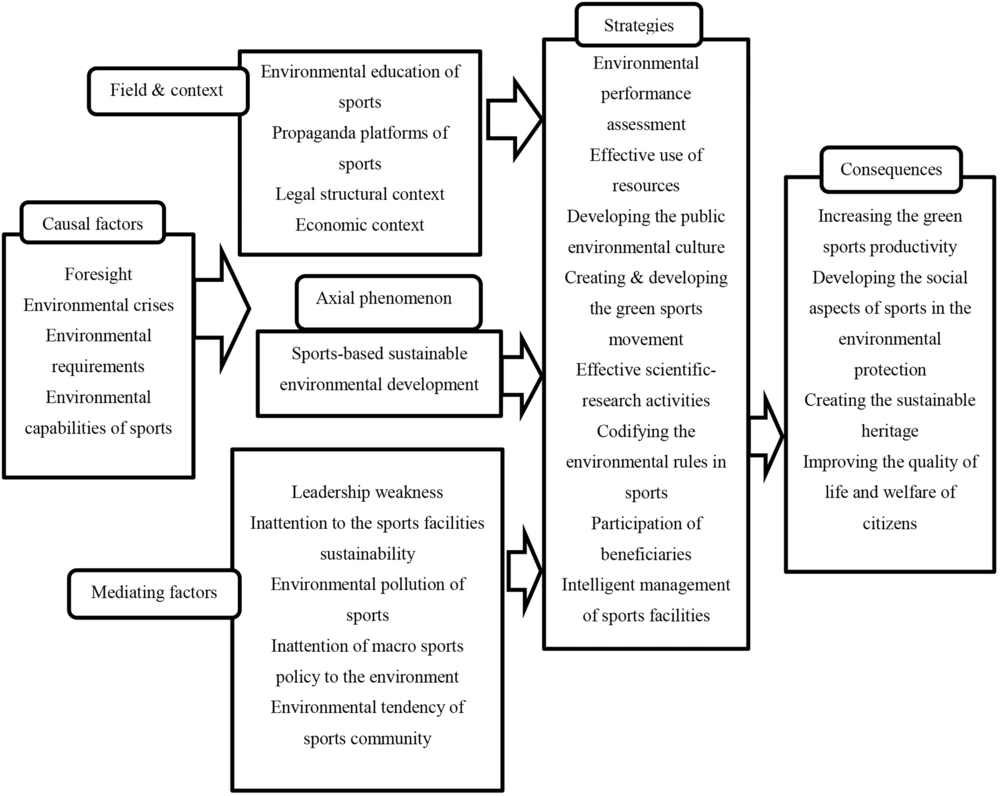
Figure 1.
Paradigm model of sports-based sustainable environmental development
Therefore, taking into account all the features of sports and its areas of influence, and taking into account the fact that sports as an industry is growing and expanding, and its global value is about 600 billion dollars (30), as well as its impressive promotional role in sustainable environmental development; All-round development in this industry seems to be necessary without a doubt, by identifying the effective factors in achieving sustainable development, a big step can be taken, and identifying these factors will help the planners of the sports industry to plan with a broader view of the path. pave for sustainable growth and development (30, 31).
In the research of the Ministry of Sports, the role of sports in the sustainable development of the environment was investigated and it was shown that causal factors, signs and strategies have an effect on it (31).
5.1. Conclusions
The results of this study indicate that sustainable environmental development in the field of sports is affected by some factors such as foresight, environmental values of sports, environmental requirements of sports, green sports movement, educational and research factors, communication and promotional elements, economic factors, and structural and managerial factors. The role of sports in sustainable environmental development can be more prominent by relying on the contexts like environmental education of sports, propaganda platforms of sports, legal-structural context, economic context, and considering the environmental tendency of the sports community. It is also suggested that the environmental laws and regulations in sports be codified and enacted; moreover, the participation of all beneficiaries should be used to increase the sports community’s role in sustainable environmental development.


