
1. Background
Nowadays, the use of physical education and sports science is more than just an academic discipline, and it has generated a tremendous impact on domestic and international communities. The background of the field of sports sciences in Iran shows an increasing trend of graduate students in this field, and these effects can be clearly seen in an increase in scientific productions (such as articles, books, posters, etc.). However, with the exception of the scientific trend of sports, in the present era, this scientific trend has caused sports to become a modern and lucrative industry. For example, about 2 to 3 million people in Europe are employed in sport sectors, and sport accounts for about 3% of the continent's gross domestic product. In Australia, about 276,000 people work in sports sections, in which the number of business units in 1995 was over 11,000 with a minimum investment of $20,000 per employee, with the value of sports investment being over $5.5 billion. In Northern Ireland, 8,000 people work in sports-related fields, and the economic value of sports for the country is one hundred million a year. In Canada (1997), 94,961 people were employed in the sports industry which is equivalent to 0.7% of the labor force in Canada. Canada's sports economy also amounted to $3.039 million that is similar to 0.6% of the country's GDP (1). International sports federations, which have faced challenging issues such as corruption and manipulation in sports, have recently been highlighted in terms of policy, practice and as a topic of scientific interest. Researchers emphasize the importance of implementing governance standards in order to raise ethical standards in sports organizations, especially federations, and point to past failures (2). The paradigm model of the occurrence of abnormalities in the national championship sport, where structural and behavioral antecedents change the attitudes of players, coaches, fans, and people, and these attitudinal changes in behavior also have abnormal effects such as player domination, lack of meritocracy and lack of society; shows the resilience of sports managers (3). All this evidence shows that sport and its surrounding issues have very valuable functions in today's world. Along with the promotion of sports science, there are some anomalies in this lucrative industry. These anomalies can be analyzed from moral, cultural, political, economic, and other aspects. For example, Nedai and Alawi (4) examined ethics in sports based on fair play and concluded if coaches can not follow ethical principles, the same anomalies will be transmitted to athletes and will have consequences. Its ethical standards are so important in sports that researchers have also explored barriers to the development of professional ethics in sports media. On the other hand, sports can also be considered socially that many of the anomalies in sports are rooted in families, and the type of attitude of families is an important determinant of children's orientation in sports. In this regard, Hajizadeh et al. (5) and Gershgorn et al. (6) showed that whatever feedback parents give to their adolescents, they also tend to give the same feedback. For this reason, one of the aspects in which sports organizations can play an active and optimal role is social and family issues. But more careful study is needed to fully determine the mechanism in action. Another one that causes multiple behaviors and some kind of unique anomalies is different cultures. For example, the range of mountaineers in the northern regions of Tehran, Iran, is different on holidays and non-holidays. Also, the value of the residential area and the type of sports activity are completely influenced by each other. For instance, people who live in high-value areas play less football than other people, while for badminton, this is quite the opposite (7). Another aspect of the sports industry that has seen various anomalies is economic issues. The results of the research show that sports venues create jobs in the vicinity of the stadium, business boom, more commercial transactions in the area, increase commercial shops, create miscellaneous jobs, increase residents' incomes, increase sales of homes in the area, increase of purchases and the sale of land in the region, increase in the price of residential land, and the increase in commercial price of the region in the city of Isfahan has been resulted (8). In this regard, Mehr Ara and Mikaeeli (9) Investigating the revenue and government sports expenses on the value added of the sports department. The results of their study show the industry's share (0.38 and 0.39) percent of GDP in the years 1998 to 2001 that lack of household orientation to sports, and a decrease in the share of sports expenses in total household expenses (0.22% in 1998 to 0.17% in 2001) and also the low share of sports exports compared to the share of total exports (0.04 Percentage in 1998 and 0.06 in 2001) and private sector sports investment relative to the total share of investments in this sector (0.001% in 1998 and 0.005% in 2001) in reducing the share of sport in GDP which they are effective. Vella et al. (10) in their study addressed social issues, including the phenomenon of sports betting in Australia for reasons such as gambling culture in Australia, available betting opportunities, threats to the integration of sports with sports betting, corruption in sports, the transnational involvement of organized crime groups in sport pointed to the strategy of struggle in the occurrence of betting and prevention and implementation of the law on this criminal behavior in sport as such important and necessary. In a study by Kraft et al. (11) that the results were as follows: The nature of sports organizations, including FIFA, as a facilitator in creating corruption, and in fact, sports play a facilitating role in creating corruption.
However, what has not been analyzed in previous research is the typology of the dimensions of corruption at each level of sport. As it is clear from the nature of all past research, corruption and anomalies do not occur in a vacuum, and it is the individuals who create this phenomenon through their actions and attitudes. In other words, human resources in sports are a key element in the occurrence or reduction of anomalies and corruption (12). Of course, the anomalies in the field of sports generally have cultural, social, economic, and moral aspects, which must be precisely determined which of its mechanisms of emergence is at the hierarchical levels of sports. As mentioned, today, sport has emerged from a purely scientific pole and has become a lucrative industry and even a political and cultural tool for many countries. Many countries introduce their country to the whole world through sports.
A clear example of this is the 2022 World Cup in Qatar, which, despite all the margins it brought, this very small country was able to make its name in history forever. On the other hand, many countries make billions of dollars through sports and are a valuable resource for their economies. On the other hand, civilized countries such as Iran can show their Iranian culture to the whole world through sports, achieving all these benefits, and taking a positive step in promoting this culture. These facts make a view of sports go beyond physical and health aspects and cast a shadow over all components of governments and countries. All this research shows that fighting corruption is especially important in sports and non-sports. However, in order to fight corruption, the first step, which is the most important step, is to identify the exact dimensions and mechanism of this event.
2. Objectives
The present study seeks to identify and analyze the exact mechanism of this kind of corruption in mentioned sports and organizations in Iran.
3. Methods
The research method is qualitative research and, in terms of type and purpose is application based. One of the reasons for the need for qualitative research is that qualitative methods can provide more detailed information on phenomena that are difficult to present in quantitative ways. Different qualitative data grounded theory was used. The grounded theory allowed the researcher not to be content with previous theoretical frameworks and to understand theories derived from real experience in a particular situation.
According to the main question of the present study, participants of all professional sports (people with master's and doctorate degrees with more than 20 years of experience in the fields of sports management, Islamic management, sports sociology, and sports philosophy) at educational, and general capacities that included championship level and professionals were present in the interview. The criteria for selecting the interviewees were to have work experiences related to the research question, and considering that complete information was not available from the list of these people, the interviewees were asked to introduce another person according to the proposed criteria. A semi-structured interview method was used to collect data, which is characterized by flexibility and depth was suitable for qualitative research. Therefore, data were collected using 20 interviews. All interviews were conducted individually, and each interview lasted an average of 45 minutes and continued until the categories reached theoretical saturation. Theoretical saturation refers to the stage in which new data related to the category does not appear and the relationships between the categories were established and confirmed (13). As it was stated, in order to identify the scope of corruption and anomalies in different levels of sports in the country, 20 educational sports specialists (6 school sports officials, teachers, and several university professors), public sector experts (4 public sports experts from the Ministry of Sports, Youth, and Municipality), championship level experts (5 presidents of national sports federations and champions) and professionals (5 CEOs of clubs and professional athletes) were interviewed. In the next step, the data were analyzed through a coding process based on grounded theory (13). During open coding, transcripts of interviews were conducted, codes were marked, and duplicated ideas were identified. The concepts included words and phrases that reflected on the experiences and ideas of sports experts and specialists from the process of anomalies and corruption at the hierarchical levels of the country's sports with an emphasis on human resources. Coding and reviewing repetitive concepts continued until saturation occurred, when no new topics could be found in the raw data. In the next stage of axial coding, these concepts were classified in the form of antecedents, effective factors, central categories, and consequences theoretically related in the form of a paradigm model. Selective coding, it offers an expressive theory of the research process and how to integrate and refine categories.
During the analysis, transcripts of interviews were reviewed several times to find a new model or to modify the previous model. In order to evaluate the validity, the completed paradigm model was compared with previous data and models and the aspects of its change in concepts and categories were clarified and rearranged. Also, according to the criteria provided by Creswell (14) to ensure the validity of the research, measures such as compliance by members (review of three sports experts from the final report) and peer review (review of the final paradigm by four sport management professors in Iran) was performed.
4. Results
By analyzing the interviews in open coding for championship and professional levels, it was determined that codes such as the behavior of officials in sports, change in the attitude of athletes and players, incompetence, change in behavior and attitudes of fans and spectators, structural and economic conditions, the way players and coaches sign contracts, lack of a culture of basic sports can be codes for anomalies in sports (Table 1).
Table 1.
Results of Open Coding in Interview Analysis for Sport
| Antecedents | Category | Concepts |
|---|---|---|
| Structural and managerial factors | Imbalance between policy and implementation | Lack of proper implementation of cultural and sports events and festivals in schools |
| Lack of proper implementation of national plans | ||
| Lack of proper holding of cultural and sports programs in schools and universities | ||
| Lack of infrastructure and software facilities | Lack of sports equipment | |
| Lack of safety in school and society | ||
| Lack of basic technologies for sports in schools and universities | ||
| Lack of space for sports in every region | ||
| Lack of space for exercise in workplace | ||
| Structural and economic conditions in professional sports | Lack of privatization of professional sports clubs | |
| Lack of copyright rules for sports sponsorship | ||
| Lack of television rights to broadcast sports matches | ||
| Too many rotations of sports directors in different departments | ||
| Lack of effective supervision of some coaches and athletes by some sports managers | ||
| Defects in method of concluding contracts for athletes and coaches | Defects in the contracts of athletes and professional coaches | |
| Short-term contracts | ||
| The fee is more than the actual amount of salary in some players and coaches | ||
| Use and trust of unauthorized intermediaries (agents) to conclude contracts for players and coaches | ||
| Too many player transfers in sports clubs | ||
| Behavioral factors | Inactivity of parents and families in sports | The cause of parents' lack of attention and information on sports participation of students |
| Reduce the amount of physical activity and sports of parents | ||
| Improper parenting style of parents | ||
| Economic Troubles of families | Hard work for families and fatigue and unwillingness to exercise | |
| Lack of proper time due to parents overwork for exercise | ||
| Insufficient income to enroll children in sports clubs | ||
| Behavior of officials in sports | Exaggeration of officials in dealing with champion and professional athletes in the field of encouragement and punishment | |
| Insufficient official support for athletes | ||
| Imbalance in the selection and talent identification of athletes | ||
| Lack of sports culture at early ages | Lack of attention to orbital ethics in basic sports | |
| Lack of moral and religious education in basic sports | ||
| Emphasis on winning and losing and neglecting to teach the spirit of sports in adolescents |
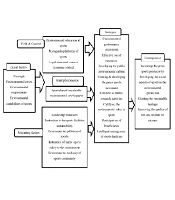
After the open coding stage and extracting the key factors of anomalies in the field of sports in Iran (educational, sport for all, championship, and professional), based on the central and selective coding, the main category or categories and then the relations between the categories to the following was determined based on Figure 1. The results of open coding showed that there are various factors for the emergence of anomalies in the field of sports in Iran, which are divided into two parts: Structural and managerial/behavioral factors.
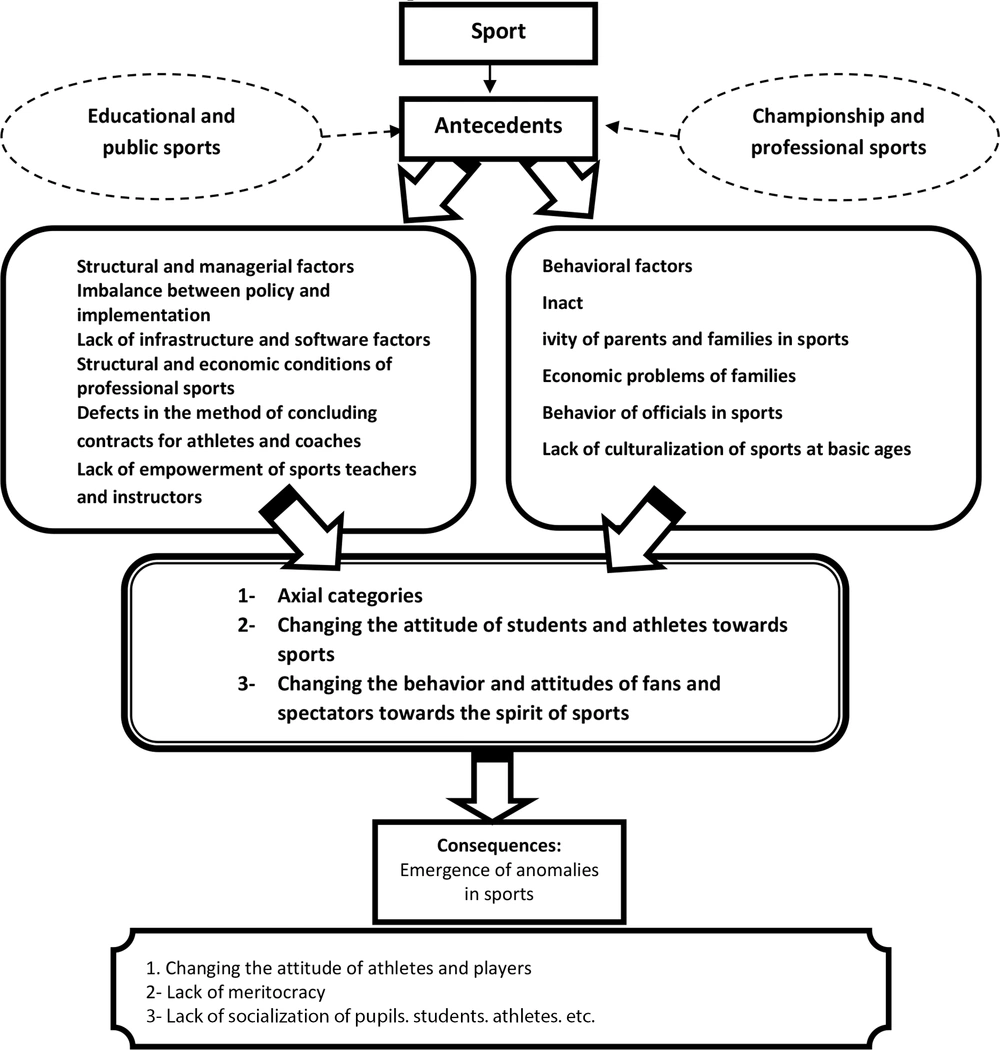
Figure 1.
Paradigm model of emergence of corruption and anomalies in hierarchical levels of sports in Iran with emphasis on human resources.
4.1. Axial and Selective Coding Results
After the open coding stage and extracting the key factors of anomalies in the country's sports arena based on axial and selective coding, the category or axes and then the relationships between categories were identified, and the results of open coding showed different factors for the emergence of anomalies. In the field of sports, they are divided into structural, managerial, and behavioral factors in the antecedents’ section (Table 2).
Table 2.
Results of Open Coding in the Analysis of Interviews for Sport
| Selected Codes | Dimensions |
|---|---|
| Antecedents: Structural and managerial factors | Imbalance between policy and implementation |
| Lack of infrastructure and software facilities | |
| Structural and economic conditions in sports | |
| Antecedents: Behavioral factors | Lack of family activity in sports |
| Problems of family economy | |
| The behavior of officials in sports | |
| Lack of sports culture | |
| Central category: Changing behaviors and attitudes, changing attitudes of adolescents and young people to sports | Consequences: Lack of meritocracy and lack of socialization |
4.1.1. Antecedents: Structural and Managerial Factors
These factors are the same infrastructural situations in sports that have been either neglected or not done properly due to their high cost and other macro conditions in the country's sports. In general, and according to the participants, the five factors in this group are among the anomalies in the country's sports arena, which cause attitude changes toward students, fans and spectators, etc., as follows:
- An imbalance between policy-making and implementation: This factor can be divided into three general categories: lack of proper implementation of cultural and sports events and festivals in schools, lack of proper implementation of national plans, and lack of proper holding of cultural and sports programs in schools and universities.
- Lack of infrastructure and software facilities: Interviewees expressed that factors such as lack of sports equipment, lack of safety in school yards/fields and environment, lack of minimal technologies for sports in schools and universities, lack of space for sports in each neighborhood and lack of space for sports in the workplace, were considered effective in the emergence of sports anomalies.
- Structural and economic conditions in professional sports: Experts interviewed mentioned other factors such as lack of privatization of professional sports clubs, lack of copyright laws for sponsorship in sports, lack of television rights to broadcast sports competitions, excessive turnover of sports managers' various departments, as well as the lack of effective supervision of some sports managers to coaches and athletes as a reason for the emergence of anomalies in Iran's sports.
- Defects in the method of concluding contracts for athletes and coaches: The results of this section showed that the interviewees stated factors such as defects in contracts of athletes and professional coaches: Short-term contracts, overpayment of some players and coaches, using and trusting unauthorized agents to sign contracts for players and coaches, the high turnover of players in the sports clubs is important in the occurrence of sports anomalies in the country.
- Lack of empowerment of sports teachers: Experts interviewed about other structural and managerial factors in sports pointed out the lack of empowerment of sports teachers. The general categories of this section include lack of provision of welfare for sports teachers, lack of appropriate in-service training for sports teachers, lack of implementation of professional development of sports teachers, and lack of proper use of teaching styles of sports teachers.
4.1.2. Antecedents: Behavioral Factors
In the section related to structural and managerial backgrounds, mainly infrastructural features were discussed. However, the interviewees mentioned in their interviews a set of four behavioral factors, along with five structural factors of the previous section, in occurrence with anomalies in the country's sports settings. They affect and change the attitudes of students, fans, spectators, and so on.
- Inactivity of parents and families in sports: Experts were interviewed about this factor, and four factors were identified: Lack of attention and information of parents to the participation of students in sports, decrease in physical activity and sports of parents, inappropriate parenting style, change in parents' attitudes from sports to home technologies have been found to be effective in creating sports anomalies.
- Economic problems of families: Other problems mentioned by the interviewees in their statements are related to the economic problems of families, such as hard work for families and fatigue, and unwillingness to exercise. Lack of proper time due to overwork of parents for sports and lack of sufficient income to register children in sports clubs are included.
- The behavior of officials in sports: Experts interviewed explicitly stated that the behavior of officials in sports, which includes excesses of officials in dealing with championship and professional athletes in the field of encouragement and punishment, imbalance in selection and talent discovery, lack of adequate official support for athletes, coaches and referees is a very important category in the occurrence of sports anomalies.
- Lack of culture-building of sports at early ages: The results of interviews from the relevant analysis and coding showed that this factor, general categories including lack of attention to ethics in basic sports, lack of moral and religious education in basic sports, and reduction and neglect of teaching the spirit of sports in adolescents.
4.1.3. Core Categories: Changing Behaviors and Attitudes
The results of the interviews showed that the center of gravity and center of occurrence of anomalies in Iran's sports arena is in the behavioral and attitudinal changes of students, coaches, fans, and spectators, which is the foundation that causes the anomalies in sports provided the results are mentioned in detail below:
- Changing the attitude of students and athletes in sports: According to the interviewees, precedents of anomalies in sports in the country mentioned earlier (structural and behavioral factors) cause changes in attitudes and behaviors in human resources in sports. General categories for attitudinal and behavioral changes are western attitudes and needs of adolescents and young people, the luxurious atmosphere of families, adolescents, and young people being influenced by peers and society, and attention to winning and losing instead of sportsmanship and ethics.
- Changing the behavior and attitude of fans, spectators, and society towards the spirit of sports: This factor is one of the main categories of anomalies in sports in Iran, which is divided into two main categories: Changing the tastes of fans, spectators, and society towards consequentialism, low social and economic status of spectators in stadium sports.
4.1.4. Consequences: Player Domination, Lack of Meritocracy, Lack of Socialization
All structural and behavioral antecedents, as well as the central categories and the center of gravity of occurrence of anomalies (change in attitude and behavior of society) cause anomalies to occur in the sports arena. According to the interviewees, examples of these anomalies in sports are player domination, lack of meritocracy, and lack of socialization. For this reason, the results of the analysis of the interviews in this section are presented in detail below:
- Player domination: A clear example of anomalies in Iran's sports is the same factor that has false confidence in professional players and champions, athletes are not familiar with the principles of professionalism and heroism, lack of proper training (culture-building) for players at basic ages, there is a lack of loyalty and sweat to your club.
- Incompetence: Interviewees for this factor share issues such as the use of incompetent people in sports management positions, the lack of sports experts and elites alongside teams and athletes, and the existence of rules related to the relationship between orbit and discipline, they said. According to the theory of scientific management, jobs and organizational work should be specialized, and specialists in each field should enter their field of specialization.
- Lack of socialization: From the perspective of participants and interviewees, the lack of sociability of sports students is another example of sports anomaly that has categories such as lack of attention to entrepreneurship and crafts and sports innovations in schools, the weakness of some among the teachers and professors in practical courses, lack of attention to internships in university is the inability of students at an individual level.
Therefore, structural and behavioral antecedents are mentioned as a center of gravity and focal point of behavior change and attitude cause abnormalities in sports, and this is a plague that spreads to other sections of society. The relationship between categories has been shown schematically in the form of a paradigm model of the occurrence of anomalies in the field of sports in Figure 1.
5. Discussion
As stated, the purpose of the study was to typologize the dimensions of corruption at the hierarchical levels of Iran's sports development. For this reason, after conducting the interviews through the qualitative method and data collection in grounded theory, the results of the analysis and a model were presented. The developed model was related to identifying the mechanism of corruption in sports, which is mainly discussed and concluded with challenging and comparative materials with previous research.
The research was designed to identify the general mechanism of occurrence of anomalies in sports in such a way that it included all four levels of educational sports, sports for all, championship sports, and professional sports. For this reason, the mechanisms of education and sport for all anomalies and the anomaly mechanisms of championship and professional sports have been integrated and analyzed. Initially, it was found that the imbalance between policy and implementation is one of the underlying factors for the occurrence of anomalies in sports. In this regard, school sports teachers and principals, as well as university professors, mentioned the gap created in program and performance as an abnormal factor or a background factor for the occurrence of abnormalities in sports. These plans include in-school Olympiads and the Sabah National Plan, each of which, for some reason, has not been able to be implemented. In fact, this factor reduces the participation of students in sports, and this factor is enough to start an anomaly in the sports community from the same educational environment. Of course, in this context, we can mention factors such as the lack of proper infrastructure, but the attitudes and activities of parents as one of the important social supporters and even students themselves are very important.
Also, other factors are a prerequisite for the occurrence of anomalies in lack of expertise of all sports teachers. Of course, in the past, this issue was more common because teachers in other fields were in the role of sports teachers, but with the hiring of specialized sports teachers in the last decade, this shortcoming was largely eliminated. However, the lack of empowerment of sports teachers should still be mentioned as an effective factor in the occurrence of anomalies in sports. Paying attention to sports teachers is important because they play the first and last role in educating infants, teenagers and youngsters, and if this role is right and in the right direction, people will be on the right path in the future, and anomalies will be reduced. Of course, most teachers feel that physical education and sports education in schools can be the basis for the growth and development of health in life. Many scientists believe that cultural development is a precondition for economic and social development. As long as a society does not achieve cultural development, development in other sectors will be difficult. For this reason, it is expected that increasing work conscience through cultural dimension based on the use of self-reflective job titles in physical education teachers will be an effective step in advancing an advanced society.
Although these issues have been raised in schools so far, students' attitudes are also critical to the emergence of anomalies in sports. In fact, one of the most important groups participating in sports programs and activities are students who participate in sports and entertainment programs as young people and active and self-taught learners with different goals and reasons (15). Thus, it is necessary to make this participation effective, and one of the methods of effectiveness and efficiency of students' sports activities is to know their perspectives and goals. Regardless of individual, family, social, economic, and past experiences, identifying students' motivations for orienting sports programs toward meeting those needs and achieving their goals is very constructive and helpful (16).
In addition, the transfer of managers in sports, players, and athletes, as well as sports coaches, is another scourge for anomalies, especially at the level of championship and professional sports. Various sources have paid attention to the dismissal of coaches from different angles, and many have examined the effect of the dismissal of coaches on the performance of club and have compared the performance and results of the club before and after the dismissal of coaches. Theories in this area can be presented in three general categories. The first approach, called the theory of common sense, involves clubs that, following poor performance and results, fire their coach and technical staff in the hope of an effective transfer, continuing competition while achieving more favorable results, and increasing performance. The second approach, called the vicious circle theory, describes the situation in which the club, following the results and poor performance, makes changes in technical staff and leadership of the team. These changes not only do not improve the situation but also achieve poor results. It turns out that the more he makes changes in technical staff, the worse the situation and performance, and the huge costs of moving coaches will be the only result of these events. The third approach, or theory of sacrifice, suggests that the performance and results of a club on the pitch are more influenced by the characteristics and quality of players than the coaches, and if the players do not have the necessary quality, a change in the technical staff will not be a solution. According to this theory, the club's owners and CEOs are aware of these cases in an attempt to divert public opinion and media, as well as appease the club's fans by dismissing the technical staff in order to put pressure on technical staff and team leadership. Media and fans should be removed from the shoulders of owners and CEOs of club. Interestingly, various studies have been conducted based on the same approaches that confirm existence of all three in sports clubs.
On the other hand, management instability in sports is also a factor in the occurrence of anomalies or perhaps anomalies in sports (17). There are various and contradictory theories about the impact of management changes on organizational performance that can be divided into three general categories. First, the approach of researchers who believed that changing the management of an organization has no effect on the performance of the organization. According to this theory, managers are removed from the board according to a routine in order to attribute improper performance and weaknesses of the organization to the fired manager. In this way, the transfer of managers can not eliminate weaknesses and problems of the organization and also will not worsen the performance of the club. According to the second approach, change of management not only does not benefit the organization in order to improve performance, but also weakens and harms the performance of the organization. Because the change of management of the organization disrupts established processes in the organization and due to stress and instability, the performance of the organization declines. This approach emphasizes that consequences of managerial changes may not appear in short term, but in the medium term, the performance of the organization is declining. The third approach is called the life cycle approach and is based on a belief that new managers improve the performance of the organization in the long run with new processes, work teams, and strategies.
As results and consequences of the central coding depicted, the main weakness of sports science students in universities is a lack of work experience. Therefore, in order to cover these two weaknesses, solutions were provided by interviewees that can reduce these anomalies to the extent that the universities have a unit as an internship. In this case, both the needs of the center will be met, and students will undergo fruitful internships. Therefore, sports experts also believe that infrastructure, as well as software resources at these levels of the country's sports, have not yet reached the desired level. In addition to these shortcomings in school and sports education, sports are no exception to this rule, and lack of privatization and copyright laws are also the cause of anomalies. Because many professional sports products belong to a club, and use of this unique product without the permission of owners of work is customarily and legally forbidden. Other economic conditions, such as the lack of television broadcasting rights, are another factor that poses many challenges.
Another point to consider is that the presence of intermediaries in athletes' contracts does not follow a principled mechanism. In psychological discussions, it has been confirmed that balance in individual, group, and organizational behavior is an inevitable principle, and if not well controlled, complications will have an anomaly. Changing the behavior of spectators in this category is so important that, from the point of view of interviewees provides the basis for the occurrence of anomalies in sports. Analysis of interviews showed that abnormal behaviors stem from wrong attitudes. This phenomenon reflects the culture of the same sport in advance.
Therefore, all of these antecedents that were discussed cause changes in the attitude of human resources in sports. Finally, these attitudes and behavioral changes can lead to abnormalities such as a lack of meritocracy, lack of socialization of students, and changes in the attitude of athletes and Bring player domination. In fact, what is clearly stated in the present study is that occurrence of corruption and anomalies does not occur subconsciously in sports environments but is a complex and internal process that develops over time in people and human resources in sports, and occurs after various stages. These findings clearly show that the process of combating corruption and anomalies should start from childhood in individuals, and most importantly, this process is not limited to sports organizations but all relevant institutions, especially education in involved schools in this process.