
1. Background
Posttraumatic stress disorder (PTSD) is a debilitating condition accompanied by some behavioral disorders, physical problems, and mental health maladjustments (e.g., depression and anxiety) (1). Categorized as an anxiety disorder, PTSD emerges as a result of an accident that usually surpasses a person’s experience tolerance (2). In different situations, people show different reactions, such as extreme fear, despair, or panic, to PTSD-causing stimuli (3). This disorder includes remembering an unpleasant experience while dreaming or being awake, repeatedly trying to avoid remembering the accident, or being unable to respond to such remembrances (4). It can also disrupt social-occupational performance or other important aspects of life (5). The repeated remembrances of wartime events, perceptions, and mental images can act as stimuli exacerbating mental discomfort. Overall, PTSD deteriorates the mental health of veterans over time (6).
Response inhibition is a variable of traumas in veterans with acute stress disorder. In fact, inhibition is among the most important operating actions and is considered a key concept in psychology (7). Inhibition refers to a person’s ability to avoid some cognitive or behavioral responses; hence, it is classified as cognitive inhibition and response inhibition (8). As the process of preventing irrelevant information from entering the working memory, cognitive inhibition includes a person’s ability to avoid, stop, or delay an action. In other words, response inhibition is a process of controlling motor behaviors, especially by preventing unwanted and reactive behaviors (9). Response inhibition includes three continuous processes: Dominant response inhibition, current response inhibition, and hesitation in response decision-making (10). Response inhibition is probably undetectable once it occurs, and a successfully inhibited response does not simply emerge as a behavior. Furthermore, response inhibition is a process that requires a relatively large amount of cognitive control and necessitates preparations for responsiveness and revision (11). Response inhibition causes veterans to remember and feel traumatic events again and experience attention bias for war emotional stimuli and certain symptoms such as pre-stimulation, unwanted thoughts, and wartime nightmares (12).
As a dynamic process responsible for a person’s positive matching with the environment, cognitive flexibility is an important factor in social interactions. In other words, despite traumatic and opposing experiences, a flexible person can adapt to changing environmental stimuli (13). Flexibility enables a person to appropriately and efficiently deal with pressure, challenges, and other emotional and social problems. The main element of cognitive flexibility is the ability to change cognitive sets to adapt to variable stimuli in the environment (14). Denoting distress tolerance, flexibility is defined as a person’s ability to cope with negative emotions (15). Individuals with low levels of distress tolerance presume emotion as an intolerable entity and deny its existence. Such people underestimate their abilities and do their best to avoid negative emotions, trying to alleviate themselves immediately (16). According to studies, many people traumatized by wars suffer from PTSD and experience low distress tolerance or emotional perception. Cognitive flexibility prepares a person to confront stressful problems and makes them resilient to stress (17).
Eye movement desensitization reprocessing (EMDR) therapy is a very effective method for treating people with PTSD. The EMDR method is a complicated and specialized therapeutic approach implemented to overcome the effects of emotional traumas and discomforting experiences (18). This approach necessitates recalling a stressful event from the past, reprogramming the mind, and replacing negative beliefs with positive, conscious beliefs that a person selects (19). In this method, the therapist asks the patient to visualize a distressing and annoying memory, keep it in mind, and focus simultaneously on an extrinsic stimulus, which is usually the therapist’s finger. The patient is then instructed to move his/her eyes in harmony with the therapist’s finger or the extrinsic stimulus (20, 21). Previous studies report the substantial effectiveness of EMDR therapy in alleviating PTSD in soldiers traumatized by wars (22-24).
Stressful events account for a considerable part of veterans’ lives. Having a physical defect, undergoing treatment, and needing to deal with such problems all the time can cause veterans to experience a spectrum of stressful events (25). Due to stressful physical problems, Iranian veterans also experience high levels of cognitive bias, response inhibition, as well as low levels of cognitive flexibility. They are also afflicted by such disorders due to the sustaining physical injuries and mental harm that befallen them in the Iran–Iraq War (26). Undoubtedly, it is essential to identify useful and effective solutions that can mitigate the impacts of handicaps on veterans.
2. Objectives
Based on the issues outlined in the background, the present study aimed to investigate the effectiveness of EMDR therapy in improving response inhibition and cognitive flexibility among veterans with PTSD.
3. Methods
This quasi-experimental research adopted a pretest-posttest follow-up control group design. The statistical population included all the veterans supported by the Foundation of Martyrs and Veterans Affairs (FMVA) in Ahvaz, Khuzestan Province (Iran), in 2021. The purposive sampling method was utilized to select 30 veterans visiting the psychological service provider centers affiliated with the FMVA of Ahvaz. They were then randomly assigned to an experimental group (n = 15) and a control group (n = 15), and EMDR therapy was implemented in the experimental group. Inclusion criteria were as follows: holding at least high school diplomas, age of 40 - 65 years old, signing a consent form for participation in the study, experiencing no stressful events (e.g., divorce and deaths of relatives) in the past three months, and undergoing no concurrent therapies. Exclusion criteria were as follows: taking psychiatric drugs during therapy implementation, refusing to complete data collection questionnaires, and missing more than two therapeutic sessions. After intervention, a posttest was conducted in both groups, and the follow-up step was then performed 45 days after the posttest.
3.1. Instrument
Stroop’s Color and Word Test of Response Inhibition Scale: This test measures the interference effects of colors and words. Based on attention processing response inhibition evaluation, this scale includes three cards: reading words (the first card), naming colors (the second card), and reading words without considering colors (the third card). The cards were randomly arranged in 10 rows, 10 columns, and 6 colors. This test consists of three phases. In the first phase, a few colors are randomly mentioned. The participant is supposed to read the words quickly with no mistakes. The same colors are painted in the second phase, and the participant is supposed to name them. In the third phase, the names of colors appear while the colors of the words differ from their background colors (e.g., blue is written in green) (27). In this case, the participant should ignore the words and only say the color. The test duration was measured quantitatively, and response times (in seconds) were employed to measure response inhibition.
Bond’s Cognitive Flexibility Questionnaire: The Acceptance and Action Questionnaire – Version 2 (AAQ–II) is a 10-item tool designed to evaluate psychological flexibility. This scale correlates with empirical avoidance and willingness to take action in the presence of unwanted thoughts and feelings. Participants respond to each item on a 7-point Likert scale. The first, sixth, and tenth items are scored inversely. After inverting these scores, the total score is determined by summing up all scores. Higher scores indicate lower levels of psychological flexibility and higher levels of empirical avoidance (28). Abasi et al. (29) reported the test-retest reliability coefficient of the Cognitive Flexibility Questionnaire as 0.89.
3.2. Intervention
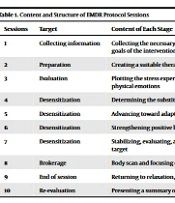
The EMDR intervention was implemented in ten 60-minute sessions for each individual twice a week. Table 1 presents an overview of these sessions.
Table 1.
The Content and Structure of Eye Movement Desensitization Reprocessing Therapeutic Sessions
| Step | Purpose | Content of Each Session |
|---|---|---|
| 1 | Information collection | Collecting the necessary information from patients, analyzing their beliefs, finding their safe zones, and setting the intervention’s objectives |
| 2 | Preparation | Creating an appropriate therapy space; teaching and explaining EMDR therapy |
| 3 | Evaluation | Drawing the experienced stress diagram displaying a few previous events until the time of the intervention and selecting a target image by patients, detecting physical feelings |
| 4 | Desensitization | Identifying alternative positive beliefs and the positive beliefs that patients like to be engaged with |
| 5 | Desensitization | Moving toward an adaptive solution, focusing on physical senses, emotions, and images, mitigating feelings of annoyance for the target |
| 6 | Desensitization | Enhancing positive beliefs; alleviating the feeling of annoyance; focusing on physical senses, emotions, and images |
| 7 | Desensitization | Fixing, analyzing, and improving the positive beliefs that the patient likes to replace; mitigating the feeling of annoyance for the target |
| 8 | Implementation | Performing a body scan and focusing on unpleasant physical senses or pain and trying to erase them |
| 9 | Finalization | Returning to the rest mode, analyzing multiple thoughts, emotions, and physical characteristics of patients simultaneously |
| 10 | Reevaluation | Presenting an overview of the therapy procedure and changes; reevaluating positive and negative beliefs; teaching coping skills |
3.3. Data Analysis
Descriptive statistics (e.g., mean and standard deviation) and inferential statistics (e.g., ANCOVA, post-hoc Bonferroni test, and its presumption tests) were used for data analysis in SPSS 24. The significance level was considered α = 0.05.
4. Results
In the experimental group, the means (± standard deviations) of response inhibition were 114.07 (± 5.09), 106.07 (± 5.28), and 105.47 (± 4.64) at the pretest, posttest, and follow-up, respectively (Table 2), and the means (± standard deviations) of cognitive flexibility at the respective timepoints were 36.93 (± 4.46), 41.93 (± 4.93), and 41.27 (± 4.49). In the control group, at the pretest, posttest, and follow-up, the means (± standard deviations) of response inhibition were 110.00 (± 5.07), 110.13 (± 4.79), and 109.60 (± 4.99), and the means (± standard deviations) of cognitive flexibility were 34.87 (± 5.08), 35.40 (± 4.45), and 35.53 (± 4.48), respectively.
Table 2.
Mean ± SD of Response Inhibition and Cognitive Flexibility in the Experimental and Control Groups in the Pretest, Posttest, and Follow-up
| Variables and Phases | Mean ± SD | |
|---|---|---|
| EMDR Group | Control Group | |
| Response inhibition (response time) | ||
| Pretest | 114.07 ± 5.09 | 110.00 ± 5.07 |
| Posttest | 106.07 ± 5.28 | 110.13 ± 4.79 |
| Follow-up | 105.47 ± 4.64 | 109.60 ± 4.99 |
| Cognitive flexibility | ||
| Pretest | 36.93 ± 4.46 | 34.87 ± 5.08 |
| Posttest | 41.93 ± 4.93 | 35.40 ± 4.45 |
| Follow-up | 41.27 ± 4.49 | 35.53 ± 4.48 |
Before data analysis in this study, Levene’s test confirmed the homogeneity of variances. In other words, the experimental group and the control group were homogeneous in terms of variances before the intervention (i.e., the pretest). According to Table 3, there were significant differences between the two groups in terms of response inhibition (response time) (F = 27.14, P < 0001) and cognitive flexibility (F = 46.26, P < 0.001) among veterans with PTSD.
Table 3.
Results of Analysis of Covariance for the Effects of Eye Movement Desensitization Reprocessing Therapy on Cognitive Bias
| Variables | SS | df | MS | F | P | η2 |
|---|---|---|---|---|---|---|
| Response inhibition (response time) | 307.49 | 2 | 153.74 | 27.14 | 0.001 | 0.59 |
| Cognitive flexibility | 283.21 | 2 | 141.60 | 46.26 | 0.001 | 0.70 |
There were significant differences between the pretest vs. posttest and pretest vs. follow-up in terms of response inhibition (response time) (P < 0.001) and cognitive flexibility (P < 0.05). However, no significant difference was observed between the post-test and follow-up phases (Table 4).
Table 4.
Results of Pairwise Comparison of Response Inhibition and Cognitive Flexibility Between the Posttest and Follow-up Phases
| Variables | Phase A | Phase B | Mean Difference (A-B) | SE | P |
|---|---|---|---|---|---|
| Response inhibition (response time) | Pretest | Posttest | - 8.00 | 1.89 | 0.001 |
| Follow-up | - 8.60 | 1.78 | 0.001 | ||
| Posttest | Follow-up | - 0.60 | 1.82 | 0.743 | |
| Cognitive flexibility | Pretest | Posttest | 5.00 | 1.72 | 0.007 |
| Follow-up | 4.34 | 1.63 | 0.013 | ||
| Posttest | Follow-up | - 0.66 | 1.72 | 0.704 |
5. Discussion
The present study aimed to investigate the effectiveness of EMDR therapy in improving response inhibition and cognitive flexibility among veterans with PTSD. The results proved that the EMDR method could improve cognitive flexibility and response inhibition (response time) in these individuals.
A few points should be taken into account to explain the effects of EMDR on cognitive flexibility and response inhibition. This method is based on Shapiro’s adaptive information processing model (23). As a fundamental hypothesis, this model can be considered an initial explanation regarding the effects of this therapy. Humans are assumed to have an innate physiological system programmed to process mental health information and recover mental health. Similarly, the body heals physiologically once it sustains physical damage. Life stressful events of life cause the formation of pathological patterns of emotions, behaviors, cognitions, feelings, and relevant structures. In fact, these pathological patterns occur because the relevant information is left unprocessed. Instead, the traumatic information is stored stagnantly and unsolved once a traumatic event happens. Previous annoying experiences are kept in a special state in the nervous system; thus, traumas are stuck or blocked in the physiology of nerves. In fact, psychological traumas persist after a disconcerting event because daily stimuli, negative feelings, and negative thoughts recall traumatic memories and make patients act in accordance with traumatic patterns (18). In other words, failure to properly process or solve problems would cause patients to react emotionally and behave in line with traumas. Once an individual is stuck in a special state of annoyance or stimulation, current events repeatedly trigger those traumas, which will be expressed as nightmares, flashbacks (i.e., recalling the past), annoying thoughts, and avoidance behaviors (23). Therefore, resolving this system and altering those memories will change personality traits.
For this purpose, saccadic eye movements are mainly employed in EMDR therapy to resolve the information processing system. This therapeutic method can probably open the locked nervous system, resembling what occurs in the rapid eye movement phase of dreams (19). Also, EMDR therapy is a method for managing disturbed memories. Once an unpleasant event occurs, the natural mechanisms of the body are affected by negative feelings. As a result, the mind is unable to completely process feelings, thoughts, and images related to that event. So, EMDR can greatly help patients process traumatic memories properly, mitigate their effects, and develop coping mechanisms to deal with those effects (21). This process is performed through an 8-step approach to address the past, present, and future aspects of memory and includes remembering bitter events at the time of receiving two-sided sensory inputs such as eye side movements, clapping, and making sounds. Moreover, EMDR therapy reactivates the natural healing power of the mind by establishing an interaction between the two hemispheres, thereby reprocessing information (24).
Eye movement can also separate the resultant stress from the emotional trauma; thus, an individual can revise and analyze the main event indifferently and regard it as watching a movie and its scenes. This state will also lead to the emergence of more natural and more spontaneous feelings through the cognitive reorganization of a traumatic event (23). The EMDR is a multifaceted approach consisting of cognitive, behavioral, and physical dimensions. Since memories are stored as different sensorimotor aspects, physical feelings, and visual images, the concurrent effects of this method on the mind, body, emotions, and feelings can be considered the reason for its success in helping patients. Although most therapists somehow look for the psychological roots of problems, EMDR therapy does not need the details of previous events to be restated (18). As a result, the re-experiencing of emotional trauma is very short-lived in this method, and memories are remembered simultaneously with cognitive processing, hindering patients from being deeply involved in their negative emotions.
5.1. Conclusions
We found that EMDR therapy improved cognitive flexibility and response inhibition (response time) in veterans suffering from PTSD. Therefore, it is advisable to adopt the EMDR method to enhance the psychiatric well-being of veterans with stress. Therapists are recommended to use EMDR therapy as a novel multidimensional technique in addition to other therapies to cure the psychological disorders of veterans. They should also prioritize this approach over other techniques for achieving better therapeutic outcomes in patients with psychological disorders.