



1. Background
Complex post-traumatic stress disorder (C-PTSD) is a severe psychological condition that typically develops following exposure to prolonged, repeated, or multiple traumatic events, such as early childhood neglect or interpersonal violence (1). Unlike standard post-traumatic stress disorder (PTSD), C-PTSD is characterized not only by core symptoms of re-experiencing and avoidance but also by profound disturbances in self-organization (DSO) (2). These disturbances include chronic emotional dysregulation, persistent feelings of worthlessness, and substantial difficulties in maintaining interpersonal relationships (3). Patients often experience a fragmented sense of self, leading to a pervasive inability to integrate traumatic experiences into their broader life narrative and resulting in long-term functional impairment across multiple life domains (4).
Autobiographical memory is a key cognitive-emotional factor in the maintenance of C-PTSD. Research indicates that individuals exposed to chronic trauma often exhibit overgeneral memory (OGM), a cognitive style in which specific past events are replaced by categorical or summarized recollections (5). This phenomenon functions as a maladaptive cognitive avoidance mechanism, preventing individuals from accessing painful episodic details. However, OGM also impairs effective problem-solving and emotional processing, leaving survivors trapped in a vague and distressing past (6). Restoring autobiographical memory specificity is therefore considered a vital component of therapeutic recovery because it facilitates cognitive restructuring and identity integration (7).
Somatization is a common and debilitating feature of C-PTSD that substantially impairs quality of life. Individuals with C-PTSD frequently experience medically unexplained somatic symptoms, including chronic pain, gastrointestinal complaints, and neurological disturbances (8). In the context of trauma, psychological distress often manifests as physiological hyperarousal and somatic symptoms (9). Studies have consistently shown that the severity of trauma exposure is positively correlated with the intensity of somatic symptoms, indicating that interventions targeting the mind-body connection may be particularly important (10, 11).
Meta-emotional therapy (MET) is a targeted intervention that focuses on meta-emotional awareness and the regulation of “emotions about emotions.” MET aims to enhance patients’ ability to identify, understand, and regulate their emotional responses to traumatic triggers (12). Previous research has shown that MET can effectively reduce emotional reactivity and improve self-regulation by addressing underlying cognitive-affective structures (13, 14). By fostering a more reflective stance toward emotional experiences, MET helps patients shift from being overwhelmed by trauma-related affect to becoming active observers and regulators of their internal states, a process that is particularly relevant to the self-regulatory deficits observed in C-PTSD (15).
Narrative exposure therapy (NET) is an evidence-based approach specifically designed for survivors of multiple and complex trauma. The core of NET involves constructing a chronological lifeline in which fragmented traumatic memories are woven into a coherent autobiographical narrative (16). By documenting “hot” traumatic memories alongside “cold” contextual information, NET facilitates habituation of fear responses and integration of the trauma into the individual’s life history (17). Literature reviews suggest that NET is particularly effective in reducing PTSD symptoms and improving cognitive clarity; however, its comparative efficacy compared with emotion-focused modalities such as MET in addressing specific outcomes, including somatization, remains an area of active scientific inquiry (18, 19).
The need for this research arises from the clinical complexity of C-PTSD, which often remains resistant to standard therapeutic protocols. Although NET primarily emphasizes narrative integration of memory and MET targets emotion-regulation mechanisms, direct comparative data on their relative efficacy for cognitive-memory deficits and physiological somatization are limited. Such evidence is essential for developing personalized treatment approaches for this population.
2. Objectives
The present study aimed to compare the efficacy of MET and NET in improving autobiographical memory and reducing somatization among individuals with C-PTSD.
3. Methods
3.1. Study Design and Setting
This randomized pretest-posttest-follow-up study employed a wait-list control group. Participants were recruited using convenience sampling and then randomly allocated to 3 study arms. The study was conducted in Ahvaz, Iran, in 2025.
3.2. Participants
The sample size was justified using an a priori power analysis conducted with G*Power software (version 3.1). The calculation was based on repeated-measures analysis of variance (ANOVA; within-between interaction), assuming a medium-to-large effect size (f = 0.35), α = 0.05, power = 0.80, and 3 groups with 3 measurement occasions. This yielded a minimum required total sample of 36 participants; therefore, 45 participants were recruited to account for potential attrition.
The statistical population comprised individuals diagnosed with C-PTSD. Using convenience sampling, 68 individuals from outpatient psychological clinics in Ahvaz, Iran, were screened. Of these, 52 met the inclusion criteria. Seven individuals declined to participate or did not complete baseline assessments, resulting in a final sample of 45 participants who were randomly assigned to 3 equal groups (n = 15 per group): MET, NET, and wait-list control.
Randomization was performed using a computer-generated sequence prepared by an independent statistician who was not involved in recruitment or assessment. Allocation concealment was ensured using sequentially numbered opaque envelopes. Inclusion criteria were as follows: 1) a definitive diagnosis of C-PTSD based on the International Trauma Questionnaire (ITQ), 2) age between 18 and 50 years, 3) at least a high school education, and 4) no concurrent psychological treatment. Exclusion criteria included comorbid psychotic disorders, active substance dependence, or missing more than 2 therapy sessions. All participants provided written informed consent after receiving a full explanation of the study procedures, potential risks and benefits, and their right to withdraw at any time.
3.3. Procedure
Of the 45 randomized participants, all completed the study, with no dropouts. All participants in the intervention groups attended at least 12 of the 14 sessions. Outcome assessments were conducted at pretest (before randomization), posttest (immediately after the intervention), and at the 2-month follow-up. Outcome assessors were blinded to participants’ group allocation. The procedure included initial screening via diagnostic interviews, administration of pretest assessments (AMT and PHQ-15), delivery of the 14-session therapeutic protocols for the experimental groups, immediate posttest evaluation, and the 2-month follow-up assessment.
3.4. Instruments
Autobiographical Memory Test: The AMT assesses the specificity of personal memories. It comprises 10 cue words (positive, negative, and neutral). Participants were asked to retrieve a specific event from their past that occurred at a particular time and place within 1 minute. Responses were audio-recorded and independently scored by 2 trained raters who were blinded to group allocation. Memories were coded as 1 (specific) or 0 (overgeneral or no response) according to established criteria. Interrater reliability was excellent (intraclass correlation coefficient = 0.89). Discrepancies were resolved through discussion and consensus. Total scores range from 0 to 10, with higher scores indicating greater memory specificity (20). In the current study, Cronbach’s α was 0.82.
Patient Health Questionnaire-15: Somatization was assessed using the PHQ-15, which screens for 15 somatic symptoms (eg, headache, gastrointestinal issues, and chronic pain). Items are scored on a 3-point Likert scale ranging from 0 (“not at all bothered”) to 2 (“bothered a lot”), with total scores ranging from 0 to 30. Scores are interpreted as minimal 0 - 4, low 5 - 9, moderate 10 - 14, and high 15 - 30 somatization severity (21). In this study, Cronbach’s α for the Persian version of the PHQ-15 was 0.87, indicating high internal consistency.
3.5. Intervention Programs
Both interventions were delivered by 2 licensed clinical psychologists, each with more than 8 years of experience in trauma-focused therapies. They received specialized training in the respective protocols before the study and were supervised weekly by a senior trauma specialist. Standardized treatment manuals were used for both interventions. Treatment fidelity was monitored by independent raters who reviewed 20% of randomly selected audio-recorded sessions using structured fidelity checklists. Adherence rates exceeded 90% for both MET and NET protocols. Session attendance was comparable between the 2 intervention groups (MET: mean, 13.4 sessions; NET: mean, 13.6 sessions).
Meta-Emotional Therapy: The MET protocol spanned 14 sessions and focused on “emotions about emotions.” Early sessions (sessions 1 - 4) emphasized psychoeducation and enhancing emotional awareness. Mid-sessions (sessions 5 - 8) involved labeling primary emotions and identifying maladaptive meta-emotional philosophies. Later sessions (sessions 9 - 14) used behavioral experiments and emotional alertness to challenge nonbeneficial metacognitive beliefs about coping strategies. The intervention concluded with relapse prevention and the development of a joint meta-emotional management plan.
Narrative Exposure Therapy: The NET protocol also consisted of 14 sessions designed to reconstruct the trauma narrative. The first 4 sessions involved the treatment rationale, trust-building, and construction of the lifeline, in which participants used symbols to represent significant life events chronologically. Sessions 5 through 12 focused on detailed narrative exposure, in which fragmented “hot” traumatic memories were integrated into “cold” contextual information through habituation. The final sessions (sessions 13 - 14) concluded with completion and signing of the written testimony, symbolizing the integration of past trauma into a coherent self-identity.
3.6. Data Analysis
Data were analyzed using repeated-measures ANOVA to evaluate the main effects of group and time and the group × time interaction, followed by Bonferroni post hoc tests for pairwise comparisons in SPSS version 26. Greenhouse-Geisser corrections were applied when the assumption of sphericity was violated. Partial eta-squared (η2p) was reported as the effect size measure. There were no missing data, and analyses were conducted on an intention-to-treat basis using all randomized participants. Confidence intervals (95% CI) are presented for key between-group differences in the Results section.
4. Results
The participants were 45 adults aged 18 - 50 years who were diagnosed with C-PTSD and recruited from outpatient psychological clinics in Ahvaz, Iran. The sample comprised 62% females, consistent with common patterns in trauma-related studies. All participants had at least a high school education, and none were receiving concurrent psychological treatment at baseline.
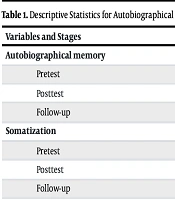
Means and standard deviations for autobiographical memory specificity (AMT scores) and somatization severity (PHQ-15 scores) across the 3 groups and measurement points are presented in Table 1. At pretest, the groups showed comparable baseline levels. After the interventions, notable improvements were observed in both experimental groups; these gains were largely maintained at the 2-month follow-up. The wait-list control group remained relatively stable across time points.
Table 1.Descriptive Statistics for Autobiographical Memory and Somatization Across Groups and Time Points a
| Variables and Stages | MET | NET | Control |
|---|---|---|---|
| Autobiographical memory | |||
| Pretest | 4.20 ± 0.94 | 4.13 ± 0.99 | 4.20 ± 0.94 |
| Posttest | 5.60 ± 1.29 | 6.93 ± 1.09 | 4.13 ± 0.83 |
| Follow-up | 5.53 ± 1.30 | 7.06 ± 1.27 | 4.06 ± 1.03 |
| Somatization | |||
| Pretest | 17.06 ± 2.49 | 16.60 ± 1.88 | 17.06 ± 1.98 |
| Posttest | 11.93 ± 2.52 | 14.06 ± 1.79 | 16.60 ± 2.19 |
| Follow-up | 11.26 ± 2.01 | 14.33 ± 1.87 | 16.93 ± 2.25 |
a Variables are expressed as mean ± SD. Abbreviations: MET, Meta-Emotional Therapy; NET, Narrative Exposure Therapy.
Before analysis, data were screened for statistical assumptions. Shapiro-Wilk tests confirmed normality for all variables across groups and time points (P > 0.05). Levene’s test indicated homogeneity of variances at each assessment phase (P > 0.05). Mauchly’s test of sphericity was significant; therefore, Greenhouse-Geisser corrections were applied.
Repeated-measures ANOVA revealed significant main effects of group and time, as well as significant group × time interactions, for both outcome variables (Table 2). Partial eta-squared (η2p) is reported as the effect size.
Table 2.Repeated-Measures ANOVA Results for Autobiographical Memory and Somatization
| Variables and Sources | SS | df | MS | F | P-Value | η2p |
|---|---|---|---|---|---|---|
| Autobiographical memory | ||||||
| Group | 82.19 | 2 | 41.09 | 13.82 | 0.001 | 0.40 |
| Time | 56.94 | 1.53 | 37.17 | 93.75 | 0.001 | 0.69 |
| Group × Time | 44.20 | 3.06 | 14.42 | 36.39 | 0.001 | 0.63 |
| Somatization | ||||||
| Group | 267.57 | 2 | 13.78 | 16.38 | 0.001 | 0.44 |
| Time | 222.32 | 1.20 | 183.94 | 51.08 | 0.001 | 0.49 |
| Group × Time | 139.71 | 2.41 | 57.79 | 12.90 | 0.001 | 0.38 |
Post hoc pairwise comparisons with Bonferroni adjustment examined changes within and between groups across time points (Tables 3 and 4). For key between-group differences at posttest, 95% CIs are also reported. No missing data were present, and all analyses were conducted on an intention-to-treat basis.
Table 3.Pairwise Comparisons of Time Points Within Each Group (Bonferroni-Adjusted) a
| Variables | Time Comparison | MET Mean Diff (P) | NET Mean Diff (P) | Control Mean Diff (P) |
|---|---|---|---|---|
| Autobiographical memory | ||||
| Posttest - Pretest | 1.40 (<0.001) | 2.80 (<0.001) | -0.07 (0.790) | |
| Follow-up - Pretest | 1.33 (<0.001) | 2.93 (<0.001) | -0.14 (0.596) | |
| Follow-up - Posttest | -0.07 (0.812) | 0.13 (0.678) | -0.07 (0.812) | |
| Somatization | ||||
| Posttest - Pretest | -5.13 (<0.001) | -2.54 (<0.001) | -0.46 (0.432) | |
| Follow-up - Pretest | -5.80 (<0.001) | -2.27 (<0.001) | -0.13 (0.784) | |
| Follow-up - Posttest | -0.67 (0.120) | 0.27 (0.571) | 0.33 (0.571) |
a Abbreviations: MET, Meta-Emotional Therapy; NET, Narrative Exposure Therapy.
Table 4.Pairwise Between-Group Comparisons at Each Time Point (Bonferroni-Adjusted) a
| Variables and Group Comparisons | Pretest Mean Diff (P) | Posttest Mean Diff (P) [95% CI] | Follow-up Mean Diff (P) [95% CI] |
|---|---|---|---|
| Autobiographical memory | |||
| MET - NET | 0.07 (0.912) | -1.33 (< 0.001) [–1.94, –0.72] | -1.53 (< 0.001) [–2.49, –0.57] |
| MET - Control | 0.00 (1.000) | 1.47 (< 0.001) [0.59, 2.35] | 1.47 (< 0.001) [0.59, 2.35] |
| NET - Control | -0.07 (0.912) | 2.80 (< 0.001) [2.19, 3.41] | 3.00 (< 0.001) [2.14, 3.86] |
| Somatization | |||
| MET - NET | 0.46 (0.784) | -2.13 (0.012) [–3.82, –0.44] | -3.07 (< 0.001) [–4.52, –1.62] |
| MET - Control | 0.00 (1.000) | -4.67 (< 0.001) [–6.27, –3.07] | -5.67 (< 0.001) [–7.27, –4.07] |
| NET - Control | -0.46 (0.784) | -2.54 (< 0.001) [–3.74, –1.34] | -2.60 (< 0.001) [–4.15, –1.05] |
a Abbreviations: MET, Meta-Emotional Therapy; NET, Narrative Exposure Therapy.
5. Discussion
The primary objective of this study was to compare the efficacy of MET and NET in improving autobiographical memory specificity and reducing somatization in individuals with C-PTSD. The results indicated that both interventions produced significant improvements compared with the wait-list control group. However, the 2 approaches demonstrated differential strengths across outcome domains. Specifically, NET showed superior efficacy in enhancing autobiographical memory specificity, whereas MET was significantly more effective than NET in reducing somatization symptoms.
NET’s superior performance in improving autobiographical memory specificity is consistent with its core mechanism of chronological narrative construction and integration of fragmented traumatic memories. Individuals with C-PTSD frequently exhibit OGM as a cognitive avoidance strategy (22). NET facilitates the transition from sensory-bound “hot” memories to contextualized “cold” memories through repeated narrative exposure within a coherent life story. These findings are consistent with previous research on narrative-based interventions for trauma (16, 23).
In contrast, MET demonstrated greater effectiveness in alleviating somatization symptoms. This advantage likely stems from MET’s emphasis on meta-emotional awareness and the modification of maladaptive beliefs about emotions (24). By helping patients adopt a more reflective and less reactive stance toward their internal experiences, MET appears to reduce the physiological hyperarousal underlying many somatic complaints in C-PTSD (13, 14, 25).
Taken together, these results suggest functional specialization between the 2 therapies. NET appears particularly beneficial for cognitive-memory restructuring, whereas MET shows stronger effects on the affective-somatic dimension. These differential effects support a symptom-matched or sequenced treatment approach rather than a one-size-fits-all model for complex trauma.
5.1. Study Limitations
Several limitations should be acknowledged. First, although the sample size was justified by an a priori power analysis, the relatively small number of participants limits statistical precision and may inflate effect size estimates; therefore, replication in larger samples is warranted. Second, convenience sampling from a single city (Ahvaz, Iran) restricts the generalizability of the findings to other cultural and clinical contexts. Third, the follow-up period was limited to 2 months; thus, the long-term durability of treatment gains remains unknown. Finally, although the study used random allocation, causal inferences should be made with appropriate caution. Future research should employ multicenter randomized controlled trials with larger, more diverse samples, longer follow-up periods, and active control conditions to further validate and extend these findings.
5.2. Conclusions
This randomized study demonstrated that both MET and NET yielded significant and sustained improvements in individuals with C-PTSD compared with a wait-list control. Nevertheless, the interventions showed complementary strengths: NET was more effective in restoring autobiographical memory specificity, consistent with its focus on narrative integration, whereas MET demonstrated greater efficacy in reducing somatization symptoms through enhanced meta-emotional regulation. These differential effects underscore the importance of tailoring psychological interventions to the predominant symptom profiles of patients with complex trauma. Further research on combined or sequential applications of MET and NET is recommended.