



1. Background
Road traffic injuries (RTI) are one of the leading causes of morbidity and mortality around the world (1). RTIs affect all regions of the world, especially low to middle-income countries, and its worldwide distribution is alarming. It is the fourth leading cause of years of life lost in the Middle Eastern countries (2). All traffic-related fatalities are important, but in low-income and developing countries, these kinds of fatalities occur mostly among pedestrians and motorcyclists (3). Iran is among the top five countries with the highest road traffic fatality rates in the world (4). In countries such as Iran, motorcycles and motorcyclists are always an integral part of traffic-related issues. The structural characteristics of motorcycles are a reason for the higher rate of injury among motorcyclists than among other motor vehicle drivers (5).
Motorcyclists comprise one of the most vulnerable groups in road traffic injuries. The unsafe nature of this vehicle and its increasing use among the youth can justify its association with the high road traffic injuries (6). In Iran, most motorcycle crashes leading to death and injury occur in crowded city streets and in a significant number of those cases, motorcyclists were at fault (6). In addition to the high rate of motorcycle crashes, a number of other factors contribute to the increased rate of fatality, including failure to use protective gears, non-compliance of manufacturers with technical safety standards, and the relatively long time that it takes to get the injured parties to a hospital (7).
In Iran, motorcyclists are involved in 51% of all the road injuries leading to death or hospitalization (8). Furthermore, motorcyclists comprise the highest proportion of victims in the city and rural streets (9). A large number of bikers suffer blows to the head in fatal injuries, consequently leading to intracranial hemorrhage. Among the injuries that bikers suffer are severe traumas to legs, especially knees, which usually result in serious damages (10). Various studies have revealed a higher frequency of injuries and fatalities among motorcyclists than in other vehicle drivers (11-13). Evidence suggests that the increasing number of motor vehicles, increasing sale facilitation policies, having a relatively young population, and being attracted to motorcycles have led to an increase in production, sale, and use of this type of vehicle in our country during the past decade. Subsequently, there has been a significant increase in the number of crashes leading to death, injury, and damages, in which the motorcyclists were at fault (14).
For this reason, the researchers believe that motorcyclists have to be given priority during interventions in order to reduce the number of injuries and deaths in crashes (15). Since motorcyclists are usually young, active individuals and usually come from lower and middle-income classes, being involved in a crash would impose high medical expenses on their families, which would cause issues aside from the pain and suffering due to injuries (16). Although the frequency of motorcycle crashes and the increased severity of injuries and deaths from traumas have been compared with other road users in numerous studies (17), appropriate policy to reduce motorcycle crashes still requires precise knowledge to reduce motorcycle-related crashes. Therefore, we ought to pay special attention to the damages caused by motorcycle crashes, and to do so, we need to have adequate information about the epidemiology of these injuries. In the present study, we aimed to determine the epidemiology of road traffic injuries among motorcyclists referring to Shahid Rajaee Hospital, Shiraz, in 2013 - 2016. The hospital is located in the northwest of the city and because of the admirable performance of its emergency and surgical wards, almost all road traffic injuries are referred to this hospital. Shahid Rajaee Hospital is a known emergency referral center in Shiraz.
2. Methods
This was a descriptive-analytical cross-sectional study. The research population included all motorcyclists with crash-related injuries undergoing treatment in Shahid Rajaee Hospital in 2013 - 2016. We used the census method to evaluate all injured motorcyclists based on age, gender, the severity of the injury, injured site, length of hospital stay, and hospital-acquired infections.
We collected data of each patient in two separate stages during the course of hospitalization. After the initial assessment in the triage ward, the reception unit assigned an eight-digit code to each patient for future use during the hospitalization. Data were collected using a questionnaire based on the ICD-10 (International Classification of Diseases, 10th revision) code set published by the World Health Organization (WHO), which included demographic and personal information, as well as information on the type of trauma. To evaluate the severity of traumas in each patient, we used the injury severity score (ISS) (18); this scoring system divides the body into different regions of the head and neck, face, thorax, abdomen, and extremities. To calculate an ISS, we first assigned to each body’s region the highest abbreviated injury scale (AIS) severity code based on the severity and type of injury. Then, we picked up the three highest scores and added their squared numbers; the final score was a number between 1 and 75, where the scores of lower than eight indicated minor, between 8 and 15 indicated moderate, and higher than 15 indicated severe injuries (19). The questionnaires were filled out during face-to-face interviews or using data extracted from patients’ records.
Statistical analysis was performed using descriptive and analytical statistics in two separate stages using SPSS V. 24. Descriptive data were presented as means and standard deviations using tables and charts, and analytical data were obtained by the chi-square test and independent t-test. The indicator of odds ratio (OR) and a confidence interval (CI) were used to measure the risk of fatality. Furthermore, studied factors affecting crash-related deaths and injuries were modeled by the logistic regression model. The significance level was set at 0.05. This study was conducted in accordance with ethical principles and approved by the vice presidency for research affairs at the Shiraz University of Medical Sciences.
3. Results
Overall, 19.5% of all road traffic injuries involved motorcyclists. Our results revealed 185.05 crashes per 100000 population in Shiraz. The year 2014 had the highest incidence rate with 227.6 crashes per 100000 and the lowest incidence rate belonged to the year 2013 with 110.9 crashes per 100000, of which 13577 (91.5%) involved men and 1258 (8.5%) women. The mean age of motorcycle injuries was 29.7 ± 13.34 years. The mean age of men involved in motorcycle injuries was 29.16 ± 13.1 while it was 35.52 ± 14.42 years for women, showing a statistically significant difference (P < 0.001).
According to the results in Table 1, based on the time of the day, the highest frequency belonged to extremity injuries occurring during nighttime with 2092 cases (41.7%), and the lowest frequency pertained to face injuries in the morning with 89 cases (2.6%). Regarding gender, the highest frequency was related to extremity injuries in men with 5129 cases (44.5%) while face injuries among women had the lowest frequency with 18 cases (1.8%). In terms of age, traumas to extremities had the highest frequency in the 25 - 34-year-old age group with 1515 cases (42.7%), and the lowest frequency pertained to face injuries in the age group of over 65 with six cases (1.8%). According to Table 1, the variables of age, gender, and the time of occurrence in the day showed to have a significant effect in this regard.
Table 1.Frequency Distribution of Injury Types Based on the Time of Occurrence in the Day, Gender, and Age Groupsa
| Region of Injury Variable | Head and Neck | Extremity | Thorax | Abdomen | Face | Total | P Value |
|---|---|---|---|---|---|---|---|
| Time of occurrence in the day | < 0.001 | ||||||
| 6 - 14 (morning) | 1199 (35.6) | 1513 (45.0) | 173 (5.1) | 390 (11.6) | 89 (2.6) | 3364 | |
| 14 - 22 (evening) | 1495 (35.8) | 1916 (45.9) | 227 (5.4) | 432 (10.4) | 102 (2.4) | 4172 | |
| 22 - 6 (night-time) | 2058 (41.1) | 2092 (41.7) | 228 (4.5) | 481 (9.6) | 152 (3.0) | 5011 | |
| Gender | < 0.001 | ||||||
| Female | 400 (38.9) | 392 (38.1) | 67 (6.5) | 151 (14.7) | 18 (1.8) | 1028 | |
| Male | 4352 (37.8) | 5129 (44.5) | 561 (4.9) | 1152 (10.0) | 325 (2.8) | 11519 | |
| Age group | < 0.001 | ||||||
| 15 - 24 | 2176 (37.8) | 2571 (44.7) | 214 (3.7) | 621 (10.8) | 168 (2.9) | 5750 | |
| 25 - 34 | 1266 (37.1) | 1515 (44.4) | 172 (5.0) | 371 (10.9) | 86 (2.5) | 3410 | |
| 35 - 44 | 514 (38.9) | 565 (42.7) | 91 (6.9) | 116 (8.8) | 37 (2.8) | 1323 | |
| 45 - 54 | 355 (35.8) | 440 (44.4) | 75 (7.6) | 98 (9.9) | 23 (2.3) | 991 | |
| 55 - 64 | 208 (37.9) | 242 (44.1) | 40 (7.3) | 47 (8.6) | 12 (2.2) | 549 | |
| > 65 | 147 (44.4) | 127 (38.4) | 26 (7.9) | 25 (7.6) | 6 (1.8) | 331 |
a Values are expressed as frequency (%).
According to Table 2, the highest frequency of injuries belonged to the age group of 15 - 24, out of which 38.3% were hospitalized for less than 24 hours. Our gender-based assessments revealed that most victims were men who were hospitalized for less than 24 hours, and the lowest frequency pertained to women who stayed in the hospital for over one month after the crash. Among patients hospitalized for less than 24 hours, head and neck injuries had the highest frequency, and the lowest frequency was related to injuries to the face. In terms of ISS, among the patients hospitalized for over one month, individuals with an ISS of over 25 had the highest frequency and individuals with an ISS of 1 - 3 were the least frequent. Among victims who were hospitalized for less than 24 hours, individuals with an ISS of 1 - 3 were the most and individuals with an ISS of 9 - 15 were the least frequent ones.
Table 2.Frequency Distribution of the Length of Hospital Stay Based on the Time of the Crash in Age Groups, Gender, the Region of Injury, and ISSa
| Length of Hospital Stay Variable | Less Than 24 Hours | 24 - 48 Hours | 48 Hours - One Week | One Week - One Month | Over One Month | Total | P Value |
|---|---|---|---|---|---|---|---|
| Age group | < 0.001 | ||||||
| 15 - 24 | 2627 | 1897 | 1276 | 991 | 71 | 6862 | |
| 25 - 34 | 1641 | 1093 | 680 | 556 | 69 | 4039 | |
| 35 - 44 | 548 | 405 | 302 | 238 | 23 | 1516 | |
| 45 - 54 | 405 | 315 | 218 | 199 | 20 | 1157 | |
| 55 - 64 | 218 | 194 | 105 | 107 | 13 | 637 | |
| > 65 | 127 | 105 | 78 | 77 | 13 | 400 | |
| Gender | < 0.001 | ||||||
| Female | 642 | 369 | 129 | 108 | 10 | 1258 | |
| Male | 5020 | 3694 | 2576 | 2087 | 200 | 13577 | |
| Region of injury | < 0.001 | ||||||
| Head and neck | 1906 | 1323 | 797 | 629 | 97 | 4752 | |
| Extremity | 1455 | 1408 | 1414 | 1192 | 52 | 5521 | |
| Thorax | 255 | 204 | 87 | 71 | 11 | 628 | |
| Abdomen | 613 | 404 | 166 | 109 | 11 | 1303 | |
| Face | 58 | 106 | 104 | 69 | 97 | 343 | |
| ISS | < 0.001 | ||||||
| 1 - 3 | 956 | 578 | 276 | 98 | 6 | 1914 | |
| 4 - 8 | 565 | 1342 | 1476 | 1332 | 86 | 4801 | |
| 9 - 15 | 42 | 61 | 49 | 54 | 2 | 208 | |
| 16 - 24 | 131 | 274 | 405 | 353 | 55 | 1218 | |
| > 25 | 76 | 132 | 220 | 204 | 24 | 656 |
a Values are expressed as frequency (%).
As shown in Figure 1, there is an increase in the number of crashes at the beginning of spring; this increasing trend continues until the end of spring. We can also see a slight decrease in the number of injuries at the beginning of summer, which increases again by the end of summer and continues to increase until the beginning of autumn. Motorcycle crashes then start to decline by the end of autumn, a course which continues until the end of winter.
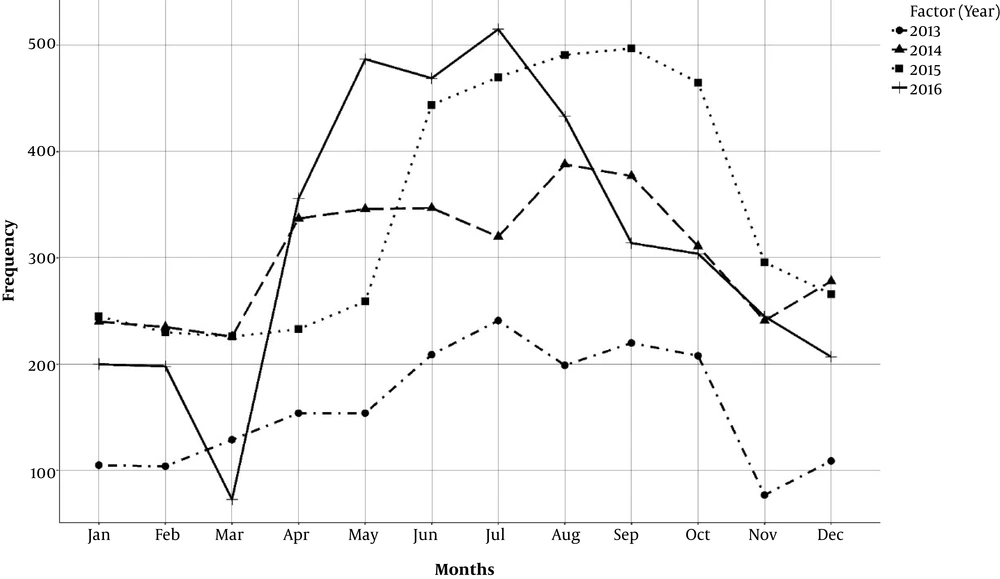
Figure 1.
Month trend of motorcycle crash occurrence by year
3.1. Estimating the Risk of Death in Motorcycle Crashes Based on a Logistic Regression Model
The study variables were entered into the model using the forward method. The variables remaining in the final regression model included age, length of hospital stay, injury site, ISS, and the time of admission. They are presented in a separate table. As shown in Table 3, the odds of mortality were significantly influenced by age. The odds of mortality were 45% higher in the age group of 30 - 44 than in the 15 - 29 age group and they were increased by 2.03 times in the 45 - 59 age group compared to the baseline. Mortality was 3.21 times higher in the elderly than in the youth. Patients hospitalized for over one month were five times more at risk of death than patients who were hospitalized for less than 24 hours. In terms of the injury site, patients with traumas to abdomen and extremities had significantly fewer odds of mortality than people with head and neck injuries by 83% and 92%, respectively. As can be seen in Table 3, with a unit increase in ISS, the risk of motorcycle mortality significantly increases by 4%.
Table 3.Estimation of Mortality Risk Caused by Motorcycle Crashes Based on Age Groups, Length of Hospital Stay, the Region of Injury, and ISS
| Variable | OR | Adjusted OR | Confidence Interval | P Value |
|---|---|---|---|---|
| Age group | ||||
| 15 - 29 | 1 | 1 | ||
| 30 - 44 | 1.40 | 1.45 | 0.94 - 2.23 | 0.047 |
| 45 - 59 | 2.05 | 2.03 | 1.25 - 3.34 | 0.004 |
| > 60 | 4.67 | 3.21 | 1.8 - 5.45 | < 0.001 |
| Length of hospital stay | ||||
| Less than 24 hours | 1 | 1 | ||
| 24 - 48 hours | 1.8 | 1.02 | 0.62 - 2.32 | 0.58 |
| 48 hours-one week | 2.6 | 0.98 | 0.5 - 1.91 | 0.96 |
| one week- one month | 3.94 | 1.68 | 0.89 - 18.3 | 0.1 |
| Over one month | 20 | 4.93 | 2.32 - 10.46 | < 0.001 |
| Region of injury | ||||
| Head and neck | 1 | 1 | ||
| Extremities | 0.08 | 0.08 | 0.04 - 0.14 | < 0.001 |
| Thorax | 0.41 | 0.5 | 0.22 - 1.11 | 0.09 |
| Abdomen | 0.17 | 0.43 | 0.2 - 0.96 | 0.04 |
| Face | 0.04 | 0.03 | 0 | 0.09 |
| ISS | 1.1 | 1.04 | 1.01 - 1.07 | < 0.001 |
4. Discussion
Our results showed that 19.5% of all road traffic injuries in Shiraz were related to motorcyclists. There was an average of 185.05 motorcycle crashes per every 10000 citizens in Shiraz. Men were more involved in motorcycle crashes than women. The ratio of male to female mortality was reported to be 10.76. It is worth mentioning that the population of women and men in Iran is almost the same. Yadollahi et al. (19) and Khorshidi et al. (20) reported that motorcycle crashes were involved in 16.7% and 25% of all road traffic injuries, respectively. In 2013, Gholamaliee et al. showed that the incidence of motorcycle crashes was 25.52 per every 10000 individuals in Fars province (Shiraz is the capital of Fars province); the male/female mortality ratio was reported to be 9.5 in this study (8). Numerous studies have evaluated the ratio of male to female populations involved in motorcycle crashes, all of which showed that men were more involved than women (21-23). This general gender-related difference could be due to physical and behavioral differences or other factors such as occupation, awareness and emotional status, economic condition, daily and recreational activities, and sociocultural conditions. Indeed, men are more involved with out-of-home jobs than women and they show more risky behaviors while crossing the street. Moreover, women rarely ride a motorcycle in Iran and in most motorcycle crashes, women were the passengers.
Our results revealed that most cases of motorcycle-related traumas happened among the age group of 15 - 29 adjusted by population. Khorshidi et al. stated that nearly half of motorcycle crashes happened in the age group of 20 - 29 (20). This is also in line with a number of Iranian studies conducted in Urmia and Mashhad and a Chinese one (22, 24, 25). The results from another study indicated that young motorcyclists are at higher risks because they do not obey the laws as much as other age groups do (11). Of course, these results were expectable because the youth show more emotional and risky behaviors, do not comply with the laws, have easier access to motorcycles, and are more likely to ride under the influence of narcotic drugs or alcohol. Concerning population mortality, there was no difference between the populations of men and women, but it was shown that the age group of 15 - 29 had the highest level of mortality.
The results showed that motorcycle crashes mostly occurred during summer, followed by spring. In line with our study, Khorshidi et al. also showed that most motorcycle crashes happened during summer (20). The increased number of motorcycle crashes in summer could be attributed to the increased use of motorcycles as a result of rising temperature or summer holidays of schools and universities. Our results also revealed that most crashes happened during the weekends, and around 40% of the injuries took place during the nighttime. We also found that extremities and head/neck were the sites mostly injured in crashes, comprising 37.2 and 32% of all injuries, respectively. A study in Malaysia showed that motorcyclists comprised 80% of the road traffic victims, who mostly had traumas to the head, thorax, and legs; it also found that most fatalities were due to head injuries (26). Rezazadeh et al. stated that most bikers suffered traumas to the extremities (arms and legs), followed by injuries to the head and neck (27-29). The present study revealed that patients who were hospitalized for over one month mostly suffered head and neck injuries, which resulted in a long hospitalization of the motorcyclists and their passengers. Moreover, patients with an ISS of higher than 15 had significantly a longer stay in the hospital than other patients. Moreover, the results showed that age is an effective risk factor for motorcycle-related fatality. In this regard, the risk of death increased by 2% with each year increase in age. The length of hospital stay, injury site, and ISS had significant effects on the risk of fatality caused by motorcycle crashes. The highest risk of fatality belonged to patients who were hospitalized for more than one month, followed by patients who were hospitalized between one week and one month. In terms of ISS, the highest risk of death was related to patients with an ISS of 9 - 15; these victims were 7.5 times more susceptible to death than patients with an ISS of 0 - 8.
There is a disturbing number of motorcycle crashes in Shiraz, possibly due to the increased use of this vehicle and the overcrowded streets. Our study was the first to present an epidemiologic pattern for motorcycle crashes in Fars province, which is a strength for this study. This is one of the few studies that has evaluated the state of motorcycle crashes in Shiraz in the past few years. Therefore, our results can be used as a basis for determining the trend of motorcycle crashes in the upcoming years and assessing the effectiveness of taken measures to reduce road traffic injuries among bikers. It seems that research to determine the number of motorists will provide more information about death caused by motorcycle crashes. This study can pave the way to develop theories on the reasons behind the high incidence of motorcycle crashes and encourage researchers to find these reasons. Moreover, due to the higher incidence of fatal motorcycle crashes, we propose a higher level of supervision on these motor vehicles. We also advise stricter law enforcement for helmet use, riding licenses, third-party insurance, and the maximum number of passengers. As a study limitation, we only used information about road traffic victims who had referred to Shahid Rajaee Hospital and neglected the cases referring to other healthcare centers in Shiraz. Therefore, we suggest that future studies include all data in their assessments. Furthermore, the effect of educational programs should be evaluated on the prevention of motorcycle injuries in future studies.
4.1. Conclusions
Overall, the results showed that motorcycle crashes and related deaths increase in warm seasons (spring and summer) and they reduce during cold seasons. Factors, such as age, length of hospitalization, injury site, and ISS, were significant risk factors for death due to motorcycle crashes. Since motorcycle riders had higher levels of severe injuries, we propose to enforce stricter laws for helmet use and riding license.


