


1. Introduction
We observe that increasing hospital efficiency in dealing with systemic challenges requires innovative analytical approaches. A seminal World Health Organization (WHO) report identified 10 critical sources of hospital inefficiency, including inappropriate workforce allocation (1), medical errors (2), wasteful resource utilization (3), and suboptimal care quality (4). These inefficiencies are not merely theoretical; studies reveal tangible consequences: (25%) of ICU beds in U.S. hospitals remain unused annually due to poor scheduling (5), directly increasing medical errors and patient dissatisfaction. Such issues collectively cost healthcare systems billions annually (6) and underscore the limitations of traditional management methods in addressing interconnected, dynamic challenges (4).
Simulation is used as a solution for complexities and offers unique capabilities for modeling, analyzing, and optimizing healthcare systems. Among its most powerful methodologies is system dynamics (SD), a computational framework that treats hospitals as dynamic ecosystems with interconnected components: patient flow (7), staffing, resource allocation (5), and policy implementation (8). By simulating nonlinear interactions, feedback loops, and time delays (1, 9), these models reveal hidden inefficiencies that conventional approaches overlook. For instance, simulations using SD in Italy reduced emergency department wait times by (30%) through optimized bed reallocation policies (2), while during COVID-19, system dynamics-driven simulations improved ICU bed allocation accuracy by aligning staffing levels with admission surges (10, 11). These successes stem from simulation’s ability to map how localized changes (e.g., adjusting discharge protocols) propagate across departments, exposing unintended consequences and enabling proactive interventions (7, 12). Simulation mechanisms, such as reinforcing feedback loops in system dynamics (e.g., increasing patient demand that intensifies waiting times) and balancing loops (e.g., discharge forecasting that stabilizes bed occupancy), provide practical insights into hospital behaviors (13). Simulation tools like SD, by integrating data and providing scenarios, enable policymakers to design strategies that align operational efficiency with hospital goals.
This article focuses on SD as a key method for addressing the complexities of healthcare, serving as an evidence-based decision-making tool for today's dynamic challenges.
2. Application of System Dynamics in Hospitals
System dynamics provides a robust framework for addressing the complexities of hospital operations, streamlining processes to improve patient care and optimize resource management (9). Given their intricate networks of patients, staff, resources, and departments, hospitals are ideal for implementing system dynamics to tackle challenges and improve outcomes. Key applications include:
2.1. Understanding Patient Flow through System Dynamics
Efficient patient flow is crucial for high-quality healthcare, and SD provides tools for analyzing and optimizing this process (14). By modeling the patient pathway from admission to discharge, bottlenecks and inefficiencies can be identified, reducing waiting times and improving patient satisfaction (8). Simulation tools predict how changes in patient numbers, staffing, and resources affect flow, allowing for operational adjustments (14). Data analysis monitors key performance indicators, while predictive modeling helps forecast patient needs, ensuring adequate staffing and resources. System dynamics fosters inter-departmental collaboration, providing innovative solutions through regular cross-disciplinary meetings (7, 9).
2.2. Effective Resource Allocation in Hospitals
System dynamics is essential for optimizing resource allocation in hospitals, increasing the quality of care while minimizing costs (15). By modeling scenarios in critical areas such as operating rooms and staffing, hospitals can precisely adjust schedules and inventory to ensure resource availability when needed (5). Advanced analytics and real-time data, including electronic health records, allow hospitals to predict patient influx and proactively adjust operations, managing overstaffing or resource shortages during periods of high demand. This approach fosters continuous improvement through regular performance reviews and analysis of patient outcomes, enabling adaptation to changing needs (16).
2.3. Enhanced Bed Occupancy Management in Hospitals
Effective bed occupancy management is crucial for hospital efficiency and patient care. System dynamics improves this process by monitoring bed availability, predicting peak admission periods, and discharge times based on historical data. Advanced analytics and machine learning identify patterns such as seasonal fluctuations, allowing hospitals to proactively adjust staffing and resources. This integrated approach maximizes bed utilization, reduces overcrowding, and ensures hospitals effectively meet healthcare needs (17, 18).
2.4. Optimizing Care Pathways
System dynamics improves care pathways, ensuring efficient patient care through coordinated efforts across departments. By predicting complications and proactively addressing challenges, it enhances patient safety and fosters continuous improvement. Standard protocols streamline communication and collaboration, reducing errors and ensuring continuity of care, especially in complex treatments (19).
2.5. Enhanced Coordination in Emergency Situations
System dynamics through scenario simulation significantly improves hospital coordination during emergencies by developing effective response strategies (7). Real-time data analysis enables hospitals to quickly address issues such as crowding. Dynamic simulations also prepare staff to respond to emergencies, enhancing teamwork and decision-making (20, 21). With system dynamics, hospitals achieve greater agility and resilience, ultimately improving patient outcomes and staff confidence in critical situations (10).
2.6. Enhancing Healthcare Training
System dynamics revolutionizes healthcare training by simulating real-life scenarios, enabling professionals to practice decision-making and teamwork in a risk-free environment. By providing practical feedback and fostering resilience, system dynamics equips healthcare professionals with essential skills for complex environments, ultimately improving patient outcomes and quality of care (22, 23).
2.7. Patient Outcomes and Follow-up
System dynamics effectively tracks patient recovery and personalizes follow-up strategies, particularly in chronic disease management and post-discharge care. By modeling the interactions between medication adherence, lifestyle, social support, and environmental factors, healthcare providers can identify key intervention points to enhance recovery. This approach improves the quality of care and empowers patients to actively manage their health. System dynamics also aids in risk stratification, enabling efficient resource allocation based on patient risk levels, fostering better communication and adherence to treatment regimens for improved long-term outcomes (5).
3. Case Studies of System Dynamics in Action
3.1. Infectious Disease Management
The outbreak of infectious diseases, including Ebola and COVID-19, has highlighted the necessity of understanding the dynamics of transmission and recovery. System dynamics models enable epidemiologists to simulate disease spread, evaluate the effectiveness of public health interventions, and propose strategies for vaccine distribution and resource allocation (5). These models have played a crucial role in controlling disease outbreaks and saving lives. For example, during the COVID-19 pandemic, system dynamics models were used to predict the spread of the virus, evaluate the impact of lockdown measures, and optimize the distribution of vital medical resources such as ventilators and ICU beds (21). This data-driven approach can facilitate adaptive interventions that can be readjusted in response to emerging trends, such as changes in vaccination rates or the emergence of new variants. Furthermore, system dynamics models that incorporate socioeconomic factors and behavioral responses can provide valuable insights into the reasons for varying transmission rates and recovery outcomes across different populations (3).
The study "Components For COVID19 Outbreak Control Model: A System Dynamics Perspective" aims to create a model for managing COVID-19 outbreaks. It emphasizes the importance of understanding how various elements of the health system interact with each other in order to effectively control the outbreak (24). The paper titled "Algorithmic discovery of dynamic models from infectious disease data" discusses a method for using real-time data on infectious diseases, like measles and chickenpox cases, to create dynamic models. It employs advanced algorithms, specifically SINDy (Sparse Identification of Nonlinear Dynamical Systems), to analyze how these diseases behave over time. This approach helps researchers understand complex patterns in disease spread and how seasonal changes affect these patterns (25). The study titled “Policy Development for Pandemic Response Using System Dynamics” focuses on using dynamic models to forecast the demand for intensive care unit (ICU) beds and ventilators during the COVID-19 pandemic. These models help in planning healthcare resources by incorporating data from hospitals (26). In the article "Developing Policy for Pandemic Responses Using System Dynamics," researchers examine how different quarantine strategies during the COVID-19 pandemic affect economic recovery and damage. They found that a complete quarantine, combined with more widespread testing, leads to better outcomes controlling the virus while also supporting economic stability. This emphasizes the need for careful quarantine policies and strong testing efforts to protect public health and maintain the economy (26).
3.2. Collaborative Efforts and Technological Advancements
Collaborative initiatives among governments, healthcare providers, and technology developers have highlighted the importance of a unified response to healthcare challenges. The creation of platforms for data sharing and communication has increased the agility of health systems in responding to crises. For example, during the COVID-19 pandemic, advancements in telehealth emerged as essential tools for managing patient care, allowing healthcare professionals to extend their reach beyond physical barriers. From managing infectious diseases to optimizing hospital operations, system dynamics provides a framework for understanding complex interactions and devising effective solutions.
This study, titled "Optimizing Hospital Operations Using System Dynamics: A Case Study of Resource Allocation During COVID-19," focused on how system dynamics models improved hospital operations and resource distribution during the COVID-19 pandemic. These models have been valuable tools for decision-makers, enabling them to allocate scarce resources such as ICU beds and ventilators more efficiently (27). Another study used system dynamics modeling to study the spread of COVID-19, the strain on hospitals, and the economic effects of the pandemic. Their model explored how disease transmission, hospital capacity, and economic constraints interacted. This study emphasizes the value of system dynamics modeling for creating informed policies during global health crises, helping leaders learn from past mistakes (28).
3.3. Emergency Department Bottlenecks
Many hospitals face significant overcrowding in emergency departments (EDs) due to inadequate capacity management and poor coordination with inpatient services (29). When hospitals neglect to implement a system-wide approach to patient flow, patients often experience prolonged wait times, leading to deteriorating health outcomes and decreased patient satisfaction. System dynamics models have been utilized to optimize patient flow, reduce wait times, and enhance resource allocation in emergency departments (7, 10, 29). A study examined how increasing the number of emergency patients affects the availability of inpatient beds in a hospital in Genoa, Italy. It used system dynamics modeling to analyze this impact. The findings revealed that by implementing flexible strategies for allocating beds between emergency and scheduled (elective) patients, the hospital was able to reduce patient waiting times by (30%) and enhance coordination among different departments (2).
3.4. Medication Errors
Inefficient communication systems can lead to medication errors. These occur when healthcare professionals do not have access to a patient’s complete medical history or medication list. Hospitals that do not effectively implement electronic health records (EHR) may encounter high rates of adverse drug interactions due to incomplete or poorly communicated information. System dynamics models assist in identifying gaps in communication and streamlining processes to mitigate errors (30, 31). The study titled "Effects of Workload on Medication Administration Errors in Nursing" analyzes (302) medication errors that occurred in three large hospitals using system dynamics modeling. The key finding is that as nurses work longer hours, the rate of medication errors increases significantly by (15%) for every additional hour worked. To address this issue, the study suggests implementing shorter shifts for nurses and improving alert systems to help prevent medication errors (30).
3.5. Infection Control Issues
Hospitals lacking comprehensive infection control strategies are at heightened risk of multi-drug resistant infections. During the COVID-19 pandemic, some facilities without robust systems for isolating infected patients and cleaning contaminated areas experienced outbreaks within their institutions. System dynamics models have been employed to design and implement effective infection control measures, thereby reducing the spread of infections (21). A study focuses on managing COVID-19 and tuberculosis (TB) infections at the same time. It explores how to optimize vaccination and quarantine strategies to effectively control both diseases. The findings reveal that by implementing a targeted vaccination approach along with temporary restrictions, the overall economic costs associated with managing these infections can be reduced by (30%) (32).
3.6. Staff Burnout and Retention Problems
Inadequate workforce management can lead to elevated levels of burnout among healthcare staff. Hospitals that fail to consider employee workload, support systems, and mental health resources often experience increased turnover rates, negatively impacting the quality of patient care and raising operational costs (15). System dynamics models facilitate the optimization of workforce management and the enhancement of staff well-being (33). The NCBI report titled "Taking Action Against Clinician Burnout: A Systems Approach" discusses the issue of burnout among clinicians in U.S. hospitals, particularly focusing on the impact of electronic health record (EHR) systems on nurses' workloads. It highlights that EHR systems can increase stress for nurses due to added administrative duties. However, the report indicates that by implementing automated data entry and streamlining administrative tasks, hospitals were able to decrease burnout by (20%). This suggests that strategic redesign of workflows is effective in alleviating stress in healthcare settings (34).
3.7. Poor Financial Management
Hospitals lacking integrated financial management systems frequently struggle with budgeting and resource allocation. This can lead to inefficiencies, such as surplus supplies in some departments and shortages in others, unnecessarily inflating operational expenses. System dynamics models enable hospitals to optimize financial planning and resource distribution (3, 35). The study titled "System Dynamic Modeling of Patient Flow and Transferal Problem in a Mixed Public-Private Healthcare System" conducted in Hong Kong identified challenges in the healthcare system related to non-integrated financial systems. It found that simply adding more human resources to public hospitals, without coordinating with the private healthcare sector, did not lead to significant improvements in patient flow. This emphasizes the importance of integrating financial and operational systems between public and private healthcare providers to enhance overall efficiency and effectiveness (14).
3.8. Delayed Surgeries and Patient Treatment
Disjointed scheduling and inadequate coordination between departments can result in delays in surgeries and patient treatments. Such delays lead to extended wait times (36), worsening health conditions, and diminished patient trust and satisfaction. System dynamics models assist hospitals in streamlining scheduling and improving coordination, ensuring timely patient care. The text discusses how system dynamics and discrete event simulation can enhance coordination among different hospital services. It includes a case study that illustrates coordination efforts at both the health system and hospital levels. The findings show that using dynamic modeling techniques helps to minimize delays in service delivery (37).
3.9. Ineffective Patient Discharge Processes
Poorly coordinated discharge planning can result in unnecessary lengths of stay, readmissions, and increased costs. For instance, patients may remain hospitalized longer than necessary due to a lack of follow-up care or unclear instructions. System dynamics models aid hospitals in enhancing discharge processes, thereby reducing costs and improving patient outcomes (15). The study of how systems behaved during the COVID-19 pandemic indicated that enforcing lockdowns can result in a rebound of risks. This can happen even if the lockdown measures are only in effect for a short time (38).
A study conducted in Hong Kong demonstrated that system dynamics models effectively simulate patient flow within healthcare settings. These models help identify bottlenecks, like congestion in emergency departments, and also enhance resource allocation. Simply increasing staff in public hospitals does not improve patient flow; however, referring patients to private healthcare and using predictive systems yields positive outcomes (14).
Additionally, a systematic review of 79 studies shows that system dynamics models have various applications, including managing patient demand, financial planning, and optimizing surgical schedules (39).
In several African countries, dynamic models have been used to predict malaria outbreaks and manage limited resources. These models have helped governments and healthcare organizations plan the distribution of insecticide-treated bed nets and antimalarial drugs more effectively, leading to a significant reduction in malaria cases in some regions (3). Figure 1 illustrates system dynamics in healthcare, which includes various strategies from reactive to proactive.
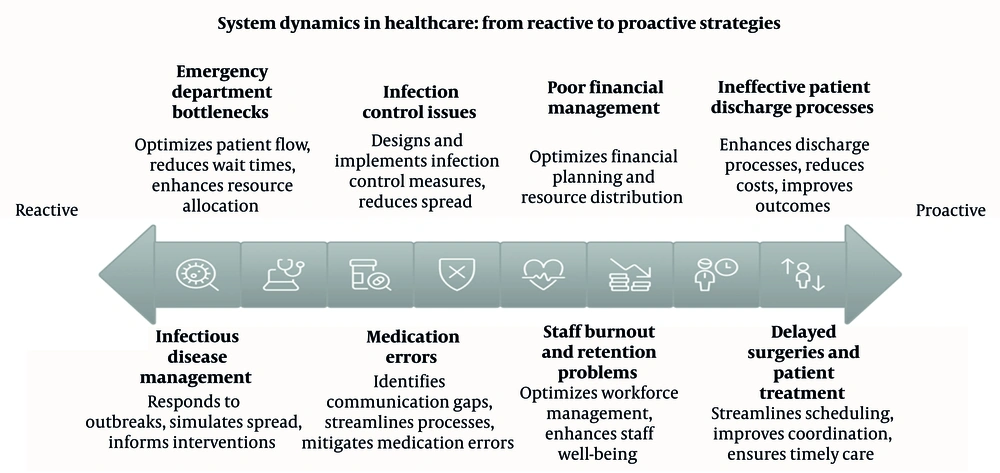
Figure 1.
System dynamics in healthcare: From reactive to proactive strategies
Integration with Artificial Intelligence The integration of SD with emerging technologies like machine learning (ML) and artificial intelligence (AI) offers a promising way to enhance system dynamics' predictive capabilities, particularly in healthcare. System dynamics is a robust modeling approach that captures system behavior over time through feedback loops and component interactions (40). By merging SD’s modeling of feedback loops and time delays with AI and ML's data-driven insights, healthcare systems can achieve more accurate predictions, improved decision-making, and enhanced operational efficiency (41).
A key advantage of this integration is the improvement in predictive capabilities. Incorporating advanced algorithms enables SD models to forecast system behaviors more accurately. For instance, in pandemic situations, ML can refine SD models by integrating real-time data and unexpected variables, enhancing forecast precision. This synergy allows for reliable predictions of patient influx, resource demands, and disease spread, enabling proactive responses to emerging challenges. Such capabilities are vital for optimizing resource allocation and preparing healthcare facilities for sudden demand surges (42).
Soft and hard convergence represent the two main pathways of integration between SD and artificial intelligence (AI). Soft convergence refers to the application of SD and AI in analyzing socio-technical systems, encompassing areas such as knowledge management, marketing, and healthcare services (40). In contrast, hard convergence focuses on utilizing AI to redesign and optimize systems, such as smart manufacturing, robotics, and digital platforms.
In hospitals, the hard convergence of SD and AI can lead to the development of predictive systems based on machine learning. These systems are capable of accurately forecasting resource demands during critical situations, such as pandemics (29).
Hybrid models combining SD with ML have shown promise in predicting patient influx and optimizing resource allocation during public health crises. For instance, researchers employed a combined SD-ML approach to model infectious disease spread, using real-time data from hospitals and social media to refine predictions and inform public health interventions (43). Another study illustrated how AI-enhanced SD models could optimize hospital bed management by accurately predicting patient discharge times and bed availability. These examples underscore the transformative potential of integrating SD with emerging technologies, paving the way for more efficient and resilient healthcare systems (42). This integration not only aids in the real-time optimization of ICU bed allocation but also effectively manages patient flow in emergency departments (29), thereby significantly enhancing the efficiency and quality of healthcare services (9).
Additionally, AI and ML integration facilitates real-time adaptation in SD models. Artificial intelligence-driven SD models can continuously update based on new data, leading to dynamic predictions of resource needs and disease spread. This real-time adaptability is crucial in fast-changing environments, such as public health emergencies, where timely decision-making is essential (44).
4. Conclusion
The absence of a systemic approach to hospital management has resulted in fragmented operations that struggle to meet the complexities of patient care. Departments often operate in isolation, leading to miscommunication, inefficiencies, and compromised patient outcomes. This lack of a unified vision complicates resource allocation, staff training, and technology integration in clinical workflows. For instance, poor coordination between emergency departments and inpatient services can cause treatment delays and longer patient wait times, frustrating healthcare providers and diminishing the patient experience.
Adopting a holistic framework requires viewing the hospital as a cohesive entity, where each component affects the overall health of the institution. Engaging stakeholders—administrators, medical staff, and patients—in collaborative decision-making promotes shared responsibility and innovative problem-solving, essential for identifying bottlenecks and implementing targeted interventions that enhance operational efficiency.
Integrating system dynamics with artificial intelligence can revolutionize hospital management. Hybrid models allow managers to tackle current issues and simulate future scenarios, such as epidemics or demographic changes, advancing hospitals toward organizational intelligence and enabling data-driven decision-making. Furthermore, incorporating data analytics and performance metrics into management strategies can uncover trends and support evidence-based practices. By leveraging technology, hospitals can gain insights into workflow patterns, resource utilization, and patient outcomes, crucial for informed decision-making that addresses both immediate needs and long-term goals in healthcare.
