
1. Context
War inflicts irreparable damage on nations, as it not only devastates physical and economic infrastructure but also profoundly and enduringly undermines the social fabric, mental health of generations, and cultural identity (1). The consequences of war, including human casualties, population displacement, environmental destruction, and the collapse of educational and healthcare systems, are so extensive and multifaceted that they remain irreparable even after decades (2). In particular, the psychosocial impacts of war — such as collective trauma, institutionalized distrust, and the breakdown of familial bonds — create a cycle of challenges that cast a long shadow over the political, economic, and human development of nations for generations (3). War fundamentally disrupts the essential infrastructure of daily life, profoundly transforming the normal course of existence. The destruction of water, electricity, and transportation systems severely restricts access to basic necessities such as food, potable water, and medical care (4). Widespread insecurity and the persistent threat of violence compel individuals to abandon their homes, resulting in displacement that, in turn, severs social and familial bonds (5). Furthermore, the disruption of educational systems jeopardizes the future of children and adolescents, perpetuating cycles of poverty (6). At the psychological level, prolonged exposure to violence leads to a marked increase in stress disorders, depression, and other mental health issues, the recovery from which requires years (7). Armed conflicts, involving the use of lethal weapons and airstrikes, result in the simultaneous death and injury of both civilians and military personnel. Many survivors suffer from limb loss, severe burns, or spinal injuries, which permanently impair their quality of life (8). Additionally, the human toll of war leads to profound grief among survivors, a phenomenon that can precipitate complex psychological disorders such as chronic depression or unresolved mourning (9). The scarcity of medical facilities in war zones significantly increases mortality rates from injuries and diseases, to the extent that even seemingly minor injuries may lead to death or permanent disabilities due to the lack of adequate treatment (10). In this context, war can precipitate post-traumatic stress disorder (PTSD) in children and adolescents by exposing them to severe and life-threatening traumatic events (11). Post-traumatic stress disorder is a debilitating psychiatric condition that emerges following exposure to a traumatic, life-threatening event such as war, assault, or natural disasters (12). Direct exposure to violent scenes — such as bombings, witnessing the death of family members, or experiencing physical injuries — can give rise to three primary clusters of PTSD symptoms: (1) Re-experiencing the traumatic event through intrusive memories, flashbacks, or nightmares; (2) avoidance of trauma-related stimuli, such as places or conversations that evoke memories of the event; and (3) hyper-arousal states, characterized by heightened irritability, difficulty concentrating, and intense fear responses (13). In children, these symptoms may manifest as regressive behaviors (e.g., bedwetting), repetitive trauma-themed play, or excessive dependence on caregivers. Given that the brains of children and adolescents are still developing, traumatic experiences can induce lasting neurobiological changes in brain structures associated with emotional regulation, such as the amygdala and hippocampus, thereby complicating the treatment of this disorder (14). Post-traumatic stress disorder resulting from war in children and adolescents can engender both short-term and long-term deleterious consequences. In the short term, this disorder precipitates issues such as sleep disturbances, including recurrent nightmares and insomnia (15), academic difficulties such as reduced concentration and declining academic performance (16), intense emotional reactions (17), and behavioral problems, including aggression, social withdrawal, and excessive dependence on caregivers (18). In the long term, untreated PTSD can lead to chronic mental health issues in adulthood, such as depression and suicidal ideation (19), impaired interpersonal and marital relationships (20), occupational challenges (21), and substance abuse (22). Furthermore, trauma-induced neurobiological changes in the developing brain can diminish an individual’s resilience to stress, rendering them more susceptible to psychosomatic disorders. This vicious cycle not only compromises the individual’s quality of life but also impacts the mental health of subsequent generations (23). Given the devastating consequences of war on the mental health of children and adolescents, coupled with the high prevalence of PTSD in these vulnerable groups, this study is significant in that it seeks to integrate existing evidence on the development of war-related PTSD, thereby providing a framework for clinical interventions and health policy formulation. The novelty of this work lies in its synthesis of findings from international studies, with consideration of cultural and social variables. Accordingly, the primary objective of the present research is to conduct a narrative review of the impact of war on the development of PTSD in children and adolescents.
2. Evidence Acquisition
This study employed a narrative and non-systematic review methodology. This approach was selected for its utility in providing a comprehensive, contextual, and interpretive synthesis of a heterogeneous body of literature, rather than seeking a pooled quantitative estimate. It allows for the integration of findings from studies with diverse methodologies, designs, and contextual settings, which is particularly pertinent when investigating a complex phenomenon such as the impact of war on pediatric mental health across different conflicts and populations.
2.1. Search Strategy
A search strategy was designed and executed to identify all relevant published literature. The search was conducted across four major international electronic databases — Web of Science, PubMed, Scopus, and Google Scholar — to ensure broad coverage of literature. The search timeframe was set from January 2016 to May 2025 to capture the most contemporary evidence from recent and ongoing conflicts. To construct a sensitive and specific search, a combination of Medical Subject Headings (MeSH) terms and free-text keywords was utilized. The key concepts and their synonyms included: (War OR armed conflict OR warfare) AND (post-traumatic stress disorder OR PTSD OR trauma) AND (child* OR adolescent* OR youth OR pediatric). These terms were combined using Boolean operators (AND, OR) and adapted for the syntax of each respective database.
2.2. Eligibility Criteria
The inclusion and exclusion criteria were defined a priori to ensure a focused yet comprehensive review. Studies were included if they met the following conditions: (1) Population (comprised children and adolescents directly exposed to war or armed conflict); (2) context (focused on contemporary conflicts, e.g., Syria, Yemen, Ukraine, Palestine, Afghanistan, or African internal conflicts); (3) outcome (investigated post-traumatic stress disorder as a primary outcome); (4) assessment (PTSD diagnosis was confirmed using validated, structured, or semi-structured diagnostic interviews); (5) study design (primary research studies, including cross-sectional, cohort, case-control, and qualitative studies). Studies were excluded based on the following: (1) Availability (lack of access to the full-text article); (2) language (articles published in languages other than English or Persian); (3) publication type (review articles, meta-analyses, commentaries, editorials, and case reports); (4) focus (studies focusing solely on trauma types other than war, e.g., natural disasters).
2.3. Study Selection
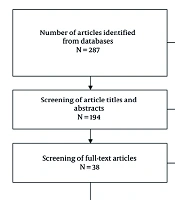
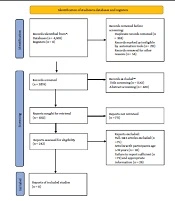
The study selection process was conducted in multiple stages to ensure methodological rigor. All records identified through the database searches were imported into EndNote (version X20) reference management software for deduplication and initial management. Subsequently, the unique records were screened by two independent reviewers based on their titles and abstracts. This initial screening phase aimed to exclude clearly irrelevant studies. The full texts of the remaining potentially eligible articles were then retrieved and assessed in detail against the predefined eligibility criteria by the same two reviewers. This process helped minimize selection bias.
2.4. Data Extraction
Data from the finally included studies were extracted independently by two members of the research team using a standardized, pilot-tested data extraction form created in Microsoft Excel. The form was piloted on a sample of two studies to ensure consistency and comprehensiveness between the extractors. The extracted data captured the following key domains: (1) Bibliographic Information (first author and year of publication); (2) study characteristics (methodology and characteristics of war); (3) key findings (Prevalence of PTSD in the study population).
3. Results
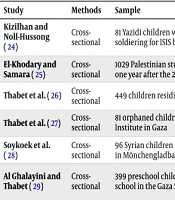
This narrative review identified 17 studies. Three studies (17.6%) utilized a longitudinal design, while the remaining fourteen (82.4%) were cross-sectional. The sample sizes across the studies ranged from 81 to 1,078 participants. Of the identified studies, most (8 studies, 47.1%) involved Palestinian children and adolescents (Table 1).
Table 1.
Characteristics and Findings of the Extracted Studies
| Study | Methods | Sample | War Characteristics | Finding |
|---|---|---|---|---|
| Kizilhan and Noll-Hussong (24) | Cross-sectional | 81 Yazidi children with history of child soldiering for ISIS between 2014 and 2017 | ISIS conflicts in northern Iraq | 48.3% of Yazidi children who served as child soldiers for ISIS for at least 6 months had post-traumatic stress disorder. |
| El-Khodary and Samara (25) | Cross-sectional | 1029 Palestinian students aged 11 to 17 one year after the 2014 Gaza war | Conflicts between the Zionist regime and Palestine | 54% of students (one year after the Gaza war from November 14 to 26, 2014) were diagnosed with post-traumatic stress disorder. |
| Thabet et al. (26) | Cross-sectional | 449 children residing in the Gaza Strip | Conflicts between the Zionist regime and Palestine | 12.4% of children selected from the Gaza Strip met full criteria for post-traumatic stress disorder. |
| Thabet et al. (27) | Cross-sectional | 81 orphaned children from Al-Amal Institute in Gaza | Conflicts between the Zionist regime and Palestine | 55.6% of orphaned children had moderate post-traumatic stress disorder and 34.6% had severe post-traumatic stress disorder. |
| Soykoek et al. (28) | Cross-sectional | 96 Syrian children from a refugee camp in Mönchengladbach, Germany | Syrian conflict with ISIS | Post-traumatic stress disorder was diagnosed in 26% of children aged 6 to 0 years and in 33% of children aged 7 to 14 years. |
| Al Ghalayini and Thabet (29) | Cross-sectional | 399 preschool children enrolled in school in the Gaza Strip | Conflicts between the Zionist regime and Palestine | 6% of preschool children enrolled in school in the Gaza Strip had post-traumatic stress disorder, and the prevalence was higher in children five years and older. |
| Murphy et al. (30) | Cross-sectional | 122 child soldiers in northern Uganda conflicts | Internal conflicts in Uganda | 35.5% of children who served as child soldiers in northern Uganda conflicts were diagnosed with post-traumatic stress disorder. |
| Thabet et al. (31) | Cross-sectional | 251 children aged 6 to 16 from 3 summer camps in the Gaza Strip | Conflicts between the Zionist regime and Palestine | 59% of children attending summer camps in the Gaza Strip had clinical symptoms of post-traumatic stress disorder. |
Furthermore, three studies (17.6%) involved Ukrainian children and adolescents, two studies (11.8%) involved Syrian children and adolescents, one study (5.9%) involved Iraqi children and adolescents, one study (5.9%) involved Ugandan children and adolescents, one study (5.9%) involved Sudanese children and adolescents, and one study (5.9%) involved Ethiopian children and adolescents. In terms of the wars examined, eight studies (47.1%) pertained to the Zionist regime's attacks on the occupied Palestinian territories, three studies (17.6%) to the Ukraine war, and three studies (17.6%) to ISIS battles in Syria and Iraq. The prevalence of PTSD among children and adolescents affected by war and its direct consequences varied from 95% (Ukraine-Russia war) to 6% (Zionist regime's attacks on the Palestinian people).
4. Conclusions
This study was conducted with the aim of reviewing evidence related to the impact of war on the development of PTSD in children and adolescents. Based on the retrieved studies, the prevalence of PTSD among children and adolescents residing in Palestinian areas was reported as follows: 9.8% in Skrypnyk et al. (32), 26.29% in Manzanero et al. (33), 52.9% in Altawil et al. (34), 54% in El-Khodary and Samara (25), 12.4% in Thabet et al. (26), 55.6% in Thabet et al. (27), 6% in Al Ghalayini and Thabet (29), and 59% in Thabet et al. (31). Additionally, the research by Pfeiffer et al. (35), Martsenkovskyi et al. (36), and Martsenkovskyi et al. (37) estimated the prevalence of PTSD among Ukrainian children and adolescents at 70%, 17.5%, and 49.4%, respectively. Furthermore, in the studies by ElBarazi (38), Kizilhan and Noll-Hussong (24), and Soykoek et al. (28), the prevalence of PTSD among children and adolescents due to war and insecurities caused by ISIS in Syria and Iraq was reported as 55%, 48.3%, and 33%, respectively. The prevalence of PTSD among children and adolescents due to internal conflicts involving the Sudanese army (39), Woldia, Ethiopia (40), and Uganda (30) was reported as 44.6%, 29.2%, and 35.5%, respectively.
In explaining this finding, it appears that children and adolescents are more vulnerable to war-related trauma and insecurity compared to adults, primarily due to their incomplete cognitive, emotional, and social development (41). From a psychological perspective, the brains of children and adolescents are in critical stages of development, and their neurological systems are not yet fully matured. This makes them more susceptible to the profound mental health impacts of exposure to violence, loss of loved ones, or displacement, leading to disorders such as PTSD, depression, and behavioral problems. Furthermore, children lack the complex coping mechanisms that adults utilize to manage stress (42). Consequently, traumatic experiences can easily disrupt their sense of safety and stability, thereby compromising their psychological well-being.
From a social standpoint, children and adolescents in war and insecurity often face deprivation of education, family support, and social networks, which exacerbates their vulnerability. The absence of supportive structures, such as schools or stable families, diminishes their capacity to process and recover from trauma. Moreover, continuous exposure to violence can normalize aggression in their minds, perpetuating a cycle of violence in future generations (43). On the other hand, adolescents are in a stage of identity formation, and being situated in high-stress environments can lead to a profound sense of purposelessness and insecurity, which has long-term consequences for their mental health and social cohesion (44). Therefore, psychosocial support and specialized interventions are crucial for mitigating the effects of trauma in this age group.
Furthermore, war, as an extreme stressor, can have profound and lasting psychological effects on children, predisposing them to PTSD. When children are exposed to violent scenes, bombings, loss of family members, or displacement, they experience intense fear and helplessness. Since their brains are still developing, the neurological systems involved in processing fear and anxiety may be permanently affected (34). This can cause traumatic memories to intrude repeatedly and involuntarily, triggering intense psychological and physiological reactions such as nightmares or flashbacks. One of the primary causes of PTSD in children is their persistent exposure to war-related threats, which erodes their fundamental sense of security. In war-torn environments, children often lack adequate emotional support, as their parents or caregivers may themselves be psychologically traumatized. This lack of support diminishes the child's ability to process negative emotions, causing fear and anxiety to persist chronically (29). Furthermore, children may be unable to properly articulate their feelings; consequently, their internal tension manifests as symptoms of PTSD, such as social withdrawal, aggression, or emotional numbness. Additionally, disruptions in normal brain function — such as hyperactivity of the amygdala (the fear-processing center) and reduced activity in the prefrontal cortex (responsible for emotion regulation) — can exacerbate anxiety responses and impair a child's sleep and concentration.
From a psychological perspective, younger children lack the fully developed capacity for logically understanding and interpreting traumatic events. They may blame themselves for the events of the war or harbor an unrealistic fear that the catastrophe will recur (24). These misinterpretations can lead to feelings of guilt, shame, or persistent terror, which are hallmark symptoms of PTSD. Ultimately, war not only destroys supportive structures like family and school but also restricts children's access to psychotherapeutic services. The absence of timely interventions exacerbates PTSD symptoms in children and transforms the condition into a long-term issue. Traumatic experiences during childhood can impact an individual's social, academic, and emotional development and may even manifest in adulthood as problems such as depression, substance abuse, or interpersonal difficulties (33). Therefore, war inflicts not only immediate harm on children but also leaves psychological sequelae, such as PTSD, which can persist for years after the hostilities have ended.
Based on the findings of the present review, global health policymakers must prioritize comprehensive mental health programs during wars and humanitarian crises, particularly by ensuring immediate and long-term psychological services for displaced children and adolescents. These programs should include training local personnel to identify and manage PTSD, establishing safe and stable environments to reduce anxiety, and integrating psychosocial interventions into primary healthcare services. Furthermore, collaboration between international organizations, governments, and non-governmental organizations is essential to guarantee equitable access to mental health care in conflict-affected areas. Investing in applied research to develop effective and culturally-sensitive interventions should also form a key part of this strategy.
Regarding the limitations of this research, differences in the methodologies of the existing studies, the variety of assessment tools for PTSD, heterogeneous samples (in terms of age, gender, and culture), and varying research designs (cross-sectional versus longitudinal) may complicate the comparison of results. Moreover, while the concurrent effects of poverty, malnutrition, parental loss, and educational deprivation can influence PTSD, it is challenging to isolate the net effect of war. Many of the included studies were cross-sectional, thereby overlooking the long-term and delayed consequences of war, such as those manifesting in adulthood.