


1. Introduction
Dependency on narcotics is one of the most important social issues worldwide. It affects not only the lives of individuals with addiction but also the relatives of substance users, especially spouses and children, exposing them to multiple harms (1).
The family is the social institution most vulnerable to the effects of addiction. Spouses of individuals with addiction, because of their dual roles as partners and heads of household, experience a high level of vulnerability due to gender-related factors and the prevailing cultural context. These women, because of their shared experiences of psychological and physical harms in married life, may be unable to return to their previous levels of physical and psychological functioning even after cessation of substance use and recovery. This is because having a family member with substance abuse problems creates stress and has destructive effects on family members, especially spouses (2, 3).
Families, especially women with substance-abusing spouses, are highly vulnerable across multiple psychological and social domains. They experience substantial emotional and psychological burdens that can disrupt daily life and long-term well-being. The presence of a substance-abusing partner creates stress and has destructive effects on family members, particularly spouses (1).
These challenges include emotional distress, financial strain, disrupted relationships, and social isolation. The constant stress associated with caring for an addicted spouse may lead to health problems such as insomnia, headaches, high blood pressure, and depression. Feelings of guilt, shame, and self-blame are common and are often exacerbated by a sense of helplessness in changing the situation. In some cases, addiction is accompanied by violent behaviors and financial abuse, further threatening the physical and psychological safety of the family. Despite these hardships, separation from an addicted partner poses emotional and social challenges, especially when children are involved. Consequently, healthcare providers should pay special attention to these families to support their complex needs and reduce the adverse effects of addiction on family dynamics (4). Accordingly, this systematic review and meta-analysis highlights the implications of these findings for policy, practice, and the development of interventions aimed at reducing the burdens borne by families affected by addiction.
2. Methods
2.1. Review Question
Does couples therapy affect the emotions of people with addicted spouses?
2.2. Search Strategy
The search was conducted in English and Persian. Searches were performed in PubMed, Google Scholar, and Web of Science using the following terms and phrases:
((((((Emotionally Focused Couple Therapy) OR (Emotionally Focused Couples Therapy)) AND (Gottman Couple Therapy)) OR (Cognitive behavioral therapy)) OR (CBT)) AND (addicted husband)) OR (husband with addiction) AND (("1970"[Date - Create]: "2025"[Date - Create]).
Additional sources of gray literature, including conference papers and key academic journals, were also examined (Figure 1).
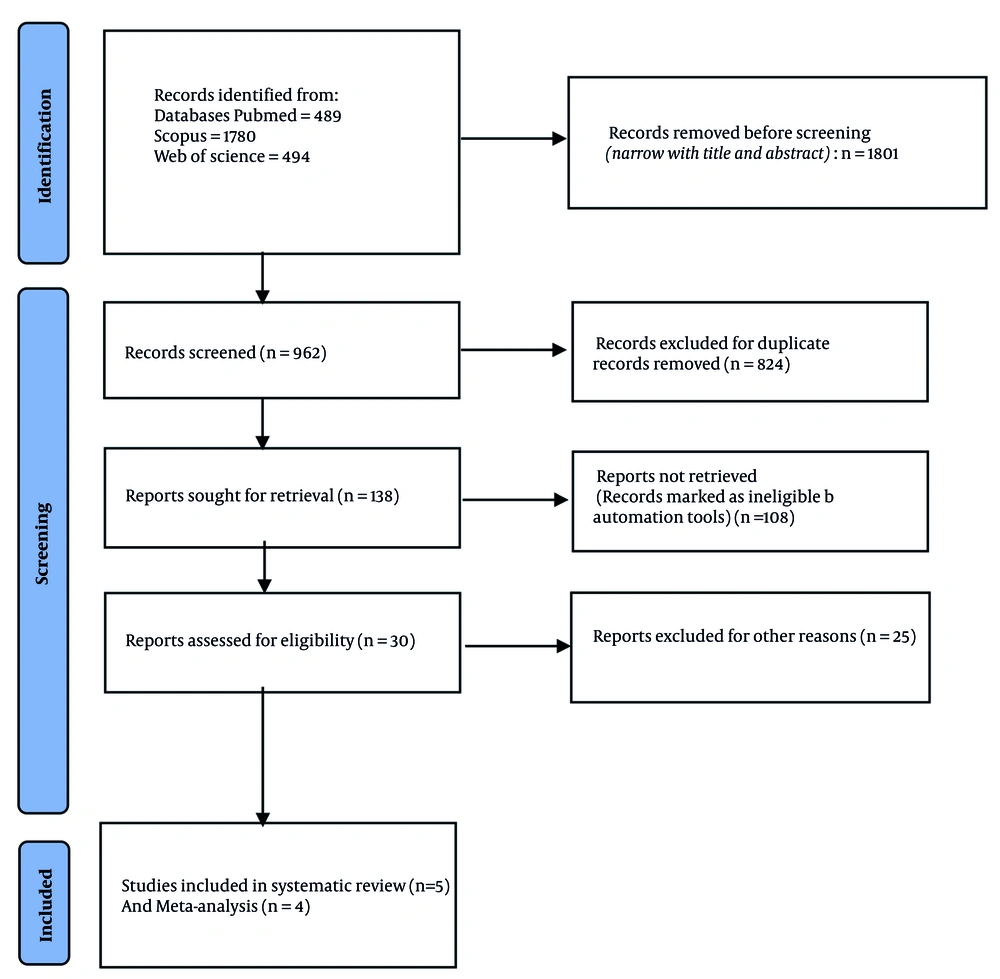
Figure 1.
PRISMA 2020 flow diagram for new systematic reviews that included searches of databases
The collected data were organized into three main domains to guide the analysis. First, study identification variables were recorded, including the article title, first author, and year of publication. Second, methodological characteristics were extracted, including study design, sample size, participant characteristics (eg, age and gender), type of intervention, measurement instruments, and risk-of-bias or quality ratings. Third, the primary outcome and any prespecified secondary outcomes were documented for each study.
2.3. Inclusion and Exclusion Criteria
Studies were included in this meta-analysis if they met the following criteria:
1) Couples therapy was defined as a psychological intervention involving both partners in regular sessions led by a therapist, with the aim of increasing relationship satisfaction.
2) At least one intervention met the criteria for GMCT or IBCT.
3) Intervention effectiveness was assessed in randomized clinical trials or quasi-experimental studies in which couples therapy was compared with inactive control groups, medication, individual psychotherapy, psychoeducation, or counseling, and the studies provided sufficient data to calculate an effect size.
2.4. Quality Assessment of Included Studies
The quality of the included studies was assessed using the updated CONSORT Statement for Randomized Trials of Nonpharmacologic Treatments (2017) (5), an extension of the original CONSORT guidelines. This statement is intended to enhance transparency and minimize reporting bias in trials of nonpharmacologic interventions, such as psychotherapy, surgery, and rehabilitation. It incorporates key elements, including participant adherence to interventions, efforts to reduce bias when blinding is infeasible, and the timing between randomization and intervention initiation. It also includes items to support comprehensive reporting of intervention implementation, care provider and center characteristics, and protocol deviations, thereby improving assessment reliability and enabling better cross-study comparisons.
2.5. Meta-Analytic Procedures and Bias Assessment
Standardized mean differences and their standard errors were calculated for continuous outcomes. A random-effects model was applied to pool effect sizes because clinical and methodological heterogeneity across studies was anticipated. Heterogeneity was quantified using the I2 statistic and Cochran’s Q test. To explore potential sources of between-study variability, a meta-regression analysis was conducted with sample size as the moderator, and adjusted R2 was used to estimate the proportion of between-study variance explained by this covariate. Separate meta-analyses were conducted for primary outcomes related to IBCT and secondary outcomes related to Gottman-based interventions.
Publication bias and small-study effects were examined using Egger’s regression test and visual inspection of the corresponding regression plot. In this analysis, the slope and intercept of the regression line of the standard normal deviate against its standard error were estimated, and a nonsignificant intercept (P = 0.402) indicated no statistically significant evidence of small-study effects. All statistical analyses, including computation of pooled SMDs, heterogeneity statistics, meta-regression, and Egger’s test, were performed using Stata version 17 (StataCorp, College Station, TX, USA).
3. Results
3.1. Characteristics of Included Studies
In total, 5 studies (6-10), with sample sizes ranging from 20 to 59 participants and predominantly quasi-experimental or randomized clinical trial designs, were included. Behavioral and integrative behavioral couple therapies, Gottman-based couple therapy, Alcohol Behavioral Couple Therapy, and related combined approaches were delivered in approximately 10 to 12 sessions of 90 minutes, primarily to women with addicted husbands or to couples with alcohol use disorders. Across studies, various validated questionnaires, including Azar Brahimi’s marital questionnaire, the Revised Dyadic Adjustment Scale, and measures of expressed emotion and marital satisfaction, were used. The key findings consistently indicated that couple-based interventions reduced emotional abuse, decreased drinking days and alcohol-related consequences, and improved marital adjustment and relationship satisfaction, although some trials reported only small differences among specific therapeutic formats (Table 1).
Table 1.Characteristics of Included Studies
| Author, Year | Sample Size | Design | Target Group | Duration of Therapy | Type of Intervention | Questionnaire | Key Finding |
|---|---|---|---|---|---|---|---|
| Taee et al., 2025 (6) | 45 | Quasi-experimental design | All women with addicted husbands | Ten 90-minute sessions | Gottman Method couple therapy (GMCT) and integrative behavioral couple therapy (IBCT) | Azar Brahimi’s (2008) Questionnaire | Dual therapeutic approaches reduced emotional abuse and improved marital satisfaction among couples affected by addiction-related issues, underscoring the need for structured psychological training and intervention programs. |
| McCrady et al., 2016 (7) | 59 | Randomized clinical trial | Women with alcohol use disorders | 12 sessions of 90 minutes | Alcohol Behavioral Couple Therapy (ABCT) and Blended Alcohol Behavioral Couple Therapy (Blended-ABCT) | Not reported | Significant reductions in drinking days and their consequences and improvements in marital satisfaction after treatment were emphasized. Although no significant difference was observed between the groups, the treatment effects of Blended-ABCT were slightly better than those of ABCT. |
| Dehghani et al., 2016 (8) | 20 | Quasi-experimental design | Women with addicted spouses | Not reported | Behavioral couple therapy | Revised Dyadic Adjustment Scale (RDAS); interview by clinical centers’ psychiatrist | Behavioral therapy was one of the most effective approaches for improving marital adjustment. |
| Vedel et al., 2008 (9) | 34 | Randomized clinical trial | Couples with alcohol use disorder | 10 sessions | Behavioral Couples Therapy | Level of Expressed Emotion Questionnaire | Marital satisfaction of the spouse increased significantly in the BCT condition. Treatment involvement of the spouse did not increase retention. |
| Samani, 2022 (10) | 45 | Quasi-experimental design | All women with addicted husbands | 10 sessions of 90 minutes | Gottman Method couple therapy (GMCT) and integrative behavioral couple therapy (IBCT) | Azar Brahimi’s (2008) Questionnaire | Group counseling based on the Gottman theory was more effective than the integrative behavioral method for emotional abuse and frustration. Group counseling based on the integrative behavioral theory was more effective than group counseling based on the Gottman theory for marital quality. |
3.2. Study Quality
Regarding study quality, 3 studies were rated as high quality, 1 as moderate quality, and 1 as low quality, based on criteria including the clarity of eligibility criteria, description of interventions, definition of primary outcomes, number analyzed, and coherence of conclusions (Table 2).
Table 2.Quality Assessment of Included Studies
| Questions | Taee et al., 2025 (6) | McCrady et al., 2016 (7) | Dehghani et al., 2016 (8) | Vedel et al., 2008 (9) | Samani, 2022 (10) |
|---|---|---|---|---|---|
| Participants (eligibility criteria for participants) | 1 | 1 | 1 | 0 | 1 |
| Intervention (intervention intended for each group) | 1 | 0 | 1 | 1 | 0 |
| Outcome (clearly defined primary outcome for this report) | 0 | 0 | 0 | 1 | 1 |
| Number analyzed (number of participants analyzed in each group for primary outcome) | 1 | 0 | 1 | 1 | 0 |
| Conclusion (general interpretation of the results) | 1 | 1 | 1 | 1 | 1 |
| Results | High quality of assessment | Low quality of assessment | High quality of assessment | High quality of assessment | Moderate quality of assessment |
3.3. Effects of Couple Therapy on Emotional Outcomes
In the quantitative synthesis, behavioral couple therapy based on IBCT showed a nonsignificant overall effect on the primary outcome, with very high heterogeneity (z = 0.57, P = 0.570; I2 = 95.3%; 3 studies). In contrast, GMCT demonstrated a statistically significant effect on secondary outcomes, again with substantial heterogeneity (z = 2.23, P = 0.026; I2 = 93.0%; 2 studies). Overall, the forest plot (Figure 2) illustrates that, despite considerable between-study variability, couple-based therapeutic approaches tended to have beneficial effects on primary and secondary outcomes related to marital functioning and substance-related problems in couples affected by addiction (6, 8-10) (Figure 2 and Table 3).
Table 3.Effect of Treatment on Primary and Secondary Outcomes of the Case Studies
| Variables | Number of Studies | Chi-Square | P Heterogeneity Value | I2 | Overall z | P Value |
|---|---|---|---|---|---|---|
| Behavioral couple therapy (IBCT; primary outcome) | 3 | 63.80 | 0.000 | 95.3% | 0.57 | 0.570 |
| Gottman Method couple therapy (GMCT; secondary outcomes) | 2 | 14.21 | 0.000 | 93.0% | 2.23 | 0.026 |
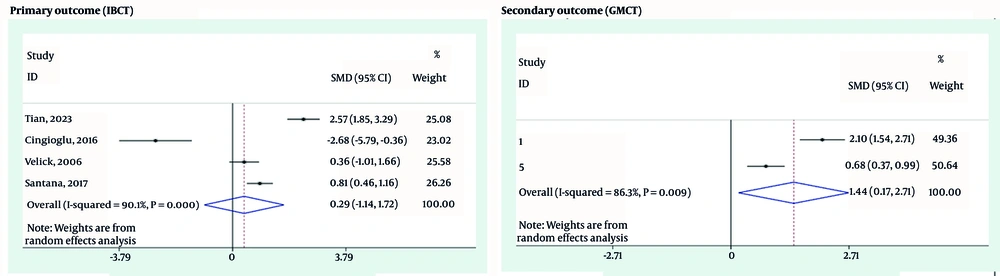
Figure 2.
Effect of treatment on the primary and secondary outcomes of the case studies
3.4. Meta-Regression
In the meta-regression analysis, the relationship between the predictor variable (_SS) and effect size was examined. The results showed a positive but statistically nonsignificant association (coefficient = 0.059, P = 0.062), indicating that this relationship might be due to chance and was not definitive. The high heterogeneity among studies (I2 = 89.08%) indicated substantial between-study variability, suggesting that the findings should be interpreted with caution. Although the predictor explained a large proportion of the between-study variance (adjusted R2 = 86.63%), the small number of studies limited robust conclusions (Figure 3).
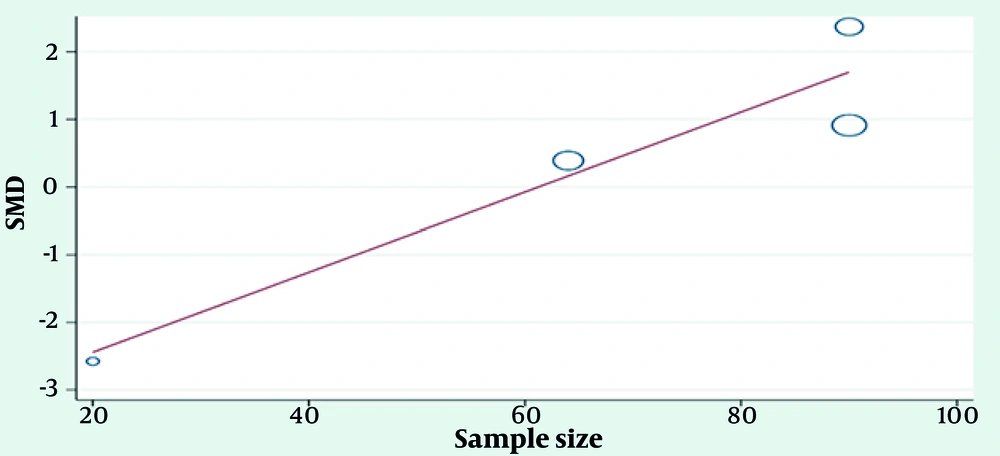
Figure 3.
Meta-regression of effect size (SMD) on study sample size
3.5. Publication Bias
Egger’s regression test did not provide evidence of significant publication bias because the regression intercept was not statistically different from zero, and the regression line showed no marked asymmetry in the distribution of studies (slope = 3.03; 95% CI, -5.88 to 11.95; intercept = -7.85; 95% CI, -39.89 to 24.18; P = 0.402) (Figure 4).
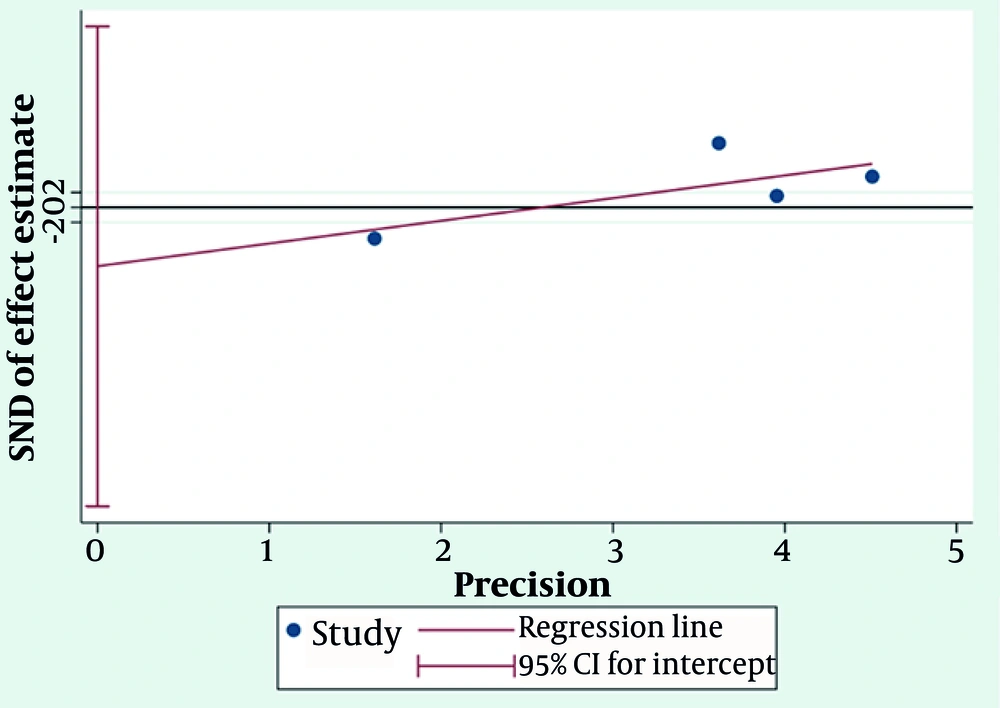
Figure 4.
Publication bias of included studies
4. Discussion
This article reviewed the theoretical foundations and empirical evidence for EFT and the Gottman Method for couples, two approaches that have been extensively studied and are highly effective in improving distressed marital relationships in the context of addiction. The authors delineated the clinical strategies used in EFT and the sequence of change processes hypothesized to be critical for partners’ improvement. Particular emphasis was placed on the central role of accessing, organizing, and working with emotions within the relational context. The review then examined outcome and process research on EFT and reported meta-analytic data from randomized clinical trials showing meaningful improvements in couple adjustment. Finally, key empirical and clinical challenges that remain for EFT and the Gottman Method were summarized.
In the present review, two prominent therapeutic approaches for couples experiencing problems related to a partner’s addiction, namely EFT and the Gottman Method, were examined simultaneously using a variety of research designs. The findings showed that couple-centered interventions focused on emotional and relational regulation can promote stable marital adjustment, reduce negative emotional behaviors, and diminish substance use and related consequences of addiction. The accumulated evidence indicated that working with relational emotions, organizing emotional dynamics, and expanding dialogue-focused skills are crucial for inducing changes in maladaptive communication patterns. Despite differences in study designs, including randomized clinical trials, quasi-experimental studies, and longitudinal studies, the findings were largely consistent with the conclusion that integrating behavioral approaches with emotional components and tracking emotion-relationship change processes can improve marital satisfaction and reduce days of use or addiction-related outcomes (6). However, factors such as cultural and demographic diversity among participants, structural variations in the delivery of clinical services, and mediators shaping the pathways of these interventions warrant more advanced research and longitudinal designs with larger sample sizes to establish a coherent and robust framework for improving relationships in the context of addiction.
Future research should prioritize methodologically rigorous designs with diverse populations, standardized outcome metrics, and explicit mediation analyses to clarify how emotional processing, dyadic communication, and engagement mediate change. Clinically, a flexible stepped-care approach that tailors interventions to cultural and individual differences while maintaining fidelity to core EFT and Gottman principles may optimize outcomes in real-world settings where addiction intersects with relationship distress.
4.1. Strengths and Limitations
The limitations of this review include small sample sizes and heterogeneity in study designs, which may limit generalizability and the ability to adequately control for mediating or covarying factors. The strengths include the simultaneous evaluation of two well-established approaches, EFT and the Gottman Method, using diverse research designs and providing clinically relevant insights for enhancing couple interventions in addiction-related contexts.
