1. Context
War, one of the most complex human phenomena, encompasses diverse political, social, and health-related dimensions (1). Its consequences are not confined to the period of military conflict but can persist for decades and even generations after the cessation of hostilities (2). War-related injuries include a wide range of physical injuries, such as shrapnel wounds, severe burns, amputation, spinal cord injuries, and brain damage; psychological injuries, including post-traumatic stress disorder (PTSD), chronic depression, anxiety disorders, and adjustment disorders; and chemical injuries (3). The Iran-Iraq War (1980 - 1988), one of the longest and most destructive wars of the twentieth century, provides a striking example of this phenomenon (4). Although four decades have passed, its profound effects on the physical and mental health of a large population of veterans and their families persist (5). Therefore, war should not be regarded merely as a historical event but rather as a chronic and transgenerational trauma that gives rise to multiple and lasting harms for those directly involved, particularly their families (6).
According to international criteria, a veteran is an individual who has sustained physical, psychological, or chemical injuries as a result of war-related conflicts (7). Statistics published by the Martyr and Veterans Affairs Foundation indicate that the population of Iranian veterans includes individuals with varying disability percentages (below 25%, 25%, 50%, 70%, and above 70%), neuropsychiatric veterans (especially those with PTSD), chemical veterans, and veterans with spinal cord injuries (8). These individuals experience various long-term consequences, including chronic physical injuries such as persistent pain, mobility impairment, sexual problems, and infertility (9); psychological injuries, including depression, mood disorders, and suicidal ideation; social consequences, such as isolation, reduced interpersonal interactions, and social stigma (10); and occupational and economic consequences, such as disability, unemployment, and chronic poverty (11). Veterans’ conditions are often unstable, and many require long-term and continuous care throughout their lives (12). In this context, the family, as the primary caregiving environment, plays an irreplaceable role in managing the consequences of war injuries, underscoring the need for a comprehensive investigation of the families of this population (13).
According to family systems theory, the family is viewed as an integrated system in which injury to one member affects the entire system and other family members, giving rise to complex, reciprocal, and cyclical interactions between the veteran and other family members (14). A review of the research literature indicates that these family consequences are broad and multifaceted: emotional and psychological harms, such as emotional distance, violence, and psychological distress, imposed on the spouse and children (15); marital relationship breakdown, including persistent conflicts, sexual problems, and divorce (16); economic and livelihood harms, such as poverty, the father’s disability as the primary income provider, and restrictions on recreation and leisure (1); social harms, including social stigma, family isolation, and distancing from relatives (17); and educational and developmental harms to children, such as academic and behavioral problems (18). These consequences persist particularly over the long term for the veteran’s spouse, manifesting as burnout and hopelessness, and for the children, manifesting as anxiety and depression (19). This complexity is further compounded by a mismatch of needs: veterans require substantial care and support but, because of their injuries, may be unable to fulfill conventional family roles (13). The problem is exacerbated because family consequences often remain hidden and overlooked, as health and social service systems have traditionally focused on the veteran, whereas the family, as a hidden victim, has received far less consideration (20).
Despite numerous yet fragmented studies in Iran on the family consequences of war injuries among veterans, a detailed examination of this body of literature indicates that most studies have adopted one-dimensional approaches: focusing solely on a specific group (e.g., spouses), examining only one outcome, or predominantly employing quantitative methods, thereby failing to achieve a deep understanding of the lived experience and hidden themes of veterans’ families. Consequently, there is a lack of a comprehensive and integrated picture of all dimensions of family consequences, as well as an absence of a coherent theoretical framework or model to guide policymakers, mental health professionals, and social workers in designing effective support programs. The meta-synthesis approach, a well-established method in qualitative research, can address this methodological need by integrating fragmented qualitative findings, extracting main and sub-themes, and offering a comprehensive theoretical model. A preliminary review indicates that no systematic meta-synthesis study has yet been conducted on the family consequences of war injuries among Iranian veterans. This study is clinically and policy relevant because it can provide an evidence-based foundation for designing support programs for veterans’ families, training social workers and family psychologists, and ultimately improving the quality of life of spouses and children. Therefore, this study aimed to investigate the family consequences of war injuries among Iranian veterans using a meta-synthesis approach.
2. Evidence Acquisition
The present study used a qualitative approach employing the meta-synthesis method, which systematically integrates findings from prior qualitative research to identify and present deeper themes within a specific domain. The target literature comprised all Iranian articles published in domestic and international journals on the family consequences of war injuries among Iranian veterans. The inclusion criteria were: 1) original research articles (qualitative, quantitative with valuable qualitative findings, or mixed-methods) published in Persian or English; 2) studies that specifically examined family consequences (including marital conflicts, children's problems, family quality of life, spouses' mental health, and family functioning) resulting from war injuries among Iranian veterans; 3) availability of the full text; and 4) studies conducted in the Iranian population. The exclusion criteria were: 1) review articles, editorials, letters to the editor, case reports, and conference papers; 2) studies addressing only individual or physical consequences in veterans without reference to the family; 3) unavailability of the full text; and 4) duplicate records across databases. No publication-year restriction was applied.
The research questions were developed to identify the various dimensions of family consequences resulting from war injuries among Iranian veterans. They focused on key components, including marital conflicts, family functioning, spouses' quality of life, and the mental health of veterans' children, to guide the search and analysis. An extensive and targeted review of the relevant literature was then conducted. All studies related to the family consequences of war-related injuries among Iranian veterans were identified and categorized without initial time restrictions. Searches were performed in domestic and international databases. Domestic databases included Magiran and Irandoc, and international databases included Google Scholar, PubMed, ScienceDirect, and PsycINFO. Among the domestic databases, Magiran and Irandoc were selected because of their advanced (combined) search capabilities. Searches covered the earliest records in each database through January 2025. The following keywords were combined using the Boolean operators AND and OR: "Veterans", "War Injuries", "Family Consequences", "Veterans' Family", "Family Quality of Life", "Marital Conflicts", "Spouse Mental Health", "Children of Veterans", "Family Functioning".
After the initial search, articles were screened according to the inclusion and exclusion criteria. First, titles and abstracts were reviewed, and irrelevant items were removed. Next, the full texts of the remaining articles were assessed, and duplicates and articles not meeting the required criteria were excluded. The numbers of articles identified, excluded, and ultimately included, along with the reasons for exclusion, were reported according to the PRISMA framework. From each included article, key information, including methodological characteristics (target population, sample size, data collection methods) and findings related to the family consequences for veterans, was recorded using standardized coding forms. As this study addressed qualitative data, a thematic analysis approach based on a method proposed in another study was used. The process involved several stages: formulating the research question, selecting relevant studies, carefully reading the included studies, determining relationships between studies, translating themes, synthesizing themes, and presenting the findings. MAXQDA version 2020 software was used to manage the qualitative data and facilitate coding and theme extraction.
3. Results
As shown in Figure 1, a total of 287 articles were identified from the databases. After removal of 93 duplicate records, 194 articles were screened based on titles and abstracts, and 156 were excluded as irrelevant. The full texts of the remaining 38 articles were assessed for eligibility, and 26 articles were excluded at this stage. Ultimately, 12 articles met the inclusion criteria and were included in the final synthesis.
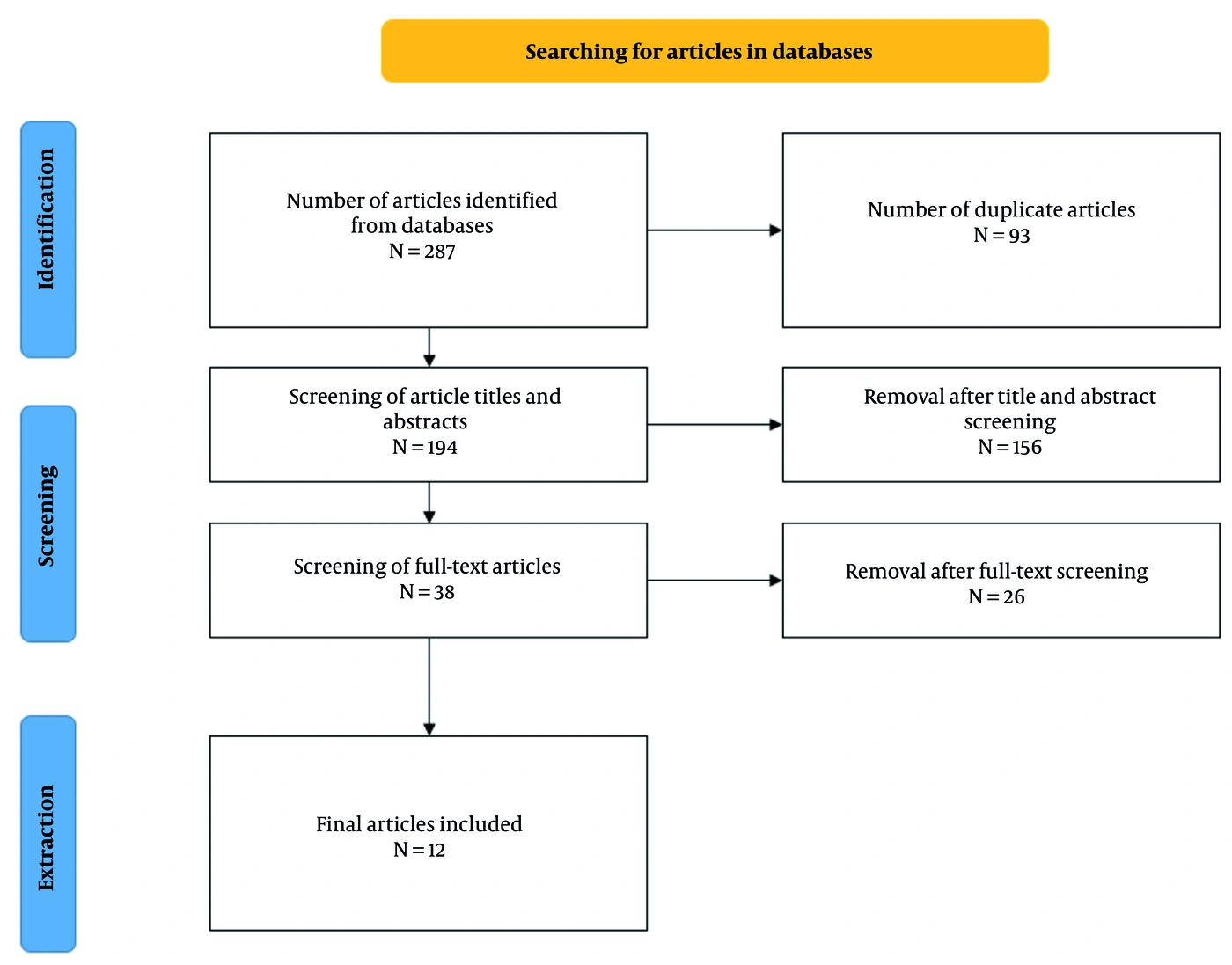
Figure 1.
Flowchart of study identification and selection
Table 1 presents the characteristics of the 12 studies included in this meta-synthesis. The publication years ranged from 2009 to 2025. The target populations varied across studies and included veterans with different disability conditions (e.g., PTSD, neuropsychiatric disorders, 25% disability, 70% spinal cord injury), as well as their spouses, caregivers, children of veterans, and mental health experts and faculty members. The study settings were primarily in various Iranian cities, including Tehran, Isfahan, Abadan, and Qom; one study did not specify the location. The number of interviews in each study ranged from 10 to 30, and the number of extracted codes per study ranged from 1 to 10.
Table 1.
Characteristics of the Included Studies
| Study | Publication year | Target population | Setting | No. of interviews | No. of extracted codes |
|---|---|---|---|---|---|
| Khalili et al. (21) | 2019 | The veteran and his caregiver | Tehran | 25 | 3 |
| Shafiei (22) | 2009 | Veterans with PTSD and their spouses | Isfahan | 25 | 4 |
| Ghazinejad et al. (23) | 2020 | Veterans with neuropsychiatric disorders | Tehran | 16 | 7 |
| Mirhashemi Rooteh et al. (24) | 2025 | Veterans with 25 percent disability | Tehran | 20 | 7 |
| Hojjati et al. (25) | 2017 | Spouses of veterans with PTSD | Abadan | 11 | 2 |
| Shafiei and Mousavi Viayeh (26) | 2020 | Spouses of veterans with children | Tehran | 30 | 10 |
| Yahyazadeh & Masoumzadeh (27) | 2016 | Spouses of veterans | Unknown | 30 | 10 |
| Mohammadi et al. (28) | 2024 | Veterans with neuropsychiatric disorders | Tehran | 10 | 7 |
| Jilanchi et al. (29) | 2020 | Experts and faculty members in the field of mental health | Unknown | 30 | 2 |
| Naderi et al. (30) | 2025 | Children of veterans with spinal cord amputation | Tehran and Qom | 10 | 3 |
| Oveisi Fardovi & Hosseini (31) | 2018 | Veterans with 70% spinal cord injury-related disability | Isfahan, Tehran and Qom | 30 | 2 |
| Oveysi Fardovi et al. (32) | 2021 | Veterans with 70% spinal cord injury-related disability | Isfahan, Tehran and Qom | 20 | 1 |
As shown in Table 2, 34 codes were extracted from the reviewed studies. The most frequent code was "veteran's violence toward child and spouse" (seven studies), followed by "emotional distance and deprivation of a supportive psychological-emotional family atmosphere" (four studies). Several codes appeared in three studies each, including "financial problems and inability to meet basic family needs," "increased tension and conflict between parents and children," "receiving social labels by the family from people," and "inability to conceive and have children." Other codes were reported in 1 or 2 studies, reflecting a wide range of family consequences, including marital conflicts, academic and behavioral problems in children, social isolation, sexual difficulties, and psychological distress in spouses and children. The meta-synthesis of qualitative studies on the family consequences of war injuries among Iranian veterans identified six main themes and several related sub-themes. The first main theme, damage to the emotional-psychological function of the family, included emotional distance (e.g., emotional distance and deprivation of a supportive psychological-emotional family atmosphere, as well as the veteran's indifference toward attending to the family), violence and destructive behaviors (e.g., the veteran's violence toward child and spouse, and destruction of household property), psychological harms to spouses (e.g., sleep disorders, role conflict, marital burnout, blame and complaint, psychological pressure and mental disorders, depression, withdrawal, and hopelessness), psychological harms to children (e.g., transmission of tension and psychological problems to children, high anxiety due to the veteran's unpredictability, and depression and low mood in the child), and marital suspicion and paranoia (e.g., the veteran's suspicion and paranoia toward the spouse).
Table 2.
Coding of the Reviewed Studies
| No. | Code | References | Frequency |
|---|---|---|---|
| 1 | Emotional distance and deprivation of a supportive psychological-emotional family atmosphere | Khalili et al. (21); Shafiei (22); Ghazinejad et al. (23); Mirhashemi Rooteh et al. (24) | 4 |
| 2 | Veteran's violence toward child and spouse | Khalili et al. (21); Shafiei (22); Hojjati et al. (24); Ghazinejad et al. (22); Mirhashemi Rooteh et al. (24); Shafiei and Mousavi Viayeh (26); Yahyazadeh & Masoumzadeh (27) | 7 |
| 3 | Restriction in recreation and leisure time | Shafiei and Mousavi Viayeh (26) | 1 |
| 4 | Veteran's suicide and self-harm in the presence of family members | Yahyazadeh & Masoumzadeh (27) | 1 |
| 5 | Problems and distancing from relatives and kin | Mohammadi et al. (28) | 1 |
| 6 | Children's academic problems | Mohammadi et al. (28); Shafiei and Mousavi Viayeh (26) | 2 |
| 7 | Destruction of household property and belongings by the veteran | Khalili et al. (21) | 1 |
| 8 | Interference of family affairs management with the veteran's condition | Mohammadi et al. (28); Yahyazadeh & Masoumzadeh (27) | 2 |
| 9 | Divorce and separation from spouse | Shafiei (22); Ghazinejad et al. (23) | 2 |
| 10 | Veteran's indifference toward attending to the family | Mirhashemi Rooteh et al. (24) | 1 |
| 11 | Father's disability as the primary source of family income | Mohammadi et al. (28) | 1 |
| 12 | Educational and occupational limitations of spouses and family members | Mirhashemi Rooteh et al. (24) | 1 |
| 13 | Financial problems and inability to meet the basic needs of the family | Mirhashemi Rooteh et al. (24); Jilanchi et al. (29); Yahyazadeh & Masoumzadeh (27) | 3 |
| 14 | Feeling guilty about the family's suffering | Shafiei (22); Ghazinejad et al. (23) | 2 |
| 15 | Sleep disorder in the spouse | Hojjati et al. (25) | 1 |
| 16 | Family's concern about the veteran's health | Ghazinejad et al. (23); Jilanchi et al. (29) | 2 |
| 17 | Increased tension and conflict between parents and children | Mohammadi et al. (28); Naderi et al. (30); Shafiei and Mousavi Viayeh (26) | 3 |
| 18 | Children's distancing and their violence toward the family | Naderi et al. (30) | 1 |
| 19 | Children's disrespect and lack of interest toward the veteran father | Yahyazadeh & Masoumzadeh (27) | 1 |
| 20 | Lack of follow-up on children's educational status and academic decline | Yahyazadeh & Masoumzadeh (27) | 1 |
| 21 | Isolation and reduced interpersonal relationships of children | Mohammadi et al. (28); Naderi et al. (30) | 2 |
| 22 | Receiving social labels by the family from people | Mirhashemi Rooteh et al. (24); Shafiei and Mousavi Viayeh (26); Yahyazadeh & Masoumzadeh (27) | 3 |
| 23 | Role conflict in women with a veteran spouse | Shafiei and Mousavi Viayeh (26) | 1 |
| 24 | Marital burnout in women with a veteran spouse | Shafiei and Mousavi Viayeh (26) | 1 |
| 25 | Transmission of tension and psychological problems to children | Ghazinejad et al. (23) | 1 |
| 26 | Blame and complaint by the spouse | Ghazinejad et al. (23) | 1 |
| 27 | Sexual problems and inability to satisfy the spouse's sexual needs | Oveisi Fardovi & Hosseini (31); Shafiei and Mousavi Viayeh (26) | 2 |
| 28 | Psychological pressure and mental disorders resulting from living with veterans | Mirhashemi Rooteh et al. (24) | 1 |
| 29 | Inability to conceive and have children | Oveisi Fardovi & Hosseini (31); Oveysi Fardovi et al. (32); Shafiei and Mousavi Viayeh (26) | 3 |
| 30 | Children's high anxiety due to the veteran's unpredictability | Mohammadi et al. (28) | 1 |
| 31 | Depression and low mood in the veteran's child | Shafiei and Mousavi Viayeh (26) | 1 |
| 32 | Depression and withdrawal of the veteran's spouse | Yahyazadeh & Masoumzadeh (27) | 1 |
| 33 | Veteran's suspicion and paranoia toward the spouse | Yahyazadeh & Masoumzadeh (27) | 1 |
| 34 | Hopelessness of the veteran's spouse regarding improvement of the family situation | Yahyazadeh & Masoumzadeh (27) | 1 |
The second main theme, collapse and conflict in marital relationships, encompassed marital conflicts (e.g., feeling guilty about the family's suffering and increased tension and conflict between parents and children), sexual and reproductive problems (e.g., inability to satisfy the spouse's sexual needs and inability to conceive), and divorce or separation from the spouse.
The third main theme, weakening of the economic-livelihood and welfare function of the family, included financial problems (e.g., inability to meet basic family needs), disability and reduced income (e.g., the father's disability as the primary source of family income), restrictions in recreation and leisure time, and educational and occupational limitations among family members. The fourth main theme, damage to relationships with social networks and social stigma, consisted of social isolation of the family (e.g., distancing from relatives and kin, and reduced interpersonal relationships among children) and social stigma (e.g., receiving social labels by the family from people).
The fifth main theme, damage to the educational-academic and behavioral function of children, included academic problems (e.g., children's academic problems and lack of follow-up on educational status leading to academic decline) and behavioral problems (e.g., children's distancing and violence toward the family, as well as disrespect and lack of interest toward the veteran father). Finally, the sixth main theme, acute crises and crisis creation in the family, comprised the veteran's suicide and self-harm in the presence of family members, chronic family worry (e.g., the family's concern about the veteran's health), and interference of the veteran's condition with family management (e.g., interference of family affairs management by the veteran's condition) Table 3.
Table 3.
Categorization and Synthesis of Themes
| Main Themes and Subthemes | Codes |
|---|---|
| Damage to the emotional-psychological function of the family | |
| Emotional distance | Emotional distance and deprivation of a supportive psychological-emotional family atmosphere; Veteran's indifference toward attending to the family |
| Violence and destructive behaviors | Veteran's violence toward child and spouse; Destruction of household property and belongings by the veteran |
| Spouse's psychological harms | Sleep disorder in the spouse; Role conflict, marital burnout in women with a veteran spouse; Blame and complaint by the spouse; Psychological pressure and mental disorders resulting from living with veterans; Depression and withdrawal of the veteran's spouse; Hopelessness of the veteran's spouse regarding improvement of the family situation |
| Children's psychological harms | Transmission of tension and psychological problems to children; Children's high anxiety due to the veteran's unpredictability; Depression and low mood in the veteran's child |
| Marital suspicion and paranoia | Veteran's suspicion and paranoia toward the spouse |
| Collapse and conflict in marital relationships | |
| Marital conflicts | Feeling guilty about the family's suffering; Increased tension and conflict between parents and children |
| Sexual and reproductive problems | Sexual problems and inability to satisfy the spouse's sexual needs; Inability to conceive and have children |
| Divorce and separation | Divorce and separation from spouse |
| Weakening of the economic-livelihood and welfare function of the family | |
| Financial problems | Financial problems and inability to meet the basic needs of the family |
| Disability and reduced income | Father's disability as the primary source of family income |
| Restriction in recreation and leisure | Restriction in recreation and leisure time |
| Educational and occupational limitations of family members | Educational and occupational limitations of spouses and family members |
| Damage to relationships with the social network and social stigma | |
| Social isolation of the family | Problems and distancing from relatives and kin; Isolation and reduced interpersonal relationships of children |
| Social stigma | Receiving social labels by the family from people |
| Academic problems | Children's academic problems; Lack of follow-up on children's educational status and academic decline |
| Behavioral problems | Children's distancing and their violence toward the family; Children's disrespect and lack of interest toward the veteran father |
| Acute crises and crisis creation in the family | |
| Veteran's suicide and self-harm | Veteran's suicide and self-harm in the presence of family members |
| Chronic family worry | Family's concern about the veteran's health |
| Interference of the veteran's condition with family management | Interference of family affairs management with the veteran's condition |
To ensure study quality, the authors repeatedly reviewed the sources to verify procedural accuracy. Quality control methods appropriate for qualitative studies were applied throughout the research process. At all stages, transparency and rigor were maintained, and efforts focused on accurately identifying the influential criteria in reverse migration. In addition, to assess the quality and reliability of the findings, Cohen's kappa coefficient was used as a measure of inter-rater agreement. The extracted results were compared by 2 additional experts, who agreed on most components and related concepts. The kappa coefficient was 0.87 (P < 0.001), indicating statistically significant agreement.
4. Conclusions
This study aimed to comprehensively identify and synthesize the family consequences resulting from war injuries in Iranian veterans using a meta-synthesis method. The first main theme, damage to the emotional-psychological function of the family, highlights the substantial emotional harm experienced by family members. The findings indicated that emotional distance, the veteran's indifference to family needs, violence toward children and the spouse, and the destruction of household property (21, 23, 24, 26) severely undermine family cohesion. Spouses reported sleep disorders, role conflict, marital burnout, blame and complaint, psychological pressure, depression, withdrawal, and hopelessness (25-27). Children also experienced transmitted tension, high anxiety due to the veteran's unpredictability, and depression with low mood (23, 26, 28). These findings underscore the need for family-based psychological interventions targeting emotional regulation, communication skills, and trauma-informed care for veteran families.
The second main theme, collapse and conflict in marital relationships, reflects the severe deterioration of the marital bond. The findings included guilt about family suffering and increased tension and conflict between parents and children (22, 23, 26, 28, 30). Sexual problems and inability to satisfy the spouse's sexual needs, along with infertility and inability to conceive, further aggravated marital discord (26, 31, 32). Divorce and separation from the spouse were also reported (22, 23). These findings highlight the urgent need for couple therapy, sexual health counseling, and reproductive health support specifically tailored to veterans and their spouses.
The third main theme, weakening of the economic-livelihood and welfare function of the family, demonstrates the substantial financial hardships faced by these families. Financial problems and inability to meet the family's basic needs were reported across multiple studies (24, 27, 29). The father's disability as the primary source of family income (28), along with restrictions on recreation and leisure time (26) and educational and occupational limitations among spouses and family members (24), created a persistent cycle of poverty and deprivation. These findings support the need for targeted financial support programs, vocational training for disabled veterans and their spouses, and economic empowerment initiatives to improve family welfare.
The fourth main theme, damage to relationships with the social network and social stigma, reflects the substantial social isolation experienced by these families. Problems and distancing from relatives and kin, as well as isolation and reduced interpersonal relationships among children, were identified (28, 30). Moreover, the assignment of social labels to families by others (24, 26, 27) indicates strong social stigma surrounding veteran families. This stigmatization further isolates families from their communities, reduces access to social support networks, and exacerbates psychological distress. Community-based awareness programs, anti-stigma campaigns, and social reintegration interventions are recommended to address this issue.
The fifth main theme, damage to the educational-academic and behavioral function of children, highlights the intergenerational transmission of war-related trauma. Children's academic problems and lack of follow-up on their educational status, leading to academic decline, were reported (26, 27, 28). In addition, children's distancing and violence toward the family, along with disrespect for and lack of interest in the veteran father, were identified (27, 30). These behavioral problems suggest that children internalize family conflicts and may replicate maladaptive coping patterns. School-based mental health services, parental skills training, and educational support programs are essential to prevent long-term academic and behavioral consequences.
The sixth main theme, acute crises and crisis creation in the family, represents the most severe and urgent family consequences. The findings indicated that veterans may engage in suicide and self-harm in the presence of family members (27), creating immediate psychological trauma for all family members. Chronic family worry about the veteran's health was also reported (23, 29), along with interference with the management of family affairs due to the veteran's condition (27, 28). These findings underscore the need for crisis intervention teams, suicide prevention programs, and ongoing mental health monitoring for both veterans and their families. In conclusion, this meta-synthesis provides a comprehensive theoretical model of family consequences following war injuries in Iranian veterans, highlighting the necessity of multidimensional, family-centered support services that address emotional, marital, economic, social, educational, and crisis-related domains simultaneously.
Despite the rigorous meta-synthesis approach, this study has several limitations. First, all included studies were conducted in specific Iranian provinces, which may limit the generalizability of the findings to veterans and their families in other cultural or geographical contexts. Second, the quality and depth of the extracted codes depended on the primary studies, some of which had small sample sizes or lacked detailed methodological reporting. Third, publication bias may be present because only peer-reviewed articles were included, potentially excluding valuable findings from grey literature. From a practical perspective, the findings highlight the urgent need for multidimensional family support programs, including family-centered psychological interventions to address emotional distance and violence, couple therapy and sexual health counseling to reduce marital conflicts, financial empowerment and vocational training to alleviate economic hardships, community-based anti-stigma campaigns to combat social isolation, school-based mental health services for children, and crisis intervention teams to prevent veteran suicide and manage acute family crises. Policymakers and mental health professionals should integrate these evidence-based recommendations into routine care for Iranian veteran families.