


1. Introduction
During the last century, following the Wright brother’s masterpiece, the invention of the first aircraft, the use of this machine for passenger transportation became an important goal. At first, because of the limitations and high expenses, this device was used by governments and rich peoples. By the time, this creation was used to equip the armies, transportation, evacuation and air bombing (1).
Over the past century, aviation technology makes it possible for wealthy people to use aircrafts for air transport of passengers and facilitates travels. In this regard, several airlines emerged around the world, and today this industry became as one of the most important branches of the economy (2).
At the end of the last century, by constructing and equipping the aircrafts, intercontinental travels were improved and in parallel of these advancements, jet lag was appearing as a new challenge. Nowadays, passengers can travel from west hemisphere to the east hemisphere easily, but in the first days after arrival they face a series of unpleasant features which bring them inability and performance decrement. For example, when an athletic team travel from one continent to another in order to play at an important competition, athletes cannot play as expected (3-5).
Later, with the continues effort of researchers, it was found that this spectrum of abnormal features occurs related to rapid changing in circadian rhythm by passing at least the 2 time zones and since this travels done with jet crafts, it is called jet lag (2, 6).
So, useful awareness of jet lag characteristics, on time prevention and effective treatment have central role in reduction of symptoms and signs and maintain their mental and physical performance. Based on this extract representation, we tried to show that treatment of jet lag is practicable and executable compared with preventive facts.
Many researches found that, in human body, there is a time machine at the suprachiasmatic nucleus of hypothalamus. Neurons of CNS have automatic molecular feedback which receive inputs from different sources and modulate their actions. These modulators receive as many internal and external sources such as light, temperature, etc. Oscillatory electrical actions of CNS neurons create the circadian rhythm. Output of this system regulates sleep-wake cycle. So, the master network coordinating this timing system is located in the suprachiasmatic nucleus (SCN) of the hypothalamus, where neurons exhibit circadian rhythms in their electrical activity and are driven by cell-autonomous molecular feedback loops (7-9).
After rapid changing of ambient cues, SCN accommodate immediately but other components need enough time to rectify them odulation. Thus, circadian rhythm and daily sleep-wake transiently disrupt and our clock network misses its synchrony with the external environment. Temporary circadian desynchronization has many effects, but the most obvious ones are disturbed sleep at night and excessive daytime sleepiness, which bring patients to the attention of the sleep clinician (8-10).
For short stopovers (1-2 days) adapting the circadian system is not advised, and at present, immediate circadian adaptation is virtually impossible (9, 11). The use of short-term measurements such as judicious naps, caffeine and short acting hypnotics to maintain alertness and sleep is preferred. For intermediate-length stays (3-5 days) a phase position with the circadian nadir situated within the sleep period is desirable but difficult to achieve. For longer stays (more than 4-5 days) strategies to accelerate the adaptation, include timed exposure to and avoidance of light. The use of artificial light enriched with short wavelengths may be beneficial (8).
The American academy of sleep medicine recommends the timely use of the chronobiotic melatonin to hasten the adaptation. Large differences in rate and direction of adaptation make timing treatment according to individual circadian phase difficult. Individual differences in tolerance of sleep deprivation of jet lag may be related to a length polymorphism in the human clock gene PER3. The maximum efficacy for jet lag avoidance is by pre-flight adaptation; however, this requires time and commitment.
The aim of this article is to provide a framework for understanding the biological basis of jet lag and recommend management strategies. Understanding jet lag can help us to address the broader problem of circadian misalignment, which has increasingly been associated with increased risk of cancer (colorectal and breast), metabolic disease, cardiovascular dysfunction, mood disorders (depression), and cognitive decline (9) (Figure 1).
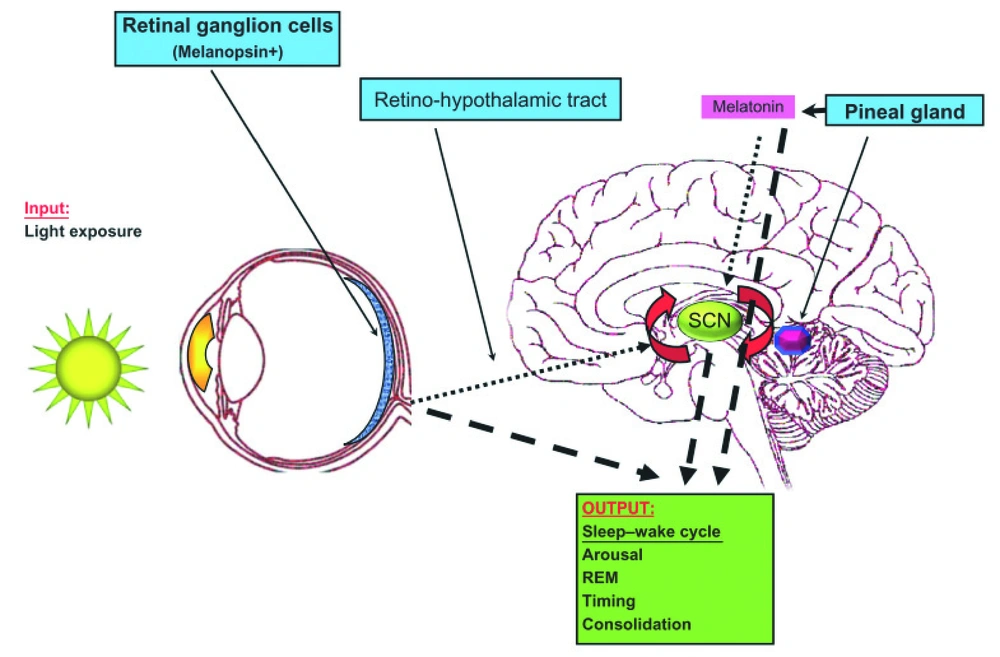
Figure 1.
Circadian Rhythm
2. Methods
The present study is a review article based on the literature in the field of aerospace medicine. It is hoped that this presentation would be useful for those who are interested in aviation medicine.
3. Findings
From scientific point of view, jet lag is classified in the group associated with circadian rhythm sleep disorders. So, at the beginning, recognition of this cycle is necessary.
3.1. Control of Sleep-Wake Cycles
Among the proposed models, two-stage model to control the sleep-wake cycle is a more critical consensus (9).
3.2. A Two-Process Model
In the simplest terms, this model proposes that sleep propensity is governed by two predominant, sometimes competing processes: one being a homeostatic load accumulated of sleep need based on time since last sleep episode, termed “process S”, and another being a circadian-controlled rhythm in wakefulness or sleep, termed “process C” (8).
3.2.1. “S” Process
Based On this process, sleep is the result of the need of sleep accumulation in the interval since the last sleep. As like an hourglass which indicates the interval of sleep and wakefulness.
3.2.2. “C” process
This process is based on the regulation of circadian rhythms on sleep-wake cycle, and dictates the time of each task to the body every moment (9) (Figure 2).
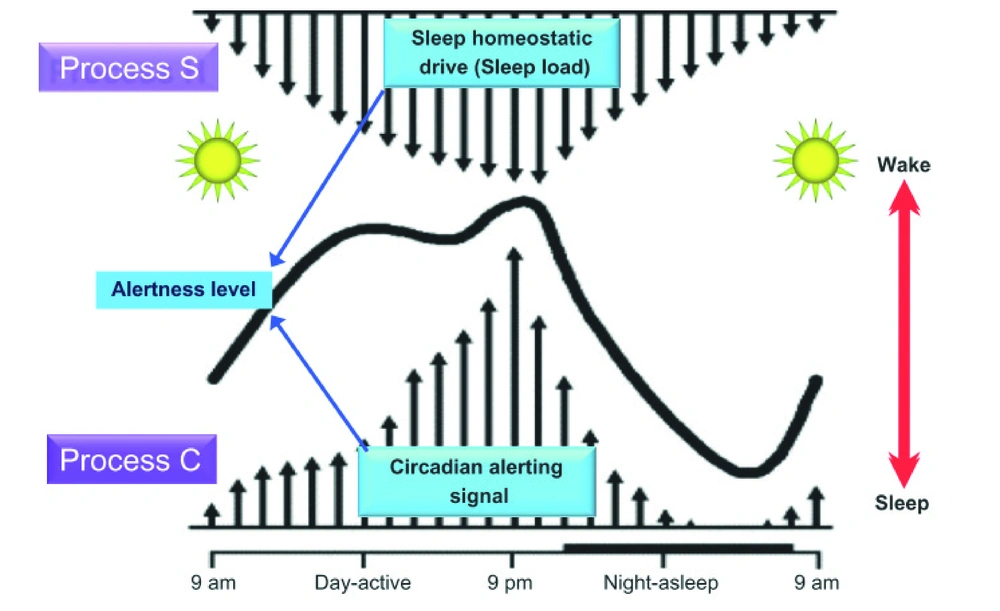
Figure 2.
Circadian Rhythm
3.3. Temporal Control of Sleep Architecture
Today, in the clinics of sleep studies, polysomnographic recordings (by use of electroencephalography (EEG), electromyography (EMG) and electro oculography (EOG)) can help us to study the sleep, wakefulness, sleep pattern and sleep disorder easily and in detail (5, 10, 12).
Scientific evidence suggests that it can be possible to use the short-wave sleep (SWS) phase of the first stage of normal sleep (Non-REM Sleep) to estimate the S process. Since, by increasing the sleep deprivation time, this phase duration would increase logarithmically. In return, core body temperature is one of the best indicators for assessing C process, because the affinity for sleep increases with decline of core body temperature (9, 12).
At this time, it has not been recognized which process has the most affecting control on sleep-wake cycle, but it seems that C process has more effect (12).
3.4. Circadian Organization
In mammals, the part of the nervous system responsible for the organization of circadian behavior lies in a paired structure in the hypothalamus known as the SCN. The SCN is a bilaterally paired nucleus made up of tightly compacted, small neurons just lateral to the third ventricle atop the optic chiasm (11).
Subcortical light information is directly transmitted to the SCN via the retinohypothalamic tract; whereas, thalamic and midbrain inputs modulate the light information and transmit non-photic signals. The SCN integrates this environmental information and modifies the oscillatory activity of its neurons to create coherent, robust, neural, and humoral signals to the rest of the brain and periphery.
3.5. The Neural Outputs
3.6. Transient Disruption of the Circadian System: Jet Lag
Following the jet lag, adjustment of circadian rhythm and environment timing is lessened so that, SCN adapted with ambient changes rapidly, whereas other organs such as brain needs more time (1 to 7 days) to adjust exactly (2, 8, 9).
Clinical manifestations are consisted of: insomnia, sleepiness, general malaise, GI upset (anorexia, indigestion and defecation disorders), neural (fatigue, headaches, and irritability) and cognitive impairments (concentration, judgment and memory disturbance), etc. (13, 14).
Jet lag severity is depended on the ability of persons to adjust to the time changing and the number of passed time zones (3,4,16). However, different persons have unlike severity levels probably due to the interpersonal diversity as present in shift work disorder (15). The results of studies on passengers who travel (flights) over the Atlantic ocean revealed that some of the patient problems are due to the sleep quality changing through flight (2, 13).
During intercontinental air travel, often on the first days of arrival (due to fatigue and sleep deprivation) passengers feel asleep easily and sense no problem, but at the end, during days 2 to 7 jet lag manifestations appear slowly (9) (Figure 3).
After eastward air travel, most people are ahead of time and so at the beginning of evening they feel asleep and awake at the early morning. Thus, the severity of disorder is higher when air travel happens from east to west hemisphere. In return, after westbound air travel, persons are behind the local time of departure and so have insomnia at the night and experience drowsiness during morning time (2, 3) (Figure 3).
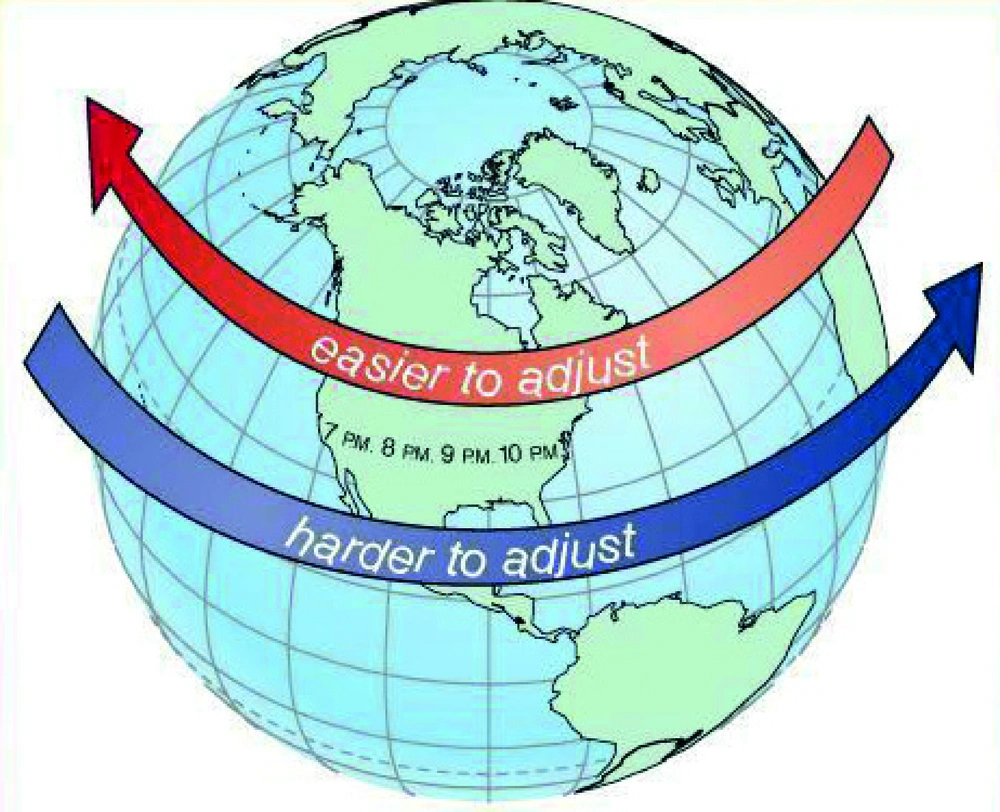
Figure 3.
Travel Direction
Jet lag is easy to diagnose and this could be achieved by the help of its clinical features. Give accurate history, notice to drug history and have robust information about physical and mental disorders are necessary. However jet lag is a self-limited disorder, with negative consequences on physical and mental performance, its perfect prevention and management has deep impact on human lives (2, 3, 8, 9).
3.7. Control and Treatment
The Basis of jet lag control is rapid adjustment of circadian rhythm and new time zone. If only 3 or less time zones were passed, control and treatment are very easier, and would achieve after 1 to 3 days (12).
3.8. Non-Pharmacologic Treatment
These methods are applicable for both passengers and aircrew without any specific limitation (13, 15). Try these tips on your next trip to avoid travel-related stress and subsequent sleeplessness:
- Bring elements or objects from home like a picture of the family, favorite pillow, blanket or even a coffee mug) to ease the feeling of being in a new environment.
- Check with the hotel to see if voice mail services are available to guests. Then, whenever possible, have your calls handled by the service.
- Check your room for potential sleep disturbances that may be avoided; i.e., light shining through the drapes, unwanted in-room noise, etc.
- Request two wake-up calls in case you miss the first one (18).
3.8.1. Sleep Environment
The most common environmental elements affecting sleep are noise, sleep surface, temperature or climate, and altitude. Your age and gender also play a part in determining the level of sleep disturbance caused by these factors. One study found that women are more easily awakened than men by sonic booms and aircraft noise, while other researches indicate that men may be more noise sensitive. Children are generally insensitive to extreme noise levels. However, this high threshold declines with age.
3.8.1.1. Noise
We have all experienced that dripping faucet, the barking dog or that blaring stereo next door have kept us awake. Indeed, experts say that intensity, abruptness, regularity, intrusiveness, familiarity, and regularity of noises all affect sleep.
Generally noises also were 40 decibels, or as high as 70 decibels keep us awake. Interestingly, the absence of a familiar noise can also disrupt sleep. City dwellers may have trouble falling asleep without the familiar sounds of traffic. Or a traveler may find it difficult to sleep without the familiar tick, tick, tick of the alarm clock at home.
Some noises, although annoying at first, can gradually be ignored, allowing sleep to follow. Studies showed that people use to noises such as city traffic in about one week. However, important noises, like a baby crying, a smoke alarm or even one's own name being called, are not easily assimilated and generally snap us awake.
Experts are also studying the ability of certain sounds to induce sleep. "White noise," such as caused by a fan, air conditioner, or radio static, can often block out unwanted noise and encourage sleep.
3.8.1.2. Sleep Surface
A few researches are available about the effects of sleeping surfaces on slumber. We know that people sleep better when horizontal and not cramped by space. As with noise, however, women and more mature people appear more sensitive to variations in sleep bed.
3.8.1.3. Temperature/Climate
The point at which sleep is disturbed due to temperature or climate conditions varies from person to person. Generally, temperatures above 75 degrees Fahrenheit and below 54 degrees would awaken people.
3.8.1.4. Altitudes
The higher the altitude, the greater the sleep disruption is. Generally, sleep disturbance becomes greater at altitudes of 13200 feet or more. The disturbance is thought to be caused by diminished oxygen levels and accompanying changes in respiration. Most people adjust to new altitudes in approximately two to three weeks (16).
3.8.2. Light (Phototherapy)
Light intensity (as luminans) is one of the most important components of jet lag control (9).
A) At eastward air travels, core body temperature increments at early morning and causes insomnia. So, light exposure should be avoided at this time. In this regard, attention to following items is indispensable:
1- Reduce room light as much as possible
2- Suitable blindfold should be used while sleeping
3- Use sunglasses when leaving the building (9).
At the early evening, light exposure should be promoted as possible and suitable lamps were used as necessary.
B) In peoples who are travel to the west, core body temperature declined later at night and increased in the morning. Thus, attention to the following items is indispensable:
1- Rise the light in the morning and facilitate light exposure
3.8.3. Lifestyle Changes
1) Perform daily activities according to the local time and exercise (14)
2) Use appropriate time dish
3.9. Pharmacologic Treatment
As a general principle, the use of any pharmaceutical composition, even OTC drugs, by aircrew is forbidden (at work) and is subjected to aerospace medicine specialist approval (12, 17).
3.9.1. Melatonin
In high doses (3-5 mg), plays role as a weak and short acting hypnotic, and has very little sleep inertia compared to other hypnotic agents. So, these days, aircrew use this agent for short naps (in non-operational intervals) all over the world. Melatonin is available on the markets as 1, 3, 5 and 10 mg tablets (2, 8, 9, 13, 18) (Figure 4).

Figure 4.
Melatonin
3.9.2. Slow-Release Caffeine
The caffeine consumption, can induce awareness and alertness during the daytime. Since caffeine can induces cardiac arrhythmia (such as PVC), its use in eldery passengers and patients who have cardiac disrhythmia has specific limitations. Indeed, aircrew should use restricted dose of caffeine (2, 8, 9) (Figure 5).

Figure 5.
Slow-Release Caffeine
3.9.3. Modafinil
In recent years, this agent was used to increase the awareness and succeed to obtain approval from the United States Food and Drug Administration (FDA) (7). Modafinil has been absolutely forbidden in aircrew and is available on the markets as 100 and 200 mg tablets (Figure 6).

Figure 6.
Modafinil
3.9.4. Hypnotic Agents
Many types of long/short acting hypnotic agents are used only in passengers. Among those we can mention the range of benzodiazepine compounds such as (12, 17):
2-Triazolam as 0.125 and 0.250 mg tablets (19).
