


1. Background
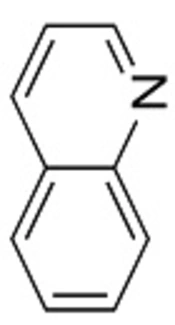
Quinoline and its derivatives have received considerable attention because of their potential activities such as anticancer (1-9), anti-inflammatory (10-12), anti-oxidant, and other biological activities (13-17).
A variety of research have demonstrated that quinoline and its derivatives have shown cytotoxic activity by inhibiting PI3K-PKB, epidermal growth factor receptor, mitogen-activated protein kinase, ALK5, platelet-derived growth factor, or non-receptor tyrosine kinase (18).
Bingul et al. investigated the synthesis of some quinoline derivatives and showed their anti-cancer activity against neuroblastoma cells (19). In another study, Meshram et al. showed that some quinoline derivatives they had prepared were toxic to human cell line HL-60 (myeloid leukemia) and U937 (leukemic monocyte lymphoma) (20). To the best of our knowledge, in all articles we reviewed in literature, the authors have reported the syntheses of quinoline derivatives and investigated their cytotoxic properties against different human cancer cell lines. Here, we have an intention to investigate the possibility of deliberately increasing the cytotoxicity of quinoline derivatives using functionalization reaction methods.
Since there is a growing interest in the development of new quinoline-based compounds for their potential cytotoxicity against cancer cells, in continuation of part of our work- for the preparation of such class of molecules- we reported the synthesis of some quinoline derivatives earlier (21). In that project, we developed a synthetic route for the preparation of a novel terpyridine ligand. The synthetic route involved the preparation of some quinoline derivatives as key materials for the preparation of a terpyridine ligand. Here in, we report the anti-cancer activity of the synthesized quinoline-based molecules and investigate the role of functionalization methods we employed in the level of cytotoxicity of such chemicals.
2. Objectives
The main aims of this research were to investigate the cytotoxicity effect of some quinoline derivatives against cancer cell line and to demonstrate the possibility of the toxicity control of such molecules by functionalization methods in a reaction route.
3. Methods
3.1. Materials
Compounds 7-methylquinoline (A) and 5-methylquinoline (B) as mixture, 7-Methyl-8-Nitro-quinoline (C), 7-(β-trans- (N, N-dimethylamino) ethenyl)-8-nitroquinoline (D), 8-Nitro-7-quinolinecarbaldehyde (E), and 8-Amino-7-quinolinecarbaldehyde (F) were synthesized as previously described (21). 3- (4, 5-dimethylthiaol-2-yl)-2, 5-diphenyltetrazolium bromide (MTT) was purchased from Sigma (St Louis, MO, USA). Dulbecco’s modified eagle’s medium (DMEM), RPMI 1640 medium, and penicillin/streptomycin solution were obtained from Gibco Invitrogen (Carlsbad, CA, USA). Human epithelial colorectal carcinoma (Caco-2) cells were provided by Pasteur Institute, Tehran, Iran.
3.2. Methods
In vitro cytotoxicity study by MTT assay (22): Caco-2 cells (human epithelial colorectal carcinoma cells) were cultured in a medium consisting of RPMI-1640, Dulbecco’s modified Eagle medium (DMEM), heat-inactivated fetal bovine serum (FBS), and penicillin-streptomycin in a ratio of 50:34:15:1 at 37°C in a humidified incubator with 5% CO2. Stock solutions of the test compounds were prepared in DMSO solvent and diluted 100 folds with the culture medium. The cells were seeded in 96-well transparent plates at 10,000 cells per well. After 24 hours, the old medium was removed and Caco-2 cells were exposed to the test compounds at concentrations ranging from 0.1 - 1000 µg/mL. After 48 houres incubation, 20 µL of MTT solution (5 mg/mL) was added to each well of the plates and the plates were then maintained in incubator. After 4 hours, 100 µL DMSO solvent was added to each well to dissolve the purple formazan crystals and then the plates were read on a Synergy HT Microplate Reader (Bio-Tek Instruments, Winooski, VT) at 570 nm with the reference wavelength at 690 nm. The IC50 values were calculated by SigmaPlot 12.0 software.
4. Results
To study the effect of functionalization reactions of quinoline derivatives on their cytotoxicity, the previously prepared compounds (i.e. a mixture of two quinoline derivative isomers (7-methylquinoline and 5-methylquinoline (A+B) and four quinoline derivatives (7-methyl-8-nitro-quinoline (C), 7-(β-trans- (N, N-dimethylamino) ethenyl)-8-nitroquinoline (D), 8-nitro-7-quinolinecarbaldehyde (E), and 8-Amino-7-quinolinecarbaldehyde (F)) were selected. For this purpose, the sensitivity of human epithelial colorectal carcinoma (Caco-2) cultured cells towards the synthetic compounds was evaluated. The cytotoxic activities of the quinoline derivatives were determined by MTT assay. The IC50 values for the quinoline compounds are shown in Figure 1.
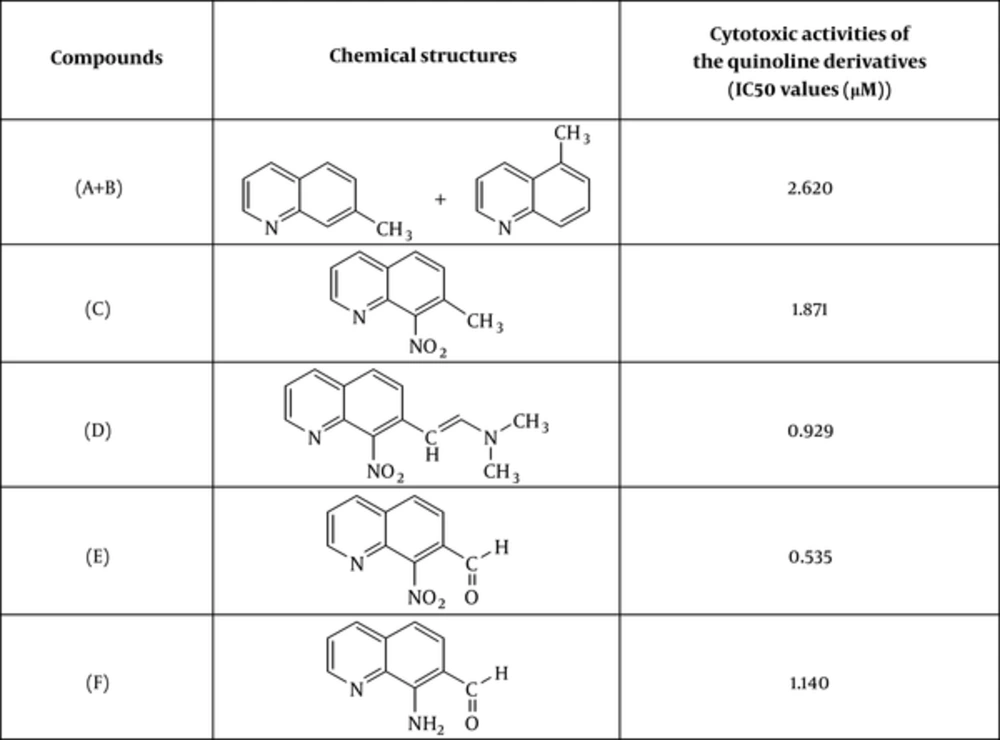
Figure 1.
Cytotoxic Activity of Some Quinoline Derivatives Against Human Epithelial Colorectal Carcinoma (Caco-2) Cultured Cells
5. Discussion
We have previously reported the synthesis and characterization of some quinoline derivatives (Figure 2) (21).
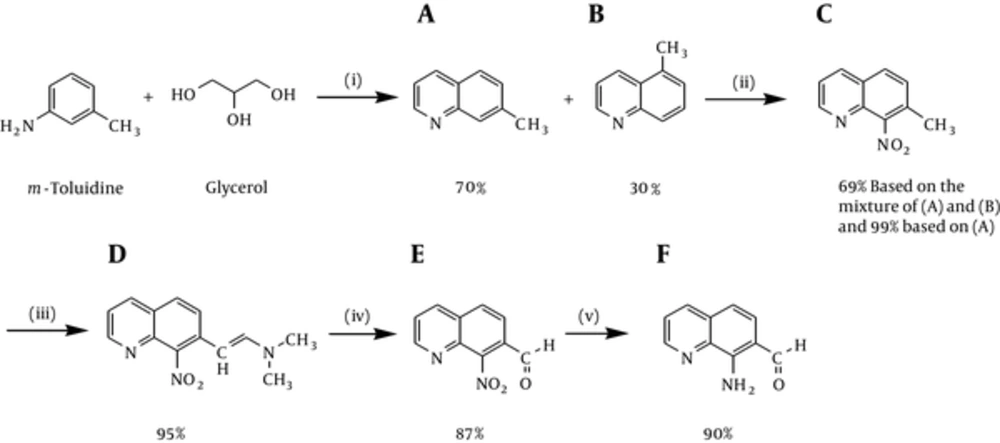
Figure 2.
(i) sodium m-nitrobenzene sulfonate, m-toluidine, 98% H2SO4 and H2O, reflux; (ii) fuming HNO3 and 98% H2SO4, -5°C; (iii) N, N-dimethylformamide dimethyl acetal, dry DMF, under Ar, 140°C, 24 hours; (iv) NaIO4, THF/ H2O, r.t, 4 hours; (v) Fe/ HCl, EtOH, HOAc, H2O, reflux, 30 minutes (21).
As shown in Figure 1, the cytotoxic activities of the quinoline derivatives against Caco-2 cell lines highly depend on the functional groups attached to the quinoline core structure. Nitration reaction of the mixture (A + B) resulted in a product with a nitro group ortho to a methyl group in compound A (Figure 2) (21). However, compound B remained unreacted and it was separated from the reaction mixture consequently. Based on our observations, the nitro derivative C is more cytotoxic than the mixture (A + B) against Caco-2 cell line. In the next step, the reaction of C with N, N-dimethylformamide dimethyl acetal (DMFDMA) gave the derivative D (21). The cytotoxic activity of compound D was also determined against Caco-2 cell line. We observed that compound D was more toxic that compound C (IC50 values of 0.929 and 1.871 µM, respectively). Oxidation reaction of D produced the nitro-aldehyde derivative E. We again observed an increase in cytotoxicity of E against Caco-2 cell line (IC50 value, 0.535 µM). A decreased cytotoxic activity was observed during the cytotoxicity evaluation of the amine-aldehyde quinoline derivative F as the product of a reduction reaction of derivative E using Fe catalyst in an acidic medium (Figure 3).
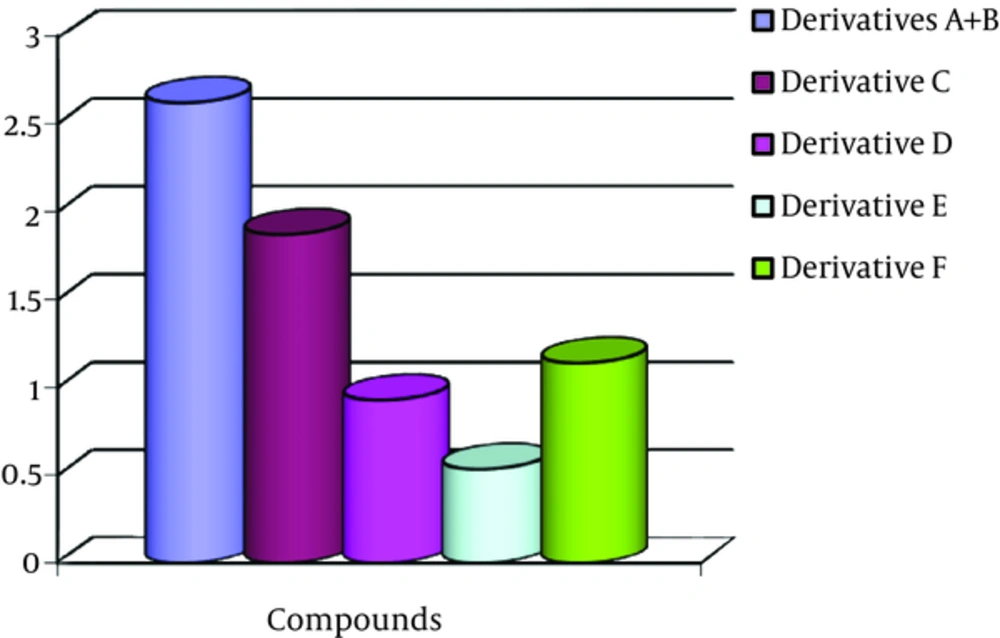
Figure 3.
Schematic Trend of the Cytotoxic Activity of the Quinoline Derivatives Against (Caco-2) Cell Lines Over the Reaction Sequences (the Values on the Vertical Axis are IC50 Values in µM)
We observed that the previously synthesized quinoline derivatives (A + B), (C), (D), (E), and (F) in a reaction sequence showed an influence in cytotoxicity against Caco-2 cell lines. Based on our evaluation, nitro-aldehyde quinoline derivative (E) showed the highest cytotoxicity against the cultured cells compared to the other compounds we studied. An increase in cytotoxicity was observed from the mixture (A + B) to the compounds (C), (D) and (E), in sequence, while a decrease in cytotoxicity was demonstrated from the nitro-aldehyde derivative (E) to its corresponding amine-aldehyde derivative (F). The latter trend we observed is consistent with the literature values in which the aromatic amine derivatives were less toxic than their corresponding nitro compounds (23). The change in cytotoxic activities of the compounds showed that functionalization of the quinoline derivatives we studied can be used as a method to control cytotoxicity of such compounds.
