Image Credit:J Cell Mol Anesth
Outline
Evaluation of outcome in sticking upper limit and lower limit in BIS monitoring for radical cystectomy
Authors

Abstract
Introduction: The electroencephalogram-derived bispectral index (BIS) is a promising new method to assess anesthetic adequacy.? The purpose of this study is to evaluation of outcome in sticking upper limit and lower limit in BIS monitoring for radical cystectomy surgery.Methods: 202 patients with elective radical cystectomy were selected randomly and divided into two groups of BIS (40-50) and BIS (50-60). The patients were blinded to the study group (BIS). Initially demographic and clinical information such as age, sex, weight, recovery time, patient extubation time, awareness during surgery, mortality rate and patient stay in hospital, BIS and patient cost were included in data collection form.Results: There were 197 males and 5 females and the average age of the patients were 67.12?8.1. There is significant relationship between recovery time, amount of anesthetic used,? ICU stay, hospital stay, hospital cost, and BIS monitoring range.(p value<0.001). Also there is significant relationship between extubation time and BIS monitoring range. (p value=0.001). The relationship between PONV with BIS monitoring range is significant. (p value<0.001). But there was no significant relationship between Analgesic drugs (p value=0.26) and awareness (p value=0.175) and mortality (p value=0.651) with BIS monitoring range.Conclusion: The conclusion is that by increasing the BIS value, the anesthetic dose, extubation and recovery time, hospital and ICU stay were significantly reduced as well as the cost.
Highlights
References
- 1.References are in the PDF file of the article.
Copyright
© 2019, Author(s). This open-access article is available under the Creative Commons Attribution 4.0 (CC BY 4.0) International License (https://creativecommons.org/licenses/by/4.0/), which allows for unrestricted use, distribution, and reproduction in any medium, provided that the original work is properly cited.
Similar Articles
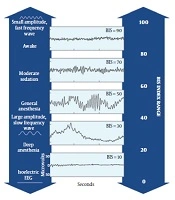
A Review of Bispectral Index Utility in Neurocritical Care Patients
Yousefi-Banaem H, Goharani R, Hajiesmaeili M, Tafrishinejad A, Zangi M, et al. A Review of Bispectral Index Utility in Neurocritical Care Patients. Arch Neurosci. 2020;7(3):e96490. doi: https://doi.org/10.5812/ans.96490
Comparison of Bispectral Index Monitoring With the Critical-Care Pain Observation Tool in the Pain Assessment of Intubated Adult Patients After Cardiac Surgery
Faritous Z, Barzanji A, Azarfarin R, Ghadrdoost B, Ziyaeifard M, et al. Comparison of Bispectral Index Monitoring With the Critical-Care Pain Observation Tool in the Pain Assessment of Intubated Adult Patients After Cardiac Surgery. Anesth Pain Med. 2016;6(4):e38334. doi: https://doi.org/10.5812/aapm.38334
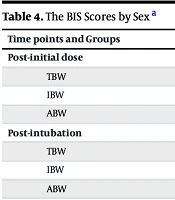
Sodium Thiopental Dosing Strategies in Overweight Patients: A Randomized Clinical Trial
Rahimi M, Farhadi A, Effatdoost Astane R, Eslami B, Montaseri A. Sodium Thiopental Dosing Strategies in Overweight Patients: A Randomized Clinical Trial. Arch Neurosci. 2026;13(2):e172002. doi: https://doi.org/10.5812/ans-172002

Comparison of Arterial Oxygenation Following Head-Down and Head-Up Laparoscopic Surgery
Imani F, Shirani Amniyeh F, Bastan Hagh E, Khajavi MR, Samimi S, et al. Comparison of Arterial Oxygenation Following Head-Down and Head-Up Laparoscopic Surgery. Anesth Pain Med. 2017;7(6):e58366. doi: https://doi.org/10.5812/aapm.58366
Comparison of Two Methods of Anesthesia Using Patient State Index: Propofol Versus Sevoflurane During Interventional Neuroradiology Procedure
Kang E, Lee KH, Park J. Comparison of Two Methods of Anesthesia Using Patient State Index: Propofol Versus Sevoflurane During Interventional Neuroradiology Procedure. Anesth Pain Med. 2019;9(2):e87518. doi: https://doi.org/10.5812/aapm.87518
- Scopus by DOI: 0
Last Update: 1 month ago
- Scopus by Title: 0
Last Update: 1 month ago
- Scopus by Title (Ref): 0
Last Update: 1 month ago
- CrossRef: 0
Last Update: 6 days ago
- OpenAlex: 0
Last Update: 6 hours ago
- OpenCitations: 0
Last Update: 4 days ago