Image Credit:J Cell Mol Anesth
Outline
The Effects of Vitamin D3 in Pediatric Patients Undergoing Congenital Heart Surgery
Authors

Abstract
Background: To investigate the effects of vitamin D3 on the surgical outcome of pediatric patients undergoing cardiac surgery for congenital heart conditions. Materials and Methods: Ninety pediatric cardiac surgery patients referred for preoperative evaluation were enrolled. Patients with insufficient vitamin D3 levels received intramuscular vitamin D3 (300,000 IU) three days before the surgery and those with final vitamin D3 level of ?30 ng/dl were included and divided into 3 groups (Group A: abnormal Vit D levels, no Vit D treatment; Group B: abnormal Vit D levels, Vit D treatment up to normal serum Vit D levels before surgery; Group C: normal baseline Vit D levels, no supplemental Vit D treatment). Interleukin 1, 6, 10, tumor necrosis factor-alpha, vital signs, and arterial blood gas parameters were measured before the surgery and at 6 and 24 hours after cardiopulmonary bypass. Data on total hospital stay, reoperation rates, and inotropes scores were retrieved. Additionally, postoperative measures including hemodynamic factors, blood pressure, heart rate, cardiac output, electrocardiography changes, chest-tube drainage, and ventilation-related factors (i.e. respiratory rate, arterial blood gas, respiratory resistance, intubation time, ?) were recorded. Results: We observed a significant increase in post cardiopulmonary bypass levels of IL-10 and IL-6 in all groups (p<0.002) regardless of vitamin D treatment status; however, no significant difference was seen in levels of IL-1 and TNF-alpha. Groups B had more patients with critical levels of VIS scores compared to groups A and C (p<0.002). Furthermore, no differences in hemodynamic and metabolic parameters were observed. Conclusion: No significant difference in the rates of postoperative parameters in patients with normal and those with deficient levels of vitamin D3 was observed.
Highlights
References
- 1.References are in the PDF file of the article.
Copyright
© 2020, Author(s). This open-access article is available under the Creative Commons Attribution 4.0 (CC BY 4.0) International License (https://creativecommons.org/licenses/by/4.0/), which allows for unrestricted use, distribution, and reproduction in any medium, provided that the original work is properly cited.
Similar Articles
The effect of 1,25 (OH)2 Vitamin D3 on serum levels of inflammatory cytokines in patients undergoing CABG
Fani K, shadnoush M, jahangirifard A, Foroughi M, Jelveh Moghaddam HA, et al. The effect of 1,25 (OH)2 Vitamin D3 on serum levels of inflammatory cytokines in patients undergoing CABG. J Cell Mol Anesth. 2018;3(3):e150279. doi: https://doi.org/10.22037/jcma.v3i3.19258
The Relationship of Serum Vitamin D Level With the Outcome in Surgical Intensive Care Unit Patients
Sanaie S, Mahmoodpoor A, Hamishehkar H, Fattahi S, Soleymani S, et al. The Relationship of Serum Vitamin D Level With the Outcome in Surgical Intensive Care Unit Patients. Iran J Pharm Res. 2019;18(2):e126234. doi: https://doi.org/10.22037/ijpr.2019.1100658
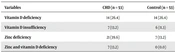
Vitamin D and Zinc Deficiency in Children with Congenital Heart Defects
Rastegar M, Hosseini Teshnizi S, Khaleghinia M, Seddighi N, Rajaei S. Vitamin D and Zinc Deficiency in Children with Congenital Heart Defects. J Compr Ped. 2024;15(3):e145841. doi: https://doi.org/10.5812/jcp-145841
Comparison of the Effect of Oral Versus Parenteral Vitamin D on Serum Levels of Vitamin D in Premature Infants with Vitamin D Deficiency
Kashaki M, Mohammadi Z, Mazouri A, Norouzi E. Comparison of the Effect of Oral Versus Parenteral Vitamin D on Serum Levels of Vitamin D in Premature Infants with Vitamin D Deficiency. J Compr Ped. 2023;14(2):e134297. doi: https://doi.org/10.5812/compreped-134297
Effect of High-Dose Vitamin D on Duration of Mechanical Ventilation in ICU Patients
Miri M, Kouchek M, Rahat Dahmardeh A, Sistanizad M. Effect of High-Dose Vitamin D on Duration of Mechanical Ventilation in ICU Patients. Iran J Pharm Res. 2019;18(2):e126208. doi: https://doi.org/10.22037/ijpr.2019.1100647
- Scopus by DOI: 5
Last Update: 1 month ago
- Scopus by Title: 5
Last Update: 1 month ago
- Scopus by Title (Ref): 5
Last Update: 1 month ago
- CrossRef: 0
Last Update: 6 days ago
- OpenAlex: 2
Last Update: 6 hours ago
- OpenCitations: 0
Last Update: 4 days ago
