
1. Background
Perioperative pulmonary aspiration of gastric contents is a rare but life-threatening complication of general anesthesia, associated with aspiration pneumonitis, pneumonia, prolonged mechanical ventilation, and mortality rates approaching 5% in severe cases (1-3). Although the overall incidence ranges from 0.1% to 19% depending on patient-specific and surgical risk factors, pulmonary aspiration accounts for up to 9% of all anesthesia-related deaths (4). The risk of aspiration is intrinsically linked to the volume and nature of gastric contents at the time of induction; a gastric residual volume (GRV) exceeding 1.5 mL/kg has been associated with meaningfully elevated aspiration risk in fasted adult patients (5).
Diabetes mellitus is a well-established independent risk factor for delayed gastric emptying. Diabetic autonomic neuropathy disrupts antroduodenal coordination, resulting in a spectrum of gastroparesis that may persist despite appropriate preoperative fasting (6). Studies using gastric scintigraphy and ultrasound have consistently demonstrated that diabetic patients have significantly larger antral cross-sectional areas (CSAs) and higher residual gastric volumes than non-diabetic controls after equivalent fasting durations (7, 8). This pathophysiological vulnerability is further compounded by chronic hyperglycemia, which independently inhibits gastric motility through enteric nervous system dysfunction, even in the absence of overt autonomic neuropathy (9).
General anesthesia exacerbates aspiration risk by attenuating lower esophageal sphincter tone and abolishing protective upper airway reflexes, rendering fasted yet gastroparetic patients particularly susceptible to regurgitation and pulmonary soiling during induction (6). Point-of-care (POC) gastric ultrasound has emerged as a validated, non-invasive bedside tool for preoperative gastric content assessment (10, 11). By measuring antral CSA in the semi-sitting (SS) and right lateral decubitus (RLD) positions, the anesthesiologist can estimate GRV in real time and stratify aspiration risk, directly informing perioperative management decisions (12). This technique has been validated against gastric scintigraphy and demonstrates good correlation with direct gastric aspirate volumes (11).
Metoclopramide is a dopamine D2 receptor antagonist and 5-HT4 partial agonist that enhances gastrointestinal motility by facilitating acetylcholine release at enteric neuromuscular junctions and antagonizing dopamine-mediated smooth muscle relaxation at the antral level (13). It is widely prescribed in the management of diabetic gastroparesis; however, evidence supporting its preoperative use to reduce gastric residual volume in diabetic surgical patients remains limited and methodologically heterogeneous (14, 15). Crucially, no prospective study has employed POC gastric ultrasound as the primary objective endpoint to assess the preoperative prokinetic efficacy of metoclopramide specifically in this high-risk diabetic population.
We hypothesized that a single preoperative dose of intravenous (IV) metoclopramide would significantly reduce antral CSA and GRV in fasted diabetic patients, partially normalizing gastric parameters toward values observed in non-diabetic controls.
2. Objectives
The primary aim of this study was to evaluate the effect of IV metoclopramide (10 mg) on ultrasonographically measured antral CSA as the primary endpoint. Secondary aims included assessment of GRV, antral gastric grade (AGG), weight-adjusted GRV, and post-intervention fasting glucose.
3. Methods
3.1. Study Design and Ethical Approval
This prospective, non-randomized, open-label, three-group controlled comparative study was conducted at Kafr El-Sheikh University Hospitals, Kafr El-Sheikh, Egypt. The study protocol was approved by the Institutional Ethics Committee of Kafr El-Sheikh University Hospitals (Ethics Reference Number: KFSIRB200-316). All procedures were performed in accordance with the Declaration of Helsinki, and written informed consent was obtained from all participants before enrollment.
3.2. Study Population
Sixty patients aged 18 - 65 years of both sexes, with American Society of Anesthesiologists (ASA) physical status I - II and scheduled for elective surgery under general anesthesia, were enrolled. Patients were allocated to one of three equal groups (n = 20 each) based on diabetic status and intervention assignment.
Inclusion criteria were adult patients aged 18 - 65 years with ASA physical status I - II who were scheduled for elective surgery under general anesthesia and had fasted for at least 8 hours. Groups I and II required a confirmed diagnosis of type 2 diabetes mellitus.
Exclusion criteria were concurrent use of medications affecting gastric motility (excluding the study drug), renal failure, gastrointestinal disorders (including irritable bowel syndrome and inflammatory bowel disease), hepatic impairment, hypothyroidism, obesity (body mass index [BMI] > 30 kg/m²), connective tissue disorders, history of gastrointestinal surgery, steroid-induced hyperglycemia, and pregnancy.
3.3. Group Allocation
Patients were allocated to three groups based on diabetic status and eligibility for metoclopramide intervention according to predefined clinical criteria. Group I (diabetic + metoclopramide) included diabetic patients who received a single IV dose of metoclopramide 10 mg (2 mL) 30 - 60 minutes before POC gastric ultrasound assessment to allow for peak prokinetic effect. Group II (diabetic, no treatment) included diabetic patients who did not receive metoclopramide or any other prokinetic agent preoperatively. Group III (non-diabetic controls) included non-diabetic patients who did not receive metoclopramide and served as a healthy reference group.
To mitigate bias, sequential enrollment was implemented, and all participants adhered to similar preoperative fasting directives (minimum 8 hours), a consistent ultrasound assessment process, and a uniform anesthetic regimen. Objective ultrasonographic measurements of antral CSA were acquired using a standardized approach to minimize observer variability. Baseline demographic and clinical data were collected before the intervention to ensure group comparability and to adjust for potential confounding variables in the statistical analysis. No enrolled patients were excluded after group allocation; all 60 participants completed the study protocol and were included in the final analysis.
3.4. Preoperative Assessment
All patients underwent comprehensive preoperative assessment, including medical history, physical examination, and laboratory investigations: complete blood count, serum fasting glucose, glycated hemoglobin (HbA1c), renal and hepatic function tests, and thyroid function tests. All patients fasted for at least 8 hours before surgical scheduling, in accordance with institutional and ASA preoperative fasting guidelines. After completion of preoperative assessment, gastric ultrasound was performed to objectively evaluate gastric contents before anesthesia induction. All patients received metoclopramide 30 minutes before induction, standardized relative to the fasting period (≥ 8 hours).
3.5. Point-of-Care Gastric Ultrasound Protocol
Point-of-care gastric ultrasound was performed by a single trained anesthesiologist using a low-frequency curved array probe (2 - 5 MHz) to minimize interobserver variability. All measurements were performed before anesthetic induction to avoid confounding effects of anesthetic agents on gastric motility. Each patient was examined sequentially in two positions: SS (approximately 45°) and RLD. A sagittal view of the gastric antrum was obtained between the left lobe of the liver and the pancreas. The anteroposterior (AP) and craniocaudal (CC) diameters of the gastric antrum were measured in millimeters at end-expiration during the peristaltic rest phase. Three measurements were obtained and averaged to reduce peristaltic variability.
All examinations were performed using a standardized scanning protocol with patients in the supine and RLD positions. The gastric antrum was identified between the left lobe of the liver and the pancreas at the level of the aorta. Antral CSA was calculated using the standard ellipse formula: antral CSA (cm²) = π/4 × AP (cm) × CC (cm). Gastric volume was estimated using the validated formula described by Perlas et al. (11): Gastric volume (mL) = 27.0 + 14.6 × RLD-CSA − 1.28 × age.
3.6. Antral Gastric Grade
Qualitative grading of gastric content was performed using the validated Perlas classification (11, 12): Grade 0, empty antrum in both SS and RLD positions (estimated GRV ≤ 0 mL, minimal aspiration risk); Grade 1, fluid visible in the RLD position only (estimated GRV approximately 100 - 300 mL, low-to-intermediate risk); and Grade 2, fluid visible in both SS and RLD positions (estimated GRV > 300 mL, high aspiration risk).
Cross-sectional area, GRV, and the GRV/weight ratio were used as surrogate markers of gastric content and potential aspiration risk. Gastric residual volume was estimated using previously validated mathematical models based on antral CSA measurements. The operators were not blinded to group allocation, which may introduce measurement bias.
3.7. Anesthetic Protocol
Following ultrasound evaluation, patients proceeded to induction of general anesthesia using a standardized protocol. After placement of peripheral IV access, standard ASA monitoring was applied, including oxygen saturation, end-tidal carbon dioxide, electrocardiography, and non-invasive blood pressure. Anesthesia was induced with IV fentanyl 1 µg/kg over 30 seconds for analgesia, followed by IV propofol 2.5 mg/kg over 30 seconds for hypnosis. Neuromuscular blockade was achieved with IV atracurium 0.5 mg/kg to facilitate endotracheal intubation. Correct endotracheal tube placement was confirmed by bilateral chest auscultation and continuous end-tidal carbon dioxide capnography. Anesthesia was maintained with a balanced technique using inhalational agents (isoflurane or sevoflurane in oxygen/air at 50:50), supplemented by intermittent atracurium as required. At the conclusion of surgery, residual neuromuscular blockade was reversed with IV neostigmine 0.04 - 0.08 mg/kg and IV atropine 0.02 mg/kg. Extubation was performed after confirmation of adequate spontaneous ventilation, full recovery of neuromuscular function by train-of-four monitoring, and return of protective airway reflexes. Use of such medications was recorded and adjusted for in the analysis.
Gastric ultrasound examinations were performed by operators who had received formal training in POC gastric ultrasonography and had completed at least 3 supervised examinations before study initiation.
3.8. Outcomes
The primary outcome was antral CSA measured by POC ultrasound (cm²). Secondary outcomes were GRV (mL), AGG distribution, weight-adjusted GRV (mL/kg), and post-intervention fasting serum glucose (mg/dL). These ultrasound-derived measures were used as proxies for aspiration risk, with thresholds and AGG grades operationally defined to reflect potential clinical risk rather than directly observed aspiration events. Perioperative glucose levels were recorded throughout.
3.9. Sample Size Calculation
Sample size was calculated using G*Power 3.1.9.2 (Universität Kiel, Germany). Based on a priori data from comparable studies, mean ± SD antral CSA was 6.6 ± 3.2 cm² in Group I, 6.1 ± 3.2 cm² in Group II, and 2.96 ± 1.88 cm² in Group III. With an effect size of 0.584, a two-tailed alpha of 0.05, and a desired power of 95%, a minimum of 17 patients per group was required. Nineteen patients per group were enrolled with an anticipated 10% attrition allowance, yielding a target of 20 per group and 60 total. No dropouts occurred during the study period.
3.10. Statistical Analysis
Statistical analysis was performed using jamovi (version 2.26.6; The jamovi project, 2022; jamovi.org). Data normality was assessed using the Shapiro-Wilk test and visual inspection of histograms and Q-Q plots. Normally distributed continuous variables are presented as mean ± standard deviation (SD) and were analyzed using one-way analysis of variance with post hoc Tukey honest significant difference testing for pairwise comparisons. Non-normally distributed continuous variables are presented as median (interquartile range) and were analyzed using the Kruskal-Wallis test, with post hoc pairwise comparisons performed using Bonferroni correction. Categorical variables are presented as frequency and percentage and were analyzed using the chi-square test. A two-tailed P-value < 0.05 was considered statistically significant. Effect sizes were estimated using eta-squared for analysis of variance and Cramér V for chi-square analyses.
4. Results
4.1. Flowchart
In this investigation, 77 patients were assessed for eligibility, 11 patients did not meet the criteria, and 6 patients refused to participate in the study. The remaining 60 patients were allocated into three equal groups (20 patients in each). All allocated patients were followed up and analyzed statistically (Figure 1).
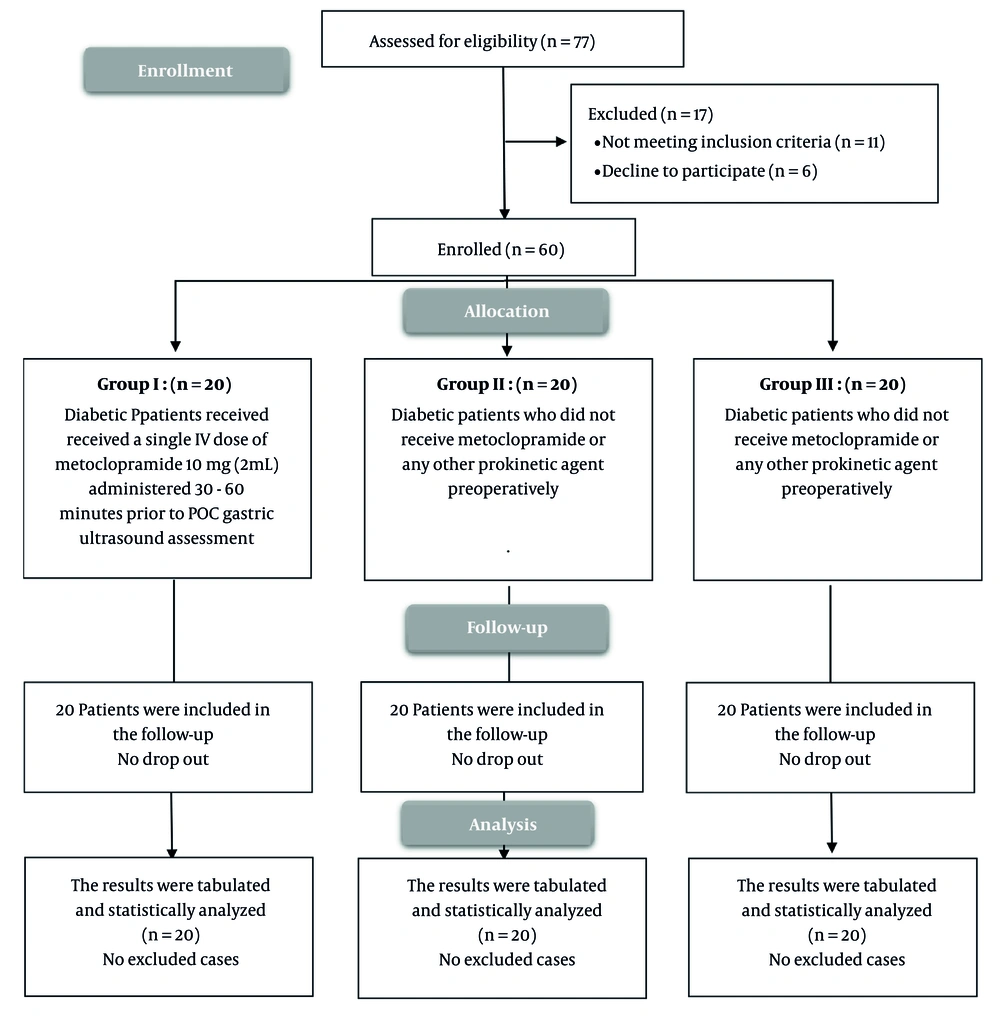
Figure 1.
Flowchart of the studied groups
4.2. Demographic and Baseline Characteristics
Sixty patients were enrolled and allocated to three groups of 20 each (Table 1). No patients were excluded after enrollment, and no dropouts occurred. The three groups were well matched for age (P = 0.109), sex distribution (P = 0.605), BMI (P = 0.140), and ASA physical status (P = 0.765), confirming demographic comparability at baseline (Table 1).
Table 1.
Demographic Characteristics of Our Patients a
| Variables | Diabetic + Metoclopramide (N = 20) | Diabetic - No Metoclopramide (N = 20) | Non-diabetic control (N = 20) | P-Value | MD or RR (95% CI) |
|---|---|---|---|---|---|
| Age (y) | 41.0 ± 7.6 | 47.8 ± 10.7 | 45.0 ± 11.3 | 0.109; F = 2.303 | MD1 = -6.8 (-14.3 - 0.8); MD2 = -3.9 (-11.5 - 3.7); MD3 = 2.9 (-4.7 - 10.4) |
| Sex | 0.605; χ² = 1.005 | RR1 = 1.18 (0.71 - 1.97); RR2 = 0.93 (0.6 - 1.43); RR3 = 0.79 (0.48 - 1.28) | |||
| Male | 13.0 (65.0) | 11.0 (55.0) | 14.0 (70.0) | ||
| Female | 7.0 (35.0) | 9.0 (45.0) | 6.0 (30.0) | ||
| BMI (Kg/cm²) | 27.1 ± 1.7 | 27.6 ± 1.6 | 26.5 ± 2.1 | 0.140; F = 2.038 | MD1 = -0.6 (-1.9 - 0.8); MD2 = 0.6 (-0.8 - 2); MD3 = 1.1 (-0.2 - 2.5) |
| ASA Status | 0.765; χ² = 0.535 | RR1 = 1 (0.54 - 1.86); RR2 = 1.25 (0.63 - 2.5); RR3 = 1.25 (0.63 - 2.5) | |||
| I | 10.0 (50.0) | 10.0 (50.0) | 8.0 (40.0) | ||
| II | 10.0 (50.0) | 10.0 (50.0) | 12.0 (60.0) | ||
| Diabetes Duration (y) | Reported per patient | Reported per patient | N/A | — |
Abbreviations: ASA, American Society of Anesthesiologists; BMI, Body Mass Index; CI, confidence interval; F, analysis of variance test; MD, mean difference; N, number; N/A, not applicable; RR, relative risk; SD, standard deviation; vs., versus; χ², chi-square test.
a Values are expressed as mean ± SD or N (%) unless otherwise indicated.
4.3. Laboratory Investigations
Baseline laboratory findings are summarized in Table 2. As expected, HbA1c was markedly elevated in both diabetic groups (Group I: 8.5 ± 1.0%; Group II: 9.1 ± 1.1%) compared with non-diabetic controls (4.7 ± 0.7%; P < 0.001 for each diabetic group vs. controls). Baseline fasting glucose was similarly elevated in diabetic patients (Group I: 151.7 ± 13.2 mg/dL; Group II: 144.6 ± 17.3 mg/dL) relative to controls (94.3 ± 8.4 mg/dL; P < 0.001). Critically, no significant difference in HbA1c (P = 0.062) or baseline fasting glucose (P = 0.278) was detected between the two diabetic subgroups, confirming metabolic comparability at the time of enrollment. Hemoglobin was modestly but significantly lower in both diabetic groups compared with controls (P < 0.001), consistent with the chronic disease anemia frequently observed in diabetes. White blood cell count and platelet count were comparable across all three groups (P = 0.209 and P = 0.348, respectively) (Table 2).
Table 2.
Baseline Laboratory Investigation a
| Variables | Diabetic + Metoclopramide (N = 20) | Diabetic - No Metoclopramide (N = 20) | Non-diabetic control (N = 20) | P-Value | Post Hoc Pairwise Comparisons | MD (95% CI) |
|---|---|---|---|---|---|---|
| Hb (g/dL) | 12.7 ± 0.8 | 12.7 ± 0.7 | 14.0 ± 1.0 | < 0.001; F = 15.04 | I vs. II: P = 0.99; I vs. III: P < 0.001; II vs. III: P < 0.001 | MD1 = -0.1 (-0.7 - 0.6); MD2 = -1.3 (-1.9 - -0.7); MD3 = -1.2 (-1.9 - -0.6) |
| WBC (10³/µL) | 7.8 ± 1.9 | 7.0 ± 1.4 | 7.0 ± 1.6 | 0.209; F = 1.61 | All pairs: NS | MD1 = 0.8 (-0.4 - 2.1); MD2 = 0.8 (-0.5 - 2); MD3 = 0 (-1.3 - 1.2) |
| PLT (10³/µL) | 244.3 ± 53.6 | 252.3 ± 45.1 | 267.1 ± 50.2 | 0.348; F = 1.08 | All pairs: NS | MD1 = -8 (-45.9 - 29.9); MD2 = -22.8 (-60.6 - 15.1); MD3 = -14.8 (-52.6 - 23.1) |
| HbA1c (%) | 10.2 ± 1.1 | 11.1 ± 1.1 | 4.7 ± 0.7 | < 0.001; F = 202.0 | I vs. II: P = 0.062; I vs. III: P < 0.001; II vs. III: P < 0.001 | MD1 = -0.3 (-0.8 - 0.2); MD2 = 3.6 (3.1 - 4.1); MD3 = 3.9 (3.4 - 4.4) |
| Fasting Glucose (mg/dL) | 151.7 ± 13.2 | 144.6 ± 17.3 | 94.3 ± 8.4 | < 0.001; F = 107.2 | I vs. II: P = 0.278; I vs. III: P < 0.001; II vs. III: P < 0.001 | MD1 = 7.1 (-3.2 - 17.4); MD2 = 57.4 (47.1 - 67.7); MD3 = 50.3 (40 - 60.5) |
Abberviations: CI, confidence interval; F, analysis of variance test; Hb, hemoglobin; HbA1c, glycated hemoglobin; MD, mean difference; N, number; NS, not significant; PLT, platelet count; SD, standard deviation; vs., versus; WBC, white blood cell.
a Values are expressed as mean ± SD unless otherwise indicated.
4.4. Primary Outcome: Antral Cross-Sectional Area
Antral CSA differed significantly across the three groups (P < 0.001). Post hoc Tukey analysis demonstrated that untreated diabetics (Group II) had significantly larger antral CSA (6.6 ± 2.0 cm²) than both metoclopramide-treated diabetics (Group I: 4.8 ± 1.2 cm²; P = 0.007) and non-diabetic controls (Group III: 2.9 ± 1.3 cm²; P < 0.001). Treated diabetics also had significantly larger antral CSA than non-diabetic controls (P = 0.001), indicating that metoclopramide substantially reduced but did not fully normalize antral area.
4.5. Secondary Outcomes
Gastric residual volume was substantially higher in untreated diabetics (16.0 ± 3.0 mL) than in both treated diabetics (6.1 ± 2.4 mL; P < 0.001) and non-diabetic controls (5.6 ± 2.3 mL; P < 0.001). Notably, no significant difference was observed between treated diabetics and non-diabetic controls (P = 0.620), indicating near-complete normalization of GRV after metoclopramide administration. Antral gastric grade 0 (empty antrum, lowest aspiration risk) was achieved in 60% of treated diabetics, compared with 25% of untreated diabetics and 90% of non-diabetic controls (χ² = 17.3, P < 0.001). Antral gastric grade 2 (highest aspiration risk) was observed exclusively in diabetic patients and was present in 20% of untreated and 10% of treated diabetics, with no grade 2 cases in the control group. Weight-adjusted GRV was significantly lower in treated versus untreated diabetics (0.08 ± 0.03 vs. 0.21 ± 0.04 mL/kg; P < 0.001) and was comparable between treated diabetics and controls (P = 0.985). Post-intervention fasting glucose differed significantly across all three groups (Group I: 127.2 ± 18.5; Group II: 153.0 ± 19.1; Group III: 84.8 ± 18.2 mg/dL; P < 0.001), with all pairwise comparisons reaching statistical significance. Full primary and secondary outcome data are presented in Table 3.
Table 3.
Primary and Secondary Outcomes by Study Group a
| Variables | Diabetic + Metoclopramide (N = 20) | Diabetic - No Metoclopramide (N = 20) | Non-diabetic control (N = 20) | P-Value | MD (95% CI) |
|---|---|---|---|---|---|
| Primary Outcome | |||||
| Antral CSA (cm²) | 4.8 ± 1.2 | 6.6 ± 2.0 | 2.9 ± 1.3 | < 0.001; F = 29.188; I vs. II: P = 0.007; I vs. III: P = 0.001; II vs. III: P < 0.001 | MD1 = -0.1 (-0.7 - 0.6); MD2 = -1.3 (-1.9 - -0.7); MD3 = -1.2 (-1.9 - -0.6) |
| Secondary Outcomes | |||||
| GRV (mL) | 6.1 ± 2.4 | 16.0 ± 3.0 | 5.6 ± 2.3 | < 0.001; F = 103.768; I vs. II: P < 0.001; I vs. III: P = 0.620; II vs. III: P < 0.001 | MD1 = -10 (-11.9 - -8); MD2 = 0.5 (-1.5 - 2.5); MD3 = 10.5 (8.5 - 12.5) |
| AGG | < 0.001; χ² = 17.3 | — | |||
| 0 | 12.0 (60.0) | 5.0 (25.0) | 18.0 (90.0) | ||
| 1 | 6.0 (30.0) | 11.0 (55.0) | 2.0 (10.0) | ||
| 2 | 2.0 (10.0) | 4.0 (20.0) | 0.0 (0.0) | ||
| GRV/Weight (mL/kg) | 0.1 ± 0.0 | 0.2 ± 0.0 | 0.1 ± 0.0 | < 0.001; F = 85.205; I vs. II: P < 0.001; I vs. III: P = 0.985; II vs. III: P < 0.001 | MD1 = -0.1 (-0.2 - -0.1); MD2 = 0 (0 - 0); MD3 = 0.1 (0.1 - 0.1) |
| Post-Intervention Fasting Glucose (mg/dL) | 127.2 ± 18.5 | 153.0 ± 19.1 | 84.8 ± 18.2 | < 0.001; F = 68.812; I vs. II: P < 0.001; I vs. III: P < 0.001; II vs. III: P < 0.001 | MD1 = -25.9 (-40 - -11.7); MD2 = 42.4 (28.3 - 56.5); MD3 = 68.3 (54.1 - 82.4) |
Abbreviations: AGG, antral gastric grade; CI, confidence interval; CSA, cross-sectional area; F, analysis of variance test; GRV, gastric residual volume; MD, mean difference; N, number; SD, standard deviation; vs., versus; χ², chi-square test.
a Values are expressed as mean ± SD or N (%) unless otherwise indicated.
4.6. Univariate and Multivariate Regression
In univariate regression, HbA1c and fasting glucose were independent predictors of treatment effect (P-value < 0.05). In multivariate regression, fasting glucose was an independent predictor of treatment effect (P-value = 0.008), whereas HbA1c was not (Table 4).
Table 4.
Univariate and Multivariate Regression of Risk Factors to Predict Treatment Effect
| Variables | Univariate Odds Ratio | Univariate 95% CI | Univariate P-Value | Multivariate Odds Ratio | Multivariate 95% CI | Multivariate P-Value |
|---|---|---|---|---|---|---|
| Age (y) | 0.944 | 0.89 - 1.003 | 0.062 | — | — | — |
| Sex | 0.897 | 0.293 - 2.75 | 0.849 | — | — | — |
| BMI (Kg/cm²) | 1.005 | 0.74 - 1.35 | 0.972 | — | — | — |
| ASA Status | 0.818 | 0.27 - 2.39 | 0.715 | — | — | — |
| HbA1c (%) | 1.861 | 1.21 - 2.87 | 0.005 | 1.139 | 0.61 - 2.13 | 0.682 |
| Fasting Glucose (mg/dL) | 1.058 | 1.02 - 1.09 | < 0.001 | 1.05 | 1.013 - 1.095 | 0.008 |
Abbreviations: ASA, American Society of Anesthesiologists; BMI, Body Mass Index; CI, confidence interval; HbA1c, glycated hemoglobin; OR, odds ratio.
5. Discussion
This prospective non-randomized controlled comparative study demonstrates that a single preoperative dose of IV metoclopramide (10 mg) significantly reduces ultrasound-derived surrogate markers of aspiration risk, specifically antral CSA and GRV, in fasted diabetic patients undergoing elective surgery, as objectively quantified by POC gastric ultrasound. Critically, treated diabetics achieved GRV values that were statistically indistinguishable from non-diabetic controls based on surrogate ultrasound measures (6.1 ± 2.4 vs. 5.6 ± 2.3 mL; P = 0.620), with a substantially lower proportion classified as high aspiration risk by ultrasound grading. These results address differences in surrogate markers of gastric clearance rather than proven reductions in clinical aspiration risk, emphasizing that standard preoperative fasting protocols do not adequately mitigate aspiration risk in diabetic patients with gastroparesis and that a single prokinetic dose administered at the time of premedication can substantially and objectively reduce surrogate markers of high aspiration risk as confirmed by bedside ultrasound.
The baseline gastric measurements observed in untreated diabetic patients (Group II: CSA, 6.6 ± 2.0 cm²; GRV, 16.0 ± 3.0 mL) confirm that standard 8-hour fasting is insufficient to ensure gastric emptying in diabetic surgical patients, consistent with a growing body of ultrasound-based literature. Haramgatti et al. (7) similarly reported significantly larger antral diameters, CSA, and GRV in diabetic patients compared with non-diabetic controls undergoing elective surgery, despite equivalent fasting periods. Rousset et al. (16), in a prospective multicenter study across three French university hospitals, found that diabetic patients were significantly more likely to exhibit a Perlas grade 2 antrum or antral CSA > 340 mm² and were less likely to have an empty stomach at induction than matched non-diabetic controls. Paidimuddala et al. (10) similarly documented higher residual gastric volumes in diabetic versus non-diabetic surgical patients using ultrasound, reinforcing the concept that diabetes independently compromises preoperative gastric clearance. Our Group II findings are therefore representative of a reproducible phenomenon in surrogate gastric markers, not necessarily reflecting observed clinical aspiration events, that should prompt anesthesiologists to reassess default fasting adequacy assumptions in all diabetic patients presenting for elective surgery.
The mechanisms by which metoclopramide reduces antral distension in this population are pharmacodynamically multimodal. Dopamine D2 receptor antagonism at the level of the antral myenteric plexus directly inhibits dopaminergic suppression of gastric smooth muscle contraction, facilitating antral peristalsis and accelerating gastroduodenal transit. Concomitantly, 5-HT4 partial agonism at enteric neurons enhances the release of acetylcholine, augmenting the coordinated peristaltic wave necessary for effective antroduodenal emptying (17). In diabetic patients, autonomic neuropathy and chronic hyperglycemia attenuate these pathways by disrupting enteric neurotransmitter signaling, impairing the tonic inhibition of the pyloric sphincter, and reducing the amplitude of antral contractions (18). Metoclopramide effectively counteracts these deficits through its dual mechanism, explaining the substantial GRV reduction observed in Group I. The incomplete normalization of antral CSA (4.8 vs. 2.9 cm²; P = 0.001, Group I vs. Group III) despite near-complete GRV normalization most likely reflects residual antral wall thickening or persistent low-grade distension arising from the irreversible structural component of autonomic neuropathy, a deficit that pharmacological prokinesis alone, administered as a single preoperative dose, cannot fully reverse. This dissociation between CSA and GRV normalization has relevance to interpreting surrogate markers rather than proven clinical readiness for anesthesia: Although metoclopramide effectively promotes luminal emptying, imaging-based antral size may remain a suboptimal surrogate for functional gastric readiness in gastroparetic patients, and GRV remains the more informative ultrasound-derived surrogate in this context.
Compared with studies employing IV metoclopramide in the preoperative context, Mosaffa et al. (19) evaluated IV metoclopramide using POCUS in opium-dependent emergency surgical patients and demonstrated a significant reduction in antral CSA and GRV, consistent with our findings in diabetics. Lin et al. (17) used ultrasound to evaluate the prokinetic effect of metoclopramide in emergency trauma patients, reporting accelerated gastric motility and reduced residual volumes after administration. The landmark study by Jellish et al. (20), which used nasogastric aspiration to measure GRV in insulin-dependent and non-insulin-dependent diabetics, concluded that metoclopramide was unnecessary in well-controlled diabetics fasting appropriately but potentially beneficial in those with poor glycemic control. Our findings refine and update this conclusion using objective ultrasound surrogate markers in a prospective design: Metoclopramide provides measurable reductions in surrogate markers associated with aspiration risk in fasted diabetic patients, but clinical aspiration outcomes were not measured. Notably, our study is the first to use POC gastric ultrasound as the primary endpoint for assessing the preoperative prokinetic efficacy of metoclopramide specifically in diabetic surgical patients, providing a more objective assessment of surrogate gastric readiness than prior aspirate-based methods, without direct evidence for reduced aspiration events.
The clinical significance of these findings is underscored by ultrasound-based aspiration risk thresholding. In our cohort, untreated diabetics had a mean weight-adjusted GRV of 0.21 ± 0.04 mL/kg, substantially exceeding the commonly cited safe threshold of 1.5 mL/kg. The AGG distribution reinforces the clinical relevance of the surrogate marker relevance: AGG grade 2, representing the highest aspiration risk category with fluid visible bilaterally, was present exclusively in diabetic patients (Group I: 10%; Group II: 20%) and was entirely absent among non-diabetic controls. This pattern reflects differences in surrogate markers rather than observed perioperative aspiration events. The fact that metoclopramide halved the rate of grade 2 classification (from 20% to 10%) and reduced the grade 0 deficit relative to controls (60% vs. 90%) demonstrates partial normalization of ultrasound-defined risk categories, highlighting measurable surrogate improvement without confirming changes in actual clinical outcomes. From a practical standpoint, this means that for every 10 diabetic patients treated preoperatively with IV metoclopramide, approximately 1 patient is prevented from entering the highest-risk aspiration category, a clinically meaningful benefit given the severity of aspiration pneumonitis and its associated morbidity.
The modest but significant reduction in post-intervention fasting glucose in treated versus untreated diabetics (127.2 ± 18.5 vs. 153.0 ± 19.1 mg/dL; P < 0.001) is noteworthy. This difference most plausibly reflects a combination of the prokinetic effect accelerating glucose absorption kinetics, baseline glycemic variability between groups, and perioperative stress responses rather than a direct hypoglycemic action of metoclopramide. Importantly, Group I patients remained hyperglycemic at 127.2 mg/dL despite treatment, which is clinically relevant: Chronic hyperglycemia independently impairs gastric motility through enteric nervous system dysfunction (21), and this residual elevation likely accounts, at least in part, for the observed incomplete normalization of antral CSA. This finding implies that optimal preoperative aspiration surrogate marker reduction in diabetic patients may require not only prokinetic pharmacotherapy but also preoperative glycemic optimization. Anesthesiologists should therefore consider both metoclopramide administration and perioperative glucose control as complementary, rather than competing, strategies in high-risk diabetic patients.
Taken together, these findings carry implications for interpreting ultrasound-derived surrogate markers in perioperative anesthetic practice. Current ASA and European fasting guidelines do not specifically address the use of prophylactic prokinetics in diabetic patients, leaving this decision to clinical discretion. Our data provide prospective, ultrasound-confirmed evidence that a single preoperative dose of IV metoclopramide 10 mg, administered 30 - 60 minutes before induction, achieves GRV normalization in surrogate measures comparable to healthy controls and reduces the proportion of patients at the highest aspiration risk. We therefore propose that preoperative IV metoclopramide should be considered as a selective intervention in diabetic patients presenting with any of the following: known or suspected gastroparesis, HbA1c > 8%, suboptimal preoperative glycemic control, or long-standing diabetes with clinical features of autonomic neuropathy. The use of POC gastric ultrasound to monitor surrogate gastric readiness adds a further layer of safety that is reproducible, non-invasive, and immediately actionable at the point of care.
5.1. Limitations
Several important limitations of this study must be acknowledged. First, the non-randomized design represents the most significant methodological constraint. Absence of formal randomization and allocation concealment introduces the possibility of selection bias, and unmeasured confounders may have differentially influenced group outcomes. A randomized controlled trial design with blinding would substantially strengthen causal inference. Second, the open-label nature of the study means that neither the treating clinician nor the patient was blinded to group allocation. The absence of a placebo comparator (saline infusion) in Group I precludes rigorous assessment of the placebo effect on gastric parameters. Third, the study was conducted at a single center with a modest sample size of 20 patients per group, limiting the generalizability of findings to other institutional settings, patient demographics, and diabetes subtypes. Fourth, ultrasound antral measurements are inherently operator-dependent. Although all assessments were performed by a single trained anesthesiologist to minimize interobserver variability, intraobserver reliability data and Bland-Altman analysis were not formally reported, representing a technical limitation for the primary endpoint. Fifth, the study lacks follow-up data on actual aspiration events, aspiration pneumonitis, or other clinical outcomes, restricting conclusions to surrogate gastric ultrasound parameters rather than patient-centered outcomes. Sixth, the duration and type of diabetes were not systematically analyzed as stratification variables, which precludes subgroup analyses exploring whether the benefit of metoclopramide varies by diabetes severity, duration, or glycemic control. Seventh, the drug-to-assessment timing interval of 30 - 60 minutes, while selected to capture the near-peak prokinetic effect of metoclopramide, was not standardized to a fixed interval, introducing some within-group variability in the pharmacodynamic response captured by ultrasound.
5.2. Conclusions
This prospective non-randomized controlled comparative study demonstrates that a single preoperative dose of IV metoclopramide (10 mg) administered 30 - 60 minutes before anesthetic induction significantly reduces antral CSA and GRV in fasted diabetic surgical patients, as objectively assessed by POC gastric ultrasound. Treated diabetic patients achieved GRV values comparable to non-diabetic controls, with a substantially lower proportion classified at high aspiration risk by antral gastric grading. Antral CSA, while meaningfully reduced, was not fully normalized relative to non-diabetic controls, reflecting the partial but incomplete reversibility of gastroparesis-related gastric distension with a single pharmacological dose. These findings support the selective preoperative use of IV metoclopramide in diabetic patients with suspected gastroparesis, suboptimal glycemic control, or clinical concern for elevated perioperative aspiration risk. Given the non-randomized design, single-center setting, and modest sample size of the present study, these results should be interpreted with appropriate caution. Larger, prospective, randomized, double-blind, placebo-controlled, multicenter trials incorporating validated clinical aspiration endpoints are warranted to establish definitive evidence-based recommendations for this practice.