
1. Introduction
Posterior spinal fusion (PSF) is a standard and effective treatment for degenerative lumbar disorders, including degenerative scoliosis, spinal stenosis, and spondylolisthesis (1). It stabilizes the spine, reduces pain, and improves function through neural decompression, bony fusion, and segmental instrumentation. However, PSF is linked to high perioperative complication rates, up to 68% in degenerative lumbar scoliosis, encompassing early and late issues that affect quality of life and increase costs (1, 2).
Intraoperative blood loss remains one of the most common and challenging complications, resulting from extensive incisions, epidural vein injury, and hemostasis disturbances (3). Significant bleeding affects an estimated 53.8% of degenerative lumbar fusions, with higher rates in revisions or multilevel procedures (4). Mean total blood loss is approximately 1439 mL in primary PSF and 1606 mL in revisions, where hidden blood loss (39% - 42% of total) contributes substantially to postoperative anemia and transfusion needs (5, 6). Perioperative anemia occurs in up to 80% of spinal surgery patients, adversely affecting recovery (7).
Key factors influencing blood loss include the number of fusion levels, patient age, body weight, preoperative hemoglobin (8), degenerative scoliosis diagnosis, and obesity, which prolong operative time (9). Interventions such as aprotinin can reduce total blood loss by up to 31% and autologous transfusion requirements by 58%, without major side effects (10). Excessive bleeding is a major risk factor for early complications, elevated transfusion rates, and cardiopulmonary, renal, and infectious issues (7).
Significant blood loss is associated with increased postoperative complications, longer hospital stays, higher revision rates (2), and poorer outcomes from transfusions, including risks of infection, deep vein thrombosis, and diminished quality of life (7). Elderly patients exhibit more early complications, underscoring the need for effective blood loss management (11). Despite advances in minimally invasive techniques and hemostatic agents, data on precise bleeding prevalence and its prognostic associations remain limited, particularly in Iranian clinical settings.
2. Objectives
This study aimed to describe the prevalence of massive intraoperative blood loss (≥ 30% estimated blood volume [EBV]) in patients undergoing elective PSF at L3 - L5 for degenerative disorders and to explore its univariable associations with perioperative factors, complications, transfusion, length of stay, and recovery-related outcomes.
3. Methods
3.1. Study Design and Setting
This retrospective cross-sectional study was conducted at Rasoul Akram Hospital in Tehran, Iran. All patients undergoing elective PSF for degenerative lumbar disorders at levels L3 to L5 were screened using routinely recorded clinical data from March 21, 2022, to March 20, 2023. The study adhered to STROBE guidelines for retrospective cross-sectional studies. The protocol was approved by the Ethics Committee of Iran University of Medical Sciences (approval code: IR.IUMS.FMD.REC.1402.117, granted in 2023/Persian year 1402). Data extraction and analysis occurred only after approval, in compliance with ethical standards. Informed consent was waived due to the retrospective design, use of de-identified data, and absence of prospective interaction.
3.2. Participants
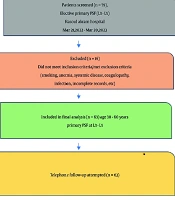
The study included all adult patients (aged 30 - 60 years) who underwent primary PSF at L3 - L5 for degenerative lumbar conditions. Convenience sampling enrolled all eligible patients during the period; of 79 screened, 63 were included (Figure 1). Exclusion criteria were current smoking, anemia, cardiac/hepatic/renal diseases, coagulopathy or anticoagulant use within the past week, psychiatric/neurological disorders, infection history, incomplete/illegible records, or patient non-cooperation/lack of access. Baseline data (age, sex, weight, Charlson Comorbidity Index, preoperative hemoglobin [Hb], and hematocrit [Hct]) were extracted from electronic and paper records.
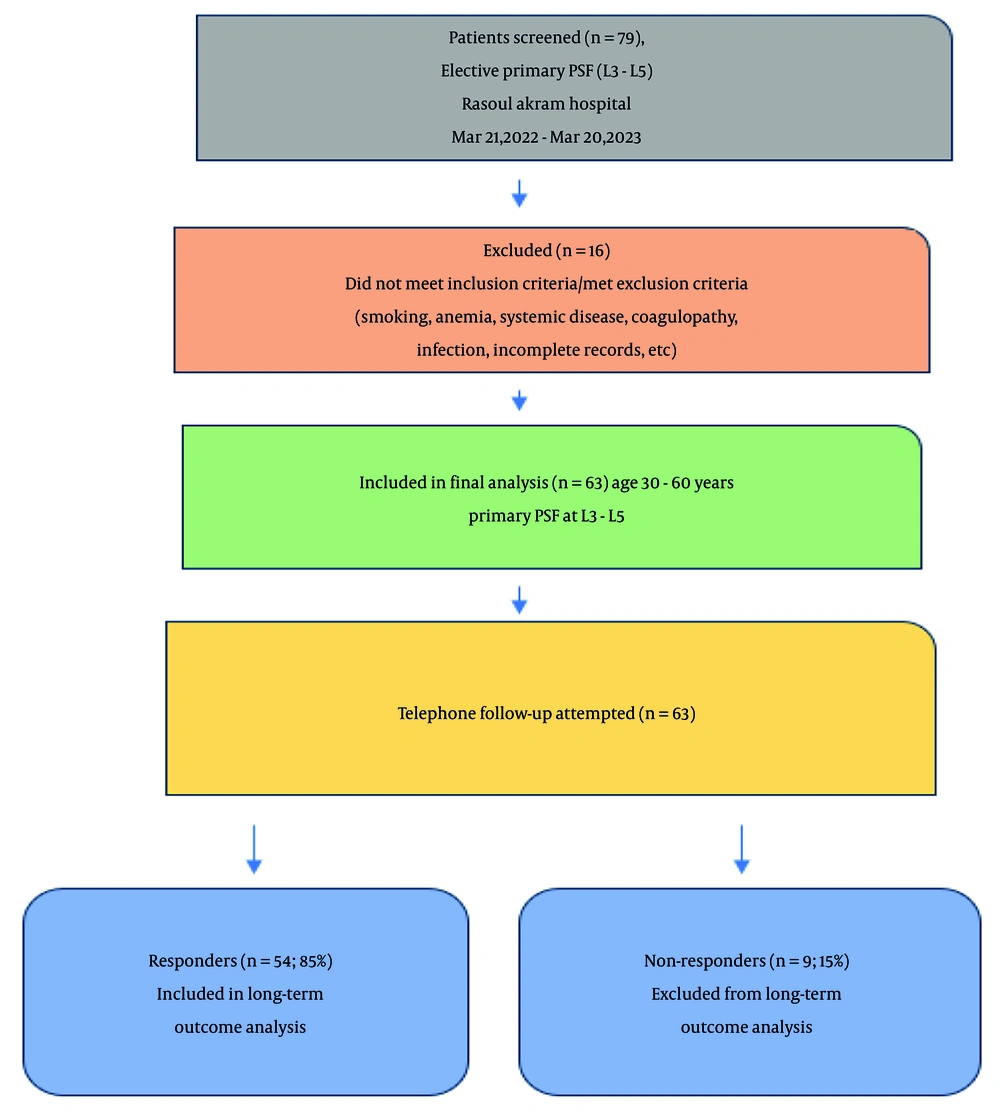
Figure 1.
Study flow diagram
3.3. Sample Size Calculation
Sample size was estimated a priori for prevalence using n = (Z² × p × (1−p)) / d², with Z = 1.96 (95% confidence), P = 0.5 (maximum variability), and d = 0.1 margin of error, yielding approximately 84 participants. With the actual n = 63, the effective margin of error was ±12.3%, giving a 95% CI width of approximately 24.6% around the estimate, acceptable for descriptive/exploratory retrospective purposes. Post hoc power analysis (G*Power v3.1.9.7) showed approximately 75% - 80% power to detect moderate effects (Cohen's d = 0.5 or OR ≈ 2) at α = 0.05 (two-tailed), slightly below the conventional 80% but reasonable given the design and inclusion of all eligible cases.
3.4. Surgical and Anesthesia Procedures
All surgeries were performed by senior spine surgeons via a standardized posterior approach, including neural decompression, posterolateral fusion with autologous graft, and pedicle screw-rod instrumentation. General anesthesia followed standard protocols with monitoring of mean blood pressure, ECG, ETCO₂, and pulse oximetry. Premedication included 0.01 mg/kg midazolam and 3 μg/kg fentanyl; induction used 1.5 mg/kg propofol and 0.2 mg/kg cisatracurium; maintenance involved propofol (50 - 100 μg/kg/min) and cisatracurium (0.02 mg/kg every 30 minutes). Hemostasis was achieved with bipolar electrocautery and topical agents. Drains were placed and removed when output was < 50 mL/24 hours.
3.5. Exposure and Outcome Measures
The primary exposure was intraoperative blood loss (IOBL), recorded by the anesthesia team from suction volume and gauze absorption (1 standard 4 × 4 gauze ≈ 10 mL). Patients were categorized as massive blood loss, defined as (IOBL / estimated blood volume) × 100 ≥ 30%, or non-massive blood loss, defined as < 30%.
This ≥ 30% EBV threshold was chosen as a clinically significant marker for massive hemorrhage in spinal fusion, correlating with transfusion needs, complications, and prognosis (12, 13). EBV was calculated using the Nadler formula: males: [0.3669 × weight (kg)] + [0.03219 × height (cm)] + 0.6041; females: [0.3561 × weight (kg)] + [0.03308 × height (cm)] + 0.1833.
3.6. Data Collection
Data were collected from medical records (baseline, IOBL, and short-term outcomes) and telephone follow-up (long-term outcomes; 85% response rate) using a standardized checklist. Two researchers independently extracted and entered data into EpiData 3.1.
3.7. Statistical Analysis
Analysis was performed using SPSS v26. Qualitative variables were reported as frequencies (percentages), and quantitative variables were reported as mean ± SD or median (IQR) based on Kolmogorov-Smirnov normality testing. The prevalence of massive blood loss included 95% CIs. Group comparisons were performed using independent t-tests or Mann-Whitney U tests for quantitative variables and chi-square or Fisher exact tests for qualitative variables. Fisher exact test was applied when expected cell frequencies were < 5 in ≥ 20% of cells in contingency tables, particularly for rare outcomes such as mortality (n = 2) and specific organ complications.
4. Results
This study involved 63 patients (mean age, 47.7 ± 4.8 years; 76.2% female) undergoing elective PSF at L3 - L5 levels for degenerative lumbar disorders. Fusion was single-level in 41.3% and two-level in 58.7% of cases, with a mean operative duration of 150.8 ± 15.4 minutes (Table 1 and Table 2). Massive IOBL (≥ 30% EBV) occurred in 30.2% (19 patients), and transfusion was required in 44.4%.
Table 1.
Demographic Characteristics of Patients a
| Variables | Values |
|---|---|
| Sex | |
| Male | 15 (23.8) |
| Female | 48 (76.2) |
| Age, y (range) | 47.7 ± 4.8 (32 - 59) |
| Body Mass Index (kg/m²) | 24.4 ± 2.5 |
a Values are presented as No. (%) or mean ± SD.
Table 2.
Perioperative and Outcome Variables in Patients a
| Variables | Values |
|---|---|
| Number of fusion levels | |
| Single level | 26 (41.3) |
| Two levels | 37 (58.7) |
| Operative duration, min (range) | 150.8 ± 15.4 (119 - 182) |
| Serum hemoglobin (g/dL) | |
| Pre-operative | 12.6 ± 0.9 |
| Post-operative | 11.8 ± 1.5 |
| Intraoperative blood loss | |
| Non-massive | 44 (69.8) |
| Massive | 19 (30.2) |
| Intraoperative transfusion | 28 (44.4) |
| Units of blood transfused | 0.9 ± 2.5 |
| Surgical complications | |
| Cardiac | 6 (9.5) |
| Pulmonary | 0 (0.0) |
| Renal | 7 (11.1) |
| Neurological | 4 (6.3) |
| Infectious | 12 (19.0) |
| Hematologic | 7 (11.1) |
| Mortality | 2 (3.2) |
| Hospital LOS, d (range) | 6.3 ± 1.8 (4 - 12) |
| ICU LOS (d) | 1.7 ± 1.2 |
| Time to return to normal activities (mo) | 0.9 ± 1.7 |
| Time to return to work (mo) | 1.3 ± 2.9 |
| Pain complaint (NRS, 0 - 10) | 1.3 ± 3.9 |
Abbreviations: ICU, intensive care unit; LOS, length of stay; NRS, Numeric Rating Scale.
a Values are presented as No. (%) or mean ± SD.
Univariable analyses revealed significant associations between massive blood loss and two-level fusion, transfusion, cardiac, renal, hematologic complications, and mortality (Table 3). No significant links were found with sex, neurological, or infectious complications. Continuous variables showed correlations with lower postoperative hemoglobin, longer operative duration, higher transfusion units, extended ICU stay, delayed return to normal activities/work, and higher 30-day NRS pain scores (Table 4). No correlations existed with age, BMI, preoperative hemoglobin, or hospital LOS.
Table 3.
Univariable Associations Between Intraoperative Blood Loss and Categorical Variables a
| Variables | Non-massive | Massive | P-Value |
|---|---|---|---|
| Fusion Levels | 0.007 | ||
| Single level | 23 (88.5) | 3 (11.5) | |
| Two levels | 21 (56.8) | 16 (43.2) | |
| Transfusion | < 0.001 | ||
| Yes | 9 (32.1) | 19 (67.9) | |
| No | 35 (100.0) | 0 (0.0) | |
| Cardiac complications | 0 | 6 | < 0.001 |
| Renal complications | 2 | 5 | 0.012 |
| Hematologic complications | 1 | 6 | < 0.001 |
| Mortality | 0 | 2 | 0.029 |
| Sex | 0.759 | ||
| Male | 10 (66.7) | 5 (33.3) | |
| Female | 34 (70.8) | 14 (29.2) | |
| Neurological complications | 3 (75.0) | 1 (25.0) | 0.816 |
| Infectious complications | 8 (66.7) | 4 (33.3) | 0.790 |
a Values are presented as No (%).
Table 4.
Associations Between Continuous Variables and Intraoperative Blood Loss a
| Variables | Non-massive | Massive | Kendall's τ | P-Value |
|---|---|---|---|---|
| Age (y) | 47.8 ± 1.8 | 51.6 ± 2.0 | 0.183 | 0.087 |
| BMI (kg/m²) | 25.1 ± 1.9 | 24.2 ± 1.1 | 0.104 | 0.326 |
| Operative duration (min) | 146.9 ± 12.3 | 159.8 ± 8.2 | 0.316 b | 0.003 |
| Preoperative Hb (g/dL) | 12.0 ± 0.7 | 12.8 ± 0.4 | -0.159 | 0.136 |
| Postoperative Hb (g/dL) | 12.0 ± 0.3 | 10.2 ± 0.5 | -0.383 b | < 0.001 |
| Transfused units | 0.0 ± 0.0 | 0.9 ± 0.7 | 0.397 b | 0.039 |
| Hospital LOS (d) | 6.1 ± 0.5 | 7.2 ± 1.1 | 0.179 | 0.115 |
| ICU LOS (d) | 1.2 ± 0.5 | 2.8 ± 0.8 | 0.618 b | < 0.001 |
| Return to activities (mo) | 0.7 ± 0.5 | 2.0 ± 0.4 | 0.465 b | < 0.001 |
| Return to work (mo) | 1.2 ± 0.6 | 3.1 ± 0.9 | 0.397 b | < 0.001 |
| NRS pain score (0 - 10) | 1.1 ± 0.6 | 1.4 ± 0.9 | 0.384 b | < 0.001 |
Abbreviations: BMI, Body Mass Index; Hb, hemoglobin; ICU, intensive care unit; LOS, length of stay; NRS, Numeric Rating Scale.
a Values are expressed as mean ± SD.
b Tatistically significant association.
5. Discussion
In patients undergoing elective PSF for degenerative lumbar disorders at levels L3 - L5, IOBL was classified as massive in 30.2% of cases. Massive blood loss was significantly associated with two-level fusion, intraoperative transfusion, and higher rates of cardiac, renal, hematologic, and mortality complications. These findings represent associations only; the retrospective cross-sectional design precludes any inference of causation. No associations were observed with sex, neurological, or infectious complications. Continuous outcomes revealed correlations between massive blood loss and lower postoperative hemoglobin, longer operative duration, higher transfusion units, extended ICU stay, delayed return to normal activities and work, and elevated 30-day pain scores.
The observed prevalence of massive IOBL in degenerative lumbar PSF closely matches recent reports. A 2025 multicenter analysis reported a 30.6% transfusion rate, indicating a similar hemorrhagic burden, although thresholds vary (14). Kang et al. found significant blood loss in 53.8% of degenerative cases, likely higher due to more extensive fusions and absent routine tranexamic acid prophylaxis, which was not standardized here (7). Our lower rate likely stems from a single-surgeon, single-center design, limited fusion levels, and exclusion of high-risk comorbidities, minimizing vascular disruption (7). These findings underscore persistent hemorrhage challenges in PSF, with differences due to methodological variations.
Risk factors, especially multilevel fusion, align with evidence linking surgical complexity to blood loss. A 2025 review of 1475 lumbar PSF cases identified > 1-level fusion as an independent predictor, due to greater epidural venous exposure in degenerative stenosis (15). Operative duration, correlated here, increased loss by 15% - 20% in a 2025 machine learning model for LDH-related fusions via hemostatic fatigue (16). Unlike older studies such as Zheng et al., which emphasized revision status (9), our primary elective focus reflects advances in minimally invasive techniques that reduce but do not eliminate risks.
Massive blood loss showed robust associations with cardiac, renal, and hematologic complications. A 2024 population-based study of 188581 lumbar fusions linked transfusion > 1 unit to elevated cardiac/renal risks via hypoperfusion (17). Hematologic issues in 85.7% of our massive cases echo a 2011 analysis in which loss > 20% EBV tripled coagulopathy, possibly amplified by excluding preoperative anticoagulants (18). Mortality tied exclusively to massive loss aligns with 2% - 4% perioperative death rates in high-loss PSF from multiorgan failure, although our low rate contrasts higher elderly figures, likely due to age restrictions (19).
No associations emerged with neurological or infectious complications, diverging from some reports but supported by others. A 2023 meta-analysis linked loss > 1000 mL to neurological deficits (20), but our non-significance may reflect routine neuromonitoring and limited decompression (21). Infections lacked correlation, unlike a 2024 study on transfusion-associated surgical site infection (17), possibly due to short follow-up and exclusion of smokers/high-risk patients.
Massive blood loss delayed functional recovery and increased pain. Delayed return to activities/work mirrors Huang and Ou (2015), where > 500 mL loss extended disability-adjusted life-years by 0.5 - 1.0 months via anemia-related fatigue (4). Higher NRS scores align with a prospective trial showing 20% - 30% greater 1-month pain from inflammatory cytokines after hemolysis (22). No link to hospital LOS contrasts prior data (23), likely from efficient single-center protocols.
This study has several important limitations. The modest sample size and low number of events in the massive IOBL group resulted in limited statistical power, particularly for detecting smaller associations or rare outcomes such as mortality and specific organ complications. Analyses involving these rare events are therefore exploratory and underpowered, increasing the risk of type II error. These findings should be interpreted with caution and require validation in larger, prospective cohorts to establish clinical relevance and potential mechanisms.
The a priori cross-sectional sample size estimate was approximately 84; with the available n = 63, the effective margin of error increased to approximately ±12.3%. Although this remains reasonable for descriptive prevalence estimation and exploratory univariable analyses in a retrospective single-center setting, the study is technically underpowered for moderate effect sizes compared with the conventional 80% power threshold. This limitation is inherent to retrospective designs with finite records during a defined timeframe. Given the small sample size and exploratory univariable analyses, the risk of type I error (false positives) is increased, particularly for multiple comparisons involving rare outcomes. These associations should be interpreted as hypothesis-generating rather than confirmatory.
The retrospective nature of the study also introduced potential biases. Intraoperative transfusion decisions were made at the discretion of the attending anesthesiologist without a standardized institutional threshold or protocol, which may have led to information or performance bias influenced by subjective factors. Although reflective of real-world clinical practice, this variability could confound the observed associations between transfusion, massive IOBL, and complications.
Strict exclusion criteria, excluding current smokers, patients with preoperative anemia, or those with cardiac, renal, or hepatic comorbidities, further limit external validity. These comorbidities are relatively common in patients undergoing degenerative lumbar spinal fusion. The selective nature of the cohort likely resulted in an underestimation of complication rates compared with unselected real-world populations.
Long-term functional outcomes were assessed via telephone follow-up with an 85% response rate. This self-reported method is prone to recall bias and may be influenced by non-clinical factors, potentially introducing noise and reducing the precision of these outcome measures. These limitations should be considered when interpreting the observed associations between massive intraoperative blood loss and delayed recovery or elevated pain scores.
These findings contribute to the limited literature in this setting and can serve as a foundation for hypothesis generation and future larger-scale research.
5.1. Conclusions
In this study, the prevalence of massive intraoperative blood loss was notable (approximately 30.2%) and associated with multilevel fusion, transfusion, and certain complications in univariable analyses. These preliminary findings highlight potential prognostic signals in PSF but are limited by sample size and design. They address the objective of describing prevalence and associations in this cohort. Future larger prospective studies are essential to confirm and extend these observations.