
1. Introduction
Neurofibromatosis type 1 (NF1) is one of the most prevalent autosomal dominant disorders, affecting approximately 1 in 3,000 individuals worldwide. It results from loss-of-function mutations in the NF1 gene on chromosome 17q11.2, leading to deficient neurofibromin, a tumor suppressor and regulator of the RAS/MAPK pathway. The clinical phenotype is highly heterogeneous and includes cutaneous, ocular, and skeletal manifestations. From an anesthetic perspective, NF1 poses specific risks, including pheochromocytomas in up to 5% - 10% of patients, renovascular hypertension, cerebrovascular dysplasia, and intrinsic vasculopathies that may cause intraoperative hemodynamic instability or stroke (1, 2). Airway management may also be compromised by plexiform neurofibromas of the head and neck, and vertebral anomalies may complicate regional techniques (3-5).
Type 1 diabetes mellitus (T1DM) is a chronic autoimmune endocrinopathy characterized by T-cell-mediated destruction of pancreatic β-cells, resulting in absolute insulin deficiency (6). The perioperative period presents a formidable metabolic challenge. Surgical stress induces insulin resistance, increases hepatic gluconeogenesis, and impairs glucose utilization, thereby promoting hyperglycemia and ketogenesis (7). Conversely, preoperative fasting and anesthetic agents increase the risk of hypoglycemia. Both extremes of dysglycemia are independently associated with adverse outcomes, including infection, impaired wound healing, and increased mortality (8, 9). Therefore, perioperative management requires a proactive, protocol-driven approach (10).
Although principles for managing isolated NF1 or T1DM are established, the coexistence of both disorders in a single patient creates a rare, high-stakes scenario. This intersection creates unique dilemmas: screening for catecholamine-secreting tumors in NF1 overlaps with the catecholamine-driven hyperglycemic response in T1DM. Likewise, a difficult airway plan must be integrated with safe access for glucose monitoring and management. No specific guidelines or case series address this dual diagnosis. This report details the comprehensive perioperative management of a patient with concurrent NF1 and T1DM, including preoperative evaluation, multidisciplinary coordination, an intraoperative plan, and structured postoperative care.
2. Case Presentation
A 42-year-old woman weighing 80 kg, with an ASA physical status of III and confirmed NF1 and T1DM, was scheduled for recurrent surgical debridement for severe hidradenitis suppurativa in the axillary and inguinal regions. Her surgical history for this condition dated back to 2021 and included 3 previous anesthetics. All previous procedures were managed successfully with a supraglottic airway device, specifically a laryngeal mask airway (LMA). Muscle relaxants were consistently avoided to preserve spontaneous breathing, and a difficult airway algorithm was in place. The clinical timeline is presented in Table 1.
Table 1.
Clinical Timeline of the Reported Case
| Date/Period | Event |
|---|---|
| Age 12 | Diagnosis of NF1 |
| Age 18 | Diagnosis of T1DM |
| 2021 (first debridement) | Three prior debridements for hidradenitis suppurativa; all performed under LMA without muscle relaxants; 2 episodes of intraoperative hypoglycemia (lowest value, 65 mg/dL) treated with 50% dextrose. Review of the records showed that, during those prior surgeries, the evening long-acting insulin dose had not been reduced and the fasting duration was 8 hours (prolonged), contributing to hypoglycemia. |
| 2 weeks before index surgery | Preoperative assessment |
| 2025 (index surgery) | Elective debridement; duration, 120 minutes |
| Postoperative course | PACU stay, 2 hours; discharged on postoperative day 2; uneventful 2-week follow-up |
The patient’s NF1 phenotype posed a significant airway challenge, including substantial posterior neck muscle hypertrophy, a thick neck with a neck circumference of 58 cm, pronounced neck stiffness with a sternomental distance of 6 cm, and an inability to extend the neck. Preoperative airway assessment showed adequate mouth opening, with an inter-incisor distance of 4.5 cm during maximal mouth opening; an inability of the lower incisors to bite the upper lip; and a Mallampati class III airway, with clinical features suggestive of macroglossia (Figure 1). Despite these findings, mouth opening remained adequate. Regarding T1DM, a recurrent intraoperative complication was significant hypoglycemia, with glucose decreasing from approximately 130 mg/dL to 65 mg/dL; this was effectively treated each time with 200 mL of 50% dextrose. As noted above, the causes of prior hypoglycemia were identified as a failure to reduce the insulin dose and prolonged fasting for 8 hours.
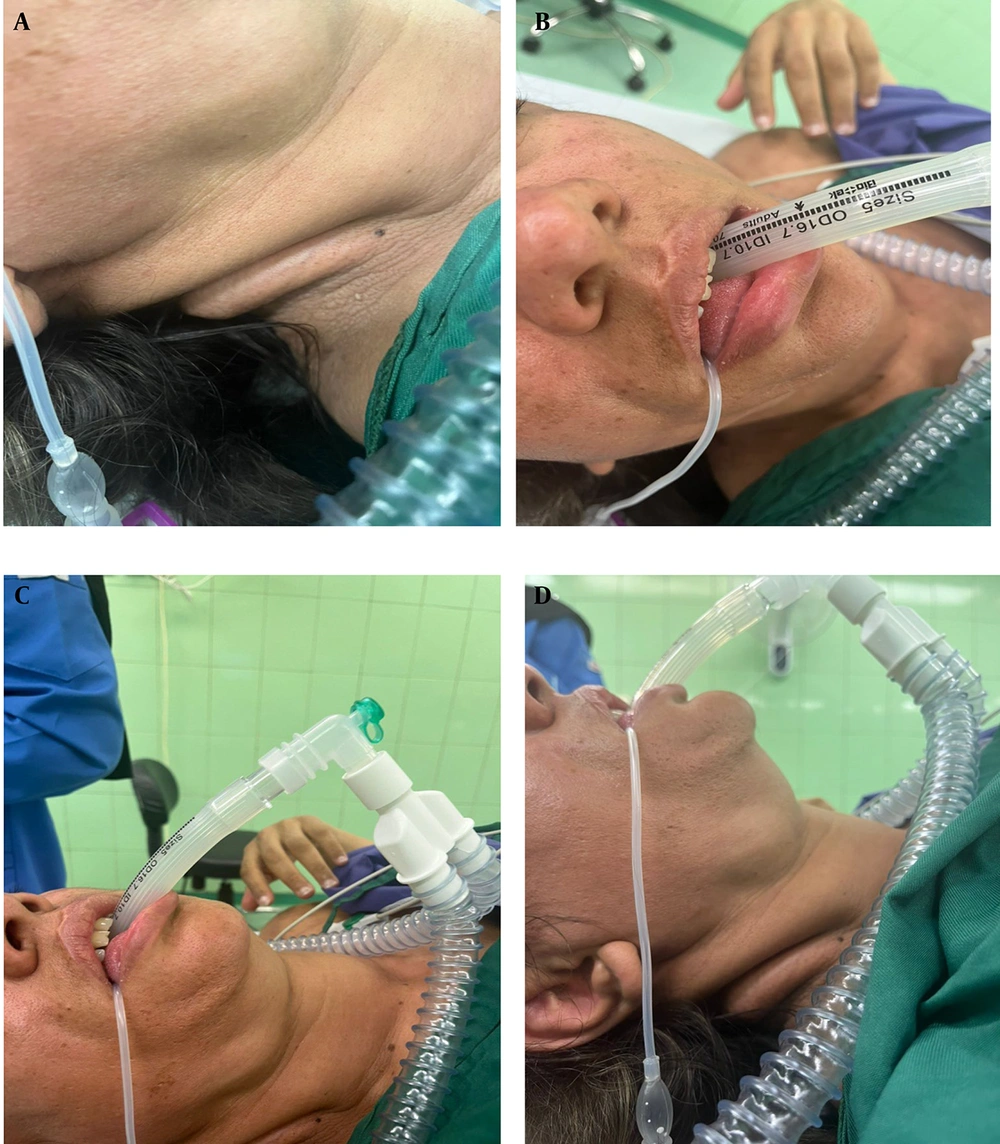
Figure 1.
Airway assessment images; A, Posterior neck muscle hypertrophy; B, Inability to extend the neck; C, Pronounced neck stiffness; D, Oral cavity assessment suggesting macroglossia. These features suggest a potentially difficult airway.
Pheochromocytoma screening was performed by measuring plasma free metanephrines. Normetanephrine was 0.28 nmol/L and metanephrine was 0.21 nmol/L, both within normal limits. Blood pressure was stable at 125/78 mmHg, and heart rate was 82 beats/min. Echocardiography showed no cardiomyopathy or valvular disease, with an ejection fraction of 60%. Diabetes-related end-organ complications, including nephropathy and retinopathy, were absent.
2.1. Perioperative Management for the Index Surgery
The scheduled procedure was expected to last 2 hours. The patient was positioned supine with slight head elevation and a rolled towel under the shoulders to optimize neck position without forced extension. Standard ASA monitoring was applied, including electrocardiography, noninvasive blood pressure, pulse oximetry, capnography, and bispectral index (BIS) monitoring.
2.2. Glycemic Preparation
The patient’s last insulin dose, glargine 12 U, was administered the night before surgery with a 20% dose reduction, from 15 U to 12 U. On the morning of surgery, no short-acting insulin was administered. Fasting duration was 6 hours for solids and 2 hours for clear liquids. Baseline capillary glucose was 135 mg/dL. Intravenous fluids consisted of 5% dextrose in normal saline at 75 mL/h. Point-of-care glucose was measured every 30 minutes throughout surgery.
2.3. Induction
Before induction, the patient received 3 mL/kg of normal saline. Anesthesia was induced intravenously using a carefully titrated regimen of midazolam 0.02 mg/kg, fentanyl 3 µg/kg, lidocaine 1 mg/kg, and propofol 2.5 mg/kg. No muscle relaxants were administered. Spontaneous ventilation was preserved throughout.
2.4. Airway Management
Given the patient’s adequate mouth opening, with an inter-incisor distance of 4.5 cm, and prior successful LMA use, awake fiberoptic intubation was considered but not selected as the primary plan. The reasons were as follows: 1) the patient had undergone 3 prior uneventful LMA anesthetics; 2) she was highly anxious and would not tolerate awake intubation without deep sedation, which could increase the risk of airway obstruction; and 3) the LMA offered a faster and less invasive option while preserving spontaneous ventilation. Based on the patient’s weight of 80 kg and anatomy, a size 5 LMA was selected. The primary plan was LMA with spontaneous ventilation. The backup rescue plan in case of failed LMA included 1) repositioning and jaw thrust, 2) video laryngoscopy with a GlideScope for intubation, 3) fiberoptic bronchoscopy, and 4) surgical cricothyroidotomy if SpO2 was less than 92% and ventilation was impossible. The LMA was successfully placed on the first attempt, and adequate ventilation was confirmed. Capnography was used, and ETCO2 was maintained between 35 and 40 mmHg. Spontaneous ventilation was maintained with pressure support of 10 cmH2O, as needed.
2.5. Maintenance
Anesthesia was maintained with isoflurane 0.7 - 0.8 minimum alveolar concentration in an oxygen-air mixture, supplemented by a propofol infusion at 50 - 75 µg/kg/min. Despite these agents, spontaneous ventilation was maintained with minimal respiratory depression due to the low-dose propofol infusion and avoidance of muscle relaxants. Pressure support of 10 cmH2O was used as needed to assist breathing without controlled ventilation. The depth of anesthesia was monitored using BIS and maintained between 40 and 60. Intraoperative hemodynamics remained stable, with a mean arterial pressure of 75 - 85 mmHg and a heart rate of 70 - 85 beats/min. No vasopressor was required. Glycemic values during surgery remained between 120 and 145 mg/dL, and no dextrose bolus was required.
2.6. Emergence and LMA Removal
Approximately 10 minutes before the anticipated end of surgery, a low-dose remifentanil infusion was initiated at 0.01 µg/kg/min to ensure smooth emergence and suppress cough. The patient emerged with the LMA in situ while maintaining spontaneous ventilation. The LMA was removed only after the patient was fully awake, obeying commands, and breathing regularly, in accordance with the ASA Difficult Airway extubation guidelines. The statement that preserving spontaneous ventilation "eliminates" the cannot-intubate/cannot-ventilate scenario was corrected to the following: Preserving spontaneous ventilation significantly reduces the risk of a cannot-intubate/cannot-ventilate scenario but does not eliminate it entirely.
2.7. Postoperative Follow-Up and Outcome
In the postanesthesia care unit (PACU), the patient stayed for 2 hours. Glucose on arrival was 140 mg/dL. No airway obstruction or respiratory distress occurred. Pain was controlled with intravenous acetaminophen. The patient was discharged on postoperative day 2. Telephone follow-up at 2 weeks revealed no delayed complications.
The intraoperative course was uneventful. The airway was managed successfully with the LMA, and no hypoglycemia occurred during this procedure. Table 2 provides a structured overview of the perioperative anesthetic management.
Table 2.
Summary of Anesthetic Protocol
| Phase | Key Actions/Drugs | Dosage/Parameters | Clinical Rationale and Notes |
|---|---|---|---|
| Monitoring | Standard ASA monitoring + BIS | BIS 40 - 60 | Hemodynamic stability |
| Induction | Intravenous agents; no muscle relaxants | Midazolam 0.02 mg/kg; fentanyl 3 µg/kg; lidocaine 1 mg/kg; propofol 2.5 mg/kg | Preservation of spontaneous ventilation |
| Airway | Size 5 LMA | First-pass success | Backup plan: Video laryngoscope, fiberoptic bronchoscope, and cricothyroidotomy; awake fiberoptic intubation was not chosen because of patient anxiety and prior LMA success |
| Maintenance | Isoflurane + propofol | Isoflurane 0.7 - 0.8 MAC; propofol 50 - 75 µg/kg/min | Propofol was selected to avoid a hyperglycemic response |
| Glycemic control | Point-of-care glucose | Every 30 minutes; dextrose 5% at 75 mL/h | Values remained 120 - 145 mg/dL |
| Emergence and LMA removal | Remifentanil + awake LMA removal | 0.01 µg/kg/min | LMA removed when the patient was awake and obeying commands |
| Outcome | Uneventful | No hypoglycemia | Stable transfer to PACU |
3. Discussion
This case describes the anesthetic management of a patient with concurrent NF1 and T1DM, a rare dual diagnosis. The two main challenges were a potentially difficult airway related to NF1 anatomy and the risk of perioperative dysglycemia related to T1DM.
3.1. Airway Management
Regarding airway management, the patient’s adequate mouth opening, with an inter-incisor distance of 4.5 cm, allowed consideration of both an LMA and intubation. Awake fiberoptic intubation was considered but deemed unnecessary and likely to be poorly tolerated because of patient anxiety and three prior successful LMA anesthetics (11, 12). We acknowledge that, in many predicted difficult airways, awake fiberoptic intubation is the gold standard. However, in this patient, the decision to forgo awake fiberoptic intubation was based on the following: 1) three prior uneventful LMA anesthetics without hypoxia or hypercapnia; 2) severe preoperative anxiety that would have required deep sedation for awake intubation, potentially worsening airway obstruction; and 3) adequate mouth opening of 4.5 cm and the absence of oropharyngeal or laryngeal neurofibromas on imaging.
An LMA with spontaneous ventilation offered a faster, less invasive option while preserving the ability to rescue ventilation with a supraglottic device if needed. We selected a size 5 supraglottic airway as the primary device for three reasons: three previous surgeries had been successfully managed with an LMA without muscle relaxants; mouth opening was adequate despite macroglossia; and avoiding paralysis preserved spontaneous ventilation. This approach significantly reduces the risk of a cannot-intubate/cannot-ventilate scenario, although it does not eliminate it completely (13). A stepwise rescue plan was prepared and included a video laryngoscope, a fiberoptic bronchoscope, and surgical cricothyroidotomy. Emergence and LMA removal followed ASA guidance: low-dose remifentanil was used to suppress cough, and the LMA was removed only when the patient was fully conscious and breathing regularly (14).
3.2. Glycemic Control
The patient had a clear history of intraoperative hypoglycemia, with glucose decreasing from approximately 130 mg/dL to 65 mg/dL during prior surgeries and requiring 200 mL of 50% dextrose. The causes were identified as a lack of preoperative insulin dose reduction and prolonged fasting for 8 hours. In T1DM, insulin sensitivity can vary, and although some patients have low glycogen reserves, this is not universal; however, our patient’s history suggested heightened sensitivity. Therefore, we implemented a structured protocol based on current guidelines (7, 15, 16): 20% reduction of the evening long-acting insulin glargine dose, 6-hour fasting for solids, baseline glucose of 135 mg/dL, continuous 5% dextrose in normal saline at 75 mL/h, and point-of-care glucose measurement every 30 minutes.
In this patient, we deliberately selected a combination of propofol infusion and low-dose isoflurane at 0.7 - 0.8 minimum alveolar concentration rather than ketamine or high-dose opioids. Ketamine is known to stimulate sympathetic activity and increase blood glucose, whereas high-dose opioids may contribute to insulin resistance. By contrast, propofol has a more favorable glycemic profile in this context (17). This choice was made to minimize the risk of perioperative hyperglycemia while maintaining adequate anesthetic depth and hemodynamic stability. During the index surgery, glucose remained between 120 and 145 mg/dL, and no rescue dextrose was needed. In the PACU, glucose was 140 mg/dL. This protocol was both safe and reproducible.
3.3. Gastroparesis and Aspiration Risk
Although T1DM is associated with gastroparesis, our patient had no clinical symptoms, such as early satiety, nausea, vomiting, or abdominal bloating, and her diabetes was well controlled, with no autonomic dysfunction. Preoperative fasting was 8 hours for solids, and clinical assessment suggested normal gastric emptying. Therefore, the risk of aspiration was considered low, and an LMA with spontaneous ventilation was deemed acceptable. Importantly, diabetic gastroparesis can be asymptomatic and has been reported to cause perioperative vomiting and aspiration of unsuspected gastric contents (18). In a patient with documented gastroparesis or delayed gastric emptying, an endotracheal tube would be preferred to secure the airway and prevent aspiration. This consideration was explicitly discussed in the multidisciplinary team meeting, and the decision was made in favor of an LMA based on the absence of risk factors.
3.4. Comparison With Failed Cases in the Literature
The literature contains reports of failed airway management in patients with NF1 despite careful planning. Baheti et al. described a patient with NF1 and a large parapharyngeal mass in whom fiberoptic intubation was initially planned but nearly failed because of grossly distorted anatomy and bleeding risk (19). Davidson et al. reported a case of rapidly progressive upper airway obstruction in a patient with NF1 due to arteriovenous malformation rupture, in which tracheal intubation failed and emergency cricothyroidotomy was required (20). Additionally, Crozier documented a case of severe upper airway obstruction at anesthesia induction in a patient with NF1 caused by a neurofibroma at the base of the tongue, necessitating emergency cricothyroidotomy (21).
Similarly, severe intraoperative hypoglycemia has been reported in patients with T1DM, often due to failure to reduce basal insulin or prolonged fasting. In contrast to those adverse events, our successful outcome highlights the value of a proactive, protocol-driven approach that integrates difficult airway planning with tight glycemic control. Although no identical dual-diagnosis failure cases are available for direct comparison, existing single-disease complications underscore the importance of the combined framework presented here.
3.5. Cardiovascular Considerations
Regarding cardiovascular considerations, NF1 carries a 5% - 10% risk of pheochromocytoma and a significant risk of vasculopathy, including renal artery stenosis and cerebrovascular dysplasia (11). We screened for pheochromocytoma using plasma free metanephrines, with normal results. Echocardiography showed normal ventricular function, with an ejection fraction of 60%. No hypertension or labile blood pressure was present preoperatively. Nevertheless, we avoided ketamine and high-dose ephedrine and maintained a stable anesthetic depth throughout. Smooth emergence with remifentanil prevented coughing or straining, which could have provoked a catecholamine surge in an undiagnosed tumor. No intraoperative hemodynamic instability occurred.
3.6. Limitations
This is a single case report without a comparator group; therefore, the proposed strategy is hypothesis-generating and not broadly prescriptive. It may not be generalizable to patients with NF1 who have oropharyngeal neurofibromas, cervical spine instability, or poorly controlled diabetes, such as HbA1c greater than 9%. Follow-up was limited to 2 weeks; therefore, long-term outcomes, such as wound healing and late hypoglycemia, are unknown. Future case series are needed to validate this approach.
3.7. Conclusions
This single-case observation suggests that a patient with coexisting NF1 and T1DM can undergo surgery safely with a meticulously planned, multidisciplinary approach. The main contribution of this report is a practical, step-by-step framework for managing the dual challenges of a predicted difficult airway due to NF1 and insulin-dependent diabetes due to T1DM when no combined guidelines exist. The core principles include a primary airway strategy that avoids paralysis and prioritizes spontaneous ventilation using an LMA, strict and proactive glycemic control according to T1DM guidelines, and an anesthetic technique selected for cardiovascular stability. Because no standardized guidelines exist for this dual diagnosis, this report provides a preliminary, hypothesis-generating framework that requires validation in larger series.