
1. Background
Cystic fibrosis (CF) is a multisystem, life-limiting genetic disorder caused by mutations in the cystic fibrosis transmembrane conductance regulator gene. Progressive pulmonary disease remains the primary determinant of long-term morbidity and functional capacity in affected individuals (1). Advances in airway clearance techniques, nutritional support, and cystic fibrosis transmembrane conductance regulator modulator therapies have significantly improved survival and altered the natural history of CF lung disease, shifting clinical attention toward functional outcomes and perioperative optimization (2, 3).
Inspiratory muscle strength is traditionally assessed using maximal inspiratory pressure (MIP) and sniff nasal inspiratory pressure (SNIP), both of which provide static estimates of respiratory muscle force generation (4). Although these methods are well established and supported by pediatric reference data, they reflect maximal static pressure at a single time point and may not fully represent the dynamic, flow-dependent performance of inspiratory muscles during rapid breathing or functional respiratory effort (5, 6). Current guidelines recommend selecting respiratory muscle tests according to the physiological construct of interest and encourage the evaluation of dynamic indices when assessing functional breathing performance (7).
The Strength Index (S-Index) is a device-based parameter that quantifies maximal dynamic inspiratory strength during rapid, unimpeded inhalation. The test is feasible in school-aged children, demonstrates construct validity compared with conventional measures, and provides reproducible results (8, 9). Reference datasets and prediction equations for the S-Index have been reported in several populations; however, pediatric normative data remain relatively limited (9, 10).
Modern respiratory muscle testing devices also report complementary dynamic parameters, such as peak inspiratory flow (PIF) and inspiratory volume obtained during maximal inspiratory maneuvers. These variables provide additional information about inspiratory muscle performance, including flow-generating capacity and the volume displacement produced by the respiratory pump. PIF reflects maximal instantaneous inspiratory flow and may be relevant when assessing the ability to generate an effective cough, whereas inspiratory volume reflects the integrated mechanical output of inspiratory effort (8, 17).
Previous studies evaluating inspiratory muscle performance in children with CF have produced heterogeneous results. Some reports describe reduced inspiratory pressures, whereas others demonstrate preserved or even increased values, possibly reflecting chronic ventilatory loading or differences in nutritional and therapeutic status (11-13). Interventional studies of inspiratory muscle training (IMT) in pediatric CF populations have shown improvements in inspiratory strength and endurance; however, systematic reviews highlight small sample sizes and methodological variability that limit firm conclusions (9, 10, 12). Furthermore, the widespread use of highly effective cystic fibrosis transmembrane conductance regulator modulator therapies may influence respiratory muscle characteristics in contemporary CF cohorts, making comparisons with earlier studies challenging (14).
Children with CF frequently undergo procedures requiring anesthesia, including nasal polypectomy, central venous catheter placement, and lung transplantation. General anesthesia, positive-pressure ventilation, and residual neuromuscular blockade can increase the mechanical load on the respiratory system and contribute to postoperative complications, such as atelectasis, mucus retention, and impaired ventilation. In CF, impaired mucociliary clearance may further compromise an effective cough and secretion mobilization after surgery (15).
Despite these clinical considerations, dynamic inspiratory parameters such as the S-Index are not routinely incorporated into preoperative assessment in pediatric CF populations, and baseline data remain limited. In Iran, most pediatric CF studies have focused on pulmonary function, exercise capacity, and rehabilitation outcomes, whereas device-based evaluation of dynamic inspiratory muscle performance has received little attention (16, 17). Consequently, regional data to support the clinical interpretation of these parameters in children with CF are scarce.
2. Objectives
This single-center cross-sectional study aimed to characterize the S-Index, PIF, and inspiratory volume in children with CF and to compare these findings with available normative reference values. The study also aimed to provide baseline data to support future investigations into the potential role of dynamic inspiratory muscle assessment in perioperative evaluation and respiratory rehabilitation.
3. Methods
3.1. Study Design and Setting
This single-center cross-sectional study was conducted at Mofid Children's Hospital, Tehran, Iran. Children with a confirmed diagnosis of CF who attended routine outpatient or inpatient follow-up during the enrollment period were consecutively recruited. The study aimed to characterize dynamic inspiratory muscle performance in a clinically stable pediatric CF population and to compare group-level results with published normative data. Consecutive recruitment was used to minimize selection bias.
3.2. Participants
Eligible participants were children aged 6 - 18 years with genetically and/or phenotypically confirmed CF according to established diagnostic criteria, as confirmed by a pediatric pulmonologist. Only clinically stable patients were included, defined as the absence of pulmonary exacerbation, hospitalization, or intravenous antibiotic therapy within the preceding 4 weeks. Participants were required to have sufficient cognitive and physical ability to understand instructions and perform maximal inspiratory efforts.
Exclusion criteria were as follows:
1) Requirement for invasive ventilation or continuous supplemental oxygen at rest
2) Thoracic or abdominal surgery within the previous 3 months
3) Neuromuscular disorders or structural abnormalities affecting respiratory muscle testing
4) Acute upper airway obstruction or severe nasal pathology interfering with inhalation
5) Refusal of participant assent or parental/guardian consent
The 6 - 18-year age range was selected to ensure the feasibility and reliability of volitional inspiratory testing in school-aged children and adolescents.
Spirometric parameters such as FEV1 and FVC were not collected as part of this exploratory protocol. Written informed consent was obtained from the parents or legal guardians of all participants, and assent was obtained from the children when appropriate. The study protocol was approved by the institutional ethics committee.
3.3. Sample Size Justification
The primary comparison involved a one-sample evaluation of the mean S-Index in the CF cohort against published pediatric normative values. Sample size estimation was based on a one-sample t-test, assuming a 2-sided α = 0.05 and statistical power of 80%.
Using a reference standard deviation of 12.1 cmH2O derived from pediatric normative data, enrollment of approximately 40 participants provided sufficient power to detect an absolute difference of approximately 5.4 cmH2O from the normative mean. This sample size was therefore considered adequate for the primary objective of this exploratory study.
3.4. Outcomes
The primary outcome was peak dynamic inspiratory strength measured as the S-Index (cmH2O). Secondary outcomes included PIF (L/s) and inspiratory volume (L) achieved during the maximal dynamic inspiratory maneuver.
For each parameter, the highest reproducible value obtained according to predefined protocol criteria was used for analysis. The S-Index reflects dynamic inspiratory pressure generation during rapid inhalation and should not be interpreted as a direct surrogate for global pulmonary function.
3.5. Measurement Protocol
Dynamic inspiratory measurements were obtained using a POWERbreathe S-Index device with digital output. The device was calibrated daily according to the manufacturer's instructions.
Testing was performed with participants seated upright at approximately 90°, with feet supported and hands resting on the thighs. A nose clip was not routinely used, consistent with previously reported pediatric feasibility protocols for dynamic inspiratory testing.
Participants were instructed to perform a rapid and forceful maximal inhalation from functional residual capacity to total lung capacity. A minimum of 3 acceptable trials was required, with up to 5 attempts permitted if reproducibility criteria were not initially met.
Reproducibility was defined as the 2 highest measurements falling within 10% of each other. The highest reproducible value was selected for statistical analysis. A rest interval of 30 - 60 seconds was provided between trials to minimize fatigue.
Acceptability criteria were as follows:
1) Clear waveform tracing
2) Absence of cough during the maneuver
3) Absence of an air leak around the mouthpiece
4) No premature termination of inspiration
All physiotherapists conducting the testing underwent standardized training before study initiation. Standardized verbal encouragement was used to reduce performance variability.
All study data were recorded in a secure, password-protected electronic database.
3.6. Statistical Analysis
Descriptive statistics were calculated for all primary and secondary variables and are presented as mean ± standard deviation (SD).
Independent-samples t-tests were used to compare the S-Index, PIF, and inspiratory volume between male and female participants and between age subgroups (≤ 12 vs. > 12 years).
To evaluate deviations from expected physiological performance, one-sample t tests were conducted to compare cohort means with published normative reference values for the S-Index and PIF.
Pearson correlation analysis was performed to evaluate associations between age and S-Index values.
A 2-sided P < 0.05 was considered statistically significant. All statistical analyses were performed using SPSS version 26. Given the exploratory design and limited sample size, multivariable regression analysis to adjust for potential confounders such as age and sex was not performed.
3.7. Ethical Considerations
The study protocol was approved by the Ethics Committee of Shahid Beheshti University of Medical Sciences, Tehran, Iran (approval code: IR.SBMU.RETECH.REC.14.05.045). Before enrollment, the study procedures were explained to both the children and their parents or legal guardians, and written informed consent was obtained from the parents or guardians before participation.
4. Results
4.1. Participant Selection
A total of 43 children with CF were initially screened for eligibility during the study period. Three participants were excluded because they exceeded the predefined upper age limit of 18 years at the time of final analysis. Consequently, 40 participants met all eligibility criteria and were included in the final analysis (Figure 1).
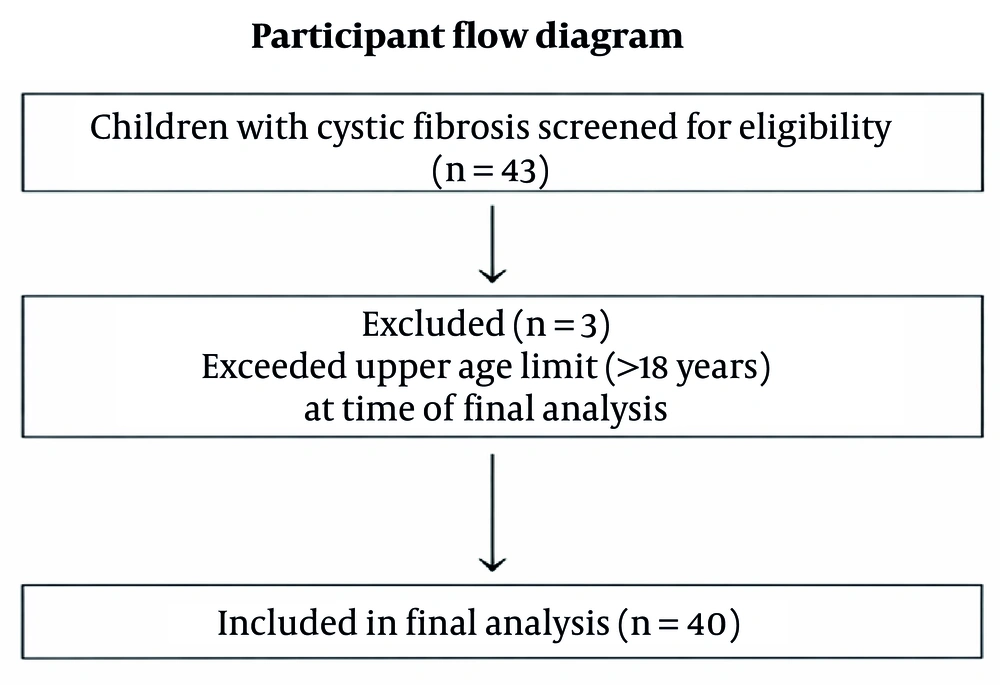
Figure 1.
Participants flow diagram
4.2. Participant Characteristics
A total of 40 children with CF were included in the final analysis. Of these, 21 (52.5%) were female and 19 (47.5%) were male. The mean age of the total cohort was 12.20 ± 3.35 years. The mean age of female participants was 12.19 ± 3.64 years, and that of male participants was 12.21 ± 3.10 years, with no statistically significant difference between the 2 groups (P = 0.985) (Table 1).
Table 1.
Demographic Characteristics of the Study Population
| Variables | Count | Percentage | Mean Age (y) | SD (y) | P Value |
|---|---|---|---|---|---|
| Female | 21 | 52.50 | 12.19 | 3.64 | 0.98 |
| Male | 19 | 47.50 | 12.21 | 3.10 | 0.98 |
| Total | 40 | 100.00 | 12.20 | 3.35 | - |
4.3. Overall Dynamic Inspiratory Performance
All 40 children with CF completed the measurement protocol. For the total cohort, the mean peak dynamic inspiratory strength (S-Index) was 47.30 ± 20.35 cmH2O, the mean PIF was 2.52 ± 1.19 L/s, and the mean maximal inspired volume during the maneuver was 1.27 ± 0.55 L.
Compared with published healthy pediatric reference values, the cohort demonstrated significantly lower S-Index values. The mean S-Index Avg was lower than the healthy norm (36.35 ± 18.02 vs. 43.2 cmH2O; P = 0.035), and the S-Index Best was similarly reduced (47.30 ± 20.35 vs. 56.6 cmH2O; P = 0.012).
In contrast, flow-based measures did not differ from healthy benchmarks: PIF Best was similar to the reference value (2.52 ± 1.19 vs. 2.52 L/s; P = 0.685), and inspired volumes were comparable to reported healthy values (approximately 1.3 L) (Table 2).
Table 2.
Comparison of Dynamic Inspiratory Performance in Children With Cystic Fibrosis and Healthy Norms
| Variables | CF Cohort (n = 40) | Healthy Norms | P-Value |
|---|---|---|---|
| S-Index Avg (cmH2O) | 36.35 ± 18.02 | 43.2 | 0.035 |
| S-Index Best (cmH2O) | 47.30 ± 20.35 | 56.6 | 0.012 |
| PIF Best (L/s) | 2.52 ± 1.19 | 2.52 | 0.68 |
| Inspired Volume Best (L) | ≈ 1.3 | ≈ 1.3 | n.s. |
4.4. Sex-Related Differences
Statistically significant differences in dynamic inspiratory performance were observed between male and female participants. Male participants (n = 19) demonstrated greater dynamic inspiratory strength than female participants (n = 21), with a mean best S-Index of 57.05 ± 22.82 cmH2O compared with 38.04 ± 12.22 cmH2O in female participants (P = 0.002).
A similar pattern was observed for flow-generating capacity: male participants achieved a higher mean best PIF (3.11 ± 1.32 L/s) than female participants (1.98 ± 0.74 L/s; P = 0.002).
Although male participants recorded slightly higher inspired volumes (1.38 ± 0.57 L vs. 1.18 ± 0.52 L), this difference did not reach statistical significance (P = 0.24) (Table 3 and Figure 2).
Table 3.
Comparison of Dynamic Inspiratory Performance by Sex a
| Variables | Total (n = 40) | Female (n = 21) | Male (n = 19) | P Value (Female vs. Male) |
|---|---|---|---|---|
| S-Index Avg | 36.35 ± 18.02 | 27.91 ± 9.44 | 46.19 ± 20.75 | 0.001 |
| S-Index Best | 47.30 ± 20.35 | 38.04 ± 12.22 | 57.05 ± 22.82 | 0.002 |
| PIF Avg | 1.89 ± 1.03 | 1.43 ± 0.58 | 2.40 ± 1.18 | 0.003 |
| PIF Best | 2.52 ± 1.19 | 1.98 ± 0.74 | 3.11 ± 1.32 | 0.002 |
| Volume Avg | 0.95 ± 0.48 | 0.81 ± 0.41 | 1.09 ± 0.52 | 0.05 |
| Volume Best | 1.27 ± 0.55 | 1.18 ± 0.52 | 1.38 ± 0.57 | 0.24 |
a Values are expressed as mean ± SD.
4.5. Age-Related Differences
When participants were stratified by age, a clear age-related gradient in dynamic inspiratory performance was observed. Children older than 12 years (n = 21) demonstrated significantly greater inspiratory and flow parameters than those aged 12 years or younger (n = 19) (Figure 3).
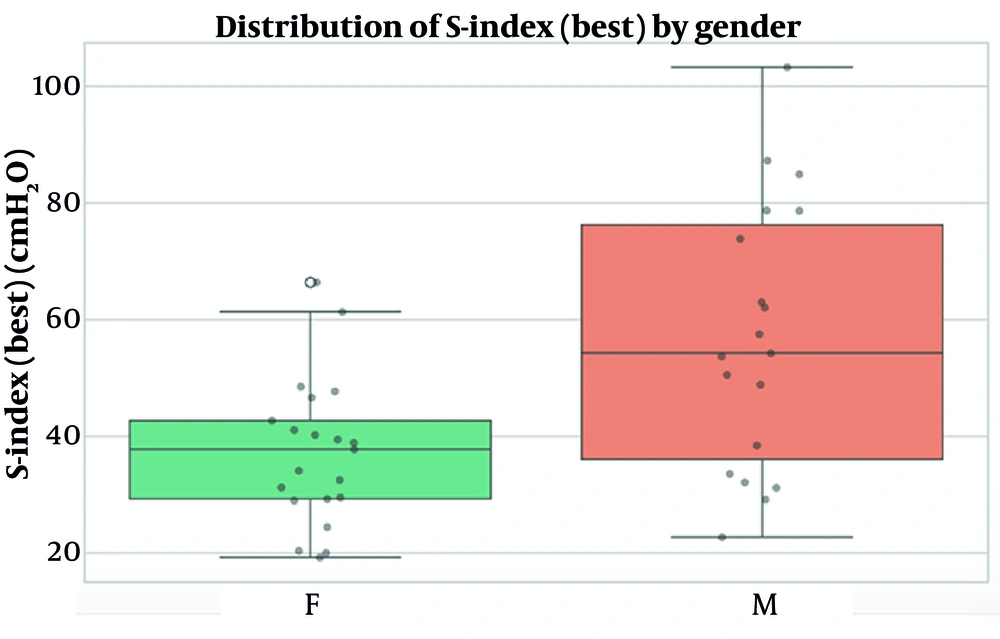
Figure 2.
Distribution of best S-index by gender
The older subgroup achieved a higher mean S-Index Best (58.15 ± 21.21 cmH2O) than the younger subgroup (35.88 ± 11.43 cmH2O; P < 0.001). Similarly, mean PIF Best was greater in older participants (3.18 ± 1.21 L/s vs. 1.86 ± 0.70 L/s; P < 0.001). Inspired volume was also significantly higher in the older group (1.47 ± 0.57 L vs. 1.08 ± 0.45 L; P = 0.02). Comparable differences were observed for the average values of the S-Index, PIF, and inspired volume (Table 4 and Figure 3).
Table 4.
Comparison of Dynamic Inspiratory Performance by Age Group a
| Variables | > 12 Years (n = 21) | ≤ 12 Years (n = 19) | P-Value |
|---|---|---|---|
| S-Index Avg | 45.57 ± 19.75 | 26.64 ± 8.91 | < 0.001 |
| S-Index Best | 58.15 ± 21.21 | 35.88 ± 11.43 | < 0.001 |
| PIF Avg | 2.45 ± 1.10 | 1.33 ± 0.54 | < 0.001 |
| PIF Best | 3.18 ± 1.21 | 1.86 ± 0.70 | < 0.001 |
| Volume Avg | 1.17 ± 0.48 | 0.73 ± 0.38 | 0.002 |
| Volume Best | 1.47 ± 0.57 | 1.08 ± 0.45 | 0.02 |
a Values are expressed as mean ± SD.
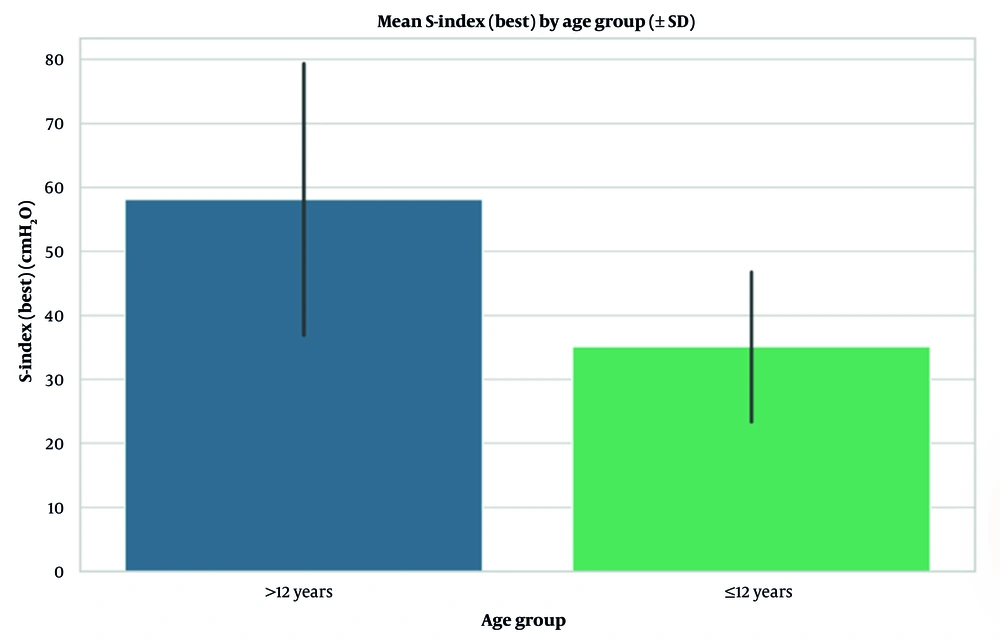
Figure 3.
Mean best S-Index by age
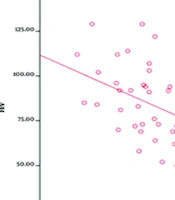
Pearson correlation analysis was performed to evaluate the relationship between age and dynamic inspiratory muscle strength. The analysis demonstrated a moderate, positive, and statistically significant correlation between age and S-Index Best (r = 0.58, P < 0.001). This finding indicates that older children tended to exhibit higher dynamic inspiratory muscle strength values (Figure 4).
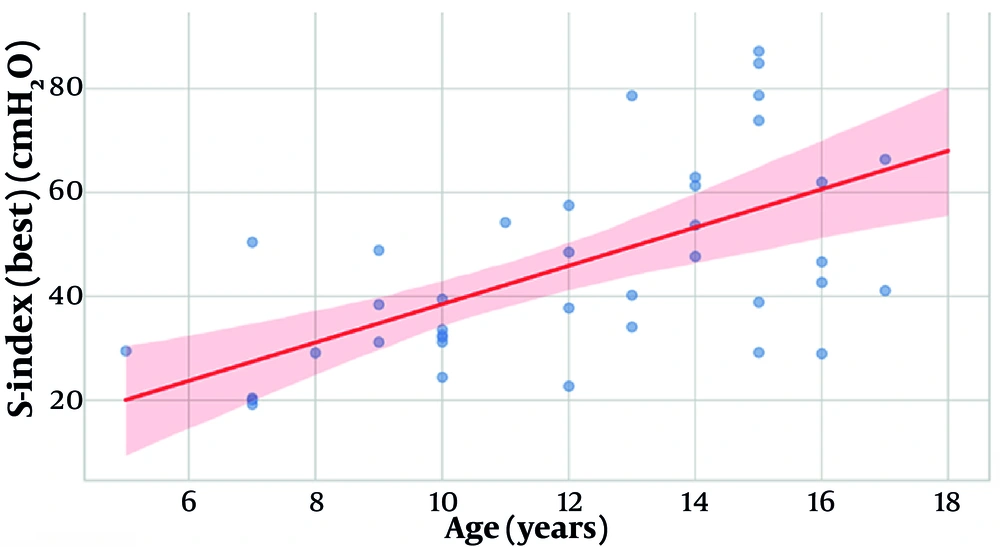
Figure 4.
correlation between age and S-index (best)
5. Discussion
The present study evaluated dynamic inspiratory muscle strength in children with CF using the S-Index and compared the results with published healthy pediatric reference values. To our knowledge, this is the first study to characterize dynamic inspiratory muscle performance using the S-Index in a pediatric CF population.
The main finding was that both S-Index Best and S-Index Avg were significantly lower in children with CF than in healthy peers. Specifically, S-Index Best was reduced by 9.30 cmH2O (16.4%), and S-Index Avg was reduced by 6.85 cmH2O (15.9%) relative to normative values. In contrast, PIF appeared relatively preserved. This pattern suggests that, in children with CF, the capacity to generate dynamic inspiratory pressure may be impaired to a greater extent than the ability to generate inspiratory flow.
This dissociation between reduced pressure generation and relatively preserved flow and volume may indicate selective impairment of inspiratory muscle force rather than global ventilatory limitation. Unlike pediatric asthma, in which both pressure and flow may be reduced (8), CF may involve disease-specific mechanisms that affect inspiratory muscle contractile performance.
These findings are clinically relevant because reduced inspiratory muscle strength may reflect increased respiratory workload, chronic pulmonary disease burden, and altered respiratory mechanics in CF. Respiratory muscle dysfunction in this population is likely multifactorial and may be influenced by air trapping, hyperinflation, chronic inflammation, recurrent infection, nutritional impairment, and increased ventilatory demand.
Sex-related differences were also observed. Male participants had significantly higher S-Index and PIF values than female participants, consistent with known differences in respiratory muscle mass, thoracic dimensions, and physical development during childhood and adolescence. Therefore, sex-specific interpretation may be important when evaluating inspiratory muscle performance in pediatric CF populations.
Age also had a substantial effect on inspiratory performance. Older children demonstrated significantly higher values for the S-Index, PIF, and inspired volume, and age showed a moderate positive correlation with S-Index Best. This increase likely reflects normal developmental changes in respiratory muscle strength, chest wall growth, and lung volume, underscoring the importance of age-adjusted interpretation in children (7, 9). García-Pérez-de-Sevilla et al. (14) similarly reported age-related trends in patients with CF receiving cystic fibrosis transmembrane conductance regulator modulator therapy, further supporting the need for age- and sex-adjusted reference values.
Previous studies have primarily assessed static inspiratory muscle strength using MIP and SNIP. These measures have yielded inconsistent findings in CF populations, with results varying by age, disease severity, nutritional status, and methodology. However, static tests do not fully capture the dynamic and flow-dependent nature of inspiratory effort during functional breathing or coughing. The present findings suggest that dynamic indices such as the S-Index may provide complementary information beyond conventional static tests (4, 13).
Several studies have shown that IMT can improve respiratory muscle endurance in CF, but baseline dynamic strength has not been systematically characterized (9-11). Our findings provide a quantitative baseline for future IMT studies and suggest that the S-Index may serve as a potential outcome measure for monitoring the training response; however, this requires confirmation in prospective studies.
Previous research has also highlighted the value of alternative respiratory assessment tools in children with CF. For example, impulse oscillometry has shown significant inverse correlations with spirometric indices in pediatric CF cohorts, supporting the utility of nonspirometric functional measures in this population (18). In this context, the S-Index may represent another useful physiological parameter for evaluating respiratory function in children who may not always perform conventional tests optimally.
Dynamic inspiratory muscle assessment may also have potential relevance in perioperative risk stratification, as suggested another study (15, 19) in adult cardiac surgery patients. However, this study did not assess surgical outcomes, and any perioperative role of the S-Index in children with CF should therefore be regarded as hypothesis-generating. Prospective studies are needed to determine whether preoperative S-Index is associated with postoperative pulmonary complications.
5.1. Limitations
This study has several limitations. Given the cross-sectional design, causal inference cannot be established, and the findings should therefore be considered hypothesis-generating. In addition, the study was conducted at a single tertiary pediatric center, which may limit the generalizability of the results to broader CF populations. Important indicators of disease severity, including spirometric parameters and nutritional status, were not collected. Furthermore, multivariable regression analysis was not performed because of the exploratory design and relatively limited sample size. Finally, perioperative outcomes were not evaluated; consequently, the potential role of the S-Index in surgical risk stratification remains to be determined.
5.2. Conclusions
Children with CF demonstrate reduced dynamic inspiratory pressure compared with healthy pediatric reference values, despite relatively preserved inspiratory flow. Dynamic inspiratory performance also differs significantly by age and sex. These findings suggest that the S-Index may provide additional physiological insight into respiratory muscle function in pediatric CF. Further longitudinal and outcome-based studies are needed to determine whether dynamic inspiratory muscle assessment has clinical utility in routine pulmonary evaluation or perioperative risk assessment.