
1. Background
Congenital hypothyroidism is one of the most endocrinological disorders in children. With early diagnosis and treatment, its complications can be prevented, and health costs can be decreased (1). Teaching congenital hypothyroidism is a challenging aspect of medical education. Since the primary mission of medical education is to train competent individuals with knowledge, attitudes, and skills for improving community health, choosing an appropriate teaching method is an important issue (2).
Since 1850, teaching methods have been changed from an unstructured educational system to structured, formalized lectures. Despite this turning point of change, traditional lecture-only passive methods are associated with tiredness, lack of attention, rejection, lack of motivation, and reduced students’ learning ability (3). Thus, the application of modified methods is recommended. These learning methods include the Socratic Method, case-based, team-based, blended, computer-assisted, flipped classroom, and simulation (4).
Storytelling or narrative learning is another modified method of teaching in medical sciences. Educational storytelling is a bridge between art and learning (5, 6), a simple and valuable method for teaching complicated topics in education. Previous studies believed ethical erosion might occur with increased clinical or healthcare training. Because caregivers may miss the empathetic link with patients (7, 8), narrative medicine is an innovative tool that can decrease the impact of ethical erosion. Therefore, it can be an applicable method for medical education (9).
Simulation is another method of medical education that uses scenarios to engage the students emotionally and provide an exceptional learning experience (10). Through simulation, the high-fidelity simulator moves like an actual patient. Simulation can be used for various medical specialties such as anesthesia, emergency medicine and trauma, and intensive care medicine (11).
In this study, the authors used none of those methods mentioned above completely; maybe this study performed a combination of storytelling and simulation. We introduced this study as the Double-S method. In this method, the authors implemented a novel method of simulation. We simulated the thyroid as a kitchen to make a new way of understanding the physiology and pathophysiology of the thyroid gland and described this simulation through storytelling. This teaching method aimed to improve the quality of knowledge in third and fourth-grade medical students. It is hypothesized that this teaching method can enhance the ability to make appropriate decisions and motivate learning in medical students.
2. Objectives
This study aimed to assess the experience of successful training in medical students by describing the physiology and pathophysiology of congenital hypothyroidism through the Double-S method.
3. Methods
This educational intervention study was conducted on medical students in the third and fourth grades of medicine with little or no clinical experience. This study was approved by the Ethics Committee of the Vice-Chancellery of Research at Guilan University of Medical Sciences (Code: IR.GUMS.REC.1400.145). Written informed consent was obtained from the participants, and they were randomly divided into two groups, Double-S (storytelling and simulation) and lecture-only. www.sealedenvelope.com conducted randomization with 60 people in each group. Results were placed in separate envelopes according to the software’s list and given to the third person. From the list of 120 students, the envelope was opened, and they were placed in each group based on the desired sequence. There was no blinding in this study.
All participants underwent the same pre-test about the physiology and pathophysiology of congenital hypothyroidism. The pre-test consisted of 10 questions assessing students’ knowledge of thyroid pathophysiology, causes of congenital hypothyroidism, interpretation of thyroid tests, and thyroid treatment to some extent. The content validity of this test was examined in consultation with 10 faculty members. So, out of the 12 questions in the first phase, nine professors agreed with 10 questions. For this reason, 10 questions were asked of these students.
The Double-S group attended a 120-minute course as described below. The other group attended a 120-minute routine lecture. A two-hour lecture was presented to teach the pathophysiology of the thyroid, causes of congenital hypothyroidism, interpretation of thyroid tests, and to some extent, treatment of the thyroid. During this period, an overview of congenital hypothyroidism was given. The same pediatric endocrinologist taught both methods. Then, the post-test was taken with similar questions to the pre-test. In both tests, 0 and 1 were dedicated to the incorrect and correct answers, respectively. Therefore, a total score ranged from 0 to 10.
3.1. Describing the Course in the Double-S Group
In this method, thyroid physiology was first explained to students based on the story of a restaurant chef. By looking at the story in the form of PowerPoint slides and animation, the student learned the causes of congenital hypothyroidism due to the lack of food at home, which strengthened clinical reasoning, the power of analysis, and the interpretation of various tests. First, the script of a story was written, and then the images related to the scenario were collected and presented in the form of slides and animations for training.
In this study, the thyroid was simulated as a kitchen. To understand this topic, the authors suggest that readers close their eyes and imagine a restaurant with a yard. The thyroid is like the kitchen of a restaurant where food is cooked, and this restaurant has two doors. From the first door (Na-I symporter), all kinds of raw materials, such as vegetables, meat, etc. (iodine), are imported, and these materials must be washed (organic) and must be passed from the second door (pendrin) into the actual kitchen. In the kitchen, the cook mixes meat (iodine) and salt (tyrosine) by his brain (TSH) in a pot of thyroglobulin and cooks it on fire (TPO). After cooking, the food is delivered by restaurant waiters (TBG). Now, if there is no food in this restaurant, it means that there is no kitchen at all (thyroid aplasia), or there is a kitchen, but it is small (thyroid hypoplasia), or there is a kitchen, but it is far from the restaurant (ectopic). All of these cases, which are problems in the existence of the kitchen, are called thyroid dysgenesis. To interpret the condition, if there is no food (T4) on the table, the message is sent to the responsible centers to send more food (more TSH). This is an example of early congenital hypothyroidism, which is a problem with the thyroid. However, if the higher centers respond to this malnutrition, either do not react at all, send little food (low TSH), or send a normal amount of TSH (normal TSH), it is secondary congenital hypothyroidism (a problem in the brain).
In some cases, despite low T4, there is normal TSH. We assess TSH or free T4 or add resin to differentiate this condition. If the resin consumes more food or the uptake is high, we lack TBG.
3.2. Statistical Analysis
After collecting data, they were reported by the mean and standard deviation. The Kolmogorov-Smirnov test assessed the normal distribution of quantitative variables. An independent t-test analyzed normally distributed variables. A P-value of less than 0.05 indicated statistical significance.
4. Results
In this study, 120 students participated, including 60 in each group. Thirty (50%) students in each group were female. The mean age of the participants was 20.4 ± 1.6 years. The results showed that post-test scores were significantly higher in both groups than pre-test scores (P-value = 0.00 and 0.001, respectively [Table 1]). Figure 1 shows the trend of pre- and post-test scores in each group.
Table 1.
The Comparison Between Pre-test and Post-test Scores in Each Group
| Groups | Mean ± Standard Deviation | P-Value |
|---|---|---|
| Double-S | 0.000 | |
| Pre-test | 3.4000 ± 1.08355 | |
| Post-test | 7.6000 ± 1.71989 | |
| Lecture-only | 0.001 | |
| Pre-test | 3.4667 ± 0.95193 | |
| Post-test | 5.3167 ± 1.11790 |
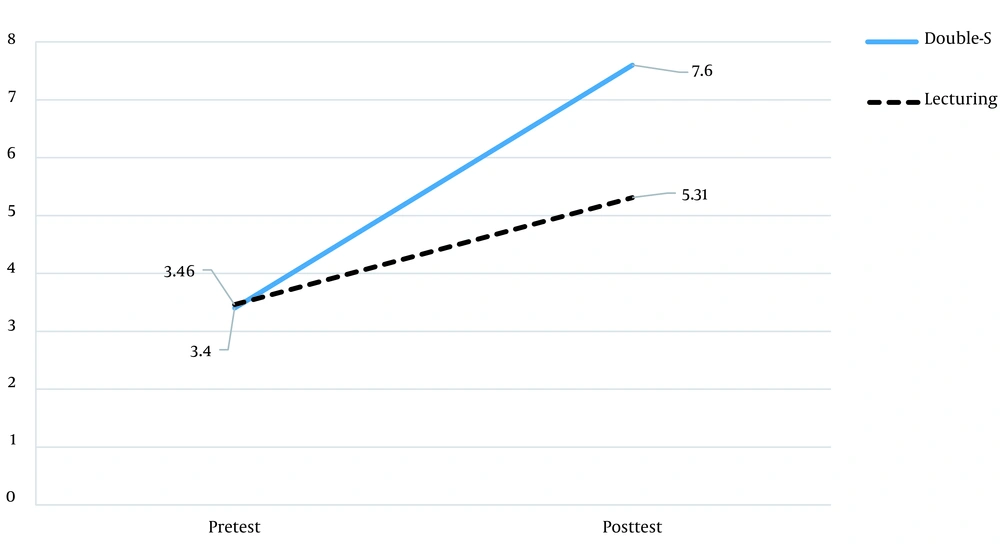
Figure 1.
The trend of pre-test and post-test scores in groups
As Table 2 shows, the intragroup analysis showed no significant difference between the pre-test scores of the Double-S and the lecture-only method (P-value = 0.843). Still, higher post-test scores were obtained in the Double-S method (7.6 vs. 5.3, respectively, P-value = 0.002). It implicitly indicated that participants in the Double-S group had two more correct answers.
Table 2.
The Comparison Between the Pre-test and Post-test Scores in Two Groups
| Groups | Mean ± Standard Deviation | P-Value |
|---|---|---|
| Pre-test | 0.843 | |
| Double-S | 3.4000 ± 1.08355 | |
| Lecture-only | 3.4667 ± 0.95193 | |
| Post-test | 0.002 | |
| Double-S | 7.6000 ± 1.71989 | |
| Lecture-only | 5.3167 ± 1.11790 |
5. Discussion
Significant changes have been made in medical education worldwide. The patient’s safety is one of the most important causes of this concern (11). Teaching medical sciences to students is very complicated and essential based on the comprehensive knowledge of medicine. Medical educators try to simplify this knowledge to promote the efficacy of education (12). In this study, we compared the effectiveness and quality of learning hypothyroidism through the Double-S method as a novel presentation of the traditional known methods (storytelling and simulation). It is an innovative concept for the relationship between primary science education and bedside teaching.
In the past, lecturing was the only method of teaching medical courses. It is a passive learning method known as large-group teaching (13). In lecturing, participants do not interact actively in the process of learning, and it may lead to direct dependence on the lecturer. The learners should be quiet at the designated time of the class and only can ask their questions. Thus, medical education transferred to modified learning methods such as case-based learning (14), team-based learning (15), computer-assisted learning (16), and storytelling (17).
There are currently different medical teaching methods, such as multimedia-based education (18), small group teaching (19), problem-based learning (20), case-based discussions (21), role play (22), simulation (10), and massive open online courses (23).
Since 1980, storytelling as narrative medicine has been introduced and promoted in medical curricula. This method involves the students learning step by step, making the knowledge simple and well-remembered; however, producing content and telling the story is time-consuming compared to other methods, and some students may not take it seriously (9). Also, simulation is another method of medical education that uses scenarios to engage the students emotionally and provide an exceptional learning experience (11). Despite the efficacy of storytelling and simulation in medical education, they only could give an interdisciplinary collaboration (9). There was a gap in a teaching method that could review and improve medical students’ primary and bedside knowledge. Indeed, applying an easy method of teaching challenging courses is helpful.
Due to the abovementioned concerns, we did not present a simple story or a simulation about the physiology and pathophysiology of congenital hypothyroidism. In this study, we simulated the thyroid gland as a kitchen with routine events while cooking a pizza. We quickly defined the steps of thyroid hormone production in the kitchen, the absence of the food, and how to solve the problem and noticed the etiologies. Our promising results showed higher post-test scores in the Double-S than in the lecture-only group. Implementing the former method in medical education can be considered a valuable and practical modified method of medical teaching through incorporating novel simulation into storytelling.
5.1. Conclusions
This study showed that teaching heavy physiological and pathophysiological content by unique incorporation of simulation and storytelling can improve learning basic and clinical courses in medical students. As our method had a novelty toward common simulation and storytelling methods, it helped medical students from the base to the bedside. It also improved the interpretation of laboratory and clinical presentations and differential diagnoses of congenital hypothyroidism.