




1. Background
There are two modes of teaching in educational programs, including teacher-centered and student-centered (1). In the teacher-centered mode, the teacher is considered as the reference point. However, learners, their abilities, and needs are core to the student-centered mode. As a subset of the teacher-centered model, the lecture method is a good tool for providing basic information and transferring empirical sciences. A large amount of content can thus be presented in a short time with the lowest costs. In this model, the teacher is the student’s point of reference, and the student simply learns what is uttered by the teacher (1, 2). Although the lecture method does not provide the opportunity for reflection in learning, other factors such as time constraints, ease of use, applicability for crowded classes, and high volume of teaching materials have led to its use as a dominant teaching method in educational centers (3, 4).
In recent decades, there has been a growing need for the revision of traditional teaching methods and the use of new and active student-centered methods of learning in educational systems, and the application of such methods in medical sciences has become commonplace. In the teaching methodology field, there are suggestions for increasing the quality of teaching by lecturing, including the use of the question and answer method during teaching (5). There are simple, inexpensive, and creative ways to increase the quality of teaching through lectures; peer learning is one of these methods that can be used to help students learn and strengthen their comprehension (6). In peer learning, people from similar social backgrounds help each other learn materials that they are also learning. There are different types of peer learning. Peers can be at the same level or higher level of education or experience (7). This method began to grow in the early 1960s and has been institutionalized in the educational framework of universities in other countries. Increasing self-confidence, content presentation skills, teamwork, and accountability scores, and the opportunity to ask questions and develop critical thinking skills are some of the benefits of using this teaching method. Peer learning is an effective way to prepare students for their future roles (8-10).
In addition to improving previous teaching methods, students’ anxiety in exams is one of the topics of interest to those involved in teaching. Test or exam anxiety is a specific state of anxiety that is characterized by physical, cognitive, and behavioral symptoms when preparing for an exam. Test anxiety becomes a problem when it interferes with preparing for the exam and taking the test. Numerous university students suffer from test anxiety. This anxiety is so severe that it sometimes disrupts the anxious person’s performance and test-taking (11). This issue not only prevents the individual from taking the test and affects the entirety of the study program, but it can also limit personal development (12). Studies have shown that anxiety has an important relationship with learning (13). It seems that the use of participatory learning methods can also be effective in reducing test anxiety. Given the importance of statistics for medical students, finding appropriate and effective learning methods is crucial. The role of biostatistics is well-recognized as an essential tool in medical research, clinical decision-making, and health management (14). In the semester during which they take biostatistics, medical students’ anxiety often manifests itself not only as test anxiety but also in the form of statistics anxiety.
Statistics anxiety is a condition in which the person experiences extreme worry, unpleasant thoughts, mental confusion, stress, and psychological arousal when confronted with concepts, issues, educational situations, and contexts related to statistical evaluation (15). Students with higher levels of anxiety in learning statistics often score lower in this course (16). The results of studies conducted in this area indicate that cooperation in learning and giving feedback can be very helpful in learning biostatistics.
Participatory learning is increasingly used as an effective tool to facilitate conceptual learning and thinking (17-19). Reviewing the results of studies shows that the sole use of traditional methods such as teacher’s lectures is of little value in the effective learning of biostatistics in today’s society. Better results can be obtained in learning biostatistics by ensuring students’ participation and engagement in problem-solving and focusing on student-centered teaching and the role of teachers as a guide. Using peer learning as a simple but scientific and efficient tool in the teaching process can be a step forward. To the best of our knowledge, no study has been conducted to investigate the effect of the peer learning method in teaching biostatistics on reducing test and statistics anxiety in nursing students.
2. Objectives
This study aimed to evaluate the effect of the peer learning method in biostatistics course on postgraduate nursing students’ test and statistics anxiety as the primary outcomes and final score as the secondary outcome.
3. Methods
3.1. Study Design
This was a quasi-experimental study conducted during the first semester of the academic year of 2019 - 2020 in the Faculty of Nursing and Midwifery of Ahvaz Jundishapur University of Medical Sciences (AJUMS).
3.2. Sampling and Data Collection
Individuals were entered in this interventional study if they were postgraduate nursing students of the Faculty of Nursing and Midwifery of AJUMS, had biostatistics course in the first semester of 2019 - 2020 academic year, and provided informed consent for participation. The exclusion criterion was absence for more than three sessions. The students were divided into two separate classes by the educational office of the Faculty of Nursing and Midwifery. One of the classes was randomly selected by the biostatistics teacher to serve as the intervention group (peer learning). Biostatistics was taught in both groups (10 students in the control group and 11 students in the intervention group) by the same instructor based on the curriculum approved by the Ministry of Health and Medical Education. The curricula of the different branches (children, surgery, ICU, and psychology nursing) were the same. The researchers tried to maintain the respondents’ confidentiality and observed all ethical considerations (code of ethics from the Ethics Committee of Ahvaz Jundishapur University of Medical Sciences: IR.AJUMS.REC.1397.805).
3.3. Measurements
The demographic information form included items on age, gender, marital status, and employment status. The demographic information form was completed by all the participants at the beginning of the study. The test anxiety and statistics anxiety questionnaires were then completed by the students in the first session and at the end of semester.
3.4. Sarason’s Test Anxiety Questionnaire
Test anxiety was measured in this study using Sarason’s 25-item test anxiety questionnaire. In this questionnaire, scoring takes place based on “yes” and “no” answers to the 25 items. An increase in the scores indicates raised test anxiety. A score of 25 indicates severe anxiety, and a score of zero indicates the lack of test anxiety. Scores below eight show mild anxiety, scores above 12 show severe anxiety, and scores between these two values indicate moderate anxiety (20). Previous studies used Sarason’s test anxiety questionnaire to determine the students’ test anxiety. They showed that this questionnaire possesses the necessary validity and reliability. In this study, Cronbach’s alpha showed the internal consistency of 0.728.
3.5. Statistics Anxiety Scale Questionnaire
Statistics anxiety was measured in this study using the 30-item statistical anxiety scale (SAS), designed and localized by Rekabdar and Soleymani (21) in 2008. The questionnaire items are scored based on a five-point Likert scale (one = never, two = rarely, three = sometimes, four = often, five = very often). The internal consistency of the SAS was calculated with a Cronbach’s alpha of 0.94. SAS has five subscales; the first subscale is “anxiety of statistics application” (six items). The second subscale is “anxiety of statistical analysis and interpretation” (eight items). The third subscale is “statistics test anxiety” (six items). The fourth subscale is “statistics tool anxiety” (six items). The fifth subscale is “statistics teacher anxiety” (four items) (21). The validity and reliability of the SAS questionnaire have been confirmed in Iran. Previous studies have shown that this questionnaire possesses the necessary validity and reliability (22). In this study, Cronbach’s alpha exhibited the internal consistency of 0.90.
3.6. Designing the Educational Intervention
Depending on the number of students in the class selected for peer learning (two groups of three and one group of five), the headings for teaching were determined (independent samples t-tests for the first group, paired samples t-test for the second group, and analysis of variance for the third group). The students prepared the topics according to a schedule and on specific dates. Teaching was performed using slides and SPSS. It took a maximum of 30 minutes to teach each topic. After teaching concepts by peers, the faculty member re-explained the headings in more detail. In the non-intervention group, all the headings were taught theoretically and practically by the same faculty member using the lecture method. Both groups responded to the statistics anxiety and test anxiety questionnaires in the first and last sessions of the semester. The final exam for both classes was held on the same day, at the same hour, in one place with the same facilities and same questions.
3.7. Data Analysis
The quantitative variables were presented with mean and standard deviation, and the qualitative variables were reported as number (percentage). The normality of the quantitative variables was assessed using the Shapiro-Wilk test. Fisher’s exact test was used to compare qualitative variables between the groups. Mann-Whitney U-test was used to compare the quantitative variables between the two groups. A P-value of less than 0.05 was considered as statistically significant. The data were analyzed in SPSS software.
4. Results
4.1. Demographic Characteristics Results
The students’ mean age in the peer learning and lecture groups were 27.45 ± 4.88 and 27.70 ± 6.23 years, respectively (P = 0.859). There was no difference between the two groups according to students’ characteristics (Table 1).
Table 1.Students’ Characteristicsa
| Characteristic | Peer Learning Group (N = 11) | Lecture Group (N = 10) | P |
|---|---|---|---|
| Age, y | 27.45 ± 4.88 | 27.70 ± 6.23 | 0.859 |
| Sex | > 0.99 | ||
| Female | 7.0 (63.6) | 7.0 (70.0) | |
| Male | 4.0 (36.4) | 3.0 (30.0) | |
| Employment status | 0.586 | ||
| Employed | 10.0 (90.9) | 8.0 (80.0) | |
| Unemployed | 1.0 (9.1) | 2.0 (20.0) | |
| Marital status | > 0.99 | ||
| Single | 9.0 (81.8) | 8.0 (80.0) | |
| Married | 2.0 (18.2) | 2.0 (20.0) |
aValues are expressed as No. (%).
4.2. Results for Final Exam Scores
The mean exam score of students in the lecture and peer learning groups were respectively 9.90 ± 4.60 and 11.55 ± 4.76. Although the mean exam score in the peer learning group was higher than in the lecture group, there was not significant difference between the two groups in this regard (P = 0.245).
4.3. Changes in Test Anxiety
Exam anxiety’s mean scores before and after the intervention are reported in Table 2. Exam anxiety was reduced at the end of the study in the peer learning group.
Table 2.Statistics Anxiety and Exam Anxiety Resultsa
| Outcome | Peer Learning Group (N = 11) | Lecture Group (N = 10) | Pb |
|---|---|---|---|
| Test Anxiety | |||
| Before intervention | 11.33 ± 5.00 | 6.25 ± 4.06 | 0.322 |
| After the intervention | 10.54 ± 3.58 | 8.60 ± 4.69 | 0.060 |
| Statistics Anxiety | |||
| Anxiety of statistical analysis and interpretation | |||
| Before intervention | 24.00 ± 10.54 | 24.00 ± 8.35 | > 0.99 |
| After the intervention | 16.00 ± 5.91 | 22.60 ± 13.10 | 0.411 |
| Anxiety of statistics application | |||
| Before intervention | 17.27 ± 6.16 | 16.40 ± 7.41 | 0.772 |
| After the intervention | 10.27 ± 4.40 | 15.60 ± 8.84 | 0.109 |
| Anxiety of statistics teacher | |||
| Before intervention | 11.27 ± 5.49 | 10.90 ± 4.06 | 0.863 |
| After the intervention | 6.81 ± 3.65 | 10.50 ± 6.15 | 0.164 |
| Anxiety of statistics test | |||
| Before intervention | 17.54 ± 9.18 | 19.30 ± 6.00 | 0.614 |
| After the intervention | 12.63 ± 5.73 | 16.70 ± 9.49 | 0.594 |
| Anxiety of statistics tool | |||
| Before intervention | 17.72 ± 9.10 | 15.70 ± 4.87 | 0.529 |
| After the intervention | 10.54 ± 6.57 | 16.00 ± 9.96 | 0.088 |
| Total score for statistics anxiety | |||
| Before intervention | 87.81 ± 39.09 | 86.30 ± 27.50 | 0.920 |
| After the intervention | 56.27 ± 23.74 | 81.40 ± 46.74 | 0.323 |
aValues are expressed as mean ± SD.
bMann-Whitney test.
4.4. Changes in Statistics Anxiety
Mean scores in different subscales of the statistics anxiety questionnaire for each group are presented in Table 2. According to the results, before the intervention, there was no significant difference in the dimensions of statistics anxiety between the two groups (P > 0.05). After the intervention, all the dimensions of statistics anxiety in the intervention group had a considerably lower mean in comparison with the lecture group. However, the observed reductions were statistically significant (Table 2).
Figure 1 shows the plot of effect sizes for statistics and test anxiety scores with 95% confidence intervals.
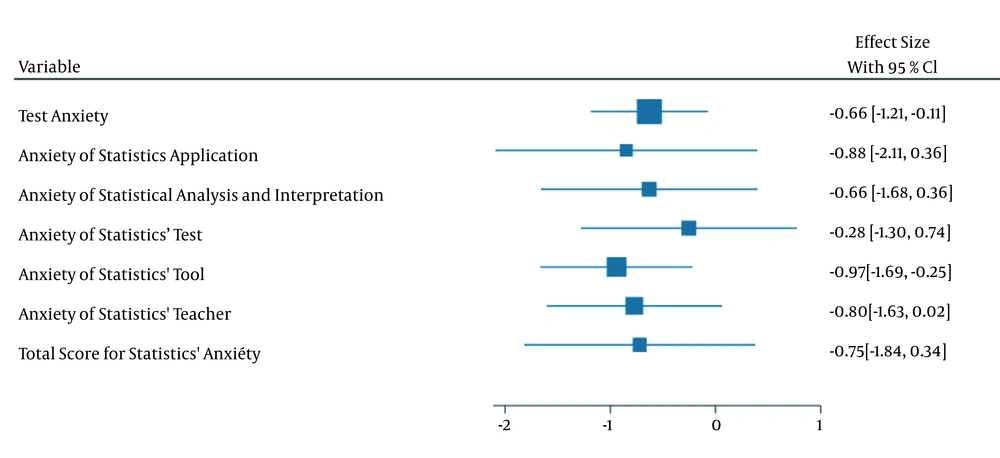
Figure 1.
Plot of effect sizes with 95% confidence intervals (95% CIs).
5. Discussion
The aim of this research was to evaluate the efficiency of the peer learning method in improving statistical analysis skills and reducing test and statistics anxiety in MSc students of nursing.
The present findings showed that the levels of test and statistics anxiety (in all the areas) were not significantly different between the two groups at the beginning of the semester. According to the results, test anxiety was lower in the intervention group than in the control group at the end of the semester. Students’ statistical analysis skills (final exam score) were higher in the intervention group compared to the control group. Moreover, the mean scores of the subscales of statistics anxiety were lower in the intervention group compared to the control group at the end of the study.
Previous studies have shown that medical students have a misconception about the difficulty of learning biostatistics concepts and have reported cases such as concern and anxiety, negative attitudes, lack of motivation, lack of interest, and not understanding the practical importance or value of statistics in students (22-28). The present study showed that MSc nursing students experienced more effective learning in the intervention group compared to the control group. This finding must due to the increase in their communication skills, problem-solving skills, and knowledge acquisition with the use of peer learning (29, 30).
In a study conducted by Anantharaman et al. (31), who used peer learning in teaching bone anatomy in first-year medical students, the students who were trained by the peer method performed better in their final exam, and in comparison with the traditional method, the peer-taught students had more active participation in group discussions and interactions and attended classes with a prior overview of the class content. In research by Fatmi et al. (32), team-based learning led to conceptual learning in students and improved their performance in the final exams. A study evaluating the results of the team-based learning (TBL) method in teaching tachycardia and bradycardia showed that TBL as a student–centered method, like peer learning, was more effective than lecture method (LM) on students’ understanding (33). Rajati et al. have shown that students’ perceptions from the educational atmosphere in the TBL method increase in comparison with the lecture method (34). In 2017, Milic et al. (35) conducted a study to evaluate the application of the combined learning method as an effective strategy for learning biostatistics in MSc public health students. The results of their research showed that the average score of the combined learning group was higher than the average score of the traditional group (35).
The disparate study findings can be attributed to differences in sample characteristics, educational contents, domains of learning, types of intervention, educators’ skills, and corresponding learning environments. In general, education authorities believe that teachers should teach students how to learn content and increase the depth of their learning and motivate them to learn by involving them in the learning process and providing educational materials and contents.
According to the results obtained, test anxiety was lower in the intervention group than the control group at the end of the semester, which is consistent with the findings obtained by Awasthi et al. The results of this study showed that learners’ level of anxiety was significantly higher at the onset of teaching in the question-and-answer and peer learning methods compared to the lecture method, and these values reduced significantly at the end (36).
Furthermore, the mean scores of the statistics anxiety subscales were lower in the intervention group at the end of the study than the control group. In other words, active participation and presence in the teaching of contents by peers can lead to less test and statistics anxiety and better performance. These findings are consistent with the results obtained in studies by Quinn (37), Pan, and Tang (38), which showed that involving learners in the teaching process reduces their anxiety. It can be argued that according to the theory of effectiveness of peer learning in increasing critical thinking and reasoning skills, these skills then increase the student’s self-confidence when dealing with statistical materials and solving the problems of this course, of which thinking and reasoning are an integral part. In 2015, McGrath et al. (39) conducted a study to reduce statistics anxiety in psychology students using a multifaceted teaching framework. The results of the study showed a significant reduction in statistics anxiety in the intervention group (39).
5.1. Strengths
Two important challenges of the peer learning method are students’ reduced hours of contact with the faculty members and the quality of teaching provided by peers. To overcome the first limitation, the faculty member was present in the classroom throughout the course and presented additional items after the peer learning was over. In order to remove the second limitation, one of the MSc students in biostatistics was put in charge of teaching the peers and practicing teaching with them.
Given that the present research is the first to evaluate the role of peer learning in reducing statistics anxiety and improving biostatistics learning, the researchers recommend that subsequent studies be carried out using a sample of students from other academic programs and fields of medical sciences; these studies should also entail continuous assessment to ensure the readiness of the students in the implementation process.
5.2. Limitations
The project was limited in several ways. First, the most important limitation of the present research was the lack of a fully similar study. Second, small sample size in each group. Third, the accuracy of the responses given to the questionnaire items could not be verified. Fourth, according to the students’ program, randomization was not feasible.
5.3. Conclusions
The use of peer learning in teaching biostatistics reduces test and statistics anxiety in all aspects. Moreover, after a reduction in anxiety, we could see a better final score in the peer learning group.


